



Volleyballexercises for u21
Execution
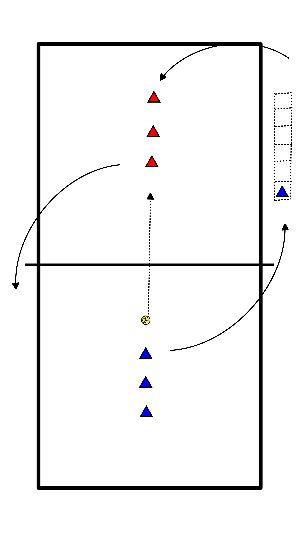
- The trainer places a ball on the centre line.
- On each side of the net, a row of players stands at the baseline.
- At the trainer's signal, the players run to the ball.
- The player who grabs the ball may keep it.
- The team that collects the most balls wins.
Execution
- Divide the group into pairs. One person from each pair starts at the net, the other on the baseline.
- The players on the baseline have a ball, possibly with a reserve ball.
- The players at the net perform a block jump.
- After the block jump, they immediately turn around and defend a ball from the baseline player.
- The ball can be tapped, hit, or played in a fast manner.
- Note: turn around immediately after the block and assess the situation. Do not step in too quickly due to a potentially hit ball.
- Let the players at the net defend 10 balls, then switch roles.
Execution
- Three players stand at the net with a ball.
- They alternate playing the ball short and long.
- Defenders move from right to left.

Objective
- The aim is to tactically place or hit the ball.
Execution
- Use tip balls at the middle position or hit the ball deep to position 1.
- Place hoops to simulate a constant block, which can later be replaced by an actual block.
- Replace cones at position 1 with a box over which the ball must fall, over the 'defender'.
- The coach hits or plays a ball in, which is first passed to the setter.
- The setter provides a set-up to the outside.
- The attacker chooses either a short tip ball to the middle position (where a hoop is placed) or aims for position 1 with a hit or quick overhead ball.
Execution
- Player 1 starts at the first cone.
- Move sideways around all the cones.
- After the last cone, sprint forward.
- The coach throws a ball around the 3-meter line.
- Pass the ball from a standstill position.
- If there are more than 6 players, set up the course twice.
- Have a teammate throw the ball in turns to reduce waiting time.
- Repeat the course twice.
Execution
- The trainer throws the ball to the setter.
- The setter delivers a set-up to the attacker.
- The attacker must hit the ball.
- The block must be well set by the outside blocker and middle blocker.
- The defence catches the ball.
- After 10 times, the players rotate positions.
Execution
- Teams stand on either side of the court behind the baseline.
- Pairs enter the court.
- The trainer introduces the ball into play.
- The pairs attempt to score underhand against the other pair.
- The winning pair remains on the court, while the losing pair joins the back of the line.
- The team with the fewest balls on the ground wins.
Execution
- Divide the team into two groups.
- Have the players form two lines facing each other at the 3-meter line.
- Players pass the ball over the net and then run around the net post to join the other group.
- Place a speed ladder parallel to the sideline.
- Have the players perform a drill through the ladder before joining the line.
- Optionally extend with block jumps, attack passes, or strength exercises.
- The ball must not fall to the ground.
- Communication is essential.
- Optionally add a penalty if the ball falls to the ground.
- Alternate between underhand and overhand passing.
Execution
- Three players stand in the backcourt.
- The trainer stands at the net.
- The players must play the ball to the trainer.
- Use different techniques: overhead, underhand, short, deep to the back.
- Vary in power: hard balls and soft balls.
- The ball may be played in two touches.
Execution
- Distribute the teams across both halves of the court.
- The coach throws the ball into play.
- The teams pass the ball to each other.
- Every player who has played the ball must touch the backline and then return to the court.
- Start first with catching and throwing. Once that goes well, proceed to real play using an overhead technique or underhand technique.
Four Players Static
- Two servers at the service area, one receiver, one catcher.
- The server serves, the receiver passes the ball to the catcher, who catches the ball and rolls it back to the server.
- Same as static, but the player follows the ball.
- The server becomes the receiver, the receiver becomes the catcher, and so on.
- See four players.
- The server serves the ball and follows it.
- The receiver passes the ball to the catcher.
- The rightmost player becomes the catcher.
- The server shifts to the left.
- The catcher becomes the server.
- If this does not work, one receiver becomes a reserve.
This activity is fun to do and brings a lot of enjoyment and competition! Relays naturally involve competition. This activity also simulates the stress factor that comes with serving.
Execution- The players are divided into equal teams and lined up at the serving area of the same side of the court.
- The first player of a team serves and retrieves their own ball.
- After tagging the next player, this player goes to serve, and so on.
- It is important for a player to serve quickly, but it must also be error-free, because otherwise the ball must be retrieved and served again!
- If the teams are small, it is fun to let everyone serve two or three times.