

Volleyballexercises for u9
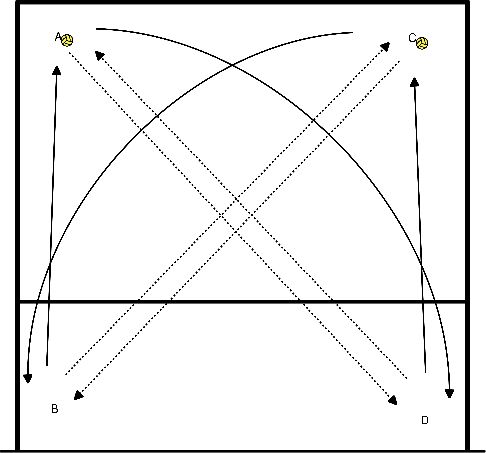
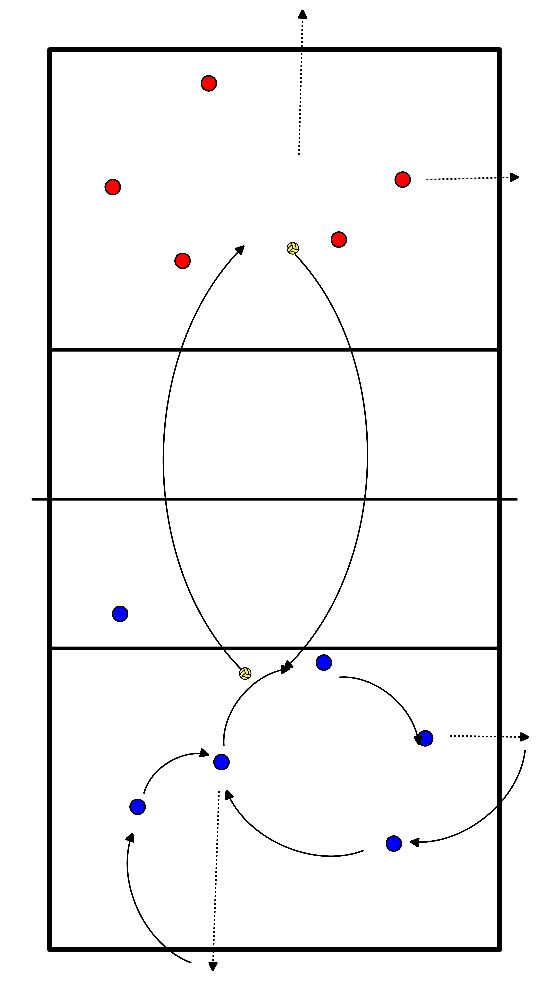
- Two balls and 4 groups.
- A and D play across and C and B also where the net players play BH and the eight-field players play OA.
- After playing B go to A. From A go to D, from D go to C and back to B again.
Divide the field into 2. Play game 2 against 2.
First round N3: Serve from anywhere, underarms pass and throw ball over the net by a teammate.
Second round N4: Serve from back line, forearm pass, teammate catches and throws up in one motion, next throws it over with a volleyball motion; bumping, throwing underarms or playing.
First round N3: Serve from anywhere, underarms pass and throw ball over the net by a teammate.
Second round N4: Serve from back line, forearm pass, teammate catches and throws up in one motion, next throws it over with a volleyball motion; bumping, throwing underarms or playing.
- Different forms of throwing and catching.
- Throwing upwards and catching behind the back (keep back straight).
- Throwing upwards, playing underarm and catching behind the back (who can do this?).
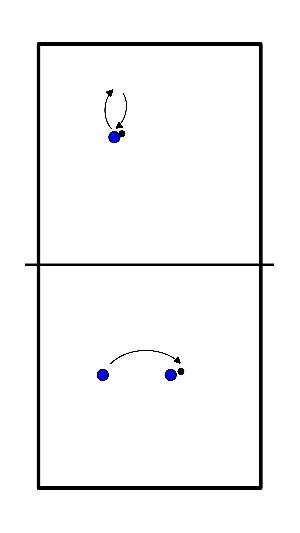
- Two players do the same exercise.
- One person throwing upwards.
- Catch the other behind the back.
- Same exercise.
- Play one underarms.
- Catch the other behind the back.
- Purpose of the exercise:
- To focus, communicate, master the task and persevere.
- At "A" and above, with fewer people on the field for more intensity.
- Explanation of the exercise:
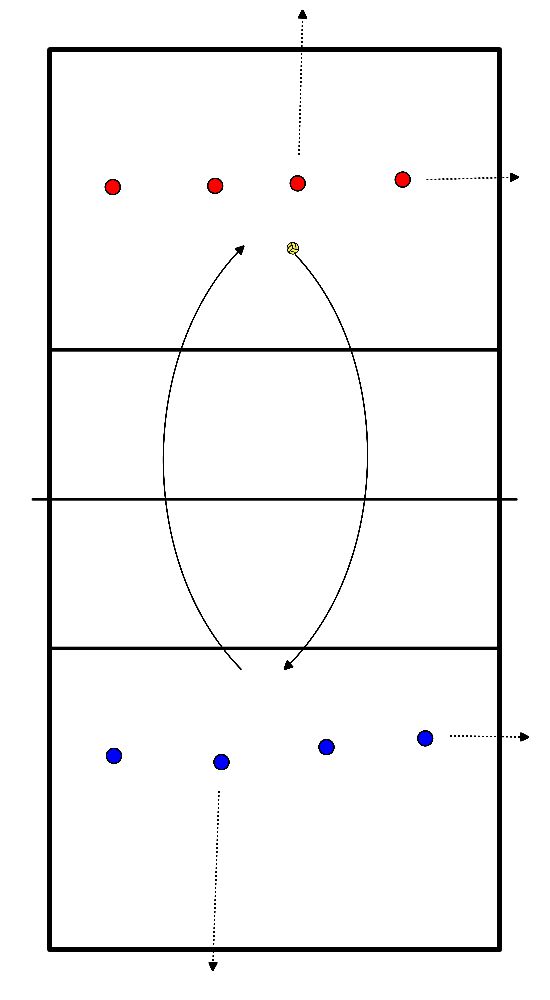
- 'Chaos Easy' starts as a warm-up, but ends as a true battle.
- The players are placed in the field (it doesn't matter where).
- The ball is caught and immediately thrown over the net (one play).
- As the player catches, he throws the ball. .
- The players on the team are turned over one spot.
- It is striking how difficult it is to score.
- When someone throws wrong (in net or out), they have to sprint around the opponent's field.
- Duration of the exercise:
- 5-10 minutes.
- Divide the team in pairs.
- Player 1 stands on the backline of the court and player 2 stands on a random spot on the other side of the net.
- The intention is that player 1 serves the ball into the hands of player 2.
- Player 2 is not allowed to step aside. If player 1 serves underarm into the hands of player 2 he gets 1 point.
- Overhand? --> 2 points.
- Change after 10 balls.
- The team with the most points wins.
- Player starts on the backline (C and higher)
- or behind the middle (CMV).
- Trainer serves high over the net
- Player runs as fast as possible and tries to catch
- Run back around the outside
- Per person 2 balls
- One ball between the legs/under the arm, other in two hands on a side of choice, throw ball straight up and catch with two hands
- When the ball is up on one side, throw the other ball up on the other side.
- Keep arms straight, throw as much as possible straight up
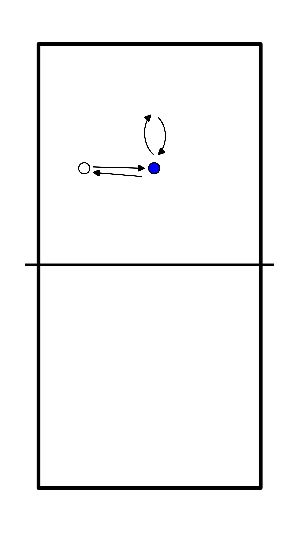
- Pairs 2 balls.
- One person throws a ball straight to the other person
- Meanwhile the other person throws his ball straight up and throws it back.
- Then catch your own ball
- Goal of the exercise:
- To focus, communicate, master the task and persevere.
- Explanation of the exercise:
- 'Chaos Easy' starts as a warm-up, but ends as a real battle.
- The players are placed in the field (it does not matter where).
- The ball is caught and immediately thrown over the net (one play).
- As the player catches, he throws the ball.
- When a player has thrown the ball, he/she goes to a wall (back of the field or on the side) and taps it, then comes back into the field.
- The other players on the team have moved forward one spot.
- You notice how difficult it is to score.
- When someone throws the wrong ball (into the net or out), they have to sprint around the opponent's field.
- Duration of the exercise:
- 5-10 minutes.
- Purpose of exercise:
- Improve motor speed.
- Explanation of the exercise:
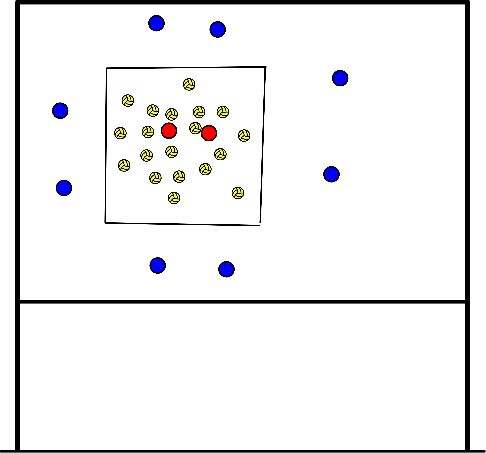
- Make a square of benches and throw in all the balls you have.
- Place two players in the square and the rest around them.
- At the sign of the trainer the two players will try to throw all balls out of the square.
- The rest of the players have to throw all the balls back into the square.
- After 60 seconds the exercises are stopped and the two players count the number of balls in the square.
- The winner is the one who has the least number of balls in the square.
- Everyone takes their turn.
- Duration of the exercise:
- 20-25 min.
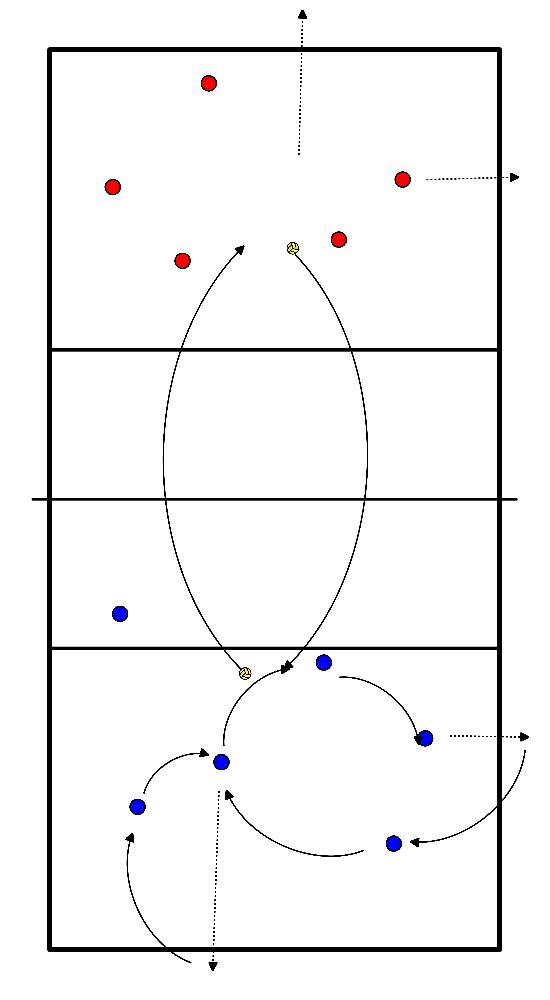
- 3 teams serve each other calmly, A serves straight through
- Two defenders, B passes underhand to C
- C gives a set-up, preferably overhand and plays the ball back to B
- B plays the ball over the net
- After 5 good balls exchange
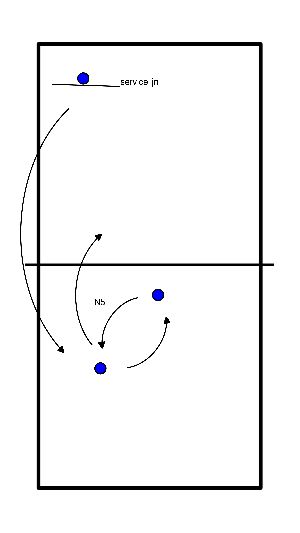
This exercise trains the split step.
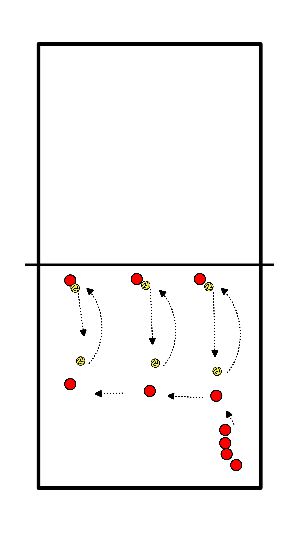
- Players line up behind the back line.
- Trainer or player stands at the net.
- One by one the players walk in from the back line.
- When the trainer hits the ball, the player makes a split step.
- Then they get the ball on a random spot next to or in front of him.
- Player passes back and retrieves ball if necessary.
- After that the player closes in at the back.
- Purpose of the exercise:
- To focus, communicate, master the task and persevere.
- At "A" and above, with fewer people on the field for more intensity.
- Explanation of the exercise:
- 'Chaos Easy' starts as a warm-up, but ends in a true battle.
- The players are placed in the field (it doesn't matter where).
- The ball is caught and immediately thrown over the net (one play).
- As the player catches, he throws the ball.
- When a player has thrown the ball, he/she goes to a wall (back of the field or on the side) and taps it, then comes back into the field.
- The other players on the team have moved forward one spot.
- You notice how difficult it is to score.
- When someone throws the wrong ball (into the net or out), they have to sprint around the opponent's field.
- Duration of the exercise:
- 5-10 minutes.