



Volleyballexercises
Groups and Positions
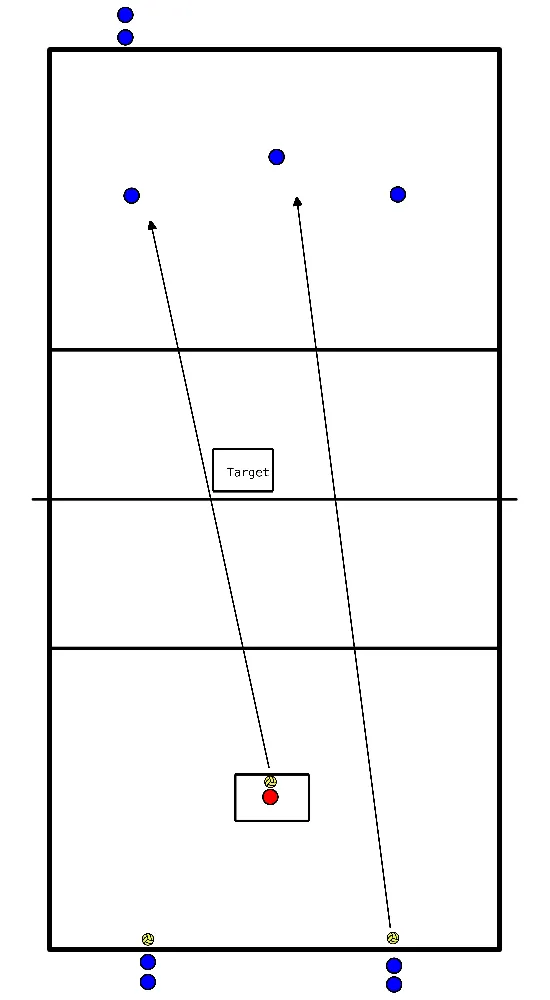
- Divide players into two groups: Passers (Liberos, DS, and Outsides) and Servers.
- Passers form the receiving line.
- Servers are divided into two lines and must alternate lines at all times.
Execution
- The drill starts with a topspin serve from the box by a coach or player.
- Followed by a serve from zone 1 and a serve from zone 5.
- Serves alternate between these zones.
- Passers must pass the ball to the target in zone 3.
- After 9 serves, the receiving line rotates.
Variations
- Instead of a target in zone 3, position setters to set the ball to targets in zones 4 and 2.
Goal
- Establish responsibility zones for each player on the reception line for serves originating from different zones of the court.
Setup
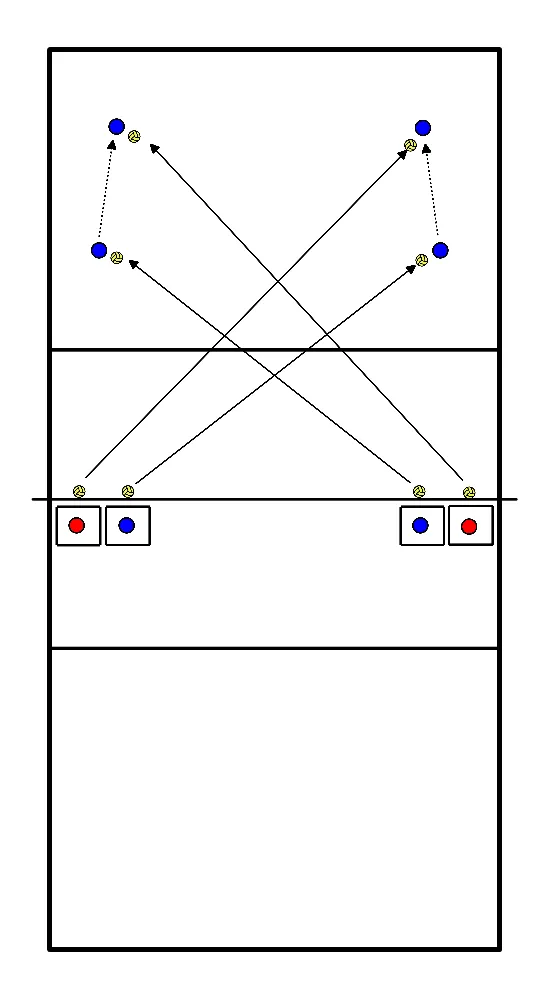
- Place 4 boxes on the court: 2 in zone 2 and 2 in zone 4.
- Position 2 players and 2 coaches to hit from the boxes.
- If boxes are unavailable, hit from the floor on the same side as the defense.
- Form 2 groups for the drill.
- Determine the base position, typically 3ft behind the 10ft line and 3ft from the sideline.
Execution
- Dig two balls from the outside or rightside hitter.
- Adjust your body by squaring to the hitter.
- Dig two balls from cross-court hits, one simulating perimeter defense and the other rotational defense.
- Perform perimeter defense first, followed by rotational defense.
- Pass both balls using only one touch to the center of the court between zones 3 and 6.
- Emphasize quick footwork to reach defensive positions efficiently.
Coaching Tips
- Do not teach players to push the defense into the net unless it is a free-ball situation.
- Teach perimeter defense even if it is not the main strategy, as players should be proficient in both methods.
- Ensure players understand the importance of their starting base position for effective defense.
Variations
- Include a middle block hit.
- Include a line tip.
- Combine a middle blocker hit, a cross hit, and a line tip for more complex scenarios.
Execution
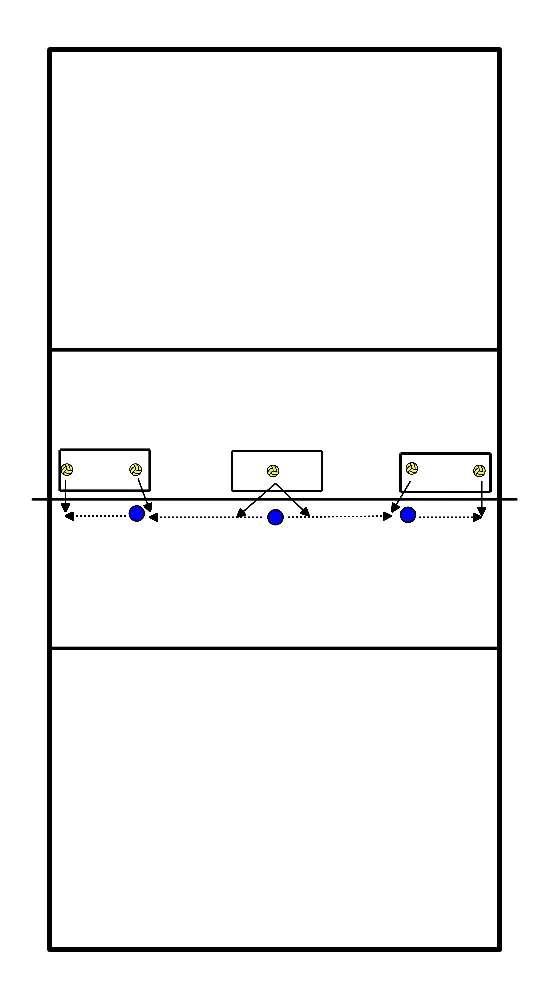
- Split the players into two groups: one group for blocking and one group on the boxes.
- Players on the boxes will hit the ball.
- The player in the middle box hits towards zone 1 and zone 5.
- Middle blockers should position their arms to close the targeted zone and swing block towards the side where the player on the box will hit.
- Rotate after each hit.
Middle Blockers
- When the player on the middle box hits to zone 1, middle blockers position their arms to close zone 1 and swing block to the left side.
- When the player on the middle box hits to zone 5, middle blockers position their arms to close zone 5 and swing block to the right side.
Outsides and Rightsides
- Start in the base position and swing block a line hit.
- Complete two blocks before rotating.
Variations
- Simulate a ball to the middle blocker, requiring outside and rightside players to assist with the block, then move to the sides with a swing block to protect a line hit.
- Simulate a ball to the middle blocker, requiring outside and rightside players to assist with the block, then move to the sides with a swing block to protect a cross hit.
- Introduce the double block.
Plank 30 seconds
- On forearms and toes
- Back straight, abdominal muscles engaged
- Do not sag!
- Lie on your back, hands behind your head
- Alternately bring your elbow to the opposite knee
- Steady pace, focus on control
- Lie on your back, knees bent
- Hips up, engage abs and glutes
- Hold, slowly return
- Sitting position, feet off the ground
- Twist your upper body from left to right
- Optionally with a ball or small bottle
- On your side, support on forearm
- Hips off the ground, body in a straight line
- Switch sides after 30 seconds
- Lie on your stomach
- Arms and legs off the ground, hold
- Strengthens lower back and glutes
Execution
- Jump on your left foot for 10 seconds on the spot and then sprint to the red line.
- Repeat this on your right foot and sprint again to the red line.
- Perform knee lifts on the spot for 10 seconds, remain on your toes and sprint to the red line.
- Do 5 lunges on your right leg and 5 on your left leg, followed by a sprint to the red line.
- Jump sideways 3 times back and forth over the line and sprint to the red line.
- Repeat the sideways jumps, but now with your back to the field.
Setup
- Arrange the situation twice.
- The first obstacle is a speed ladder. Move sideways through the ladder, placing both feet inside the ladder and one foot outside the ladder.
- Next, encounter three hurdles that increase in height from low to high. Jump over these hurdles.
- Along the way, take a bag from the bucket with you.
- Which team has all the bags on the other side first and then sprints to the other side first?
- The final sprint may only be initiated once the last bag is placed!
Starting Formation
- Each player receives a number.
- Swiss ball in the centre.
- Players stand in a circle around the Swiss ball.
- Players move around the ball, sideways or backward-forward.
- When a number is called, the player responds, takes the ball, and throws it at the retreating players.
- Add-on: The player who is hit takes the Swiss ball and tries to hit another player.
- Move around the circle.
- Respond to changes in direction.
- Improve movement, enhance focus.
Game Progression
- At the start of the game, one player is designated as "it".
- The remaining players are given a few seconds to run away.
- If the player who is "it" tags someone, they hold hands and continue as a joint "it".
- Does the chain consist of four players who are "it"? Then the chain splits into pairs.
- The pairs attempt to tag the remaining players.
- The game continues until only players who are "it" remain.
Setup
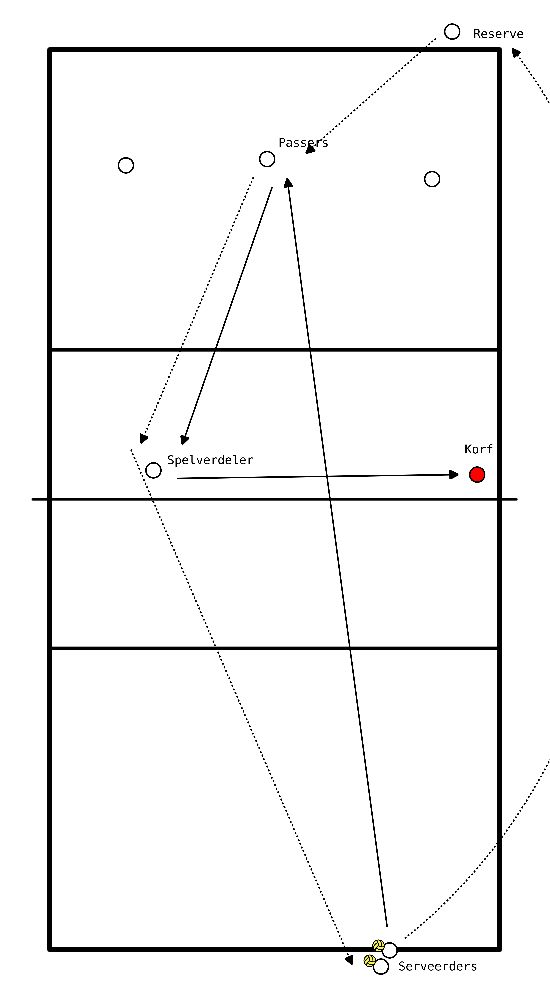
- Three players in the serve-receive on positions 5, 6, and 1.
- One substitute behind the court.
- A setter starting on position 2/3.
- The rest of the players with a ball on the opposite side.
- Serve towards the receivers.
- Pass to position 2/3.
- The setter plays the ball to position 4 where a hoop is placed.
- A ball in an acceptable trajectory hitting the hoop is 1 point, directly in is 2 points.
- Encourage the team to aim for as many points as possible.
- Choose a fixed setter or rotate: receiver -> setter -> server -> substitute -> receiver.
- With a large group, you can use two sides.
- With a small group, you can reduce the number of receivers.
Starting Formation
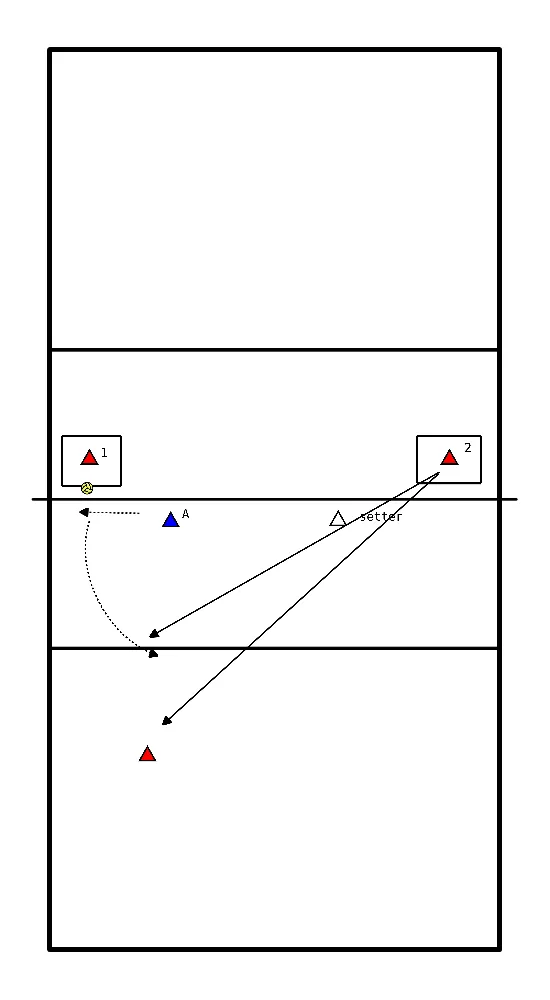
- Use 2 to 3 courts.
- Player 1 and Player 2 stand on the box with the ball.
- Player A is in the blocking front formation.
- The libero is in zone 5.
- The setter is ready.
- Player 1 holds the ball high.
- Player A performs a block movement and places hands over the net.
- Player A moves out for the defence of Player 2.
- The setter performs a block jump for Player 2.
- The setter passes to Player A.
- Player A executes an attack.
- Focus on attack build-up from defence.
- Ensure quick movements and good footwork.
T-Catch Tennis Ball
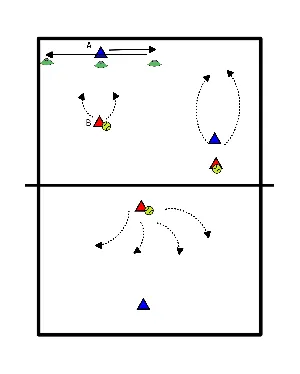
- Starting Position: 2 players, 3 cones, 2 tennis balls
- Execution: Player A moves between the cones. Player B holds 2 tennis balls up high. Player A returns to the central point, after which Player B taps a tennis ball. Player A catches the ball.
- Starting Position: 2 players, 5 tennis balls
- Execution: Player B throws 5 tennis balls randomly into the field. Player A tries to hit the balls after 1 bounce.
- Starting Position: 2 players, 1 tennis ball
- Execution: Player A stands with their back to Player B. Player B throws a challenging tennis ball over Player A. Player A catches the ball after 1 bounce.
- Movement and Reaction
- Footwork
- Always return to home base!
Initial Setup
- Each player is assigned a number.
- A Swiss ball is placed in the middle.
- Players form a circle around the Swiss ball.
- Players move sideways or backwards-forwards around the ball.
- When a number is called, that player responds, takes the ball, and throws it at the players who have run away.
- Add-on: The player who is hit takes the Swiss ball and tries to hit another player.
- Move around the circle.
- Respond to changes in direction.
- Improve movement, enhance focus.