

Basketballexercises for technique condition
Execution
- Form a line of 5-6 players, with two lines per basket.
- Each line has one ball.
- The first player throws the ball against the backboard.
- The next player catches the ball and immediately throws it against the backboard again.
- Repeat this process.
- Place a cone further away where players must run around after their throw.
Execution
- Divide the players into two groups.
- The group without the ball tries to tag the player from the other group who has the ball.
- As soon as they have tagged the player, the ball is theirs.
- The player with the ball tries to pass the ball as quickly as possible to a teammate.
- Tagging someone with the ball scores a point.
- The team that scores ten points first wins.
- The children develop better ball control.
- The children learn to aim with the basketball.
- The children learn to dribble well.
- The children develop a sense of teamwork and learn to cooperate.
- The children move around in the gymnasium or on the sports field outside.
- Training sessions
- Lessons
- Fun activities
Execution
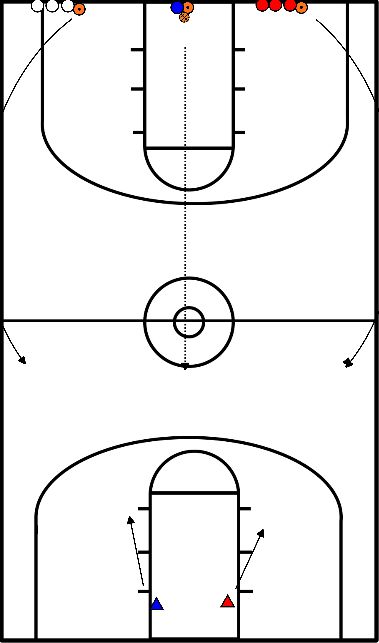
- Divide the team into three groups of four players each. One group stands on each baseline, and the third group is in the middle of the court. Players in the middle spread out along the midline.
- At the whistle, the players in the middle run to the baseline and ask for a ball. The player catches the ball, shoots at the nearest basket, and retrieves their own rebound.
- The player who passed the ball runs to the other side of the court for a pass from the other baseline. The rotation continues.
- Players must work hard for conditioning improvement.
- Set a target for passing and use correct footwork and shooting techniques.
- Ensure clean and accurate passes.
- Vary the type of shot (three-pointers, mid-range, lay-ups, etc.).
- Give players a time limit and a target for the number of scores to make.
- Adjust based on the team's level or the available time.
Description
- Three players start on the baseline, with the middle player holding a ball.
- The middle player passes the ball to one of the other players and runs after the ball.
- The receiver passes the ball to the player on the opposite side and also runs after the ball.
- This process repeats as they move towards the basket on the other side of the court.
- When a player is close enough to the basket, they perform a lay-up.
- The player who performs the lay-up becomes the defender.
- The remaining two players become attackers and try to reach each other with a long pass.
- The defender attempts to prevent the attackers from scoring.
- If the attackers do not score, they must do five push-ups.
- The objective for the defender is to prevent the attackers from scoring.
Execution
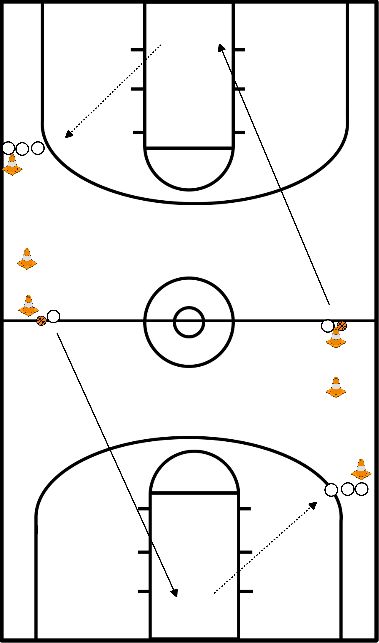
- The rebounder (1) passes to the outlet player (2) and runs behind the outlet player along the sideline to the other side to receive the ball back for a lay-up.
- The outlet player (2) passes to the player in the centre circle (3), who then dribbles to approximately the three-point line and gives a bounce pass to (1) for a lay-up.
- Player (3) grabs the rebound and becomes player (1) on the other side of the court.
- With 10 players or more, there is also a player (4) in the far corner. In that case, player (3) passes to player (4), who then gives a bounce pass to player (1) and subsequently grabs the rebound and becomes player (1).
Objective
- Try to score 5 times as quickly as possible with your group.
- Divide the players into 2, 3, or 4 groups, ensuring that each group has a maximum of 6 players.
- Assign each player in every group a number from 1 to 6.
- Each group is positioned in a corner of the court.
- In the center, place 2, 3, or 4 basketballs inside hoops.
- When the coach calls out a number, the players with that number sprint to the center as quickly as possible, take a basketball, and dribble towards the basket.
- They have only one attempt to score.
- After their scoring attempt, they return the balls to the center and rejoin their group.
- The first group to achieve 5 scores wins the game.
- Make scoring easier by hanging a hoop on the ring where players can also score.
- A score through the hoop is worth double points.
Setup
- Players gather at the baseline in two groups.
- One player stands under the basket with the ball.
- Two players are ready to defend on the opposite side.
- The player with the ball dribbles to the other side.
- Players on the left and right run along the sideline to join the offense.
- The defense freely chooses whom to defend but remains active without taking a position in or around the key area.
- The player who finishes or loses the ball returns together with the two defenders.
- On the opposite side, two new defenders are already prepared.
Execution:
- Play freely on one or two baskets, depending on the number of players.
- No dribbling allowed, only passing.
Execution
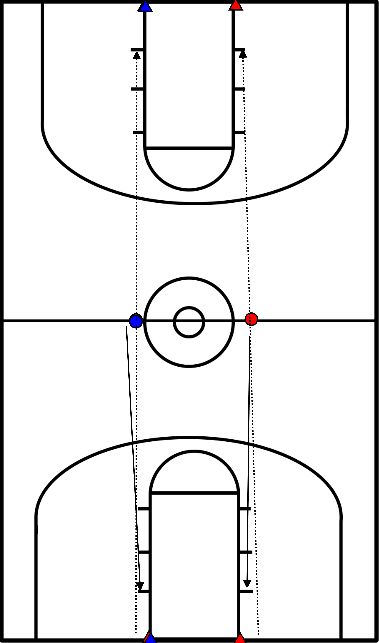
- Start with three players on the baseline, with the middle player holding a ball.
- The middle player passes the ball to one of the other players and runs after the ball.
- The receiver passes the ball to the player on the other side and also follows the ball.
- This pattern is repeated as the players move towards the basket on the other side of the court.
- When a player is close enough to the basket, they make a lay-up.
- The lay-up shooter becomes a defender, while the other two players become attackers.
- The attackers try to reach each other with a long pass and score.
- The defender tries to prevent the attackers from scoring.
- If the attackers do not score, they must do five push-ups.
- Starting lineup:
- Use an entire field
- 1 player near the center line (left)
- 1 player at the center line (right)
- Group of players in line with the free throw line (one side of the court)
- Group of players at the extension of the free throw line (other side terrain)
- Progression:
- Players at the center line start their lay-up
- After the lay-up, they take their own rebound and give an outlet pass to the waiting player on the sideline
- Then they join the sideline, at the level of the free throw line
- Lay-up, bob cousy, power lay-up, lay-back, jump stop
- Progression:
- Change of direction at the level of the three-point line
- Crossover, behind the back, reverse dribble at the center line
- Coach defends, attacker adjusts
- Stepping towards the ball instead of running forward
- Retrieve ball in the middle and from there dribble and lay-up through the middle
- Add 2 players defending passively at the three-point line
- Add 2 players actively defending at the three-point line
- 2 players defending actively
- Regression:
- Taking shot instead of lay-up
- Starting lineup:
- Everyone has a ball
- Everyone stands back to back at elbow level
- Maximum of 4 players per group
- Progression:
- The first player shoots from the right elbow
- The player takes his own rebound and runs to the right elbow
- The other players shoot one after the other
- The first player shoots from the left elbow
- ALWAYS spin-the-ball first before shooting
- Progression:
- Coach calls the next position (always left and right mirrored)
- Three-pointers
- With pass back to coach
- Regression:
- With 2 instead of 4 players
- 3 players per team
- 1 player from each group stands on the baseline on each side with ball each time
- 1 player starts in the middle and chooses a side to run to, then gets the ball from the baseline player and takes a shot
- the player on the baseline who gave the pass runs to the other side to get the pass and take a shot.