




Beachvolleyballexercises for technique defense / toetsen / onderhands / duiken
Game Progression
- Play on a half court on one side of the net.
- The teams attempt to throw the ball over 10 times.
- Upon 10 successful throws, the team earns a point.
- If the ball is intercepted, the team that caught the ball may start throwing.
- When the ball goes out of bounds, the opposing team receives the ball.
Execution
- Set up an attack on one side. The blocker stands in front of the attacker, pretends to jump, and steps back.
- The attacker plays a short ball over the blocker.
- The blocker defends the ball, after which the rally continues or the ball is scored.
- When the attacker comes to the middle, you can train on both sides. The same applies when the attacker plays a short diagonal ball.
- The blocker makes a step in the diagonal, pretends to jump, and then runs to defend the diagonal ball.
- The first ball must be played short. Afterwards, play against each other for the point.
- Apply it in a situation where the attacker has no restrictions. The trainer or a player throws the first ball from a table.
- The attacker may try to score the ball in the area just behind the net, along the line, or diagonally.
Organization
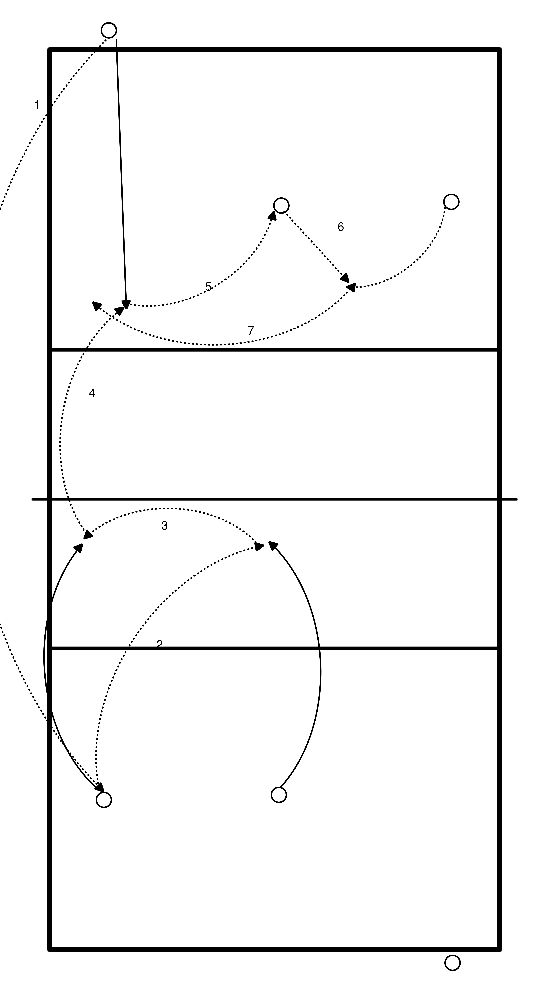
- 6 players per court.
- 2 players serving, each on either side of the net at position 1.
- Serve to position 5 or 6.
- Build up and place the ball to the server.
- The server defends to position 6.
- Player at position 6 makes the first contact.
- The previous attacker sets the ball to position 2 for the defending player.
- Continue as long as there are 2 balls. If 1 ball drops, play for the point.
- Observe if the defender is standing short or deep.
- A short ball is a pokey.
- A deep ball is a technical ball.
Execution
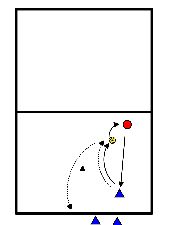
- Player at the net hits the ball to the defender.
- Defender controls the ball for themselves to the right place to provide a set-up.
- Defender moves and gives a set-up to the net player.
- Net player hits the ball to the next defender.
- After the set-up, the player joins the line with the defenders.
- Rotate after 10 balls.
- Control over the defense and preparation for a set-up.
- Ensure the set-up is high enough and on the correct "arm" for the attacker.
Objective
- The objective is to separate the elements and deliver quality. Pass the ball to the desired position. Then get into an attack position and execute the hitting technique. Here, preparation for the jump and reach height is essential.
- Both sides of the net are used. Player 1 stands on one side of the net, tosses the ball, and hits it to Player 2, who is in a service-receive position. It is important to use the desired technique when hitting. Player 2 passes the ball to the trainer. Pay attention to passing to the desired set position. The trainer catches the ball and immediately throws it in a perfect setup (starting with a 1-meter set that includes a peak). Player 2 gets into position for the attack and attacks in a specific area (use cones as a target). After the attack, the player moves to the serving position. After Player 1 has hit the ball, they join the line of passers/attackers.
- The attack direction is initially "only" right or left. As the exercise progresses, the target can be made smaller and more precise. The ball can also be tossed instead of hit by Player 1. Give Player 1 a more targeted assignment. Use a setter instead of the trainer who catches and throws the ball. Make attack zones smaller to increase the required precision. Build the attack from the serve and attack with a defense.
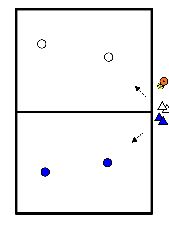
- Two against two
- Trainer brings in ball
- Teams play rally against each other
- The one who loses goes out
- Substitutes come in
Setup:
Which team brings in most gold pieces/ pits?
Which team brings in most gold pieces/ pits?
- 1 bank & one-against-all
- 2-4 gangs of thieves
- 1-2 guards.
Game consists of 4 rounds of play:
Game Round 1:
Game Round 1:
- Thief - attacker: per post only 1 active & 1 gold piece at a time try to steal from bank.
- Collect in own vault -hoop-.
- Guard - defender- may only defend outside the bank.
- If the thief is caught so tapped, he must leave the gold piece in the police station -under a cone.
- Which team was able to steal most gold pieces?
Game Round 2:
- Divide gold pieces equally among the thieves.
- Thieves: safely move your gold pieces 1-for-1 to other safe -from one hoop to another.
- Thief -attacker: walk around your cone without the guard catching you.
- Agent -defender: in this case may only defend inside the bank.
- If the thief is caught -attacked, he must leave the gold piece in the police station -under a cone.
- Which team was able to transfer most gold pieces safely?
Game Round 3:
- Thieves: for x time, steal as many gold pieces as possible from other safe.
- Thief -attacker: mandatory back & forth through bank = watch for guard inside bank.
- Guard may only defend inside bank.
- If the thief is caught so tapped, he must leave the gold piece in the police station -under a cone.
Game round 4:
Same as game round 3, but with double guard 1 guard outside & 1 guard inside the bank.
Which team will have the most gold pieces in their possession after 4 rounds of play?
Needs:
2 teams and a ballYou
Play on half a field / one side of the net.
2 teams and a ballYou
Play on half a field / one side of the net.
- The teams try to pass 10 times, if they succeed they have a point.
- Is the ball intercepted? Then the first one to get the ball can throw over with his or her team.
- Is the ball out of the field? Then the ball is for the other team.
- Player at the net hits the ball to the defender.
- The latter defends the ball for himself to the appropriate place to give a set.
- He moves to there and gives a set to the net player.
- The latter passes the ball to the next defender.
- After the set, line up with the defenders.
- After 10 balls turn around .
Goal of this exercise is to control the defense and set up.
In setting; apply ball high enough and on the right "arm" for the attacker.
In setting; apply ball high enough and on the right "arm" for the attacker.
Organization: 6 players per court
- 2 on each side of the net, at position 1
- Storage to position 5 or 6, build-up and pass the ball to the server
- The server defends to position 6,
- This player executes the first contact
- and the previous attacker sets the ball to position 2
- the defence player
- As long as there are 2 balls, keep going, when one is dropped, go for the point.
Variant: the defender is short or deep, short ball is pokey, deep ball is technical ball.
Objective:
- The goal is to separate the elements and deliver quality.
- Pass the ball to the desired position.
- Then getting into an attacking position, and executing the hitting technique.
- Hereby preparation for the jump and reach is essential.
Execution:
- Two sides of the net are used.
- Player 1 stands at one side of the net, throws up the ball and hits it to player 2, who stands in a service-pass position.
- It is important to use the right technique when hitting the ball.
- Player 2 passes the ball to the trainer.
- Pay attention to the passing to the desired set position.
- The trainer catches the ball and throws it immediately in a perfect setup (start with a 1m set which contains a peak).
- Player 2 gets into position for the attack, and attacks in a specific area (use pawns as targets).
- After the attack, the player advances to the serving position.
- After player 1 hits the ball he joins behind the line of passers/attackers.
Adjustments
- Initially the direction of attack is "only" right or left.
- As the exercise progresses, the goal can be made smaller and more accurate.
- The ball can also be thrown in instead of hit by player 1.
- Give player 1 a more specific assignment.
- Use the distributor instead of the trainer who catches and throws the ball.
- Make attack zones smaller to increase the precision needed.
- Build up the attack from the service and attack with a defense.
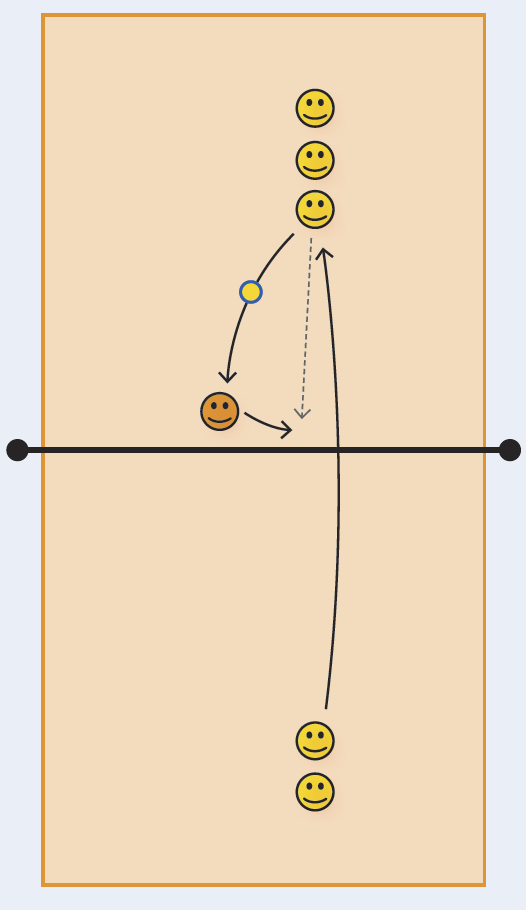
- Build an attack on one side;
- The blocker stands in front of the attacker, pretends to jump and steps back;
- The attacker plays a short ball over the blocker; the blocker defends the ball and the rally continues or the ball is scored.
- When the attacker gets in the middle, you can train both ways.
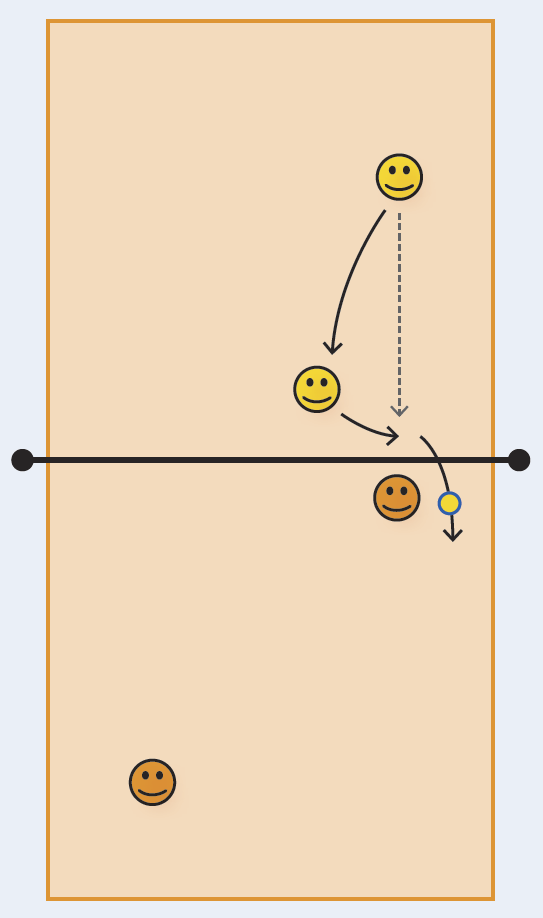
- The same when the attacker plays short diagonally
- The blocker makes a step into the diagonal, pretends to jump and then runs to defend the diagonal ball.
Variations:
- The first ball must be played short.
- Then play against each other for the point.
- Apply it in a situation where the attacker has no restrictions.
- Trainer (or one of the players) throws in the first ball from a table.
- The attacker may try to score the ball in the area just behind the net.
- Along the line or diagonally. With a defender added the