


Gym classexercises for technique games
Last update: january 2026
Execution
- Divide the players into groups of 2 or 3 and position them on the left side of the field.
- Give each player a tennis ball.
- At the starting signal, the first player from each group runs with a ball to the right side of the field.
- Upon arrival, the player places the ball outside the line and runs back as quickly as possible.
- The next player in the group repeats this with his or her ball.
- The exercise ends when all balls are on the right side and the last player is back with the group.
- The first group to return completely wins.
Game Setup
- Divide the class into two teams.
- Place a thick mat upright on the center line of the hall.
- Position a mini trampoline in front of each horizontal mat.
- Each team has six cones.
- Jump with both feet simultaneously onto the mini trampoline.
- Land with both feet simultaneously on the landing mat.
- Take a run-up from the front onto the mini trampoline and do not bounce on the trampoline.
- Eliminate opponents by throwing over the thick mat from the air.
- If you are hit, place a cone down next to the field.
- The game is played with two teams, each on one side of the hall.
- The children must eliminate their opponents by jumping on the mini trampoline and throwing over the thick mat from the air.
Setup
- The instructor creates a square using benches in the middle of the playing field.
- All balls are placed inside the square.
- The instructor selects 2 students to stand inside the square.
- The remaining students spread out over the playing field.
- The throwers try to throw all the balls out of the square.
- The retrievers try to bring all the balls back into the square.
- Each round lasts 2 to 5 minutes, as determined by the instructor.
- At the final signal: if there are more balls inside the square, the retrievers win; otherwise, the throwers win.
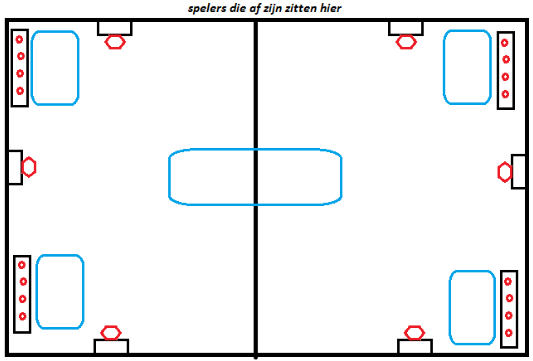
At the back line, place a bin of balls.
- The players start with a ball in their hand and run to the two hats closest to the net.
- They stand still between the hats and try to throw the ball into the bucket from there.
- Successful. Then they run back to the ball pit. Grab a new ball and run to the two hats in the middle to throw the ball into the bucket again from there.
- Failed. Then they run back to the ball pit. New ball and try again on that level.
- The one who completes the three levels first wins.
Warm up exercise in relay form
- Divide the players into groups of 2 or 3 players and place them on the left side of the field.
- Give each player a tennis ball.
- At the start sign, the 1st player of each group starts running to the other, right, side with a ball.
- Once there, they put the ball outside the line and run back as fast as they can so that player 2 of their group can start running with his/her ball.
- When all the balls are on the right side and the last player has returned to his/her group, it is over.
- The first one back to his/her group wins.
- Play this game on 1/3 or half the room.
- Choose 2 tokens who will receive a ribbon.
- The taggers must try to throw the tokens off with the goalcha or foam ball.
- They are not allowed to run with the ball
- At the side of the field are 5 pylons
- When a token is thrown he/she has to put a pylon on his/her side
- He/she continues to participate in the game
- When all pawns are knocked down, the taggers win and 2 new taggers are chosen.
- If after 5 minutes of play the pawns are still not knocked over, the tokens win and 2 new taggers are chosen
The game is played with at least 4 players
- 1 mouse who has a t-shirt or piece of cloth in the back of his trousers
- 1 dog who has a tennis ball
- 2 cats without attribute
- the mouse runs around with the dog,
- the cats try to grab the tail of the mouse and bring it to their cone
- But the dog can tap the cat with the tennis ball and it will do a punishment of its choice in the camp.
- If there are more players a group can be created and 2 games can be played together.
- The teacher makes a square of benches in the middle of the playing field and puts all the balls in it.
- The teacher chooses two students who will stand in the square.
- The other students are spread over the playing field.
- The assignment is simple.
- The throwers must throw all balls out of the square, the bringers must throw all balls back into the square.
- Each round takes 2 to 5 minutes. This is for the teacher to decide.
- If at the final signal there are more balls in the square than in the field the bringers win.
- If there are more balls in the field than in the square then the throwers win.
- The teacher will make sure everyone has a place on the parachute (most parachutes have loops on the outside to hold it).
- Before you start it is important that the parachute is tight.
- So have some of the students walk backwards until everyone is in the right position.
- It is easiest if the teacher gives the rhythm, later you can let the children do it themselves.
- The teacher chooses two students who have to lay down on the ground under the parachute.
- The remaining students raise and lower the parachute simultaneously.
- Every time the parachute goes from high to low, the two students on the ground get a gust of wind and an imprint is left on the parachute when it hits the ground.
- The children always love this!
- After a few times you can change the students.
- The teacher will make sure everyone has a place on the parachute (most parachutes have loops on the outside to hold it).
- Before you start it is important that the parachute is tight.
- So have some of the students walk backwards until everyone is in the right position.
- It is easiest if the teacher gives the rhythm, later you can let the children do it themselves.
- The parachute goes up and down 5 times.
- At the 6th time up everyone dives in under the parachute and holds it on the ground.
- If everyone does this simultaneously, a tent will be formed.
- After a few seconds the teacher gives a signal and everyone gets out of the tent and starts all over again.
- The teacher will make sure everyone has a place on the parachute (most parachutes have loops on the outside to hold it).
- Before you start it is important that the parachute is tight.
- So have some of the students walk backwards until everyone is in the right position.
- It is easiest if the teacher gives the rhythm, later you can let the children do it themselves.
- The teacher chooses two students who have to swap places when the parachute goes up.
- The parachute goes up and down 3 times.
- At the 4th time the parachute goes up, the two students who were chosen, swap places.
- When they have taken their new place the teacher chooses two new students and it starts all over again.
- Use pawns (or other materials) to mark out two lanes and place two hoops against the wall.
- Make sure there is a maximum of 5 pupils on 1 lane, if necessary set out more lanes.
- Place a basket at the starting point to collect all the balls.
- Place different balls in the basket so the pupils can experiment with them.
- After all, every ball rolls differently.
- The pupils have to roll the ball in the hoop.
- This means that the ball is lying still in the hoop.
- The overview picture shows where they have to start.
- The teacher makes a square of benches in the middle of the playing field and puts all the balls in it.
- The teacher chooses two students who will stand in the square.
- The other students are spread over the playing field.
- The assignment is simple.
- The throwers must throw all balls out of the square, the bringers must throw all balls back into the square.
- Each round takes 2 to 5 minutes.
- This is for the teacher to decide.
- If at the final signal there are more balls in the square than in the field the bringers win.
- If there are more balls in the field than in the square then the throwers win.
- The students form pairs and each select their own mat.
- The pairs stand opposite each other on the mat.
- You may only stand with the front foot on the edge of the mat and the heel must be off the ground.
- You place your flat hands against each other and the game begins.
- The goal of the game is to unbalance your opponent so that he/she has to take a step.
- If this happens, you have won.
- You may unbalance someone by pushing or holding while the other pushes.
- Have the students switch opponents every 2 or 3 minutes to keep the tension up.
- The students form pairs and each select a mat of their own.
- The pairs sit opposite each other.
- The attacker on hands and knees, the defender on elbows and knees.
- There are 2 roles:
- Attacker: Must try to catch the ball.
- Defender: Must defend the ball.
- The game begins and the attacker will try to grab the ball.
- Succeeds this? Then the attacker wins.
- If not within 60 seconds? Then the defender wins.
- Let the students switch opponents every 2 to 3 minutes to keep the tension in the game.
- The students form pairs and each pair takes two badminton rackets and a shuttle from the basket.
- Then one of the teams stands on the line of the pawns and his/her buddy stands opposite.
- This creates a sort of street through which you can walk.
- This is for safety reasons.
- The assignment is that the students have to pass the shuttle to each other 10 times without touching the ground.
- If you manage to do this quickly you can have a game of who can skip the most shuttles within 5 minutes.
- Play this game on 1/3 or half the room.
- The teacher chooses 2 runners who get a ribbon.
- The taggers must try to throw the runners off with the foam ball.
- They are not allowed to walk with the ball.
- The runners are allowed to hide behind the cupboards for the taggers.
- When a token is thrown, he/she has to put a pawn on his/her side.
- He/she continues to participate in the game.
- When a runner throws the basketball from the hoop into the basket, all pawns are put back upright and the tickers have to start all over again.
- When all pawns are knocked down, the taggers have won and 2 new taggers are chosen.
- If after 5 minutes of play the pawns are still not knocked down, the tokens win and 2 new taggers are chosen.
- The teacher divides the students into 2 teams of 3.
- The students have to lie down on their stomachs and take a cube.
- The teacher rolls the tennis ball into the court and the game begins.
- The students have to hit the ball against the mat of the other team.
- If they succeed they get 1 point.
- They have to do this by rebounding the ball with the cube.
- Just like playing air hockey.
- The team with the most points at the end of the game wins.
- Prepare 4 benches in a square, 4 pawns at the corners of the benches and a basket in the square.
- Then prepare 2 tjoeks in an angle of 45 degrees.
- Test the tjoeks before you start.
- The teacher makes teams of 3 to 4 students per team.
- 2 go in the field and the rest on the bench.
- We play rounds of 5 points.
- The goal is to put the ball in the square through the corner (you can score through both corners).
- If you succeed in doing so you get 1 point, if you hit a pawn you get 2 points and if the ball goes into the basket the other team loses.
- The losing team exchanges with the team on the bench.
- The side with the most players on it hits the ball.
- Each player may touch the ball once per turn.
- After the ball is hit to the other side, he has to run to the other side of the table.
- The game is played according to the normal table tennis rules.
- Af is sitting on the bench until the game is over.
- Eventually 2 players remain.
- They play a final best of 5 (the first to score 3 points wins).
- The winner gets a life as a prize and can come back into the game once if he has been eliminated.
- The teacher puts numbers 1 to 20 on 20 tennis balls (for a lesson with 20 students).
- The teacher gives each student a piece of paper with his/her own number on it.
- The game begins. All balls are thrown around the room at the same time.
- The students have to look for their own ball.
- When a student has checked a ball and it is not his/her ball, the student may roll the ball away on the floor.
- Does the pupil find the ball?
- Then he/she goes to the teacher who stands at the side of the hall.
- The teacher then checks if the number is correct with the number on the paper.
- The first one with the right ball to the teacher wins.
- The game stops when 10 students have found their ball.
- The teacher chooses 2 tickers.
- They have to stay inside their ticker box (inside the 4 pawns) and tap the basketballs away from the runners when they want to cross.
- They have to do this while also dribbling with a ball.
- The runners have to dribble to the other side without losing their basketball.
- If a runner doesn't have the basketball with him, he's out and he automatically becomes a ticker.
- A tip that you can give to the runners is that they should shield the ball with their body.
- This means staying between the ball and the opponent.
- The pupils may only cross again when everyone has been tagged or has reached the other side.
- In the end, as the game progresses, you get more and more tickers and less and less runners.
- The last remaining runner is the winner.
- Each group gets a pole (or a tube) that can stand upright on the ground by itself.
- Around it, a circle with a diameter of about 3 to 4 meters is drawn.
- When the game starts, you can throw over with a ball (don't run if you have one!) and you have to try to knock over the shaft(s) of the other party.
- However, the circles are off limits!
- If you want to keep it simple, you can say that as soon as the ball is above the circle it may no longer be touched.
- This is to prevent "jumpshots", but with older participants it is allowed, if the circle is taken a bit wider.
- Point distribution: everybody gets 5 points, every time a pole falls over, a point is subtracted from it.
- A playing field of 2 by 2 square, equally sized fields of +/- 10 by 10 meters per field are laid out.
- Over the central intersection (the middle of the four spaces) another circle is put with a diameter of about 4 meters.
- The four fields are continents, the circle the Pacific Ocean (and forbidden area).
- Two teams, fielding and batting.
- Field party is divided over continents, and there they are fixed.
- Fielding cannot switch continents during the game.
- The batting team has 4 men/women in the field and they are allowed to enter all continents.
- Player 5 of the batting team picks up the bat/wood/breadboard or tennis racket and hits the infield ball.
- If the (minimum 2) umpires think this is a strike, player 5 also throws the ball to one of the 4 players from the batting team who are loose in the continents.
- How do you score points?
- The batting team gets 1 point for every time the ball passes through all continents clockwise or anti-clockwise, without falling on the ground (no running with the ball).
- Does the ball fall?
- From that continent you start over again.
- This may continue until the fielding side has also taken the ball and made a round through the four continents.
- All players must stand in a circle facing the middle.
- There stands the game leader with a ball.
- All players have their hands behind their backs.
- When the leader of the game throws the ball to you, you have to catch it.
- When you catch the ball, you can take your hands behind your back.
- When you don't catch the ball, you are out of the circle.
- If the person in charge of the game tricks you into throwing the ball, you are not allowed to take your hands behind your back.
- If you do so, you are out.
- Same game as dodgeball.
- The only difference is that on the centre line a sail is stretched so high that the players cannot see over it.
- For the rest there are no differences: Two playing fields with a back section for people who have finished.
- At the start of the game, a volunteer takes his place and may return after the first player has finished.
- Throwing the ball, which is not allowed on the ground.
- Hands or head are free.
- When you are ready, you go to your own backfield (behind the opponent).
- If the ball is caught by the opponent, it means that someone has to return to his or her own section.
- If you are in a backfield and you throw someone off, you may return too, but always at least one person in the backfields.
- The losers have lost when there is no one left in their box.
- It's just dodgeball, so there are 2 teams.
- One team on one side of the hall and the other team on the other side.
- Now the children have to throw their opponents off by jumping into the minitramp with a ball in their hands and throw it from the air over a thick mat that stands upright on their opponents.
- When you are knocked off, knock over a pawn that is standing next to the field.
Rules dodgeball game 2:
- Divide the whole class into 2 teams teams
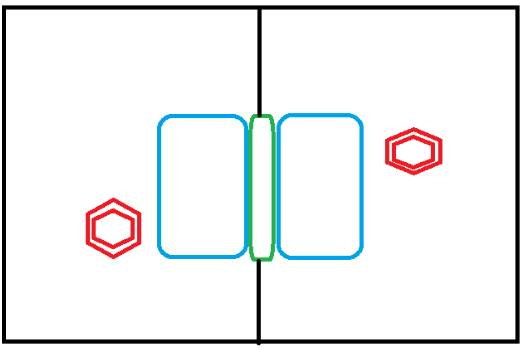
- 1 thick mat, standing upright (on its side) on the centre line of the hall.
- on each side of the upright mat, 1 thick mat.
- In front of each mat is a mini-tramp.
- 6 cones per team.
- You have to jump with 2 feet at the same time into the mini-tramp.
- You have to land with 2 feet at the same time on the landing mat.
- You have to jump into the mini trampoline with a run from the front and you may not bounce on the trampoline.
- 2 teams against each other each team on one side of the room.
- You can win the game in 3 ways, namely:
- by knocking down the team (except the goalkeepers)
- knocking over all pawns on 1 bench
- by scoring in the basket(s) in the opponent's box.
- When you are finished you sit down at the side of the field.
- Everyone is free again and can participate when a teammate knocks over a pawn.
- The pawns are reversed on a bench in each corner of the hall.
- In front of the bench is a thick mat.
- The goalies can stand on this mat and defend the pawns.
- The goalies cannot be thrown off.
- On the other hand, the goalkeepers cannot throw anyone off either.
- You can use the catwalk (mat or long mat halfway between both fields) to enter the opponent's field, but if you do, you can be tapped and then you're out.
- The advantage of this is that you can get close to your goals, which of course makes scoring easy!
- Because the balls always come from the front, you can play this game of dodgeball with 2 or 3 balls.
- This game has multiple roles so everyone can play at his or her own level.