


Handballexercises for u14
Execution
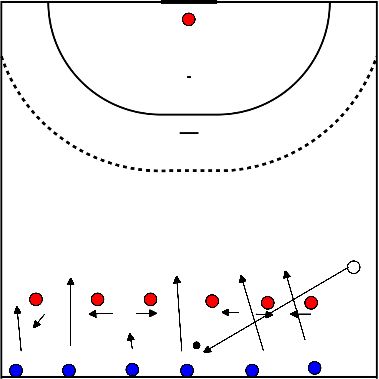
- The pivot player stands in the middle between the two defenders.
- The left attacker threatens to move inside, causing the right defender to step out.
- The defender of the pivot defends on the ball side.
- When the ball moves to the right, the right player threatens to move inside and the left defender steps out.
- The pivot defender continues to defend on the ball side.
- Back coverage is provided by the left or right defender.
- The centre back (CB) defends the pivot player.
- Switch after 1.5 minutes counterclockwise.
- Start slowly and increase the pace during the exercise to match game speed.
- Be alert to providing back coverage.
- The CB must continuously shield the pivot player towards the ball side.
Execution
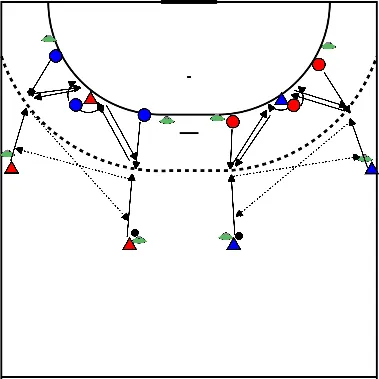
- Form two lines, one at the left backcourt (LB) position and one at the right backcourt (RB) position.
- Place two players at the centre backcourt (CB) position.
- LB and RB throw the ball to the CB while they start moving.
- The CB passes the ball back to LB or RB just before the free-throw line.
- LB and RB take two steps and perform a jump shot towards the goal.
- Both groups shoot at the goal, so ensure you quickly retrieve the ball and pay attention to where you shoot.
- Have the players shoot over a thick mat for an added challenge.
- Open up during the first pass.
- Keep the arm raised during the first pass.
- Jump high and not forward during the jump shot.
- Complete the shot fully.
- Land on the take-off leg.
Setup
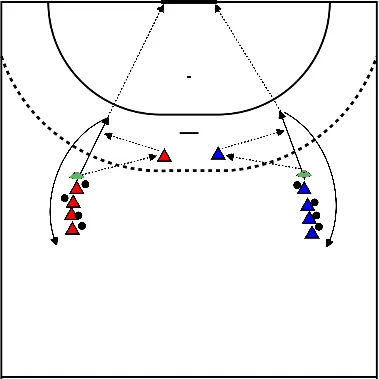
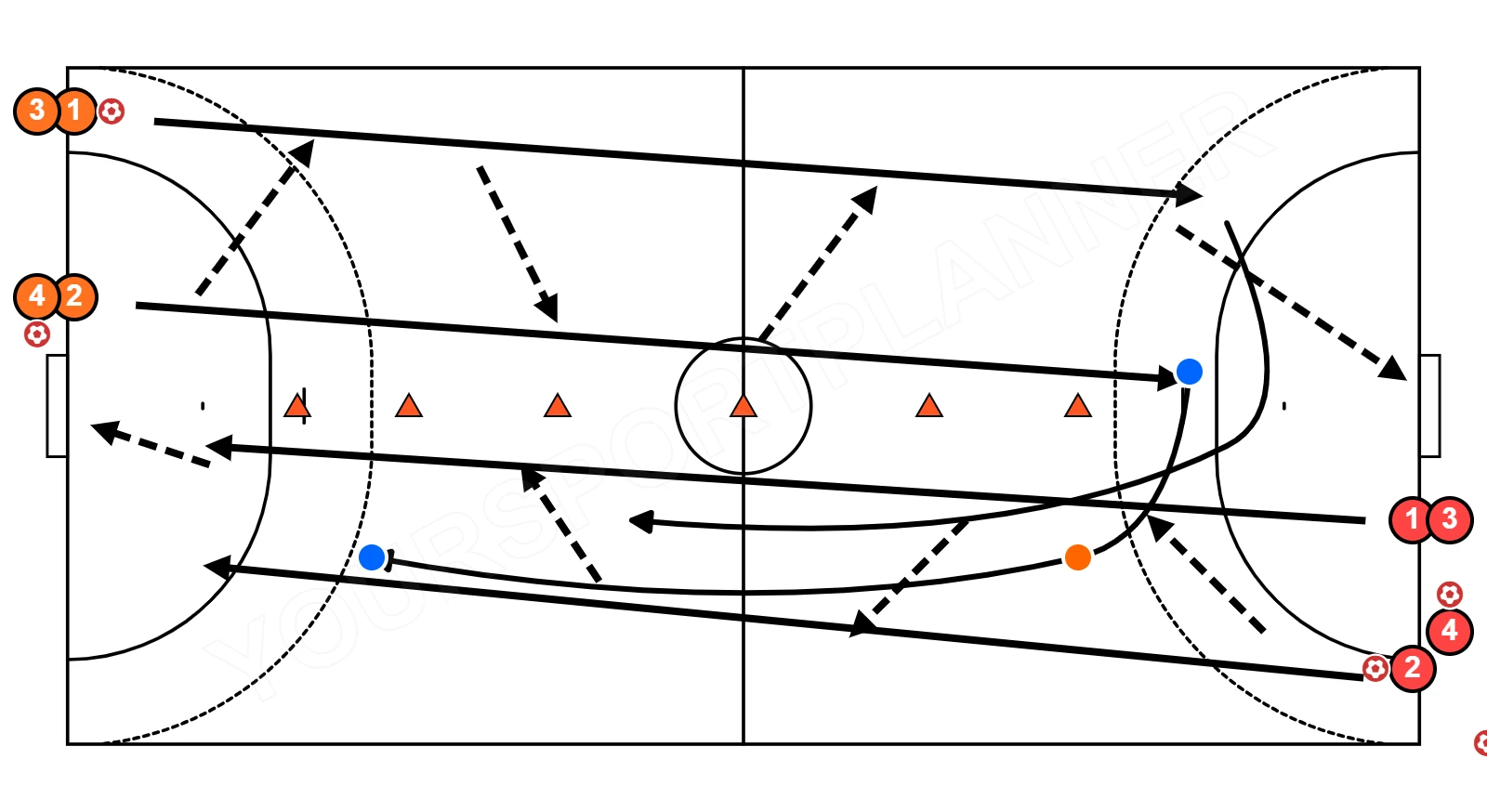
- Divide the field into a left and right half.
- Players work in pairs, each pair has one ball.
- The pairs position themselves in two groups along the back lines.
- A pair (for example, orange 1 and 2) starts by bringing up the ball and tries to take a shot.
- At the moment of the shot, the pair on the opposite side (for example, red 1 and 2) begins their attack on their side of the field.
- Orange 1 and 2 must switch immediately to defence after their shot and try to interrupt the attack of red 1 and 2.
- After the shot from red 1 and 2 or in case of ball loss, orange 3 and 4 begin their attack and red 1 and 2 defend.
- The game repeats with new pairs.
- Pay attention to the timely start of the attackers; it should not be too early or too late.
- If necessary, the start can occur on a signal from the coach.
- The exercise focuses on the fast counterattack and the transition from attack to defence.
Execution
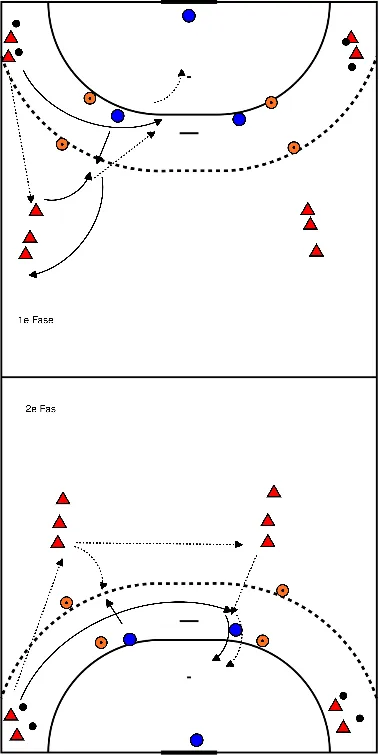
- First Phase: The wing player passes the ball to a backcourt player and receives it back immediately, after which the wing player shoots at the goal.
- Second Phase: The wing player passes to a backcourt player, who then passes to another backcourt player, after which the ball returns to the wing player who shoots at the goal.
Objective
- Footwork, agility, backward movement, coordination, and match-oriented acceleration.
Setup
- Two identical rectangles side by side.
- Per rectangle: 2 rows of 4 cones.
- Distance between cones in one row: approximately 1 metre.
- Distance between the two rows: approximately 2 to 3 metres.
- The centre line is the endpoint at approximately 10-15 metres distance.
- Divide the group into two teams. Each team behind its own starting point.
Execution
- Phase 1: Forward - Diagonal - Backward
- Start at cone 1. Sprint straight forward to cone 2.
- Move with quick, small steps diagonally to cone 3.
- From each cone, always move backward to the starting cone.
- Repeat: forward to the next cone until all four are completed.
- High tempo, low stance.
- Phase 2: Slalom Sliding
- After the fourth cone: proceed directly to the second row of four cones.
- Slide sideways, slaloming between the cones.
- Keep the torso low, arms active. Do not cross feet.
- Phase 3: Final Sprint
- After the last cone: full sprint to the centre line, touch the cone.
- Sprint back. Tag the next player.
Competition Format
- Two or three teams against each other.
- Point for the team that first gets all players over the centre line.
- Losing team performs 5 push-ups or 5 jumping power actions.
Execution
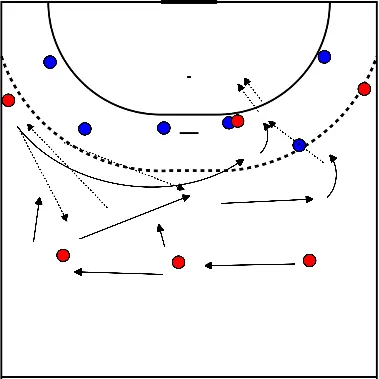
- The wing player initiates movement and collaborates with the backcourt player next to them. They move from the left backcourt/left wing position to the right side.
- The right backcourt and centre backcourt shift one position to the left.
- The pivot sets a block on the third defender.
- The left backcourt passes to the left wing cutting between positions 2 and 3.
- The other backcourt players move to act as decoys.
- Counter to the left backcourt or centre backcourt who has shifted.
- Passing
- Timing
- Blocking
Execution
- Place all players around the centre circle.
- One player stands in the middle as the tagger.
- The remaining players decide themselves when to run to the opposite side.
- Try to reach the other side without being tagged by the tagger.
Objective
- The aim is to place three in a row.
Execution
- The group is divided into two teams.
- One player from each team runs with a coloured cone and places it in a hoop.
- As soon as the first player returns, the second player from the team starts, followed by the third.
- If there is one cone of each colour, the fourth player may move a coloured cone to achieve three in a row.
Execution
- Triceps: Push on the edge of a bench or chair with hands behind the body.
- Jumping Jacks: Jump with arms and legs wide.
- Crunches: Lie on your back, make yourself small in a fetal position and stretch out without letting arms and legs touch the ground.
- Sumo Squat: Wide squat with feet pointed outward.
- Superman: In a quadruped position (dog position), lift one arm and opposite leg diagonally.
- Lunges: Step forward and bend both knees.
- Perform each exercise for 1 minute.
- 30 seconds rest between exercises.
- At least 2 repetitions of the entire series.
Execution
- Each exercise lasts 1 minute with 30 seconds of rest in between.
- Perform at least 2 repetitions of the entire sequence.
- Crunches Long: Lie on your back with your arms extended above your head. Touch the ground and then bring your hands to your toes.
- Squat: Perform a classic squat.
- Push-Ups: Perform push-ups.
- Backward Lunges: Step backward and bend your knee for a lunge.
- Penguin: Lie on your back with bent knees. Alternately touch your left and right ankle with your hands.
- Reverse Push-Ups: Sit on your buttocks with bent knees and feet flat on the ground. Place your hands behind your buttocks with bent elbows. Extend your arms to lift your buttocks.
Execution
- Wall Sit: Sit with your back against the wall as if sitting on an imaginary chair.
- Side Plank with Open Swing Right: Perform a side plank and swing your upper arm open upwards.
- Mountain Climbers: In push-up position, alternately bring your knees towards your chest.
- Crunches: Lie on your back and lift your shoulders off the ground while engaging your abdominal muscles.
- Side Plank with Open Swing Left: Perform a side plank and swing your upper arm open upwards.
- On Stomach, Lift Arms and Legs: Lie on your stomach and simultaneously lift your arms and legs off the ground.
- Each exercise 1 minute, 30 seconds rest. Minimum 2 repetitions.
Execution
- Start from the centre line with a formation of 5 versus 4 or 5 versus 5.
- The trainer throws the ball to the attackers.
- The defenders may start immediately after the throw.
- The attackers attempt to score.
- The defenders try to gain possession of the ball.