





Handballexercises for u16
Execution
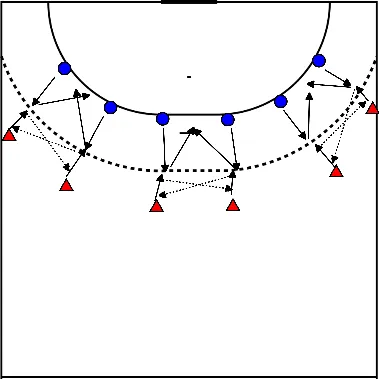
- Form pairs on the field: two attackers and two defenders.
- The attackers position themselves 3 metres outside the free throw line.
- One attacker begins by making a throwing motion towards the defender opposite him.
- The opposing defender attempts to block the ball by touching it with both hands.
- The other defender provides backup to his teammate.
- The attacker throws the ball to his teammate.
- The teammate repeats the throwing motion while the defender opposite him tries to block the ball.
- Repeat this cycle five times and then switch roles.
Execution
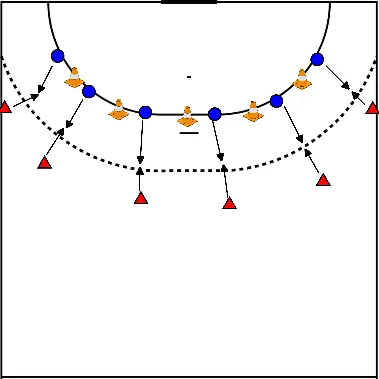
- The attacker starts at a distance of 3 metres from the free throw line.
- The attacker begins with three steps and makes an overarm throw movement.
- The defender steps forward and touches the ball with both hands.
- Both players return to their starting position.
- Repeat this five times before switching roles.
- Ensure that the defender stands with the correct foot forward to offer the path to the side.
- The attacker must stand with the correct foot forward and make a powerful throwing movement.
Execution
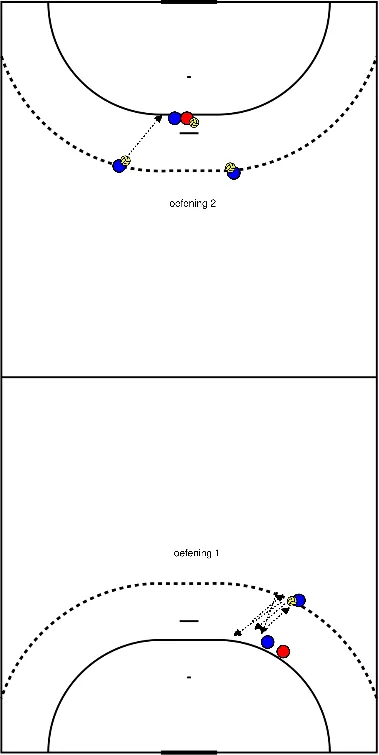
- The defender holds the pivot player by the throwing arm/hand and pulls lightly. Player 2 passes the ball to the pivot player, targeting the 'wrong' arm/hand, and the pivot player returns the ball.
- On the pivot player's signal, player 2 delivers a bounce pass. The pivot player breaks free, grabs the ball, and scores.
- Two backcourt players alternately pass the ball to the pivot player.
- The other pivot player defends and can be engaged in various ways: closer, bounce pass, behind the back, etc.
- The defending pivot player defends with a ball in their hand.
Execution
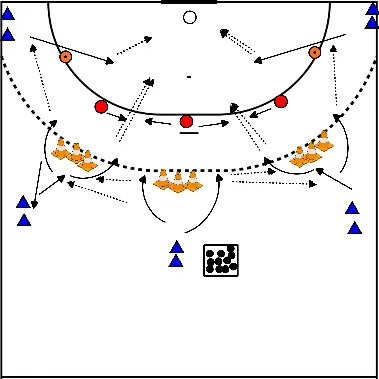
- The centre backcourt player applies pressure between positions 2 and 3 and passes to the left backcourt player who is starting in motion.
- Then, the centre backcourt player returns to position and receives a new ball.
- The left backcourt player applies pressure between positions 1 and 2 and passes to the left wing player, who finishes with an angle extension.
- Subsequently, the left backcourt player returns to his position.
- The centre backcourt player once again applies the same pressure and passes to the incoming backcourt player, who comes up from 10 meters and finishes.
- Repeat the exercise on the other side.
- Finally, the centre backcourt player receives the ball after team play with the left backcourt player or right backcourt player and finishes.
Execution
- Form a large circle with all players. There is one ball in play.
- Designate one player who must sprint around the circle as quickly as possible.
- The remaining players pass the ball to each other within the circle as quickly as possible.
- The goal is to see who returns to the starting point first: the sprinting player or the ball.
Setup
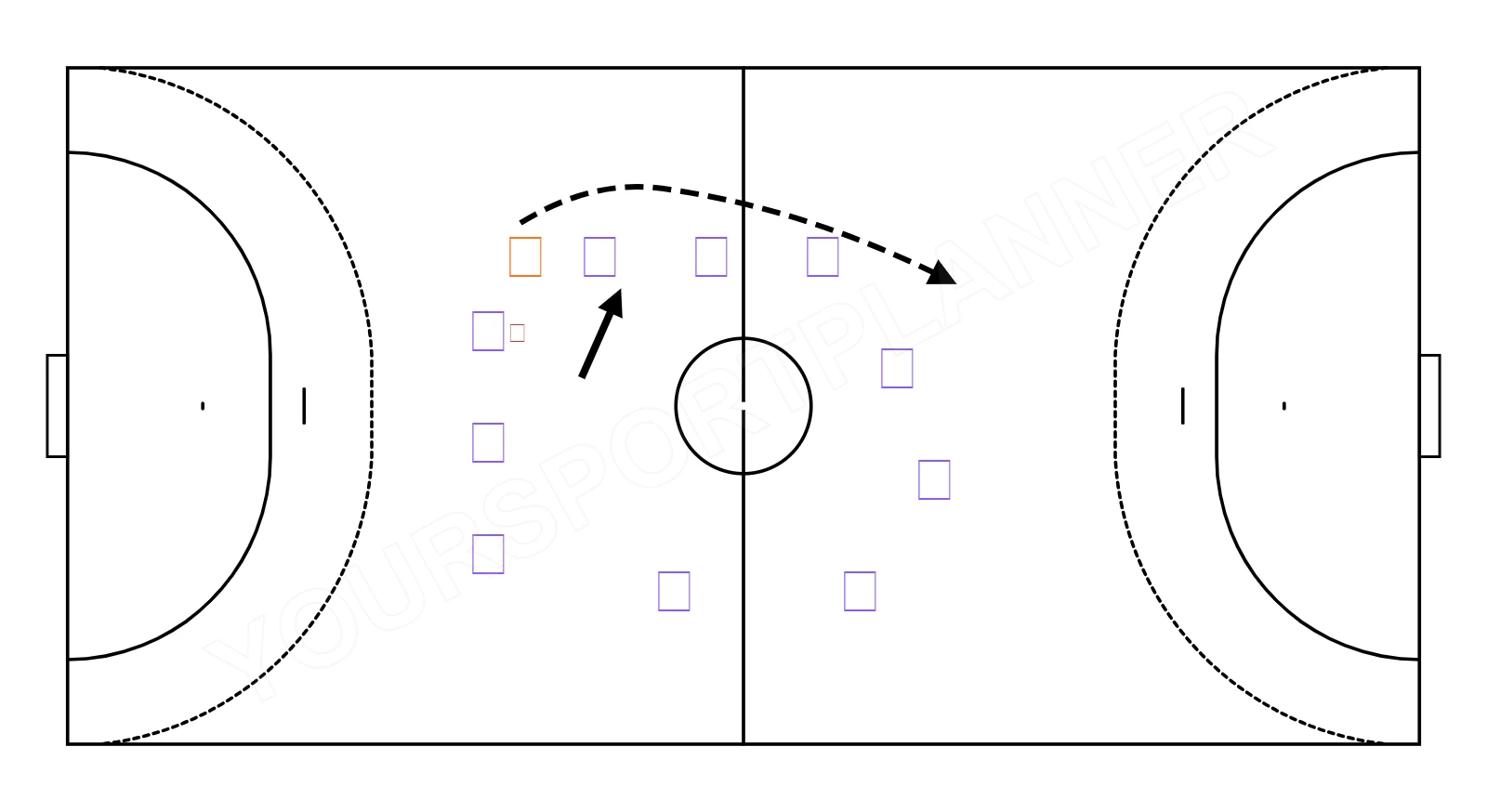
- 3 defenders: one on the wing, one in the backcourt, and one in the centre.
- 3 attackers: positioned in the same places as the defenders.
- The attackers attempt to break through the defence using ball circulation and quick passes.
- The defenders must maintain their positions and collaborate to stop the attackers.
- After a set period, switch the roles of the players so that everyone experiences both attacking and defending.
Execution
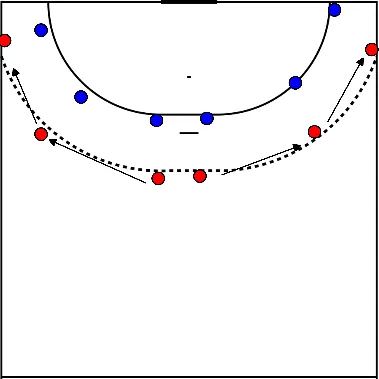
- The ball is introduced by the centre back to the incoming left wing player.
- The left wing player applies pressure between the second and third defender and passes to the overlapping left back.
- The pivot sets a screen on the centre back defender.
- The left back finishes or uses other variations.
- Direct pass to the wing player.
- Counterattack on the back player with the centre back in the left back position.
- Passing to the pivot.
- Timing of the passing.
- Applying pressure on the defence.
Setup
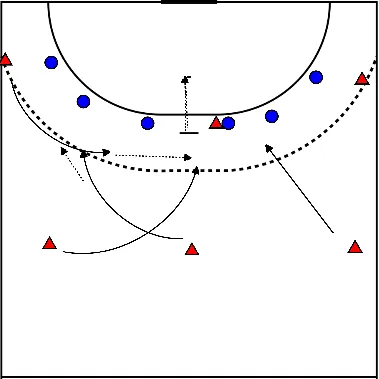
- Divide the field into a left and right half.
- Players work in pairs, each pair has one ball.
- The pairs position themselves in two groups along the back lines.
- A pair (for example, orange 1 and 2) starts by bringing up the ball and tries to take a shot.
- At the moment of the shot, the pair on the opposite side (for example, red 1 and 2) begins their attack on their side of the field.
- Orange 1 and 2 must switch immediately to defence after their shot and try to interrupt the attack of red 1 and 2.
- After the shot from red 1 and 2 or in case of ball loss, orange 3 and 4 begin their attack and red 1 and 2 defend.
- The game repeats with new pairs.
- Pay attention to the timely start of the attackers; it should not be too early or too late.
- If necessary, the start can occur on a signal from the coach.
- The exercise focuses on the fast counterattack and the transition from attack to defence.
Execution
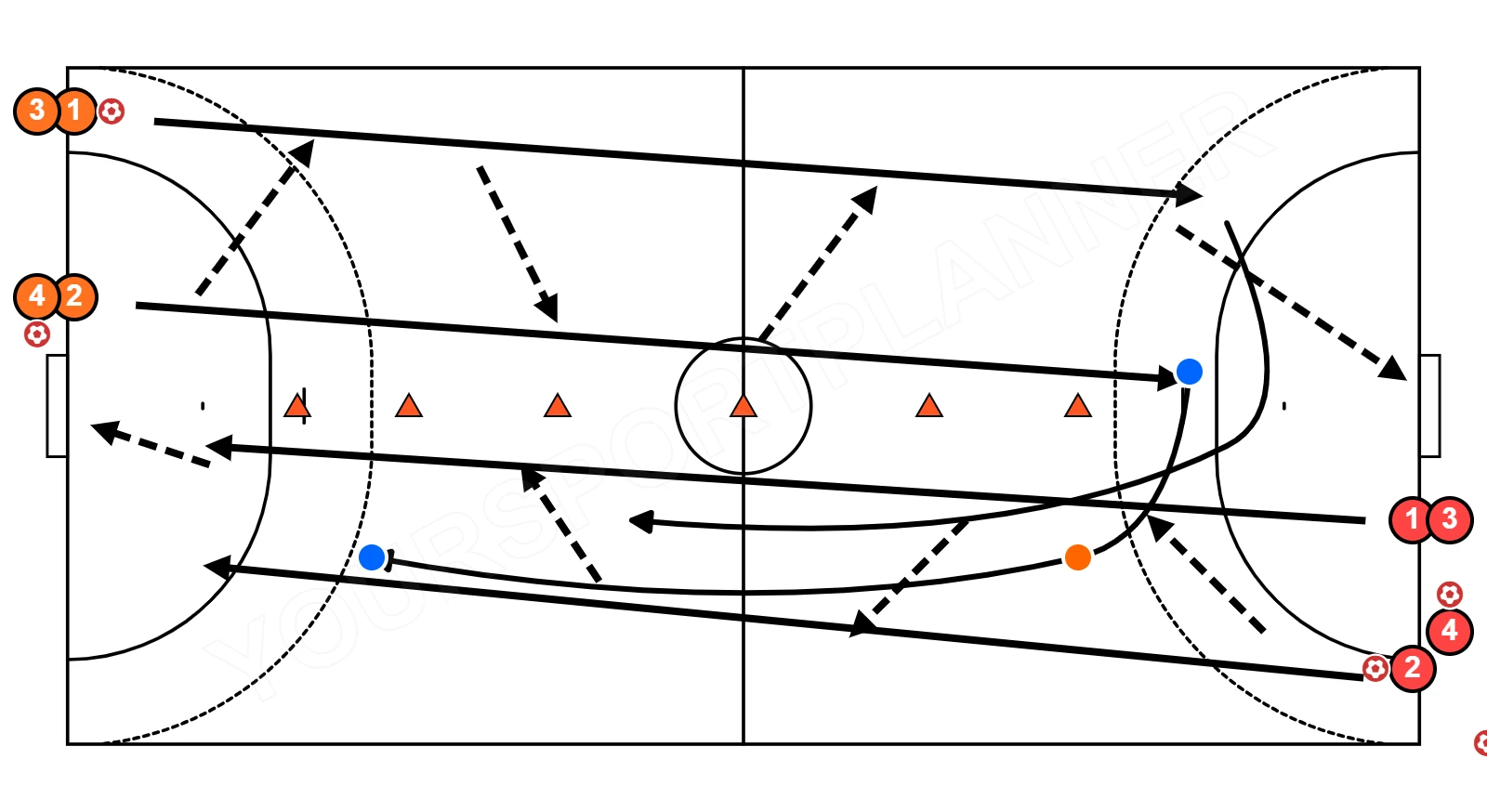
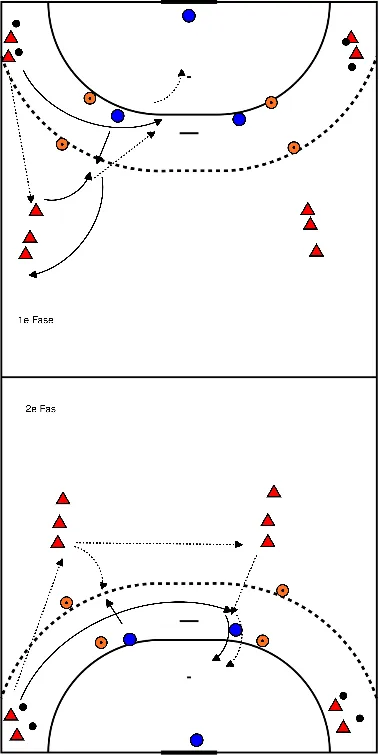
- First Phase: The wing player passes the ball to a backcourt player and receives it back immediately, after which the wing player shoots at the goal.
- Second Phase: The wing player passes to a backcourt player, who then passes to another backcourt player, after which the ball returns to the wing player who shoots at the goal.
Objective
- Footwork, agility, backward movement, coordination, and match-oriented acceleration.
Setup
- Two identical rectangles side by side.
- Per rectangle: 2 rows of 4 cones.
- Distance between cones in one row: approximately 1 metre.
- Distance between the two rows: approximately 2 to 3 metres.
- The centre line is the endpoint at approximately 10-15 metres distance.
- Divide the group into two teams. Each team behind its own starting point.
Execution
- Phase 1: Forward - Diagonal - Backward
- Start at cone 1. Sprint straight forward to cone 2.
- Move with quick, small steps diagonally to cone 3.
- From each cone, always move backward to the starting cone.
- Repeat: forward to the next cone until all four are completed.
- High tempo, low stance.
- Phase 2: Slalom Sliding
- After the fourth cone: proceed directly to the second row of four cones.
- Slide sideways, slaloming between the cones.
- Keep the torso low, arms active. Do not cross feet.
- Phase 3: Final Sprint
- After the last cone: full sprint to the centre line, touch the cone.
- Sprint back. Tag the next player.
Competition Format
- Two or three teams against each other.
- Point for the team that first gets all players over the centre line.
- Losing team performs 5 push-ups or 5 jumping power actions.
Execution
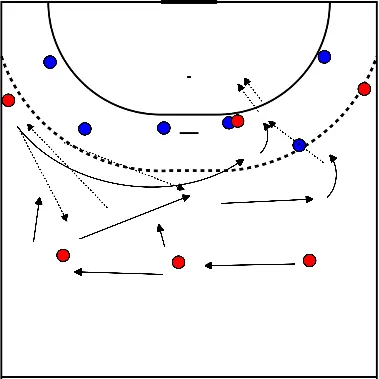
- The wing player initiates movement and collaborates with the backcourt player next to them. They move from the left backcourt/left wing position to the right side.
- The right backcourt and centre backcourt shift one position to the left.
- The pivot sets a block on the third defender.
- The left backcourt passes to the left wing cutting between positions 2 and 3.
- The other backcourt players move to act as decoys.
- Counter to the left backcourt or centre backcourt who has shifted.
- Passing
- Timing
- Blocking
Execution
- Place all players around the centre circle.
- One player stands in the middle as the tagger.
- The remaining players decide themselves when to run to the opposite side.
- Try to reach the other side without being tagged by the tagger.