



Hockeyexercises for technique 1,5 meter / corona / covid-19
- Improving passing.
- Improving finishing on goal.
- Use half of the playing field.
- 2 distributors (Z) and 1 goalkeeper.
- Course with one-two passes, dribbling, and finishing on goal.
- After each pass, continue running to receive the ball back from the distributor.
- Pay attention to the position of the goalkeeper before shooting on goal.
- Train different passing movements.
- Practice both leftwards and rightwards.
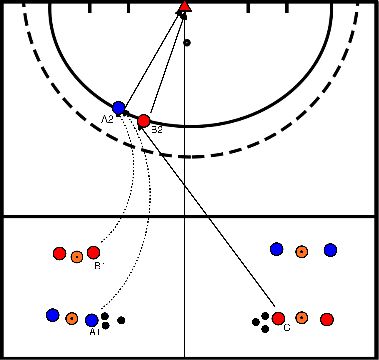
- Exercise B+C
- B is about the left
- C is over the right
- A1 dribbles with ball to A2
- B guides player A, at 1,5 meter, backwards (open position).
- This is about footwork, so when A arrives at A2 he just lets A strike at goal.
- After the hit, A leaves the circle. B turns around and gets a ball from C. B takes a closed approach, turns open and plays the ball.
- B takes a closed approach, turns open and rounds the goal.
- Then the exercise starts on the right.
Do you want to get in shape? You can, but you need a few things for it.
- What do you need?
- Pawns
- Soccer
- Clothes you can work out in
- Stairs
- First of all, it's important that you warm up well before you start working on your fitness!
- What do you need to do?
- Run 2 cones to the front 1 to the back and repeat this every time.
- Do that twice
- Take the ball and run with it in 5 circles.
- This will give you ball control and also ensure that you have worked on your fitness for a while.
- You can also do exercises for your condition inside by running 5 times up and down the stairs.
- Run 2 cones to the front 1 to the back and repeat this every time.
- Of course you can give your own twist to how you want to do it, but I find these are the nicest and most fun ways to improve.
- Don't try to run fast the first day without stopping, do it in steps!
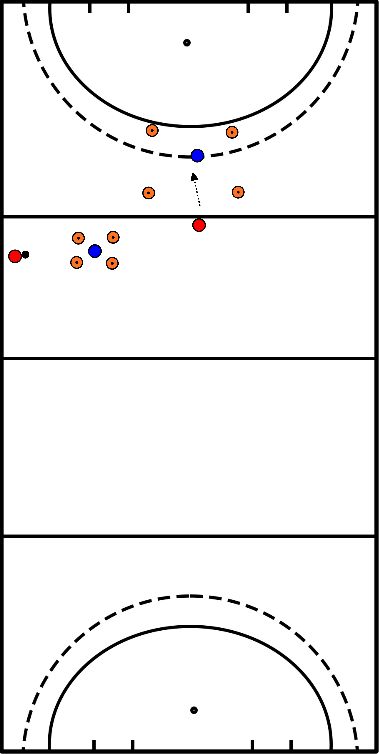
1 v 1
- Make a square from 5m-5m and play a 1v1. the defender is only allowed to defend with his body so no stick.
- Focus on defence.
- Use your body to force them to go to your strong side.
- When you push them to the side make a block tackle.
- Block tackle is always on the forehand, 2 hands on the stick and step forward.
- Stick is on the ground.
- Jab:
- Make a small square 1m-1m.
- The defender is inside the square and the attacker tries to get the ball inside the square.
- The defender use the jab to defend his square.
- You jab with your stick to the ball.
- Left foot in front and right food in the back (not flat fooded).
- Use your stick as poke.
- Putting down pawns.
- Make several situations, this depends on the amount of players you have.
- Dribble around the cones, at the last cone pass the ball back to the waiting team-mate, the team-mate also starts the slalom dribble again.
- Same as above, but now after the slalom score in the goal ( between two cones ), you take the ball out of the goal again yourself.
- Variation:
- Instead of shooting into the goal, give a cross after the last pawn to the person who is waiting at the pawn in front of the goal,
- This person shoots it into the goal and takes the ball back.
- The person who has passed stands on the spot in front of the goal to receive the ball.
- The backhand stroke is useful for a shot on goal but also to pass to your teammate.
- With the backhand, you place your left hand at the end of your stick and your right hand slightly above the middle of your grip.
- Usually you play a backhand from the barrel.
- When your right foot is in front you let the ball roll a little bit.
- Meanwhile you turn your stick to the backhand, you bend your right knee and then you hit the ball with the part of your stick just above the curl (make sure the ball doesn't stick in the curl otherwise you have no control over it).
- You can make the ball go low or high by turning your stick.
- With a diagonal stick the ball flies upwards, with a straight stick it stays on the ground.
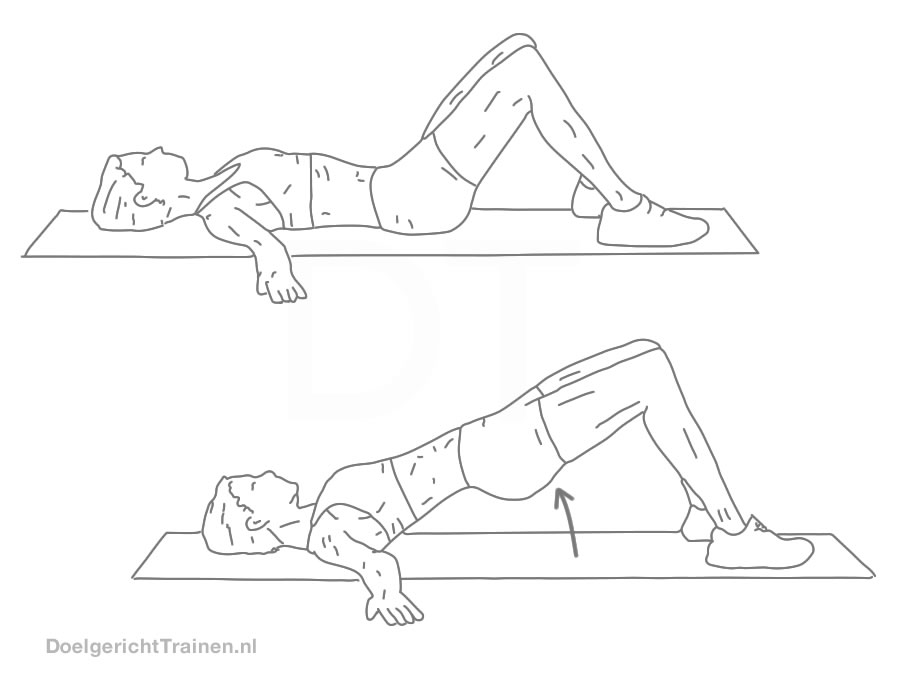
Bridge
Starting position
- Lie on your back.
- Bend your knees to 90 degrees and place both feet flat on the floor.
- Your arms are along your body with the palms facing down.
Action
- Tighten your buttocks and stomach.
- Lift your buttocks off the ground to form a straight line with your knees, hips and shoulders.
Difficulty
- To make this exercise more difficult: alternately extend your right and left leg, keeping your hips in position.
- Set up the exercise and where the ball is played to the team-mate it goes through the alley.
- At the end of the exercise the ball carrier can score on goal.
- After the exercise, the players walk along the outside back to the start.
- Increase the distance between them
- Make the street narrower and narrower
- change the starting position after a while
- Players divided into two groups on one side of the field.
- Two rows of cones next to each other.
- Players pass the ball back and forth while walking past the cones.
- Variations
- Individuals keep ball high along a row of cones, both groups independent of each other.
- Passing the ball two by two
- Individually dribble two balls at the same time, slalom through the cones
- Pass the ball and dribble a second ball at the same time (player says yes).
- Three of you play over 2 balls to the other side.
Purpose
- Practicing different techniques. (Also useful to observe how things are going during the 1st training).
Set up
- All players line up on the baseline (or another line) and do a certain
- and do a certain exercise until the 23m line (or another line).
- This can be only floating, or floating + at whistle a drag or lift, etc.
- Important is that it is not about the fastest, but the best!
- You can make it easier or more difficult by making a difference in the exercise.
Goal
- The goal of this exercise is to learn to look ahead when floating. In addition, you train your ability to react.
Set up
- The players line up on, for example, the back line.
- The trainer stands 10-15 metres away from the players.
- At an agreed signal, the players start drifting towards an imaginary line at your height.
- But in the meantime, they have to look in front of them, because you raise a certain number of fingers and the players have to say that number.
- To make this exercise more difficult, you can ask the players to make a passing move on an agreed signal, or you can make the distance bigger, or the players have to walk instead of saying the number, to a point which corresponds with the number.
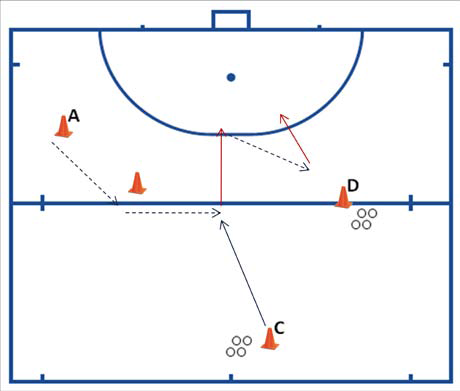
- Position the pawns as shown in the figure
- Spread the balls on pylons C and D.
- In this exercise you place a player on the pylons C and D.
- The rest of the team lines up at the A-post.
- From A the player walks around the pylon
- From the pylon, the player makes a sideways movement, facing the ball (facing C)
- Player C plays the ball into the forehand of A
- A takes the ball and turns to the right to open
- A runs towards the circle and finishes on goal.
- From here he runs to D and receives another ball.
- The player turns open to the left and again finishes on goal.
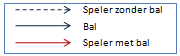

Goal: Improve passing. To improve finishing on goal.
Organisation: Half playing field 2 attackers (Z) â€" 1 goalkeeper Course with 1,2-ties, dribbling and finishing on goal. After each pass you have to run to get the ball back from the attacker.
Tip: Before shooting on goal, pay attention to the position of the goalkeeper!
Variations: Practise different passing moves, both anti-clockwise and clockwise.
The exercises can be played in 2 variants the variant for really beginning hockey players (this exercise can be used for a clinic for example) and the variant intended for beginning hockey players who have already been in touch with hockey.
Variation 1:
- Player 1 plays the ball to player 2,
- Player 2 receives the ball and passes to player 3.
- Player 3 receives the ball and shoots at goal.
- Player 4 tries to stop the ball with the bottom of his foot or with his stick.
- Player 4 retrieves the ball and joins the back of the line at the starting pawn of player 1.
- For safety's sake don't shoot on target when player 4 picks up the ball.
- It is also possible to get the balls out of the goal later or use a break for that.
- This is for safety reasons.
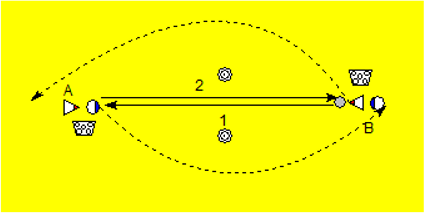
- This is a basic exercise in preparation.
- Just like a tennis player who prepares for training with basic strokes, the players must prepare for the complex training and competition forms, with direct simple passes on top of each other.
- In this way, the trainer has the ability to see technical errors in each individual player and correct them as early as the basic exercise.
- The players pass the ball directly between two pylons and walk counter-clockwise to the other side.
- The size of the target and the distance between the players will be adjusted according to the age and level of the players.
- Jump where you stand:
- Stand with your feet shoulder-width apart.
- Concentrate on a point on the floor and hop up and down where you stand.
- Jump sideways:
- Stand up straight, keep your hands in front of you and jump from side to side.
- Butt Kicks:
- Stand up straight, and keep running in your place as you lift your heel up and touch your buttocks with every step.
- High stepping:
- Lift the leg with the knee at a 90 degree angle.
- Quickly alternate with the other leg.
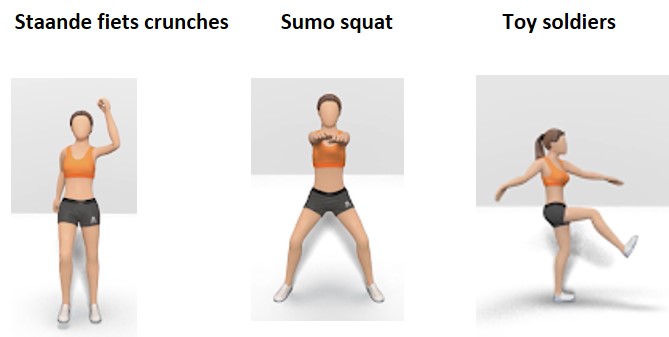
- Standing bike crunches:
- Stand with your feet apart at shoulder width.
- Bring your knee to your opposite elbow.
- Go back to the starting position and repeat with the other side (belly / legs).
- Sumo squat:
- Stand with your feet 6-12 cm apart.
- Stretch out your arms in front of you.
- Lower your body until your thighs are parallel to the floor.
- Return to the starting position and repeat the exercise (legs / buttocks).
- Jumping without a rope:
- Hold your arms along your side and pretend to hold the end of a jump rope in each hand.
- Jump up and come down alternately on the ball of each foot, while simultaneously twisting your wrists as if you were letting a rope go around.
- Jumping without a rope:
- Hold your arms along your side and pretend to be holding the end of a skipping rope in each hand.
- Jump up with 2 feet, while at the same time twisting your wrists as if you were making a rope go around.
- Arm Swings clockwise:
- Stand on the ground with your arms straight outstretched to the side at shoulder height.
- Move your arms quickly in large circles clockwise (arms).
- Arm Swings counterclockwise:
- Stand on the ground with your arms straight outstretched to the side at shoulder height.
- Move your arms quickly in large circles counterclockwise (arms)
- Toy soldiers:
- Start with your feet at shoulder width apart. Keep your legs and arms stretched.
- Kick up your left leg until your right hand touches your toes.
- Repeat with the other side (belly / legs / arm / shoulder).
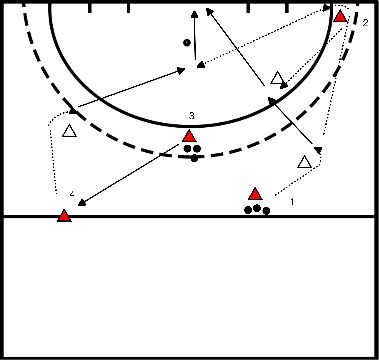
- Player 1 runs with the ball to the white pilon, player 2 runs without the ball to the white pilon.
- Player 2 rounds off on goal (with backhand).
- Player 1 runs around the pilon where player 2 started and runs to the center of the circle.
- As soon as player 1 has played the ball to player 2, player 3 may start. Player 3 plays the ball to player 4.
- Player 4 runs around the white pilon and plays the ball (with backhand) to player 1 who has run into the circle.
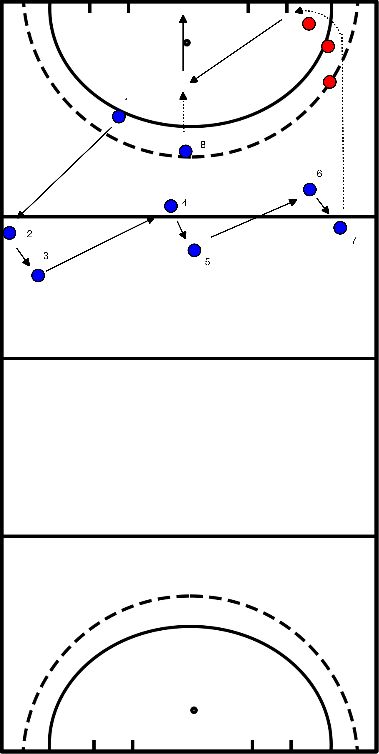
- Goal: to show the player when it is best to pass and when it is best to push.
- In case of a long pass you pass, in case of a short pass you push.
- Player 1 passes (long pass) the ball to player 2
- Player 2 pushes (short pass) the ball to player 3.
- Player 3 passes (long pass) the ball to player 4.
- Player 4 pushes (short pass) the ball to player 5.
- Player 5 passes (long pass) the ball to player 6.
- Player 6 pushes (short pass) the ball to player 7.
- Player 7 runs along the red pilons to the back line and passes (long pass) the ball to player 8, who has entered the circle.
- When explaining the exercise, you can let the player fill in whether it's a long or short pass and what kind of stroke you use, this way they will actively think about it and will apply it earlier in the game.
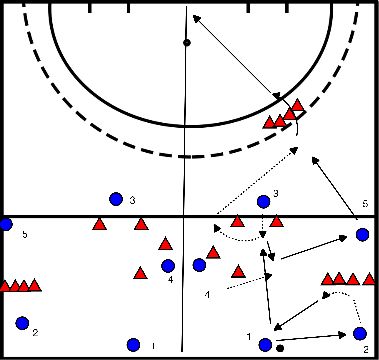
- Player 1 passes the ball to player 2.
- Player 2 runs on the pilon sequence, turns around at the last moment and passes the ball back to player 1.
- Player 1 passes the ball to player 3, who walks in between the pilons.
- Player 3 passes the ball to player 4, who has entered.
- Player 3 walks around the outer pilon to the series of pilons on the circle.
- Player 4 passes debate to player 5.
- Player 5 passes the ball to player 4 who entered the circle.
- Player 4 performs a trick on the pilon sequence and finishes on goal.
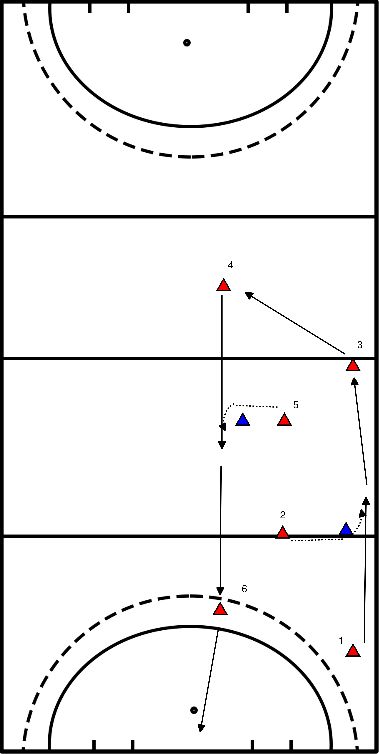
- Player 1 plays the ball towards the blue pilon
- Player 2 walks around the blue pilon towards player 3
- Player 2 takes the ball with the backhand and plays the ball to player 3.
- Player 3 controls open and plays the ball to player 4
- Player 4 plays the ball towards the blue pilon
- Player 5 runs around the blue pilon towards player 6
- Player 5 takes the ball with the backhand and plays the ball to player
- Player 6 takes the ball in closed and round on the forehand or takes the ball open and round or on the backhand
- You can extend this exercise on 2 sides towards the other goal
- Too few players?
- Eliminate pilon 3
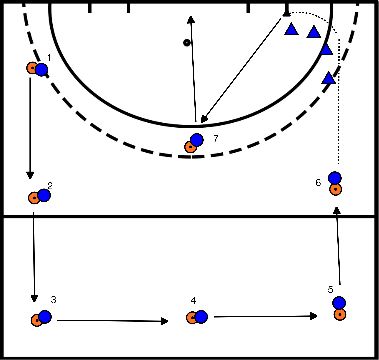
- Player 1 passes the ball in the forehand to player 2.
- Player 2 takes the ball open/closed and passes it to player 3.
- Player 3 takes the ball open/closed and passes it to player 4.
- Player 4 takes the ball open/closed and passes it to player 5.
- Player 5 takes the ball open/closed and passes the ball to player 6.
- Player 6 takes the ball open/closed and runs to the back line along the blue pilons and passes the ball to player 7.
- Player 7 finishes off on goal.
- Fewer players?
- Remove a few pilons.
- Points of attention:
- Pay attention to posture while assuming
- Tight passes in the forehand
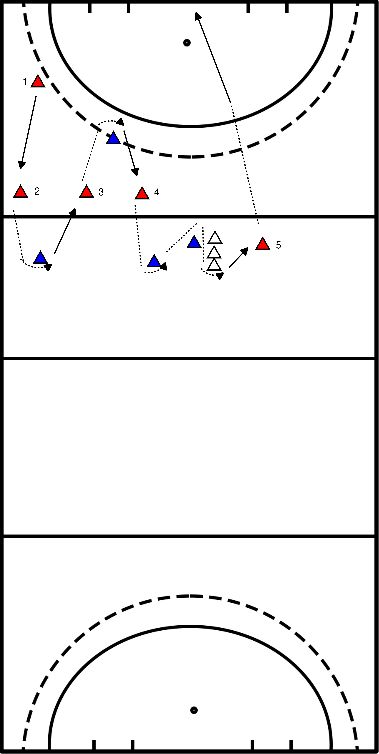
- Player 1 passes the ball to player 2.
- Player 2 takes the ball open/closed and runs to the blue pilon and rotates around it.
- Player 2 passes the ball to player 3.
- Player 3 takes the ball open/closed and runs to the blue pilon and turns around it.
- Player 3 passes the ball to player 4.
- Player 4 takes the ball open/closed and goes to the blue pilon and spins around it to the next blue pilon.
- Player 4 makes a feint (between the blue and white pilons) and passes the ball to player 5.
- Player 5 finishes on goal.
- If you have a closed control, place a pilon around which the player has to turn.
- Points of attention:
- Pay attention to the posture at the assumption
- Keep speed in the exercise
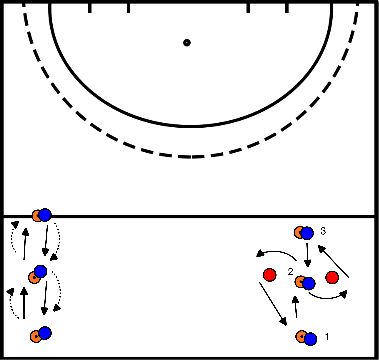
- Right: closed control
- Player at pilon 1 passes the ball to player at pilon 2.
- Player with pilon 2 takes the ball closed to the left of the pilon and then passes the ball to the player with pilon 3.
- Player on pilon 3 passes the ball to the player on pilon 2.
- Player on pilon 2 takes the ball closed around the pilon to his/her left and passes it to the player on pilon 1.
- Left: open control
- Player at pilon 1 passes the ball to player at pilon 2.
- Player on pilon 2 takes the ball open and passes it to the player on pilon 3.
- Player on pilon 3 passes the ball to the player on pilon 2.
- Player on pilon 2 takes the ball open and passes it to the player on pilon 1.
- Swap:
- The player chases the ball.
- Pay attention:
- You need a minimum of 5 players per exercise.
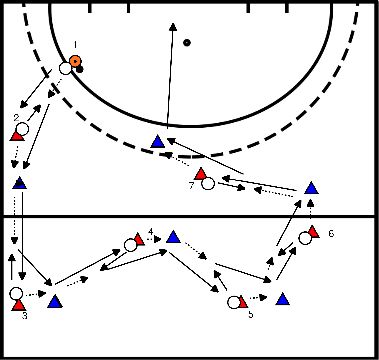
- Player 1 passes the ball to player 2, player 1 walks halfway to the red pilon of player 2.
- Player 2 passes the ball back to player 1.
- Player 2 moves on to the blue pilon, player 1 passes the ball to player 2.
- Player 2 passes the ball to player 3 on the red pilon, player 2 walks halfway to the red pilon of player 3.
- Player 3 passes the ball back to player 2.
- Player 3 passes the ball to the blue pilon, player 2 passes the ball to the passed player 3.
- Continue until player 7 can finish on goal.
- Points of attention:
- Tight passing
- Always keep looking at the ball
- Good attitude for open assumption
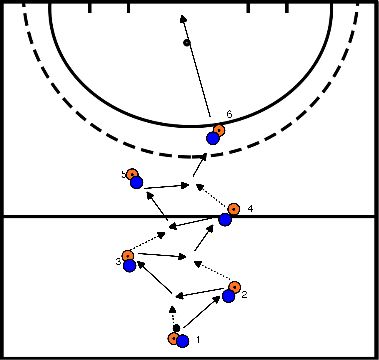
- Player 1 passes the ball to player 2.
- Player 1 runs through to create a triangle between player 1,2 and 3.
- Player 2 passes the ball to player 1 who ran in, player 1 passes the ball to player 3.
- Player 2 runs through to create a triangle between player 2, 3 and 4
- Player 3 passes the ball to player 2, player 2 passes the ball to player 4.
- This is repeated until the ball reaches player 6, player 6 shoots on goal.
- Easier:
- Put the pilons further apart and possibly put flaps on the spot where the player has to run to when he/she has to run in
- More difficult:
- Move the pilons closer together.