



Hockeyexercises for technique ball control
Last update: january 2026
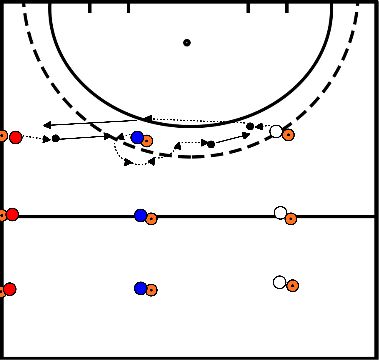
- Player 1 plays in hard to player 2 with flats.
- Player 2 runs in on the ball, takes the ball in stride and turns left or right.
- Player 2 plays the ball in to player number 3 with a hard push.
- Player 2 then runs to pawn number 3 without the ball.
- Player number 3 accepts the ball in the run and runs on to pawn 2.
- Player number 3 hits a regular high shot to player 1.
- Player #1 takes the ball in the run and then plays another flats on the player at the pawn.
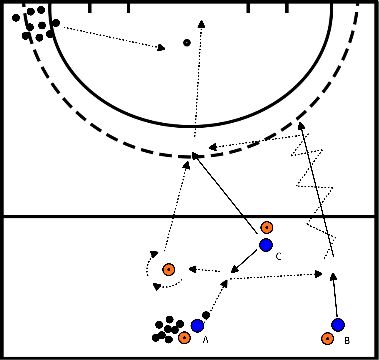
- Player A plays the ball with a flats or hard push on C.
- Player C comes running in and rebounds the ball wide at once to player B who has come running in.
- B takes the ball in stride and accelerates with the ball on the stick to the edge of the "dotted circle.
- There he passes the ball with a hard push to player C who has run around the pawn and offers himself.
- The ball is accepted just outside the circle and then taken into the circle with 1x touch and hit on goal.
- Then the player gets a 'rebound' ball played to him from the back line by the trainer and finishes it on the goal.
Passing: CAB
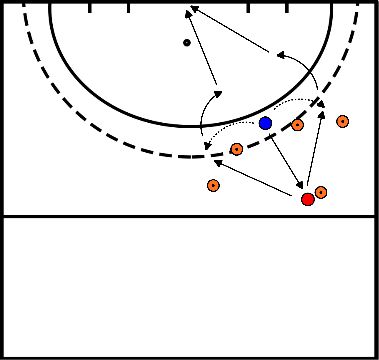
Exercise:
- Player Blue stands between the four pawns and plays player Red firmly -hard push.
- Player Blue keeps eye contact with player Red and chooses position left or right between the pawns.
- Player Red plays the ball firmly back to Blue's chosen position -attack position.
- Player Blue accepts open and then finishes on goal.
Important:
- Players Blue and Red stand with straight backs and bent legs on the ball of the foot. In the 'starting blocks'.
- Stick just slightly above the knees.
Construction:
- Player Blue takes open first at both attack positions on the forehand, then on the backhand, then alternately.
Level:
- For 1st year D players, it is recommended that the trainer take the role of player Red in the beginning.
- As confidence grows, and effectiveness, players can assume the role of Red.
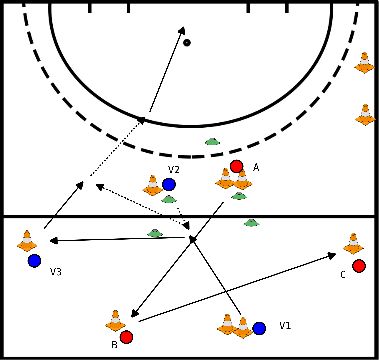
- V1 starts with the ball
- V2 comes running in and gets the ball from V1
- V2 takes the ball open and passes to V3
- V2 runs right through to offer his pass to V3
- V3 passes the ball back to V2, who runs into the circle and completes
- A passes the ball to B when V3 has given the ball to V2
- B passes the ball outside where C presents himself
- It now becomes a 3 vs.
- V1, V2, V3 are going to try to defend the goal
- A, B, C want to score on the goal
- If the defense takes the ball away, they can score in the goal on the side
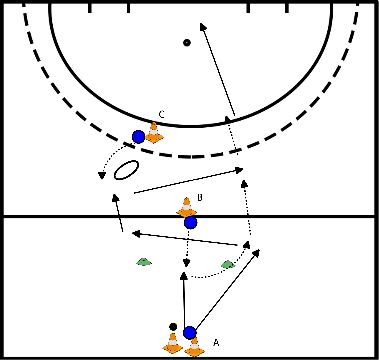
- A starts with the ball
- B comes running in and gets the ball from A. B takes the ball strongly and passes it back to A
- B turns right on away and gets the ball in his forehand from A
- A runs through, B passes the ball through the triangle to A
- A takes the ball and passes it to the incoming C
- C comes in front of the band and takes strong possession
- B has run through, C plays the ball wide to B
- B takes hold, drives into the circle and rounds on goal
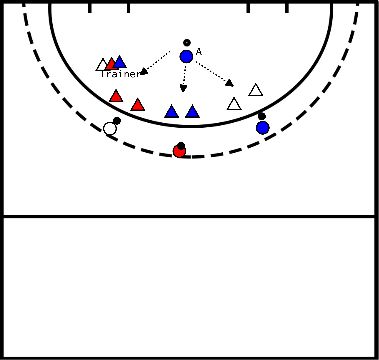
Three color game
- The trainer has three colors of pawns in his hand. Red, white and blue.
- Player blue A takes his turn.
- Trainer first puts color pawn 1 in the air --> For example, pawn white.
- Player blue A starts running towards the edge of the circle and receives the ball from player blue ->.
- The latter then plays the ball through the white gate as the trainer thus puts the white pawn in the air.
- Player A takes the ball through the gate and rounds on goal.
- After his shot, he takes over the spot of the player who passed the ball to him.
- The trainer puts a new color pawn in the air for the next player etc.
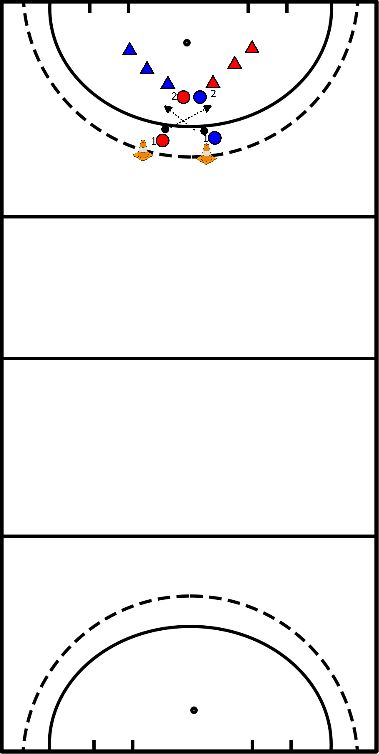
- Player blue 1 plays the ball with a controlled push or flats diagonally onto the forehand of player red 2.
- Player red 2 takes the ball on the forehand and rounds on goal.
- Player red 1 plays the ball with a controlled push or flats diagonally onto the backhand of player blue 2.
- Player blue 2 takes the ball on the backhand and rounds on goal.
Points of focus:
- The focus in this exercise is on the approach.
- Make yourself small when making the approach.
- Try to pick up the pace of the ball.
- Let the ball roll past you and take the ball as late as possible.
- Make sure that the ball does not rise when taking it on. So keep your stick straight and not angled.
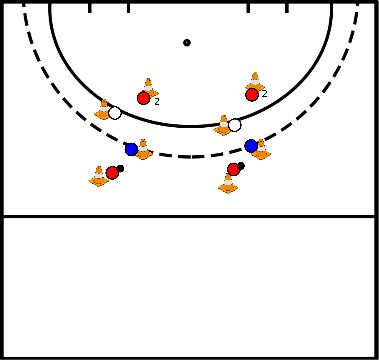
Two touches
- Player red pushes the ball to player blue, player blue to player white and player red 2. Players may touch the ball a maximum of two times.
- Player red 2 takes the ball and rounds on goal. Preferably a flat.
- After your pass, move on to the next pawn. The player who rounded on goal joins the back of the line again.
Points of attention:
- Because the player is allowed to touch the ball a maximum of two times, the ball must be right at once when taking it on. So make sure the player concentrates extra well on the takeover.
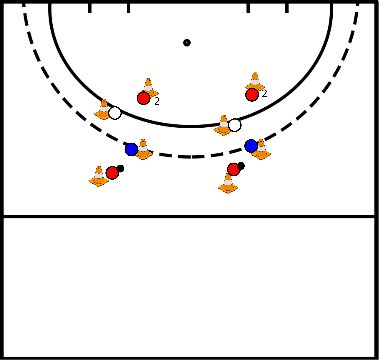
Two touches
- Player red pushes the ball to player blue, player blue to player white and player red 2. Players may touch the ball a maximum of two times.
- Player red 2 takes the ball and rounds on goal, preferably a flats.
- After your pass, move on to the next pawn.
- The player who rounded on goal rejoins the back of the line.
Points of attention:
- Because the player is allowed to touch the ball a maximum of two times, the ball must be right at once when taking it on. So make sure the player concentrates extra well on the takeover.
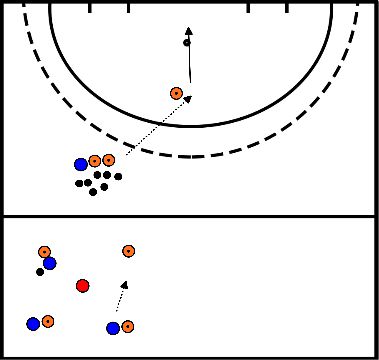
- Choose 1 warm-up exercise from the warm-up exercises.
- Flats out of the run:
- Drive the ball toward the pawn.
- Get them to shoot the ball at the goal with flats. Do this without stopping the ball.
If this is still too difficult, have them stop the ball first.
- Loafing:
- Put 1 player in the middle and 3 players at the pawns.
- They are going to pass to each other.
- The player with the ball must always have 2 passing options.
- So other players should run to the other pawn so that those play-off opportunities are there.
Start with that the loafer can only intercept the ball if a pass is given, then
you can also have the loafer take the ball away if a player gives the ball.
- Play a match.
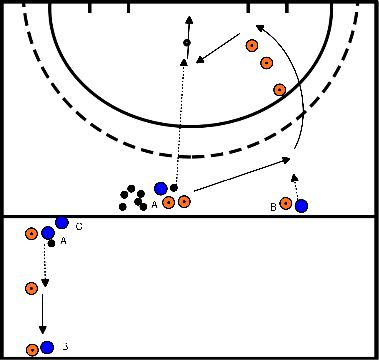
- Choose 1 warm-up exercise from the warm-up exercises.
- Attack over right:
- A pushes the ball to the in-running B.
- B floats around the pawns with the ball on the stick.
- A has run on and gets the ball back from B with a push.
- A scores in the goal.
- Push out of the run:
- 1 player floats forward with the ball.
- Push the ball when she reaches the pawn, without stopping the ball.
- B takes the ball from A and does the same again.
- A connects behind B
- Match.
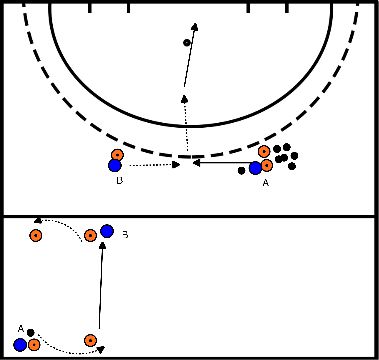
- Choose 1 warm-up exercise from the warm-up exercises.
- Push straight from the run:
- A starts with the ball and floats around the pawn and push the ball to B.
- B does the same on the other side and push back to A.
Keep repeating.
- Take on frontally and turn away:
- A starts with the ball and push the ball to the running-in B.
- B takes the ball head-on.
- Then turns away and accelerates to the goal and scores with en flats.
- Play a match.
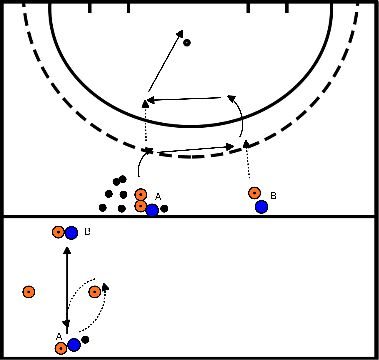
- Choose 1 warm-up exercise ui the warm-up exercises.
- Passing over through the gates:
- A starts with the ball and floats forward and pushes the ball through the gate.
- B has run along and receives the ball.
- B floats forward with the ball and plays the ball through the gate again.
- A receives the ball and scores with a flats on the goal
- Run and play the ball:
- A gives the ball, B points left or right.
- A then floats with the ball to that pawn and circles it and floats back to his starting pawn.
- A then push the ball to B.
- B then does the same thing.
- Play a match.
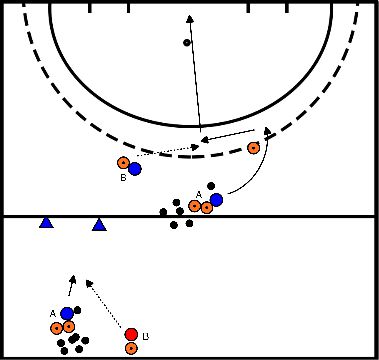
- Choose 1 warm-up exercise from the warm-up exercises.
- Defending 1 against 1:
- A starts with the ball and floats toward the goal.
- B may start running when A starts.
- B wants to start taking the ball away from A.
- If B takes the ball away then she gets to score on the goal.
- Attack on goal:
- A floats around the pawn with the ball.
- B runs in toward A and gets the ball from A with a push.
- B runs toward the goal and scores with a flats.
- Party play.
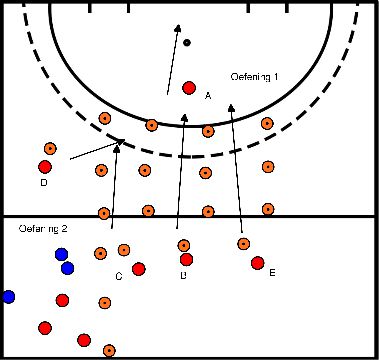
Exercise 1:
- A stands in the middle of the circle and gets start 4 balls to round off on goal.
- Ball 1: B passes the ball to A, A takes it and rounds off with the forehand stroke.
- Ball 2: A immediately turns around and receives the ball from C exactly along the pawns so that A can elevator the ball over the pawns and then rounds with the backhand on goal.
- Ball 3: A turns back immediately and receives a hard ball from D which she elevators over the pawns by placing her stick in front of the pawns and finishes with the forehand strike on goal.
- Ball 4: Turns right back and receives a hard ball from E which she takes closed and then turns away to her backhand and finishes with the backhand on goal.
Exercise 2:
Play possession with communication as the focus.
Play possession with communication as the focus.
- Give 1 player on each team the lead to direct possession of the ball.
- The players listen to the instructions of these players.
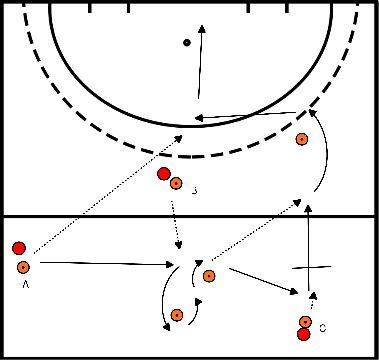
- A starts with the ball and passes the ball into the run of B who comes forward to offer.
- B takes the ball with the backhand and accelerates around the pawns.
- B passes the ball on the run to C who comes running in forward.
- C takes the ball and passes it forward to the runner-up B with a lift pass.
- C receives the ball with the backhand and accelerates around the pawns and passes to the runner A.
- A receives the ball and turns to her backhand and finishes with a backhand strike on goal.
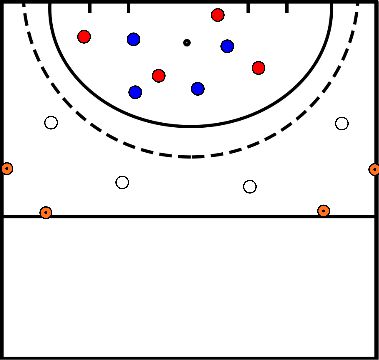
Make 3 equal teams.
One team starts as defenders in the circle, one team starts as attackers in the circle and the other team starts outside the circle as a bowl.
One team starts as defenders in the circle, one team starts as attackers in the circle and the other team starts outside the circle as a bowl.
The goal is for the bowl to pass to each other at tempo and to play to the attackers in the circle.
It is important for the bowl to pre-scan before they receive the ball and to already know where the attackers are or will be in the circle.The
rest of the team then does not participate in the attack, but can get the ball back and then it starts over again.
It is important for the bowl to pre-scan before they receive the ball and to already know where the attackers are or will be in the circle.The
rest of the team then does not participate in the attack, but can get the ball back and then it starts over again.
1 defender is allowed out of the circle to pressure the bowl. the rest of the defenders stay in the circle.
If the defenders take the ball away, they can score in one of the two goals on the side of the
circle.
If the defenders take the ball away, they can score in one of the two goals on the side of the
circle.
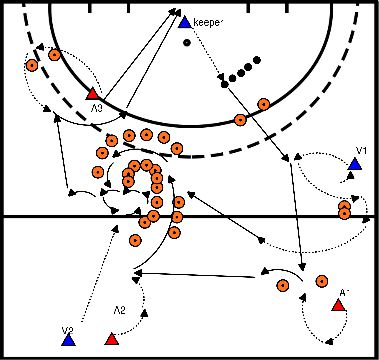
- We start with the goalkeeper coming out and kicking ball to defender 1 through the gate.
- Defender 1 runs with a run and takes the ball behind the gate.
- This defender loses possession of the ball to A1 due to a pass into the left up feint space.
- A1 passes the ball to run-in A2 with a feint pass.
- A1 switches and starts putting pressure on A2 who drives the ball protectively between the pawns and has to watch out first for forehand or backhand shave from V1 and then a steal from V2. Defender play at 70%. After this A2 plays A3 in with pass from the wrist.
- A3 Starts at the same time as A2 gains possession of the ball, but shoots first after an elevator on goal and then goes to offer himself for A2's ball as described.
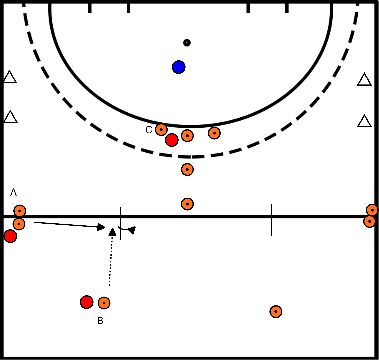
- A starts with the ball, B comes offering forward and gets the ball from A on his forehand.
- B takes the ball with an elevator action over the pawns. When B has done this a 2:1 is played.
- B and C belong together and play against the defender standing in the circle.
- The defender tries to take the ball away and score in the goalmouth on the side.
The exercise can be done on both sides, but please check with each other that we are not playing with 2 players in the circle.