


Hockeyexercises for technique condition
- The tagger should try to tap as many children as possible.
- If you are in danger of getting tapped you can call a television show and then the tagger is not allowed to tap you.
- You have to stand with your legs wide.
- The rest can be relieved by crawling between your legs.
- When you are tapped, you stand by the trainer.
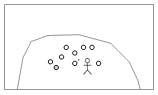
- 2 players give each other a hand and start tapping together (don't let go).
- Player who is tapped gives a 3rd hand and when another player is tapped they form another twin pair.
(each group of four splits).
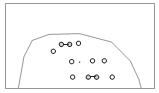
- Groups of 2 in a row.
- There is one tagger and one runner.
- The one who has to run away, because otherwise he will be tapped, will quickly stand in front of 2.
- The last one of these two has to run away quickly in order not to be tapped, because 3 is too much! If you get tapped, you become the tagger.
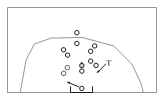
- 1 or 2 taggers.
- On the spot where you are tapped, the tagger must hold his hand, for example, a hand on his shoulder.
- With the other hand another has to be tapped.
- The children are placed in 2 rows.
- The trainer stands just behind the 2 rows and rolls a ball forward.
- The front 2 players try to conquer the ball.
- The player in possession
- drives the ball towards the goal.
- The other tries to conquer the ball again.
- From a marked point, the ball may not be taken away and the player in possession makes a shot at goal.
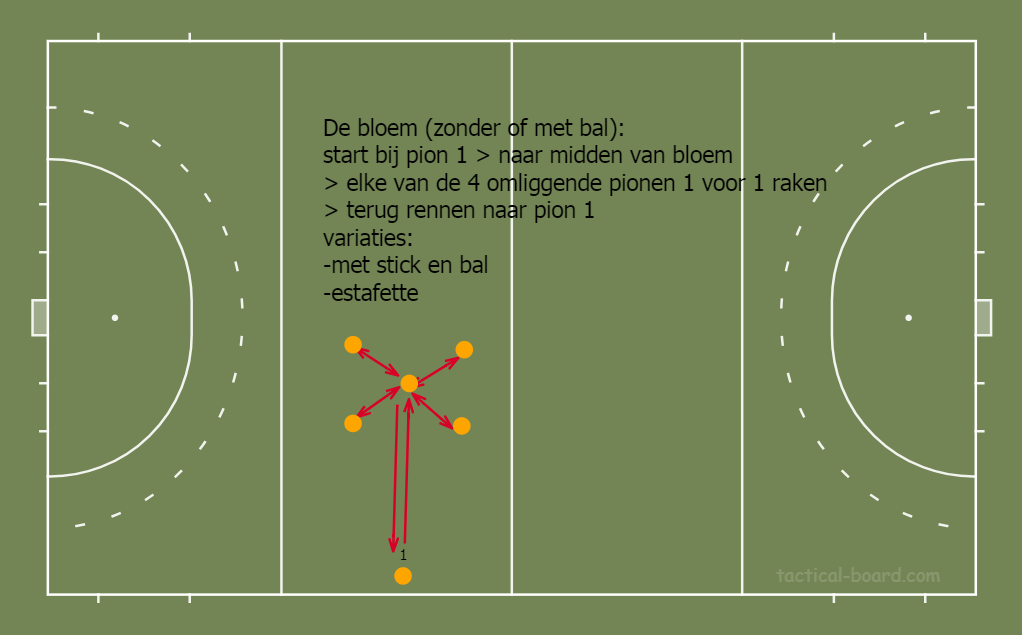
The flower (without or with ball):
- start at pilon 1 > to the center of the flower
- hitting each of the 4 surrounding pilons 1 by 1
- run back to pilon 1
- variations:
- with stick and ball
- relay race
- The group is positioned in the four corners of the field.
- One who tags has to wear a party ribbon
- On a sign, they cross the field in three directions of their choice:
- the short side, the long side or diagonal.
- This results in one, two or three points each time they return.
- A tagger operates in the free space and obliges the tagged children to first go back to their corner before they may cross again.
- How many points can you score in a set time?
- This is a good exercise for conditioning:
- The group has to stand in a row and you let them start dribbling.
- As soon as the trainer blows his whistle, the last one of the row should run forwards.
- You do this until everyone has been there and then you let them finish running the track.
- Let the team run for about five minutes and then continue with the following exercises:
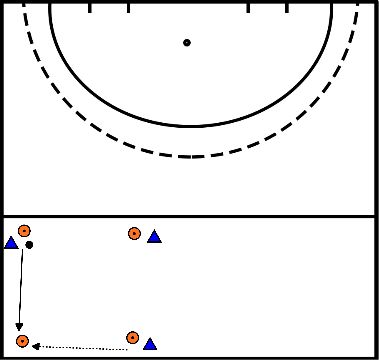
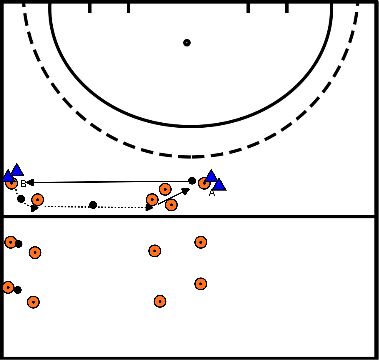
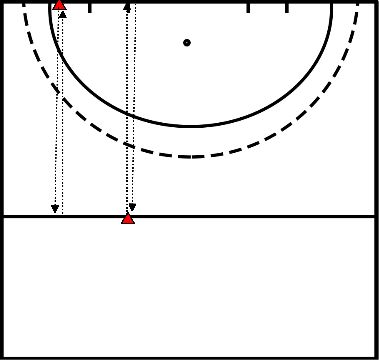
- put out the pilons as shown in figure one.
- Have the team make two rows on the sideline at the height of the 23-metre line.
- Perform the following running exercises on the dotted line:
- - Knee lifting (constructive 50%, 80%, 100%).
- - Heel to buttocks (building 50%, 80%, 100%).
- - Sideways
- - Cross step.
- - And finally, release the arms.
- Flat
- Open reception,
- Accelerate & push pass out of the barrel (alternate with other techniques such as stroke, push pass, backhand pass).
- A flats to B (A runs after own ball);
- B takes it open and runs around the pilon.
- B accelerates with the ball stuck to the stick and plays the ball through the gates to A.
- Resumption
- From the back line to 23 m line in 30 sec 3x back & forth.
- 30 sec rest, then repeat.
- H1 level 4x (start competition half) 80% within time should be achievable.
- Pay attention to turning speed.
- Start low to quickly get on track.
- Carry energy in the turn.
- For larger groups, make 2 groups.
- Group one start on back line, group two on 23 meter line. When group one is running, group two is resting (30 seconds).
- Put out a square of 10 by 10 meters.
- A player is placed at 3 pilons.
- One pilon remains empty.
- The player with the ball plays to the pilon without a player.
- The player standing diagonally runs to the pilon and receives the ball. And so on.
- In this way, the next goal is reached:
- a lot of movement,
- playing while running
- take it in motion.