

Hockeyexercises for technique dribbling
Goal :
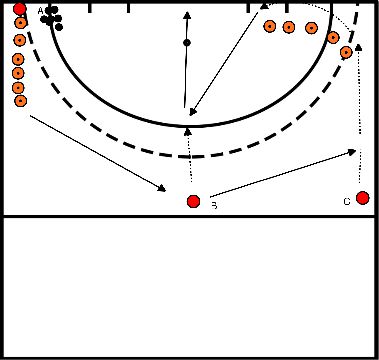
- Transfer , quick assumptions and passing
Execution :
- A does Indian dribble at the pawns
- Pass to B.
- B takes open and passes immediately to C who comes up along the sideline.
- C runs on to the back line and runs via the back line in the direction of the goal.
- C passes back to A at the head of the circle.
- A scores.
Points of attention:
- Clean passing
- Quick passing and
- Correct passing in the run
Variations :
- From the other side
- Instead of dribble 3 D, introduce aerial dribble or passing moves (drag, dummy).
- B takes closed take instead of open take.
- C can come up unhanded along the back line,
- C, after taking the ball, passes straight to the far-post area where A goes.
- Bring in the rebound
- From B to C a high ball.
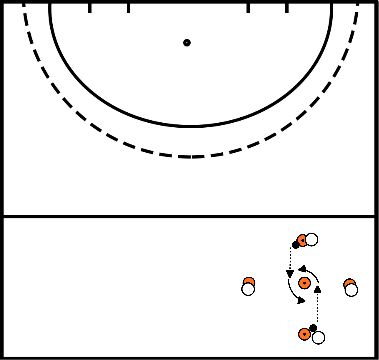
- There are 4 pawns in a diamond, and 1 in the middle.
- The balls start at 2 pawns opposite each other.
- Then walk to the center and pass it to the right.
- Ball starts with player 1, who runs to the back line, turns close and passes the ball in the run to player 2.
- Player two runs towards the 23, makes a turn to the right and pushes the ball to player 3.
- Player 3 attempts to run towards header circle but retrieves the ball at the ion and passes to player 4.
- Player 4 runs towards the back line and passes the ball towards head circle.
- Player 3 has run on after the pass and has taken position between the head circle and the center spot and will choose from here between rounding or playing on the tip.
- Player 1 is ready for the tip.
- Direction of rotation in chronological order.
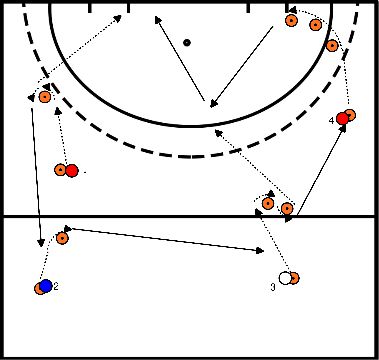
- Depending on the level of the player, put a bit larger or smaller.
- Can also be mirrored with a backhand finish.
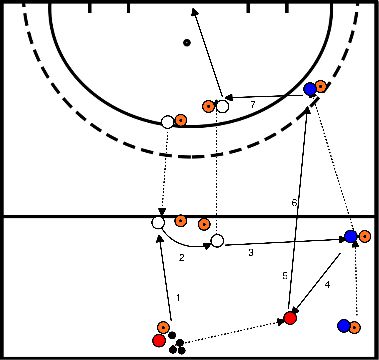
- Ball starts at red.
- White runs back to give support and gets the ball.
- When they take the ball, they accelerate to the side where blue has walked to.
- Red makes the point of the triangle backwards and is played.
- Blue runs deep and white goes to the head of the circle.
- Blue is played and passes the ball to the player on head circle who scores.
Points of attention:
- Acceleration on take-off
- After a pass follows a run
- High ball pace
- Look at what is happening and anticipate
- Searching for eye contact
Possibly expand to
- 3:1
- 2:1
- or 3:2
Improve driving
- Player starts with a ball
- You as trainer call 1 colour
- In this case you call RED
- The player drives through the 2 red gates
- At the end she goes through the white gate and flattens the ball on goal.
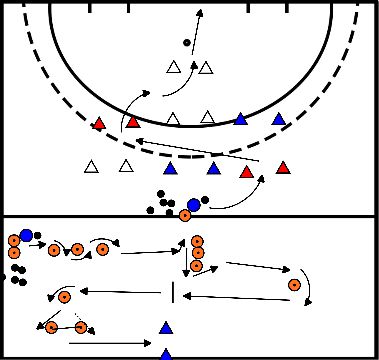
- Technique course
- Player starts with the ball and does a slalom
- Drifts further and puts a dummy near the pawns
- Drifts around the pawn
- Dribbles towards the balk on the ground and lifts the ball over it
- Dribbles on and goes around the pawn
- Does a herring trick near the cones
- Then passes the ball on to the goal
- Exercise B+C
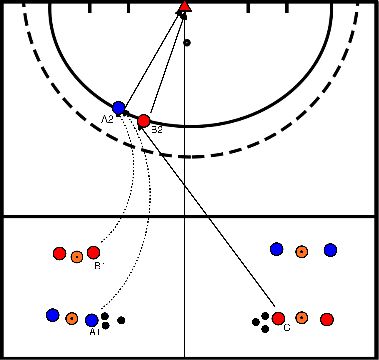
- B is about the left
- C is over the right
- A1 dribbles with ball to A2
- B guides player A, at 1,5 meter, backwards (open position).
- This is about footwork, so when A arrives at A2 he just lets A strike at goal.
- After the hit, A leaves the circle. B turns around and gets a ball from C. B takes a closed approach, turns open and plays the ball.
- B takes a closed approach, turns open and rounds the goal.
- Then the exercise starts on the right.
- The players are divided into teams of 3.
- The game is played 3-3 on different fields.
- Players can score in 2 goals and therefore must also defend 2 goals.
- Variation:
- Take away the goal.
- Each team can only score on 1 goal, so they only have to defend 1 goal.
- This step is performed in different ways.
- The easiest way is to make a kind of sideways jump.
- It is also possible to make a cross pass, which brings you to the same height as the jump.
- indian dribble / slalom
- give the ball small touches from FH to BH
- Drag the ball to the left and to the right to dribble past the cones
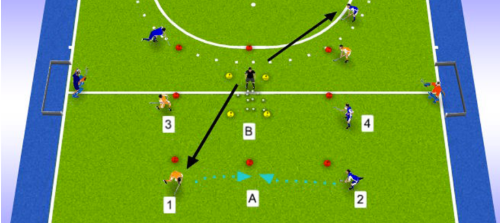
- Player 1 and 2 are defenders
- Player 3 and 4 are attackers
- Player 3 runs with a ball to player 1 and tries to get past player 1.
- The same happens on the other side.
- There are at least 2 teams
- The field is the 23, from marker to other marker
- You may shoot on goal from any position in the field if not dangerous
- After 2 goals by the same team the losing team switches (After 3 wins the winning team switches)
OrganizationField
: half field
Implementation
General
- Play direction of the game
- Goals in the middle of the field to stimulate awareness of the context of the game (from where do I defend, where do I score?).
- 1:1 : the trainer plays a ball to Orange 1 or Blue 2. Defender's goal is to prevent a goal and score himself.
- 2:1 : The trainer plays a ball to Orange 1 or Blue 2. When Orange 1 gets the ball, Orange 3 can join in the playing field of Orange 1
- Orange 1 and 2 play a 2:1 on Blue 4 (same if Orange 3 gets the ball (Section B)).
- 2:2 : Same as 2:1, but if Blue 2 gets the ball, Blue 4 may join the attack in the section of Orange 1 (Section A).
Tips on ball possession - Perform a feint when passing.
- Cut in after the passing action; protect the ball from the defender.
Tips on non-ball possession
- Find your opponent as quickly as possible.
- Keep your stick on the ball.
- Keep the opponent in front of you (on the forehand).
- ps changeover
At loss of ball:
- Put direct pressure on the ball handler, cut the shortest path to the goal.
On winning the ball:
- Perform a quick action/goal attempt towards goals.
- Making it easier
- Change the start location regularly.
Make it more difficult
- Vary the speed of throw.