

Hockeyexercises
Team Composition
- Create 3 equal teams.
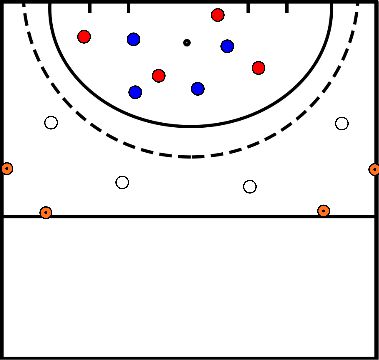
- Team 1: Defenders inside the circle.
- Team 2: Attackers inside the circle.
- Team 3: Players outside the circle as the "bowl".
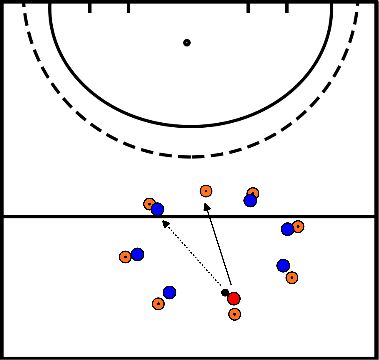
- The "bowl" quickly passes the ball around and looks for an opportunity to pass to the attackers inside the circle.
- To receive the ball, the "bowl" must look ahead and know where the attackers are or will move.
- After an attacker receives the ball, they pass it back to the "bowl" and may enter the circle to score.
- The other players in the "bowl" do not participate in the attack but can regain the ball, after which the play starts over.
- One defender is allowed to leave the circle to put pressure on the "bowl".
- The remaining defenders stay inside the circle.
- The attackers are not allowed to leave the circle.
- If the defenders gain possession of the ball, they may score in one of the two goals on the side.
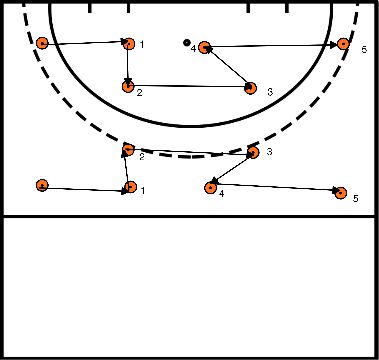
Formation
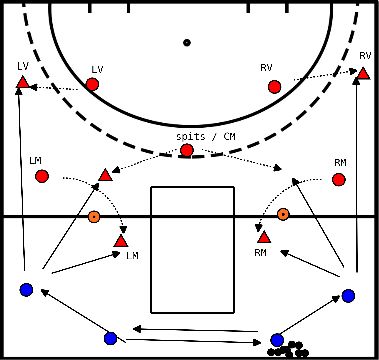
- 4 defenders in the bowl play the ball around without pressure.
- 2 midfielders and 3 forwards are positioned.
- 3 defenders from the opposing team and a goalkeeper are in the circle.
- The 2 midfielders offer themselves from the axis to the back where the ball is going.
- If not played, move to the line and back to the axis.
- Avoid offering on the long pass line.
- Upon a pass, open up and then play to the hanging striker or the wing striker.
- After passing, continue to offer in the guard position.
- The 2 wing strikers offer themselves on the 23-metre line.
- The hanging striker positions at the top of the circle in attack.
- The wing striker on the support side seeks a scoring position at the far post.
Execution
- Start without a ball and perform the exercises to improve speed and agility.
- Repeat the exercises with a ball to test the same skills under pressure.
Instructions
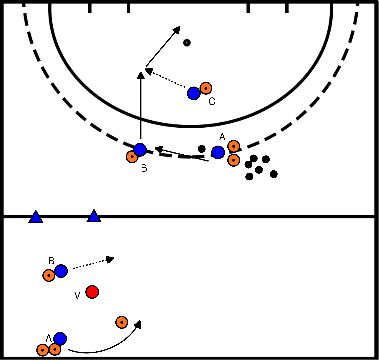
- A starts with the ball and gives a push pass to B.
- B receives the ball and sees that C is running into depth.
- B gives a push pass to C.
- C receives the ball and shoots at goal with a slap shot.
- A starts with the ball and dribbles around the cone.
- From that moment, the defender may try to take the ball away from A.
- A and B want to score together in the goal.
- Try to have them run and give a depth pass.
- Let them try a few times first, then explain what you as a trainer want to see.
Execution
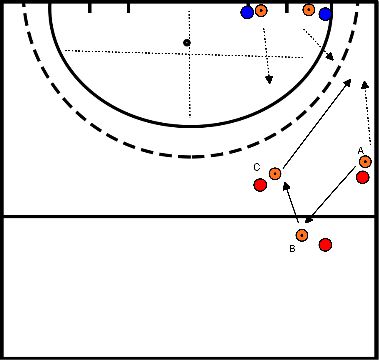
- Player A starts with the ball and passes to Player B.
- Player B receives the ball and passes to Player C.
- Player C receives the ball and plays it into the depth to the advancing Player A.
- Player A receives the ball and from here a 3 versus 2 situation begins.
- Consider the scoring positions in the circle and maintain eye contact with each other.
- For the defenders, communication is crucial; ensure they audibly communicate with each other about their positions.
Execution
- Conclude the training session with a match form on a half field.
- Adjust the width of the field depending on the size of your team during the training session.
Execution
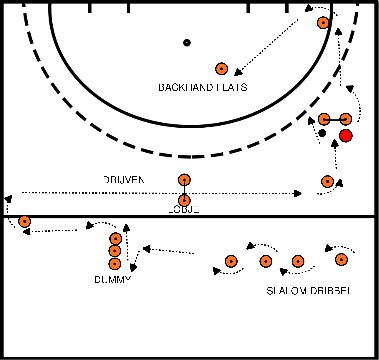
- Several exercises are set up on a quarter field.
- The players can start immediately one after the other.
- Exercises vary from slalom, dummy, herring trick to a lob.
- The goal is to focus on all techniques during the warm-up.
Objective
- To warm up both physically and technically as preparation for the training session.
Setup
- The exercise is performed with a maximum of 4 players.
- You can set up multiple groups so that the exercise continues to function effectively.
- Players 1 start with the ball and pass it to players 2. Then they switch positions.
- Players 2 pass the ball back to players 1 and also switch positions.
Variations
- Vary the method of passing (hitting, pushing, slapping).
- Increase the distance between the cones so that players have to run further.
- Increase the distance between the cones so that players have to hit further.
- Increase both distances.
- Increase the speed.
- Deliver as many successful passes as possible within the time limit.
Key Points
- Stay low for good control.
- Stick should already be on the ground when receiving the ball.
- Pass the ball to the forehand side.
- Stand still when receiving the ball.
Objective
- To seek the flanks instead of hitting the ball through the centre of the field. Teams look for solutions and are inclined to shift the game. This increases the percentage of ball possession.
- Two teams are formed, depending on the number of available players. In the middle of the field, there is a square or rectangle where neither the ball nor the player may pass through.
- Adjust the size of the square or rectangle to change the level of difficulty. The larger this area, the more challenging it becomes.
- You can agree that players may run through the area, but the ball may not pass through it.
- Ensure there are no items in the area and use flat cones to prevent tripping.
- With an odd number of players, you can play with a 'chameleon'. This player always joins the attacking team and thus constantly changes roles.
- Place balls at the side of the field so that when a ball is out, a new ball can be immediately picked up to continue play.
- As a trainer, stand in the middle of the field and coach both teams.
Execution
- Players stand back-to-back.
- At a distance of 10 metres from each player, there is a cone with a ball on it.
- At the whistle or the command "START!", players run to the cone.
- They each pick up the ball, run back to each other, and hand the ball to one another.
- Subsequently, players walk with the new ball to the cone and place the ball on it.
- They both walk back to the centre and finish back-to-back.
- Optionally, this can be done in relay form or multiple times in succession.
Objective
- Make players understand that getting ahead of your opponent and quickly passing the ball is essential in an attack.
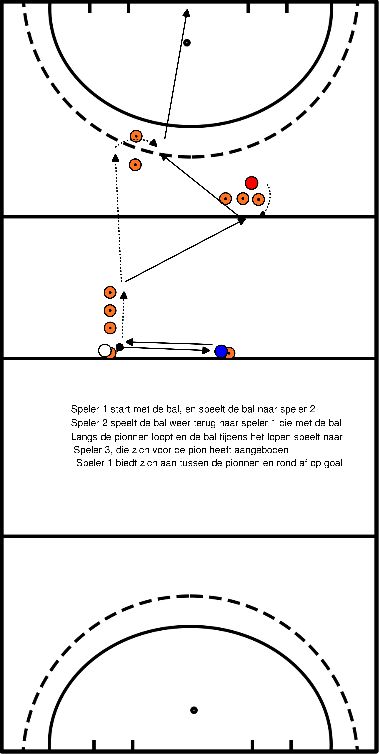
Execution
- There is one more cone than the number of players.
- After passing the ball, run to the empty cone.