

Hockeyexercises
Objective
- Various technical forms to warm up with.
- The setup can be either one-sided or two-sided, depending on the number of players.
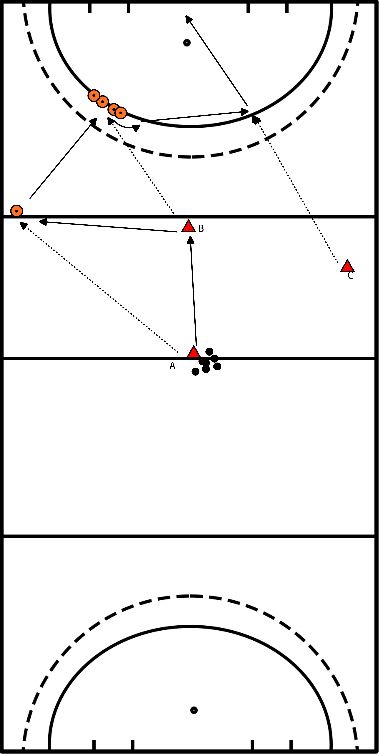
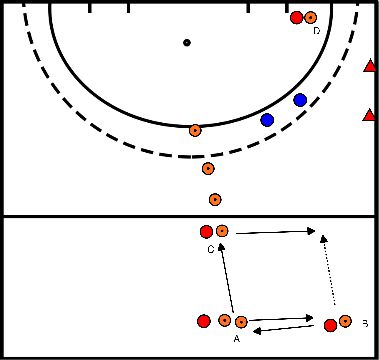
- At point A, the player performs a drag movement and passes the cones.
- The player passes to point B.
- At point B, the player receives the ball and dribbles to point C.
- From there, he plays to the player at point C.
- The player at point C receives the ball, turns towards the goal, and finishes.
- After finishing, the player runs after the ball.
- Point D joins again at point A.
- One-sided or two-sided setup possible.
- Use the exercise to warm up the goalkeeper.
- At point C, sides can be switched.
- Play the exercise from both sides.
- Observe and improve various techniques of the players.
- When turning and dribbling, the ball should stay on the stick.
- Ensure players do not hinder each other at point C.
- All balls are played to the forehand of teammates.
Description
- Player A passes the ball to Player B.
- Player A runs deep to the first cone (running path).
- Player B passes back to Player A and moves quickly towards the circle (short quick action).
- Player A returns the ball to Player B.
- Player B receives the ball on the forehand and turns away over the backhand of the opponent (cones).
- Player C sprints towards the top of the circle (timing).
- Player B passes to Player C, possibly with a backhand sweep pass.
- Player C receives the ball, brings it into the circle, and finishes.
- Perform two actions, keep the ball under control, and finish.
Objective
- As attack: achieve efficiency from your attack.
- As defense: execute clever defensive plays.
- The field is limited to the dotted line.
- The attackers take the ball somewhere on the dotted line and try to score.
- The defenders attempt to clear the ball via the outside.
- The attackers score 3 points for a goal, 2 points for a forced penalty corner, and 1 point for a good scoring opportunity.
- The defenders earn 3 points when they clear the ball by playing between the cones, 2 points for a free hit, and 1 point when the ball goes over the sideline.
- Adjust the size of the teams based on the number of available players.
- Play with one team on the side and switch every 2 to 3 minutes to facilitate rest and discussion.
- Make the cones for the defenders smaller.
- Use a 'chameleon' to give the attackers a numerical advantage if scoring is difficult.
- Ensure clarity on who is marking which opponent.
- Defenders must stay low and avoid fouls.
- Attackers should actively seek a foot.
- As an attacker, target the opponent's backhand; an attack on the right side is often easier.
- Defenders should assist in defending if their direct opponent is not active.
Execution
- Player A maneuvers through the cones.
- Player A delivers a firm and accurate pass to Player B.
- Player A moves away from Player B.
- Player B passes back to Player A, who receives the ball on the move.
- Player A takes the ball into the circle and finishes.
- Ensure quick, firm, and accurate passes.
- Receive the ball while moving.
- Maintain speed throughout the exercise.
- Optional: Add a defender in the circle for additional challenge.
Execution
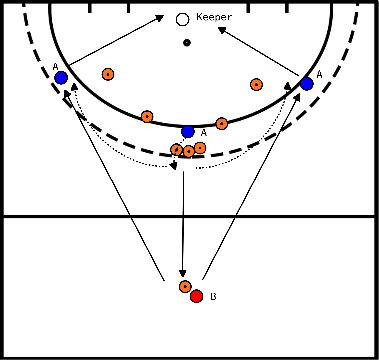
- Player A starts with the ball and passes to player B.
- Player B passes the ball back to player A.
- Player A receives the ball openly and plays to player C.
- Player B continues running and receives the ball wide from player C.
- From this point, it is a 3-on-2 situation: players B, C, and D against the two defenders.
- If the defenders intercept the ball, they score at the small goal on the side.
Objective
- Warm up through a combination of passing, running, and receiving on the move and from a standstill.
- The player at position A passes the ball straight to the player at position B.
- The player at position B passes the ball to the player at position C and runs towards point A.
- The player at position C receives the ball at point D and passes it to point A.
- For rotation, player A moves to B, B goes via D to C, and C moves to A.
- Variations in striking techniques can be applied (hit, push, slap).
- Distances can be adjusted to vary the difficulty level.
- Cones can be placed for passing in between to increase precision.
- Smaller cones increase the difficulty level.
- The ball from C to D can be rebounded.
- The ball from D to A can be rebounded.
- Point C can be placed on the other side for backhand and forehand variation.
- With a 90-degree setup of points B and C, the exercise can be performed from a different angle.
- Different scenarios can be set up to vary the exercise: standard, mirrored, 90-degree setup.
- As a trainer, observe the different techniques of the players.
- Stay low when receiving.
- When passing the ball from C to D, ensure the ball does not overshoot towards A.
- The player from B must receive the ball perpendicularly.
- Pass to the forehand whenever possible.
- Be ready to receive a ball (low to the ground, stick on the ground).
Execution
- Balls start at the first cone. The first player passes the ball on the run to the second cone.
- The second player pushes the ball through the cones to the third player.
- The third player runs onto the ball and continues his path.
- Then he pushes the ball to the fourth player on the run.
- The fourth player runs around the cones and passes the ball to the top of the circle.
- The fifth player has moved to the top of the circle to finish the ball directly into the goal.
Execution
- Depending on the level, the playing field can be set up larger or smaller. It can also be executed in mirror image, possibly with finishing on the backhand.
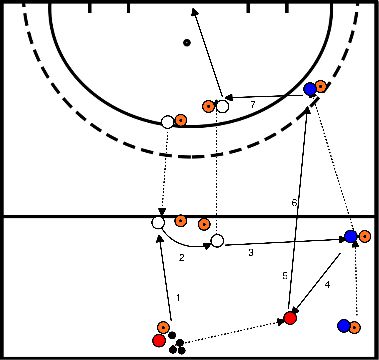
- The ball starts with the red player. The white player runs back to offer themselves and receives the ball.
- Upon receiving, the white player accelerates with the ball to the side where the blue player has positioned themselves.
- The red player forms the tip of the triangle backwards and receives the ball.
- The blue player runs deep away and the white player moves to the top of the circle.
- The blue player receives the ball and passes it to the player at the top of the circle who scores.
- Accelerate upon receiving.
- After a passing action, follow with a running action.
- Maintain a high ball tempo.
- Observe what happens and anticipate.
- Seek eye contact.
- Optionally expand to situations such as 3 versus 1, 2 versus 1, or 3 versus 2.
Execution
- Player 1 starts with the ball and moves towards the backline. There, he turns tightly and passes the ball on the move to player 2.
- Player 2 moves towards the 23-meter line, turns to the right, and pushes the ball to player 3.
- Player 3 attempts to move to the top of the circle, but retrieves the ball at the ion and passes to player 4.
- Player 4 runs towards the backline and passes the ball to the top of the circle.
- Player 3 continues after the pass and positions himself between the top of the circle and the center spot. From here, player 3 chooses between finishing or playing for the deflection.
- Player 1 is ready for the tip-in.
- Turning direction is in chronological order.
Objective
- To be able to combine, run with and without the ball, turn open, pass, and finish on the goal.
- At least 2 participants are active. With a goalkeeper, there is a third person active.
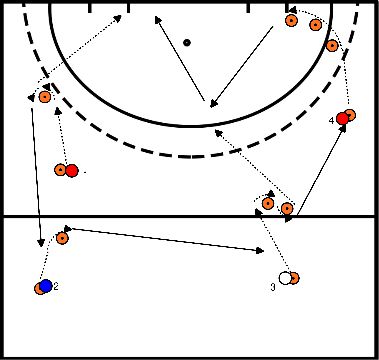
- Player 1 starts without the ball and runs from point A to point B.
- Player 2 stands at point E and plays the ball to player 1 in stride.
- At point B, player 1 plays the ball back to player 2 and continues to point C.
- Player 2 plays the ball to point C so that player 1 can receive it there.
- Player 1 turns inside and runs to the top of the circle.
- At point D, player 1 finishes on the goal and exits the exercise on the right side.
- Player 1 takes over the position of player 2.
- Player 2 runs to point A and joins the back of the line.
- At point B, player 1 can make a turn to position their body between the ball and the opponent.
- Player 2 can give the second pass in stride to player 1 between points B and C.
- The exercise can be mirrored.
- Instead of 1 player at point E, 2 different players can execute the pass.
- Player 2 can deflect the ball from point E to point C to increase the difficulty level.
Objective
- The objective of this training is to actively offer yourself between the ball and the defender, making yourself available for a pass.
- The player at point B starts running and moves in an arc past the orange cones to make themselves available.
- The player at point A passes to the incoming player and runs around the designated cones towards point B.
- The player at point C runs in an arc around the orange cones, paying attention to the position of the player at point B.
- The player at point B passes the ball to the player who started from point C.
- The player from point C receives the ball before the orange cones, dribbles into the circle, and finishes on goal.
- The player who has finished runs around the cones back to point A.
- Reduce the training area by removing one station, requiring fewer players.
- Change the starting position to adjust the direction of availability.
- Add an extra station at the goal for a tip-in, noting that more players will be needed.
- Keep the ball close to the stick while dribbling to prevent losing the ball.
- Make yourself wide when offering to effectively position yourself between the ball and the defender.
- Pay attention to timing when starting to run.
- Make passes before the orange cones to ensure clear running in front of the player.
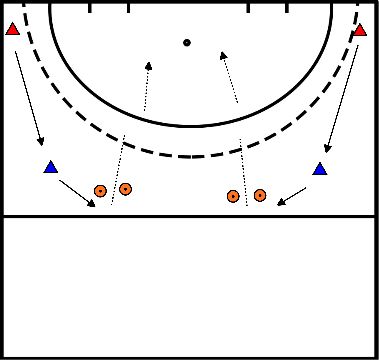
The team is divided into 2 squads:
- 1 team to the right of the circle
- 1 team to the left of the circle
- One player from each team will stand at the blue pot and on the 23 meter line at the orange pots.
- The rest of the teams start at the red pots.
- The ball passes through a push from the red to the blue and from the blue to the orange pots.
- When the player at the orange potty receives the ball, this player dribbles until he is in the circle and then finishes on goal.