

Hockeyexercises for u6
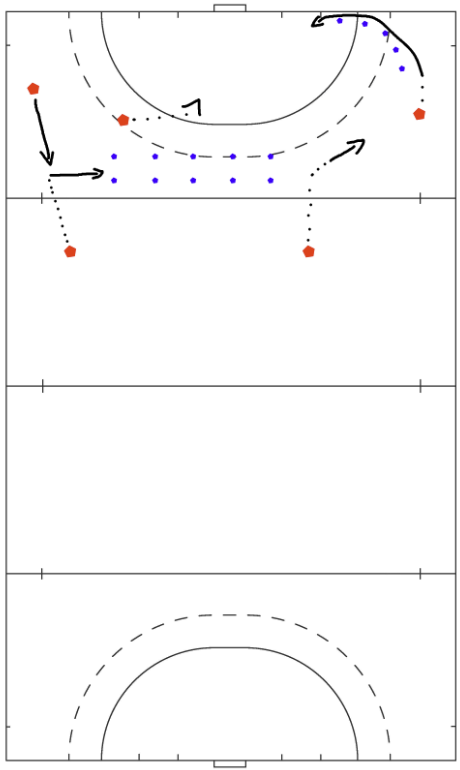
- defense intercepts the ball
- the ball is played to the right back
- the middle right pulls in so that the flank is open
- the back right plays the ball into the depths to the striker
- the striker pulls out to take the ball along the line
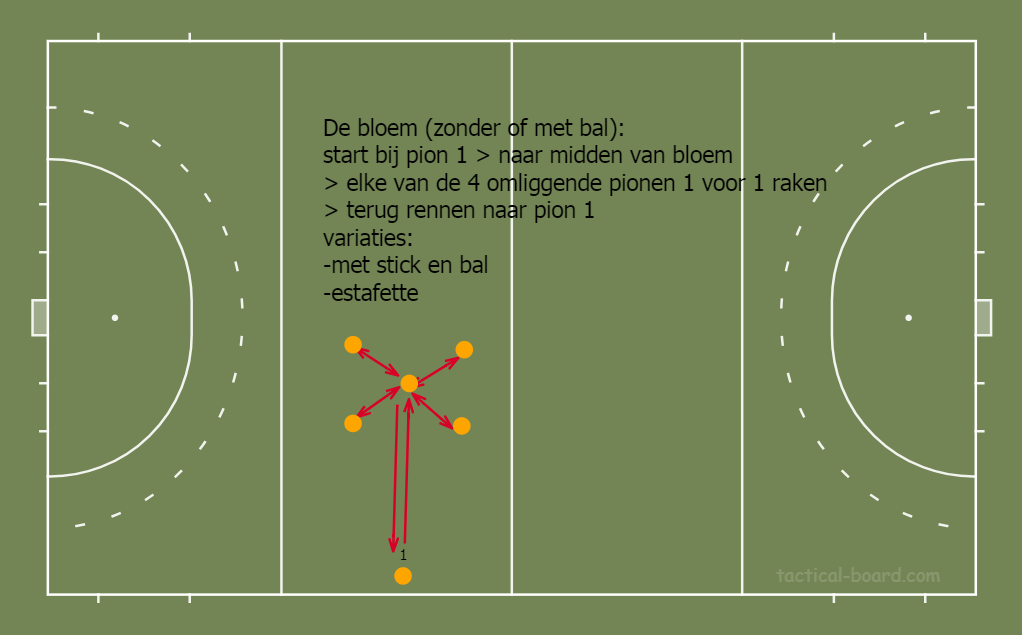
The flower (without or with ball):
- start at pilon 1 > to the center of the flower
- hitting each of the 4 surrounding pilons 1 by 1
- run back to pilon 1
- variations:
- with stick and ball
- relay race
- This is a good exercise for conditioning:
- The group has to stand in a row and you let them start dribbling.
- As soon as the trainer blows his whistle, the last one of the row should run forwards.
- You do this until everyone has been there and then you let them finish running the track.
- Two teams with subs, there's a change if there's a score.
- Each person defends a goal, there are five goals on each field, so there are also five people defending these goals.
- If a goal is scored in your goal, you have to sit on the side and switch.
- A new player (sub) enters the field from the side and defends the goal.
- If there's a goal, it's a point.
- The team with the most points at the end of the match is the winner.
- The exercises can be played in 2 variations: the one for real beginning hockey players (this exercise can be used for a clinic for example) and the one for beginning hockey players who have already been in contact with hockey.
- Variant 1:
- Player 1 plays the ball to player 2, he takes the ball and passes on to player 3.
- Player 3 takes the ball and shoots at goal.
- Player 4 tries to stop the ball with the bottom of the foot or with the stick.
- Player 4 picks up the ball and joins the row at the back of the starting pilon of player 1.
- For safety's sake, don't shoot at goal when player 4 takes the ball.
- The balls can also be taken out of the goal later on or use a break for that.
- This is for safety reasons.
- 3 persons stand at the pilons and try not to let the player in the middle touch the ball.
- It is important that the diagonal pass is not made possible.
- So the players without the ball have to stand in the corners compared to the player with the ball.

Variation:
- Attacker plays to defender, and plays the ball back to the attacker.
- Then the attacker is allowed to attack towards goal.
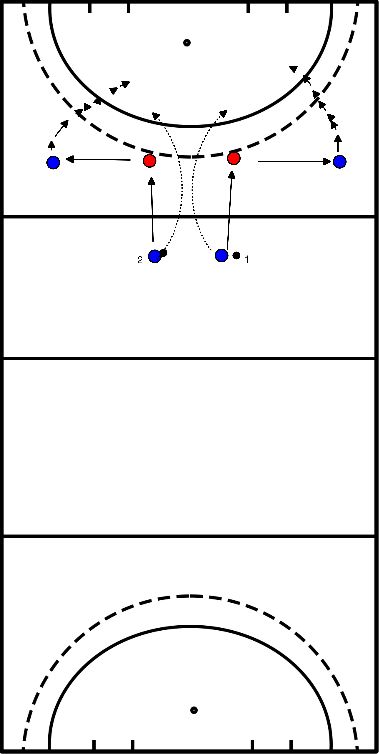
- At 1, the ball begins and passes to the defender who then passes it to the out-going attacker.
- From there it is 2 to 1
- See number 2, only the players remain and it becomes a 4 against 2.
Game with different variations:
- with grip
- with globe
- with stick in weird position
- with other balls
- Player A plays the ball to Player B, who comes running into the ball.
- Player B bounces the ball directly back and runs towards the corner edge circle with a slalom through the gates.
- Player A runs towards the first pole to perform a tip in
Exercise is set up in the middle.Player A becomes player B and vice versa.
- Each player takes a pilon.
- Fields of about 10x5 are made.
- The pilon is placed in the middle of the back lines.
The aim is to play past your opponent and dribble the ball over the pilon. IT IS NOT ALLOWED TO SHOOT FROM 10 METERS!
The winner goes one square to the right and the loser goes one square to the left. Rounds of -/+ 2 minutes
- Balls are at the first pilon.
- The player at the first pilon passes the ball to the second pilon,
- who pushes the ball through the pilons to the third person.
- The third person runs in on the ball and runs even further,
- then he pushes the ball to person 4 while he's running.
- Person 4 runs around the pilons and passes the ball at the top of the circle,
- where person 5 has just run up to finish the ball in the goal.
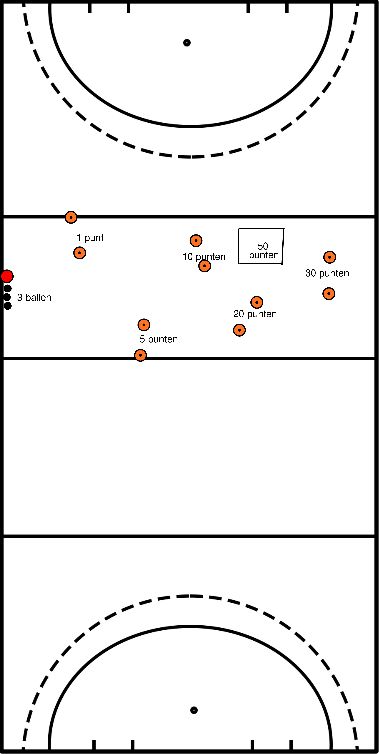
- Put out gates of pilons (2 meters wide). from sideline to sideline.
- Players get 3 balls on the sideline
- any ball they can pass through a gate
- In advance, the player indicates which gate he is going to play through
- Each gate has points, the further the gate the higher the points:
- 10 Meter gate = 1 point
- 15 meter gate =5 points
- 20 meter gate = 10 points
- 30 meter gate is =20 points
- 40 meter gate = 30 points
- See how many points each player scores, this makes it clear to the players that a long-distance pass is often not very accurate.
- In addition, you can show that pushing and flatting can be much more convenient than hitting.
- You can put (depending on the level) a square of 3M x3M on the field and if the players score and the ball lands in the square it is worth 50 points.