

Hockeyexercises for u7
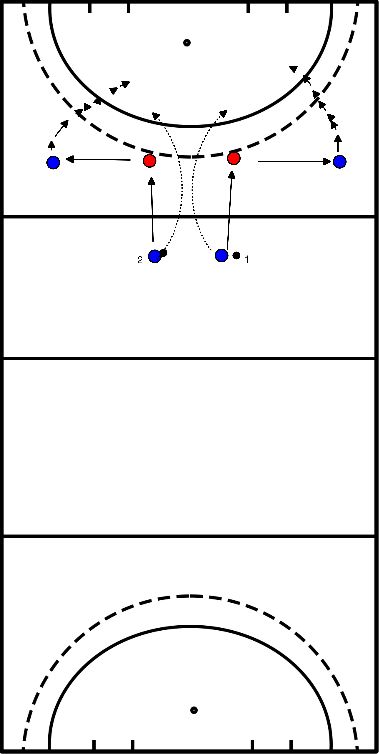
- 3 persons stand at the pilons and try not to let the player in the middle touch the ball.
- It is important that the diagonal pass is not made possible.
- So the players without the ball have to stand in the corners compared to the player with the ball.

Variation:
- Attacker plays to defender, and plays the ball back to the attacker.
- Then the attacker is allowed to attack towards goal.
- At 1, the ball begins and passes to the defender who then passes it to the out-going attacker.
- From there it is 2 to 1
- See number 2, only the players remain and it becomes a 4 against 2.
Aim
- A game is not only fun, you also learn a lot from them.
Set up
- Very simple: 2 goals, some vests and some balls.
- Surely no more explanation is required?
- This kind of game isn't really for training something specific (e.g. playing outside with a box in the middle), but just to have fun.
- If a team goes loses way too easy, you can enter the rule that they have to pass 3 times before they can score.
- Or you can make that team's goal smaller.
Game with different variations:
- with grip
- with globe
- with stick in weird position
- with other balls
- Each player takes a pilon.
- Fields of about 10x5 are made.
- The pilon is placed in the middle of the back lines.
The aim is to play past your opponent and dribble the ball over the pilon. IT IS NOT ALLOWED TO SHOOT FROM 10 METERS!
The winner goes one square to the right and the loser goes one square to the left. Rounds of -/+ 2 minutes
Aim
- Practicing some useful hockey techniques.
Set up
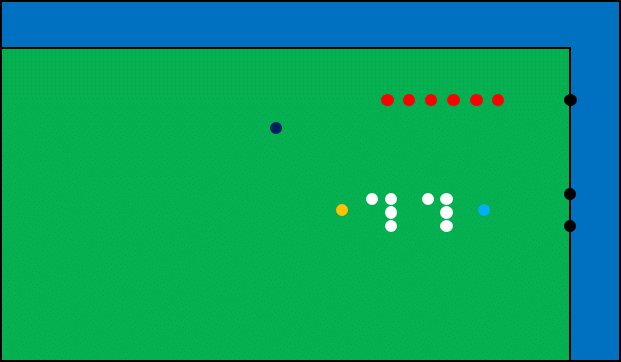
- The player starts at the top black pilon.
- He/she goes through the red slalom and then dribbles towards the (dark) blue pilon.
- From the (dark) blue pilon an Indian will follow
- Dribble to the yellow pilon.
- This is followed by passing moves, in this case a drag has been chosen.
- With other movements, the pilons may have to stand slightly different.
- But here the player runs to the left (end of the L) and drags in front of the 3 pilons the ball forcefully to the right.
- This is repeated again and then the player pushes the ball onto the black goal.
- This exercise can be made easier/complicated. E.g. by changing the passing movements, increasing/reducing the distance of dribbling, making the goal smaller/ larger, adjust the slalom slightly, etc. etc. You can really let your own imagination run wild.
- The trainer (T) rolls the ball (1) to one of the four front players (for example A).
- Player A receiving the ball (2) plays a duel with player V1 opposite him.
- The goal is to score the ball at the opponent's goal.
- If V1 manages to intercept the ball, he plays it to V2.
- Now V2 may try to score with player B.
- After a goal, the form of play starts over again.
Making it easier
- Play a 1-1 duel on the two fields for a few minutes, after a goal, the substitute player comes into play.
Make it more difficult
- After the ball is taken by V1, V1 and V2 may try to score against player A (now it has become a 2-1 game).
- A has to defend.
- If A takes the ball, he plays it to player B.
- Player A and B play a 2-2 duel on players V1 and V2.
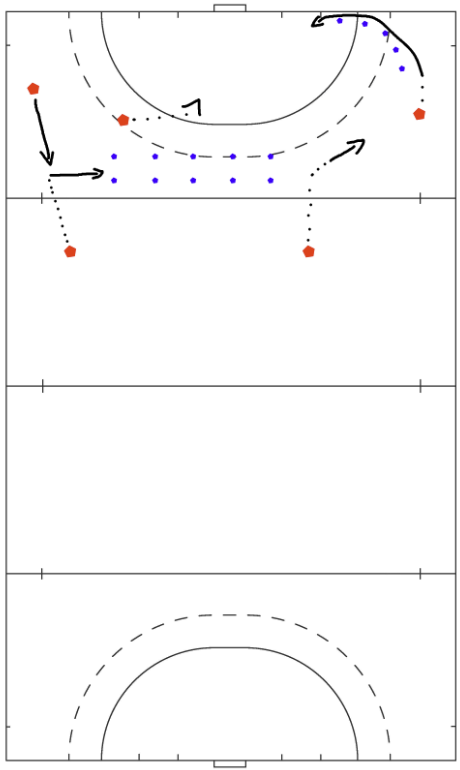
- Balls are at the first pilon.
- The player at the first pilon passes the ball to the second pilon,
- who pushes the ball through the pilons to the third person.
- The third person runs in on the ball and runs even further,
- then he pushes the ball to person 4 while he's running.
- Person 4 runs around the pilons and passes the ball at the top of the circle,
- where person 5 has just run up to finish the ball in the goal.
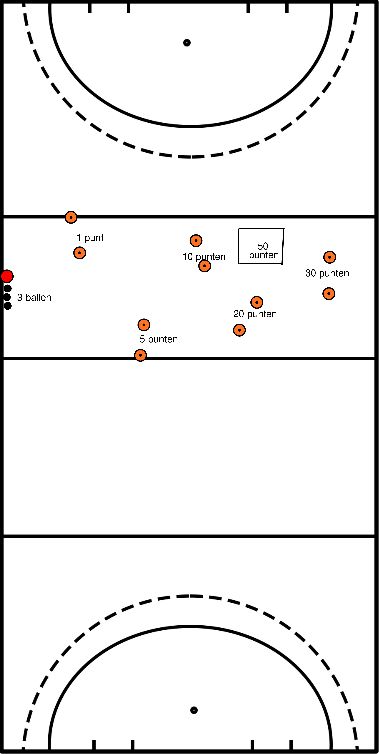
- Put out gates of pilons (2 meters wide). from sideline to sideline.
- Players get 3 balls on the sideline
- any ball they can pass through a gate
- In advance, the player indicates which gate he is going to play through
- Each gate has points, the further the gate the higher the points:
- 10 Meter gate = 1 point
- 15 meter gate =5 points
- 20 meter gate = 10 points
- 30 meter gate is =20 points
- 40 meter gate = 30 points
- See how many points each player scores, this makes it clear to the players that a long-distance pass is often not very accurate.
- In addition, you can show that pushing and flatting can be much more convenient than hitting.
- You can put (depending on the level) a square of 3M x3M on the field and if the players score and the ball lands in the square it is worth 50 points.
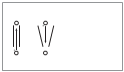
- One street per 2 and passing in this street.
- increase / decrease the distance between each other
- Narrowing the street
- gradually narrow the street like a funnel
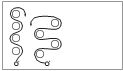
- Place pilon to form a little slalom.
- Increase speed
- customize slalom
- finish at goal at the end of the slalom
- Use in a relay race; dribble around the hoops and dribble back in one go.
- through the hoop
hoop on a pilon and play through it (hold the hoop and play or crawl through it