

Korfballexercises for u19
Setup
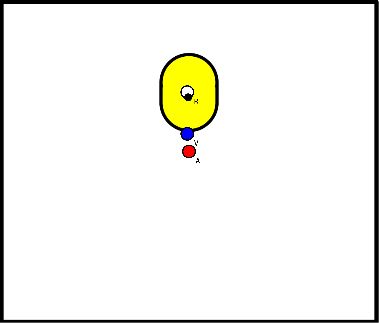
- The attacker and defender are ready in front of the korf.
- The passer is positioned under the korf with the ball.
- The defender shifts towards the korf.
- Play one-on-one until an attacker scores.
- The defender always tries to be near the ball.
- The korf of the defender who concedes a goal receives a penalty point.
- The defender returns to their own korf.
- Move to the next position.
Execution
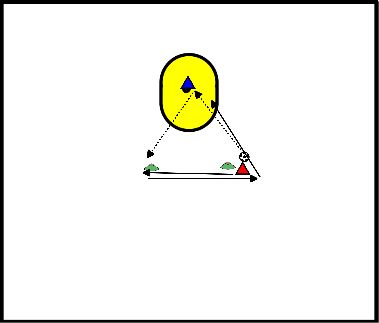
- Form groups of three or four players at a korf.
- Pass the ball towards the korf and move to the left.
- Receive the ball back and shoot.
- Then move to the right and take a running-in ball.
- Score 10 distance shots from the left and 10 from the right.
- Emphasise the running-in ball by scoring 20 running-in balls on the right and 20 on the left.
- Vary with a shot at one cone and a running-in ball at the other cone.
Execution
- Children stand in a line and run in a circle.
- When the coach calls the name of the player at the back, this player sprints to the front.
- Example: Player Red goes to the front.
- Jump: All children jump in place.
- Ground: All children touch the ground.
Execution
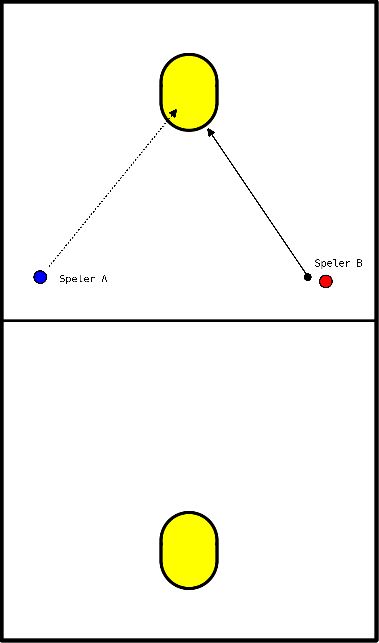
- Player A cuts inside to take a running-in ball.
- Player B passes the ball to player A.
- Player A catches their own ball and takes over player B's position.
- Repeat the process.
- Make the exercise more challenging by having the player who passes the ball also catch the ball themselves.
Formation
- 4 or 5 players per korf
- 1 feeder
- 1 defender on the feeder
- 2 attackers
- The feeder attempts to get into position while the defender applies front defence.
- Attackers must play in such a way that they can pass to the feeder and put the defender out of play.
- Continuously shift the play.
- If the feeder can be passed to, make a move and switch roles.
- Play the feeder out by passing the ball over them.
- Or move away to behind the korf.
Formation
- Three players per korf: one shooter and two rebounders.
- Rebounders stand behind the korf at a distance of 3 or 4 meters, depending on their level.
- Of the two rebounders, one is an attacker and one is a defender. Agree in advance who has which role.
- The shooter stands in front of the korf and calls "yes".
- At that moment, both rebounders may move towards the korf to take the correct position.
- When the attacker indicates that he/she is in a good position, the shooter may shoot.
- After three rounds, switch positions.
- Pay attention to the positioning of the attacker and defender in the rebound.
- Ensure proper blocking out of the opponent.
- Do not agree in advance who has which role and let players count points separately for a certain number of rebounds.
- The shooter shoots at a random moment, after which the rebounders may react to catch the ball.
- The shooter also participates in catching and may pass to the attacking rebounder for a short chance if the shot fails.
Setup
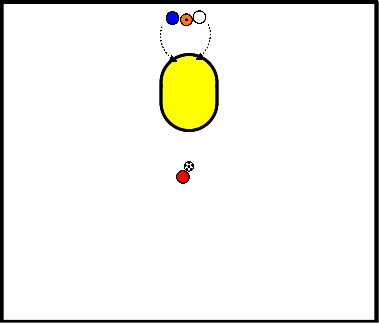
- Divide the entire group into equal teams of 2, 3, or 4 players.
- Each team has one post as their "Home Base".
- Start with one ball in play.
- Teams attempt to score on each other's baskets.
- If a basket is scored upon, that team is eliminated.
- The game continues until only one basket remains.
- The team with the last remaining basket wins the game.
- Introduce additional balls into play to increase the pace as needed.
Setup
- Player 1 starts 6 metres from the post.
- Player 2 stands between Player 1 and the post, 2 metres from Player 1.
- Player 1 runs for a running-in shot.
- Player 2 must prevent the running-in shot by bending their knees well and moving immediately when Player 1 starts running.
- If Player 2 does not react immediately, Player 1 will no longer be able to be caught up.
- The objective is to prevent the running-in shot.
Organisation
- Pairs per korf. One fixed feeder and one fixed shooter, for example, four metres in front of the korf.
- The shooters are tasked with scoring 10 points as quickly as possible.
- A goal counts for two points.
- If a shot is missed, one point is deducted from the total (the total remains at 0 points if you are at 0 and miss).
- As soon as someone reaches 10 points, the players switch roles.
- For less advanced players, you can reward a goal with, for example, 3 points.
- For advanced players, you can make it more challenging by awarding only 1 point per goal.
- The distances can be increased or decreased as needed.
Preparation
- Set up a 3x3 grid with cones, leaving some space between them.
- Give each team 4 cones.
- Create two evenly matched teams and place them at a korfball post with a ball.
- Come up with a task they must perform at the post, such as shooting from a distance of 5 meters.
- For each successful shot, a team may place a cone.
- The team that first gets three in a row wins the game.
Execution
- All four corners are occupied, the ball starts at the left front.
- The ball is passed around once.
- When the ball is back with the first player, player three moves to the support position.
- The ball goes inside, player four moves into position for the rebound.
- Player one crosses with player two and takes a shot.
- Player two remains in motion and takes a short-range shot.
- Player one finishes with a running-in ball.
- The movement into position should not take too long.
- The crossing must be executed precisely.
- The passing must be accurate.
Setup
- Work in pairs or groups of three. In pairs, alternate turns; in groups of three, rotate positions.
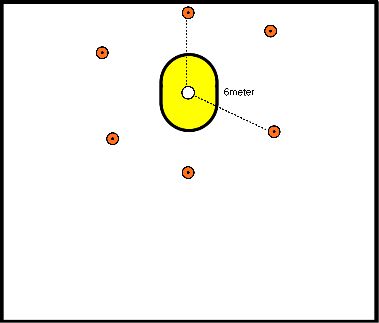
- Place 6 cones around the korf, all at a distance of 6 meters.
- Which pair or group of three scores first 5 times with a running-in shot from each cone?
- Next, which pair or group of three scores first 2 or 3 times from each distance?
- Then, move the cones to a distance of 2 meters and let each player score 2 goals from each side.