

Korfballexercises for u22
Organisation
- Pairs stand on either side of a line in the middle of the hall.
- The number 1s, slightly to the left of the line, are the rats.
- The number 2s, half a metre to the right of the line, are the ravens.
- There is a metre of space between the rats and the ravens.
- The trainer calls out 'rats' or 'ravens' in random order.
- When 'rats' is called, the rats run as fast as possible to their side of the hall.
- The ravens try to tag the rats.
- Who tags their personal opponent the most?
- To keep it exciting, let the 'r' roll for a long time or make a short story out of it.
Moving Freely and Maintaining Ball Possession
- Set up four cones in a square of 7x7 meters. Have three players work together within this square. One player is the interceptor who tries to intercept the ball. Play a game lasting 30 seconds; intercepting earns a point.
- Players must move freely by moving towards the ball or away from it, depending on their position relative to the interceptor, the distance to the ball, and the available space. Pause the game to demonstrate where they should move.
- The ball holder must learn not to make risky passes; it is better to make no pass than a wrong pass.
- Sometimes use a lob pass or a direct pass; a feint pass can also be useful.
- Slowing down, speeding up, and changing directions are important to move freely.
Objective
- Practicing the running-in shot from challenging situations.
Organisation
- Groups of three or four per korf.
- One or two players under the korf, two in front.
Execution
- After passing, run forward and take a running-in shot, then rotate positions.
Variants
- Bounce running-in shot: Running-in shots are passed with a bounce.
- Delayed overhand running-in shot: The pass is delayed, take overhand running-in shots.
- Delayed sideways running-in shot: The pass is delayed, run left or right past the korf and bring the ball sideways or diagonally backwards upwards. When pushing off with the right leg, the movement is smoother and the shot more accurate if you run past the post on the left.
- Durk Bergsma shot: The pass is delayed, run past the post and sling the ball with one hand over the head into the korf.
- Delayed jump running-in shot: The pass is delayed, take the running-in shot in a jump.
- Early long pull shot: The ball is passed too early, take a 'long pull shot' with a long floating moment.
- Rolled ball: The ball is not thrown but rolled.
- Show movement: The ball is passed slightly too early, bring the ball once around the body before shooting.
Variations
- Space passing: The pass is no longer made from under the korf, but from the space approximately 5 meters diagonally in front of the korf.
- Long distance: The passer stands more than 20 meters from the korf.
- With defender: All exercises with a defender at the taker of the running-in shot.
Execution
- 10 shots from the width line
- 15 running-in balls
- 15 away-withdrawal balls
Objective
- Accurate shooting and building stamina.
- Start by sprinting up and down the width of the hall 5 times as quickly as possible.
- Then shoot 10 times from within 2 meters and count how many times you score.
- Alternate shots, so each person shoots 5 times.
- If you score 5 or more times (half of your number of single sprints), you may sprint up and down one less time, thus 4 times.
- Then shoot again and count how many times you score.
- If this is half or more of the number of times you have sprinted, you may reduce the sprints by one again.
Execution
- There are three players per korf with one ball.
- One player shoots the ball.
- The other two players stand under the korf and both try to catch the ball.
- The player who first reaches a certain number of points swaps with the shooter.
Setup
- There is a pair at each korfball post. The number of posts depends on the size of the group.
- Everyone starts by scoring twice on the korfball post.
- After scoring twice, they move to the next post.
- It may happen that there are two pairs at one post, as not everyone needs to rotate.
- The pairs only rotate when they have scored twice themselves.
- Place a marker in front of the post at a suitable distance for your team.
Objective
- Shooting exercise where shots are taken from different sides of the korf.
Organisation
- Per korf, one pair with a ball, or if there are not enough korfs, two pairs each with a ball.
- At each korf, place four cones or other markers: one in front, one behind, one to the left, and one to the right of the korf, each approximately 6 meters away.
- From each pair, one player starts under the korf. The other player scores a goal from each marker. Then they switch roles.
- Which pair completes the 'journey around the world' the fastest?
Variations
- The distances can be adjusted as desired, or two goals can be made from each marker.
- Instead of shooting from a standstill, shots can be taken on the move, or dodge shots can be used.
- Two pairs work per korf. The two shooters must score twice together at each marker, regardless of who scores the goals.
- Roles are switched after four times two goals.
Execution
- The exercise encourages shooting from different positions around the korf.
- It is important to shoot accurately, especially since shooting from the side or back is different due to the angle of the korf.
- Players may be noisy at first but quickly become focused and significantly improve their shooting skills.
Execution
- One player is active and stands approximately 3-4 metres in front of the post.
- The rebound player stands with the ball under the post.
- The active player receives the ball, shoots, and immediately runs to the back of the post.
- There, the player shoots again from a distance of 3-4 metres.
- Repeat the process by continuously moving from the front to the back of the post.
- After one minute, switch roles between the rebound and active player.
Objective
- Score 5 goals.
- The rebounder under the post competes against the shooter in front of the post.
- Which of the two players scores 5 goals first?
- The rebounder starts as the passer so that the shooter must shoot while moving outside the 6-meter area.
- The rebounder may only shoot if he or she catches the ball in one motion without a goal being scored.
- If someone scores 5 goals, switch roles.
- We play the best of 3 matches. At 2-0, it is finished.
- Increase or decrease the shooting distance to adjust the difficulty.
- Play with the number of goals they must achieve.
- To challenge the rebounder, they can start a few meters from the post.
- Score goals quickly enough, or you will lose the match.
- The rebounder must try to catch the ball in one motion.
In Brief: Practicing various shooting techniques from a supporting position.
- Organisation: Two players per korf: one fixed person under the korf and one in front. Switch after approximately 1 minute.
- Execution:
- a) The passer stands about 6 meters in front of the korf, the shooter begins under the korf. The shooter starts diagonally backwards, receives the ball and shoots immediately. The passer catches the ball.
- b) As in a, but the shooter feints a shot, causing the defender to jump in, and follows with an 'underhand pull shot' from about 5 meters diagonally behind the korf. The passer catches the ball.
- c) The shooter has a defender. The defender determines the opportunity: reacts too late (shot follows) or follows aggressively (opportunity for the pull shot).
- d) As in b, but the shooter moves sideways and makes a turn of almost 180 degrees towards the korf to take the pull shot. Can also start from a standstill.
- e) As in d, with a defender on the shooter. The defender rushes in aggressively.
- f) The shooter stands half a meter in front of the korf, defender between shooter and post. The shooter throws the ball with two hands backwards into the korf.
- g) The shooter stands half a meter behind the korf, with the defender in front. The shooter makes a feint throw, then shoots as soon as the defender turns around.
- h) The passer deliberately shoots over the korf. The shooter under the korf catches the ball and shoots immediately in one smooth motion.
- i) As in h, but now the person under the korf shoots directly from a jump.
- j) The passer shoots over the korf. The catcher lets the ball go over them, runs after it, and shoots with a half turn.
Execution
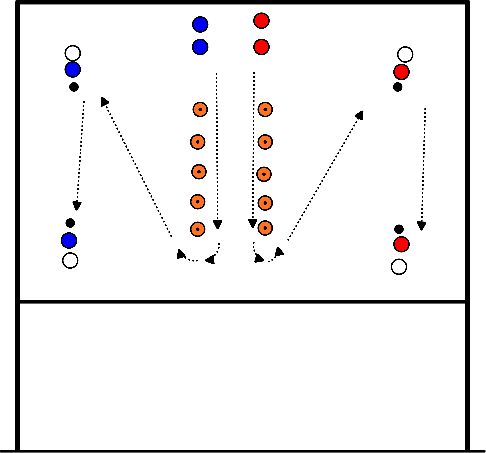
- Stay with your team on your own side of the field.
- Feeders rotate so that everyone keeps moving.
- The exercise should be performed with high intensity.
- Start at the cones. After cone 5, sprint to the first korf.
- The rebounder then sprints to the second korf and rejoins at the cones.
- Count the scores per team out loud to maintain the competitive element.
- Score 20 running-in shots.
- Cone exercises: slalom.
- Score 10 shots from 3-4 metres.
- Cone exercises: 2 cones forward, 1 cone backward.
- Score 20 short chances behind the post.
- The sprinter is indicated and passes back to the stepping-out rebounder under the post.
- Cone exercises: hopping over the cones.
- Score 10 shots from 4-5 metres.
- Cone exercises: jump skating over the cones, hold the landing briefly.
- Score 10 evasive shots.
- Cone exercises: jump at cones 1, 3, and 5 and squat at 2 and 4.