

Korfballexercises for u6
Exercise:
When the cubs can shoot, throw and catch, they can play a korfball game.
Join in with the ball-carrying side yourself to keep things going a bit and in the meantime, give instructions and encourage them.
Exercise:
Each cub 1 ball, 1 adjustable basket. Set the basket so low that the basket is within reach of the shooter, however low that may be. Have the cubs shoot from close to the basket, grab the ball themselves, etc. Teach the technique correctly. Pay attention to:
- Stand in a small staggered position
- Hold the ball well on the side/bottom, hands symmetrical left/right on the ball, fingers spread
- Elbows not outwards
- Hold the ball high: in front of the nose
- Look over the ball to the basket (use the ball as a crosshair)
- Incline: sink a bit through your legs (the ball must remain in front of your nose)
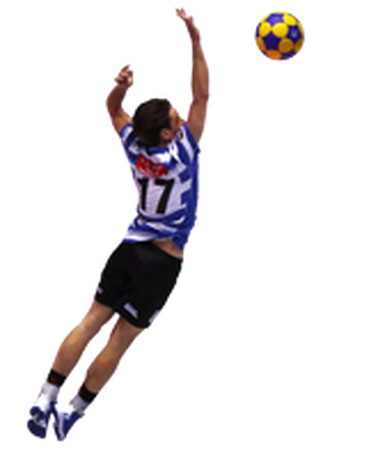
- push out, i.e. make a long jump towards the basket, point at the ball with 2 index fingers and get slightly off the ground.
N.B.: Keep the basket low in the beginning, if it goes well it can be put higher and further.
- There's a support and an attacker.
- The support throws the ball to the attacker
- As soon as the ball is thrown, the support must immediately go after it to defend it.
- So the intention is that they shoot as fast as possible.

The chaos game is fun for younger children, but can also be played with older children.
- In the chaos game the intention is that every child has a ball, and that there are 3 or 4 poles (also depending on the number of players).
- lined up.
- Each player starts at the same pole,
- there's a countdown and then they all start shooting,
- if they can score, they proceed one pole
- if they don't score, they stay at the pole until they do.
- You can agree in advance whether they should have been past each pole 1, 2 or 3 times depending on the level.
- Variation: you can use pilons to mark a circle outside which players have to shoot,
- they're only allowed in to catch the ball.
- The materials below are for 4 persons (hat = pilon)
- You put pilons in a square.
- In the square you put a number of balls (one less than the number of players).
- The players run around the square and then the trainer yells YES.
- If the trainer says YES, the player takes a ball as quickly as possible.
- If you have a ball, you score 3 goals.
- The remaining player continues to run around the square until someone finishes shooting.
- 2 groups at pilons,
- Run to the hoop.
- Through the hoops and run to the pilons.
- Zigzag through the pilons.
- Finally shoot ( 2 attempts).
- Whoever scores 5 times first, wins
PURPOSE: Warm-up (concentration and reaction)
ORGANISATION: groups of two, three or four in a defined space.
RUNNING THE GAME: slowly run behind each other, crisscrossing through the entire space. Number 2 always follows every movement of number 1 as quickly as possible and keeps a distance of about 1 meter. Switch positions after a while.
VARIATIONS:
- now the front runner tries to get rid of the back runner by sudden feints and/or tempo changes.
- But now other movements are allowed as well: cross steps, jumping, lying down and getting up again etc.
- No more groups: everyone runs freely. The players run towards each other, make a feint and:
- then pass each other on the left.
- pass each other on the right
- turn around each other and run back
- make 2 groups
- the attack takes the ball from the trainers.
- When the defence has intercepted the ball, they return it to the trainers.
- When they have scored, the team gets a bonus and is allowed to take the ball back.
- 1 of the young trainers can act as referee to gain experience
In short: practicing various shooting variations in a fun competition form.
Organization: per group a post and a ball, the posts are preferably (but not necessary) arranged in a circle or rectangle. The number of people per group is less important (but all groups are about the same size).
- The first task for the groups is to score 10 goals.
- When you have completed this assignment, the person who scored the last goal runs to the trainer to pick up the next assignment.
- Which group completed all the assignments first?
- In the meantime, the trainer walks around encouraging or correcting where necessary.
- He has a piece of paper with him with a row of assignments on it. When someone gets to get the next assignment, first ask which one has just been completed (this can vary quite a bit over time) and then give the next assignment.
- An example list: 5 walk-through balls, 5 penalty throws, 5 4-meter shots, 5 walk-through balls from behind the post, 5 shots behind the post.
- Two players stand 7 meters in front of the post and eight meters apart.
- A player with the ball under the post and a receiver slightly behind the post.
- One player in front of the post takes the through-ball that is passed, after the other player in front of the post has received the ball.
- The ball is caught by the receiver.
- A1 becomes A2,
- A2 becomes A3,
- A3 becomes A4 and
- A4 becomes A1.
What can you see?
- The passer learns that the shooter can only take a through-ball if the throwing is calmly prepared, is thrown in front of the shooter and the ball is passed at the right height.
- The speed and trajectory of the shooter can be regulated by the speed of throwing, ball trajectory and ball speed.
- Learning to control problems such as timing requires a lot of repetition and sometimes adjustment of the distances used.
- The problems for the shooter, the starting position of the ball is different because the body is twisted for ball reception, lead to impure actions. Stay attentive to this.
- The action speed must be increased.
Variant: - Just like exercise 12, but the passer throws the ball to a shooter who dodges to a position diagonally behind the post.
- There is a ball through the centre where the passer must consider two opponents, his direct opponent and the shooter's opponent, as they are not far from the ball line.
Variant: - The marksman makes a feint shot and passes the ball to the player below the post indicating a through-ball.
- One ball per groups of two/three.
- The players pass until they reach a post.
- At the post both players may shoot once.
- Then they have to pass again to another post.
- All groups just cross each other.
- Whichever team to achieve 15 goals first wins(optional).
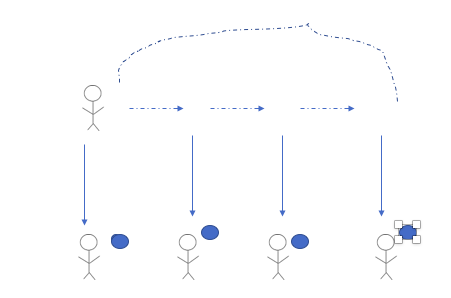
- 4 children are standing next to each other, about 5 meters apart.
- 1 child is going to do the exercise:
- Receives the ball at the first pilon, returns it to the player on the other side, and moves on to the second pilon and so on.
- At the back pilon he returns with a full sprint.
- Then switch, everyone moves a place, number 5 does the exercise now.
- Everybody has their turn. Possibly everyone could go 2-3x.