



Korfballexercises for u7
Execution
- The players run around the circle.
- Inside the circle, there are several balls, one fewer than the number of players.
- When the trainer shouts "YES", the players grab a ball as quickly as possible.
- The player who scores two goals first wins.
- The player without a ball continues running until someone finishes shooting.
Setup
- X number of korfs.
- Let the players use a die to determine how many shots or opportunities they must score at each korf.
- They may dribble with the ball to the other korf.
- Different types of opportunities: with one hand, penalty shot, running-in shot while they are moving with the ball.
Setup
- The attacker and defender are ready in front of the korf.
- The passer is positioned under the korf with the ball.
- The defender shifts towards the korf.
- Play one-on-one until an attacker scores.
- The defender always tries to be near the ball.
- The korf of the defender who concedes a goal receives a penalty point.
- The defender returns to their own korf.
- Move to the next position.
Execution
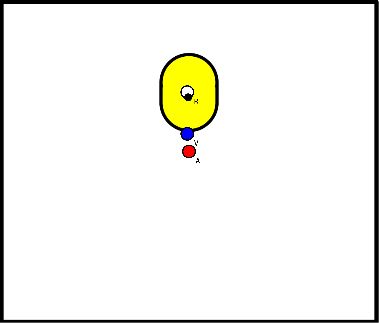
- Children stand in a line and run in a circle.
- When the coach calls the name of the player at the back, this player sprints to the front.
- Example: Player Red goes to the front.
- Jump: All children jump in place.
- Ground: All children touch the ground.
Task
- Who is the first to complete a circle around the ball or the player?
- Everyone stands in a circle with enough space to quickly throw a ball.
- The ball starts to the right of the child who is going to run.
- The child who is going to run starts running simultaneously with the first throw of the ball on the outside of the circle.
Setup
- Player 1 starts 6 metres from the post.
- Player 2 stands between Player 1 and the post, 2 metres from Player 1.
- Player 1 runs for a running-in shot.
- Player 2 must prevent the running-in shot by bending their knees well and moving immediately when Player 1 starts running.
- If Player 2 does not react immediately, Player 1 will no longer be able to be caught up.
- The objective is to prevent the running-in shot.
Organisation
- Pairs per korf. One fixed feeder and one fixed shooter, for example, four metres in front of the korf.
- The shooters are tasked with scoring 10 points as quickly as possible.
- A goal counts for two points.
- If a shot is missed, one point is deducted from the total (the total remains at 0 points if you are at 0 and miss).
- As soon as someone reaches 10 points, the players switch roles.
- For less advanced players, you can reward a goal with, for example, 3 points.
- For advanced players, you can make it more challenging by awarding only 1 point per goal.
- The distances can be increased or decreased as needed.
Preparation
- Set up a 3x3 grid with cones, leaving some space between them.
- Give each team 4 cones.
- Create two evenly matched teams and place them at a korfball post with a ball.
- Come up with a task they must perform at the post, such as shooting from a distance of 5 meters.
- For each successful shot, a team may place a cone.
- The team that first gets three in a row wins the game.
Game Progression
- Divide the players into two teams.
- Silently assign each child a number within their team.
- Once everyone has a number, place the ball in the middle between the teams.
- Call out a number (or multiple numbers), and the children with that number try to be the first to bring the ball to their "camp".
- Once a child has picked up the ball in the middle, the other child may attempt to tag them.
Organisation
- 3-5 players per korf with two balls.
- Marker cone approximately 6 metres in front of the korf.
- Players are numbered and stand in order behind each other at the marker cone.
- Numbers 1 and 2 have a ball.
- Number 1 starts shooting and retrieves their own ball.
- If they score, they pass the ball to the next player.
- If they miss, they shoot again from the spot where they retrieved the ball until they score.
- The shooter joins the back of the line and waits for their next turn.
- Number 2 starts shooting as soon as number 1 has taken a shot.
- Number 2 continues shooting until they score, then passes the ball to the next player and joins the back of the line.
- If someone scores before the person who started before them, that person is out.
- Who remains the longest?
- There are 4 participants.
- Number 1 scores immediately, passes the ball to number 3, and joins behind number 4.
- Number 2 misses, and the ball rolls away.
- Number 3 scores, number 2 is out and no longer participates.
- Numbers 2 and 3 pass the ball to numbers 4 and 1.
- Number 1 waits to shoot until number 4 has taken their shot.
Objective
- Improve shooting accuracy and build fitness.
- Which pair will be the first to complete 5 runs back and forth?
Rules
- Start with 10 sprints back and forth.
- Then shoot 10 times and count how many goals you score.
- If you score 5 or more times (half of your number of sprints back and forth), you may sprint one less time, so 9 times.
- Then shoot again and count how many goals you score.
- If this is half or more than the number of times you have run back and forth, you may reduce the sprints by one more.
Organisation
- Pairs stand on either side of a line in the middle of the hall.
- The number 1s, slightly to the left of the line, are the rats.
- The number 2s, half a metre to the right of the line, are the ravens.
- There is a metre of space between the rats and the ravens.
- The trainer calls out 'rats' or 'ravens' in random order.
- When 'rats' is called, the rats run as fast as possible to their side of the hall.
- The ravens try to tag the rats.
- Who tags their personal opponent the most?
- To keep it exciting, let the 'r' roll for a long time or make a short story out of it.