

Soccerexercises for technique attack / offense
Explanation:
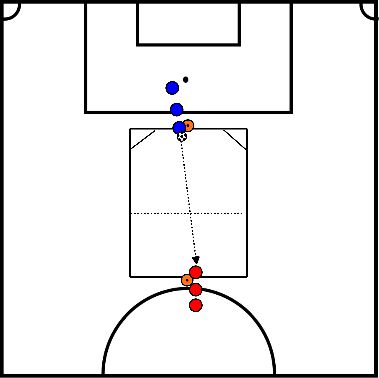
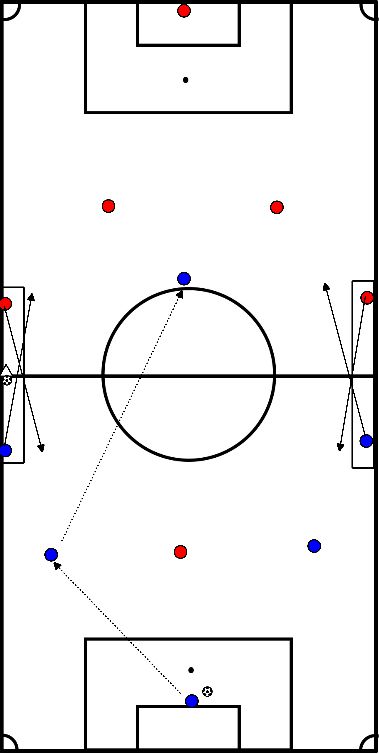
- The 2 slanting continuous lines are 2 mini goals
- The dotted line is the 'middle line' to get the right of attack.
- 4 to 8 players, in 2 teams or each player for himself
- Team/player with most points after a certain time/ number of points wins
Aim of the game:
- Blue plays the ball in to red
- Red has to dribble over the centre line to score in 1 of the 2 goals
- If he scores, he gets a point
- If blue takes the ball away, he can also score and thus gets a point
- When a point is scored or the ball is out both players join the other row and the next 1v1 starts.
Important:
- This exercise is about making an action.
- Therefore choose a certain move that the attackers can use to get past the defender
- If the attacker does this and scores from it: 2 points.
- The defender can never get more than 1 point when he scores.
- The attacker only gets 2 points if he passes the defender with this move
- if he already passed and then makes the move, he gets only 1 point
Variations:
Movements which can be trained are:
- Single scissors
- Double scissors
- Step over
- Zidane-turn
- Elastico/akka
- Reverse elastico/akka
- Iniesta/La croqueta
- Ball roll + Ronaldo chop
- Drag 'n roll
Focus points:
- Attacker's take: at least forward for speed in the attack
- Preferably sideways so that he is already running towards one goal and also creates space near the other goal
- Make sure that the defender applies pressure immediately after passing, so that the attacker has to react quickly
Explanation:
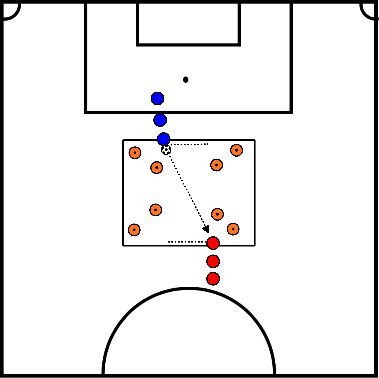
- Square is the playing field, marked out with pawns
- Horizontal dotted lines represent mini-gallies
- 2 teams of 3 to 4 players: set out several squares next to each other (also possible with 2 per team, but it is more fun with 2 or 4)
- Set out 4 gates of pawns
- Keep the playing field small so that you can act quickly.
Aim of the game:
- Blue plays a tight ball to red
- Red has to dribble through at least 2 gates and can score in 1 of the 2 goals.
- The ball can be taken away so that blue can also score
- When the ball is out both players join the back of the other row and the next 1v1 starts
Variations:
- When blue takes the ball he must dribble through at least 1 gate to be allowed to score
- same if ball is taken away again
- Red must dribble through 3 or even all 4 gates
- In 2 teams, the team that scores the most, wins.
- Make sure teammates do not bump into each other
- Everyone for himself
- The one with the most points after a certain time or with a certain number of points wins
Focus points:
- Good and tight 1st pass
- Good take off from red:
- forwards or sideways
- But do not deadlock it because you need to act quickly
- The man who passes the ball must apply pressure immediately so that this happens
- The ball must always be in motion and may not lie still
Ball movement:
- Player 1 plays the ball into player 2
- Player 2 turns with his furthest foot and passes to player 3
- Player 3 turns and makes action along the line, passes the ball
Running movement:
- Player 1 runs outside to the 2nd pole
- Player 2 slides in to support 1 and 4
- Player 3 makes action along the flank and crosses the ball
- Player 1 or 4 finish
Shifting: 1 - 4 - 3 -2 - 1
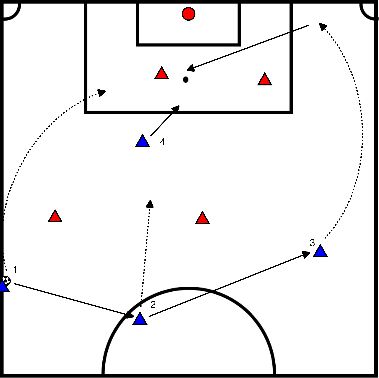
In this training form there are two variants
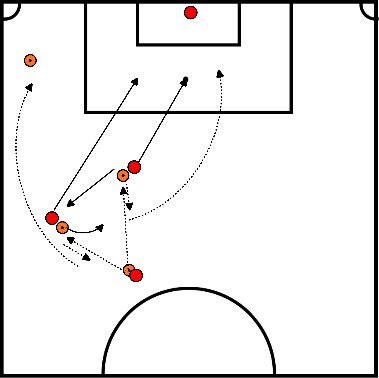
- The team on the left plays against the team on the right.
- Always swap sides so that players practice on both sides and with both legs.
- The deepest player is played in and drops the ball to the 3rd man who finishes
- The deepest player then gets directly into the ball and rebounds, after which the ball is played to the flank
- The winger can take the ball inside once to enter half space and must hit the low cross
Addition in the form is a defender of the opposing team may also defend the low cross (2vs1).
- Two small goals against each other.
- Two players stand at center spot and under goal.
- Players on side dribble to square and pass to opposite player.
- Players do this simultaneously.
- Passed player (under goal and at centre spot) takes over and immediately tries to score on small goal.
- Passed player immediately engages in a duel to defend.
- Passed player goes to receiver. (Underneath the goal and on the centre spot)
- Player who tried to score gets back in line.
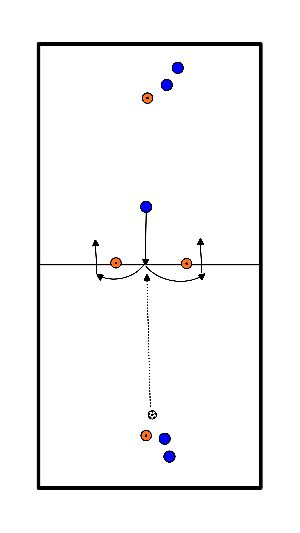
- Left and right 2 rows are made
- Between the rows is a gate
- The player gets into the ball and must turn left or right around the gate.
- The turn must be 180 degrees and at high speed because the player who plays in will be tagged
- Good shooting and not being tagged earns you a point
- If you tag, the tagger gets a point.
Attention.
- Player must move towards the ball for the take, so not stand still between the gates.
- If he doesn't make it because of the tagging, move back and again towards the gate.
- In the first part, a goalie, two central defenders play against a striker (3vs1)
- The central defenders try to play the deepest man (striker)
- The striker is positioned deep and is defended by two central defenders (build up the degree of defence)
- When the striker is reached, the two outfield players are allowed to join in and these players will join in under the striker, creating a 3vs2 situation (5vs3 in total)
- After a shot from the attacking side, the trainer will play a 2nd ball to the striker or outfield players of the other side.
- This also creates a 3vs2 situation there (5vs3 in total)
- This way this form continues and the goalkeeper takes turns with the 'build-up'.
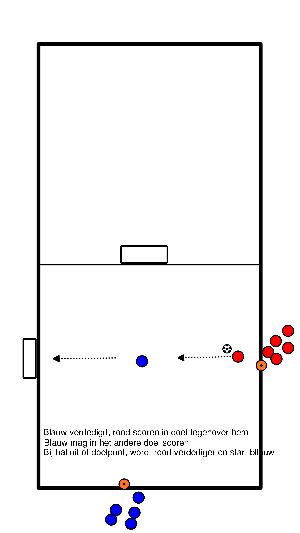
- 2 Goals on a 10 x 10 pitch
- 2 rows of players opposite the goals
- 1 player in the middle
- The player of row 1 starts and tries to score in the opposite goal
- The other player tries to prevent this and when he has conquered the ball he can score in the other goal.
- If the ball is out or if a goal is scored, the player in line 1 starts to try to score in the goal opposite him
- The player who was in the middle goes out
- The player from row 1 becomes defender
High intensity
- The player waiting in the line must start immediately when the ball is out of play.
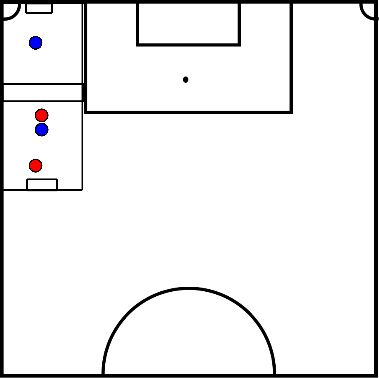
- In this game 2vs1 is played in two squares
- The two squares are split by a strip in which an attacker and a defender start
- The attacker must be played into this lane by his/her team-mate who dribbles into it
- The defender tries to prevent this
- The attacker who is played into the lane can rebound or turn on the ball
- The defender in the box is only allowed to defend in the box and in the front part of the pitch
- The defender in the second box may only defend there
- In this way, getting free in a small space, shielding the ball, rebounding under pressure, opening up under pressure and playing out a 2vs1 situation are trained
- When the defenders take the ball away, the 2vs1 situation changes into a 2vs2 situation and everyone can come into all the squares
- The defenders can then make a point by scoring in the opponent's goal
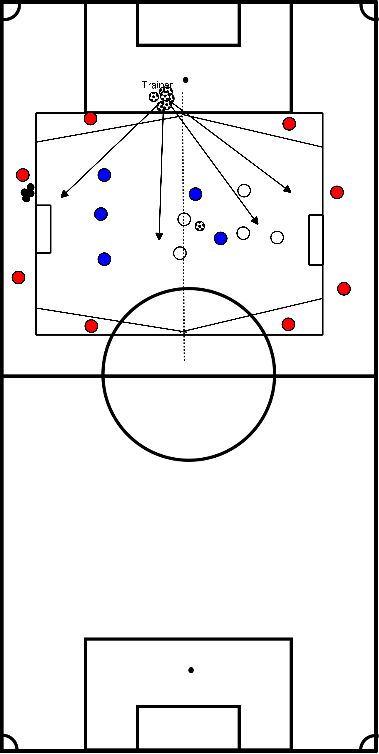
Organization :
- Set out a 6-corner (see diagram)
- 2 goals (small one without goalie, other one with goalie) 8 handball players (red), 2 teams of 6 players (depending on the people present)
Explanation :
- We play a game 6 vs 6 +1 neutral player if there are an odd number of players.
- 8 players each on 1 side along the hexagon
- Handball maximum 1 time, no passing to each other, only to the players in the central area.
- When the ball is out, trainer lets play resume somewhere in the game, can also be to goalkeepers,...
Coaching :
- Let the form do its work
- Quick changeover
- Make your own choices about the rules of play applied, according to the objective (e.g. oblige to have been on the 2 sides, so turn over, maximum 2 times in neutral shape,...)
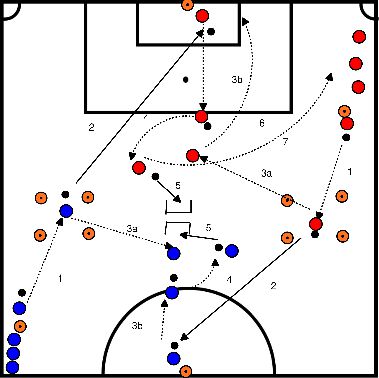
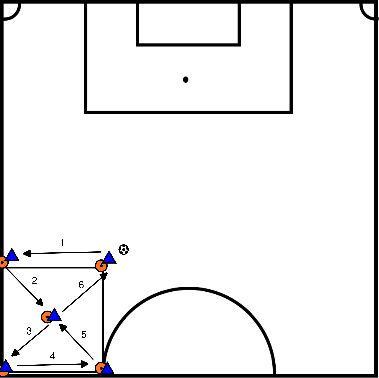
Exercise to change sides, practise taking the ball and turning it on.
- A square is set out with a hat on each corner
- In the middle comes a 5th hat
- The player on the top right plays to the top left (1)
- From the top left to the middle (2)
- From the middle to the left bottom (3) From the left bottom to the right bottom (4)
- From the bottom right to the middle (5)
- and from the middle back to the starting position (6)
- Players follow the ball
- Go around
- Tight fit
- Take it well and open up!
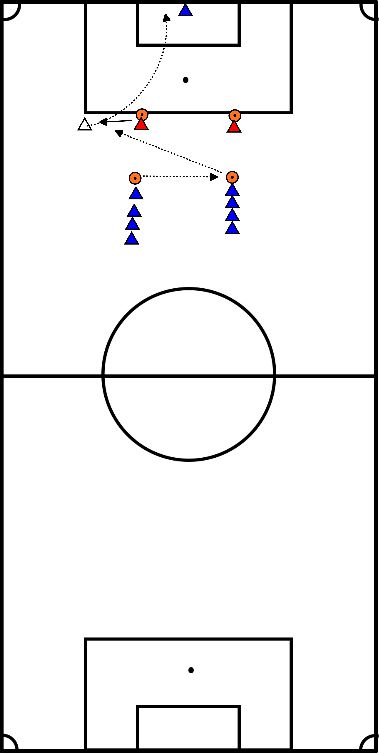
- 2 lines about 10 metres outside the 16-metre area
- On the edge of the 16 meter zone, 2 more players stand in line with the rows next to a pops/large pawn
- The player in one line plays the ball wide to the first player of the other line
- He passes the ball crosswise to the player on the edge of the 16-metre area
- He walks away from his defender (pawn)
- Makes sure he stands open and shoots at the goal