



Soccerexercises for u11
Execution
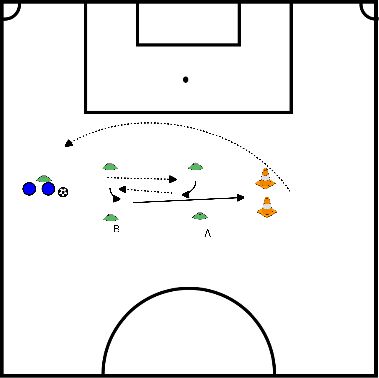
- Distance from point A to point B is 5 metres.
- Distance from point A to the goal is 5 metres.
- Distance from the cone to line B is 1 metre.
- The size of the goal varies depending on the age; younger players have a larger goal.
- The player dribbles to line A, cuts the ball, dribbles to line B, cuts again, and shoots the ball at the goal.
- The player retrieves the ball and runs around the outside back to the start.
- Cutting with the inside or outside of the foot.
- Cutting behind the standing leg.
- Dribbling with both the left and right foot.
- Dribbling: Touch the ball with each step.
- Make a short turn when cutting.
- At line B, cut so the ball is well positioned to step directly and shoot, without needing to go backwards for a run-up.
Content
- Defender number 1 delivers a long pass to attacker number 2.
- The attacker controls the ball and goes directly towards the goal to score.
- Defender number 1 engages in the one-on-one duel.
- If intercepted, the defender finishes on the small goals.
- If the goalkeeper stops the ball, the same applies.
- Defender number 1 may play with his goalkeeper.
- Defenders start with a ball.
- Attackers start without a ball.
- Switch roles and join after each turn.
- Distances can be increased or decreased.
- The attacker must accelerate towards the goal.
- The defender must control the pace.
- Switch immediately upon losing the ball.
- Encourage players to engage in duels.
- Upon ball recovery, immediately coach whether to play with the goalkeeper or go directly to one of the goals.
Execution
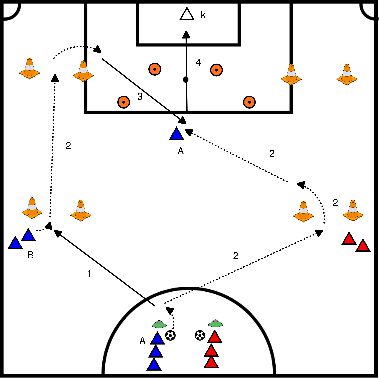
- Player A frees themselves from behind the cone and passes to Player B.
- Player B dribbles with the ball through both gates towards the goal line.
- Meanwhile, Player A runs through the right gate to the centre, just in front of the penalty area.
- Player B passes the ball to Player A through the gate.
- Player A finishes on goal.
- Player B retrieves the ball and joins the red side; Player A becomes the red Player B and vice versa.
- The exercise is alternately performed on the blue and red side; red starts when the diagonal pass from blue is given.
Field Setup
- Mark the field with 4 cones in a 20 by 20 meter area.
- Each pair of players receives a ball.
- The purple player must try to shield the ball from the blue player.
- The blue player must try to recover the ball without committing a foul.
- If a player recovers the ball, that player may shield the ball and the other player must try to take it back.
- On the coach's whistle, you must switch player groups.
- You may not switch to another player you have already played against.
- Use your body effectively when shielding the ball.
Organisation
- The game is played between two teams against each other.
- The attackers play towards a large goal.
- The defenders play towards four small goals on the sides.
- If the team that must score on the large goal loses the ball, they must defend the four small goals.
- After 15 minutes, switch halves.
- If the attackers lose the ball, it can quickly result in a counter-goal.
- Players who do not defend enough in competitive matches may find this game form challenging.
- Mark the opponent on time.
- Do not lunge.
- Defend on the correct side.
- Posture during duels, bend the knees.
Introduction
- This activity involves speed, agility, coordination, passing, and duels.
- Suitable for all age groups with possible variations.
- The FUN aspect is enjoyable for both young and old.
Execution
- Players A start shoulder to shoulder and sprint to the cones.
- Accelerate around the marker and move backwards to the pole.
- Move sideways over the hurdles and then back behind the pole.
- Accelerate forward to the furthest pole and then backwards to the other pole.
- Player B plays a ball to A who finishes on goal.
- The player who finishes first wins.
Variations
- For older age groups, the loser may receive an extra task.
- For younger age groups, points are accumulated.
- Players switch positions after each round.
- Player B can throw the ball so A must head it towards the goal.
Execution
- Player 1 engages in a one-two with player 2.
- Player 2 moves towards the ball.
- Player 1 provides a through pass to player 3.
- Player 3 plays into player 4, who moves towards the ball.
- Player 4 creates space for the incoming player.
- Player 3 passes to player 5 across the width.
- Player 6 moves towards the ball, and player 5 decides through the pass whether he wants the ball on the left or right.
- Player 6 controls the ball and scores.
- Start with a ball at player 1.
- Have three players at player 3 and player 5.
- Shift from player 1 to player 6.
- If there is no goalkeeper, player 6 goes for the goal.
- Distances can be increased or decreased.
- Pass to the outer foot.
- Maintain eye contact, create space, and move towards the ball.
- Add a defender at the position of player 2, player 4, and player 6.
- Ball can be played on the ground and/or through the air.
- For player 2, player 4, and player 6, first move away from the ball and then towards it.
- Only move towards the ball when player 1 has control.
- Ensure players do not play too close to each other, as it is easier to defend.
- Player 5 decides himself whether he wants the ball on the left or right through the manner of passing.
Execution
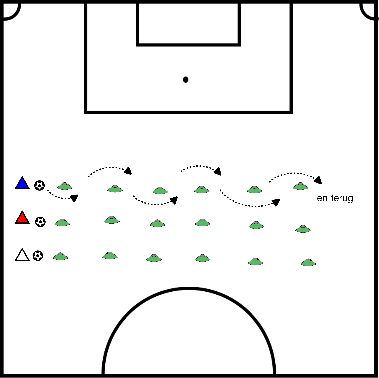
- Place 7 cones at a distance of approximately 15-20 meters from each other.
- With a small group: one player per series of cones; with a larger group: players one behind the other.
- Slalom at pace through the cones back and forth.
- Stop the ball next to the cone.
- The fastest player wins.
- Slalom at pace through the cones, but without slalom back.
- Stop the ball next to the cone.
- The fastest player wins.
Formation
- Arrange your team in 2 lines with 4-5 players per line.
- Use only 1 ball.
- Players receive the ball and pass it to the first person in the line opposite them.
- Immediately after the pass, they sprint and join the end of the line they just played into.
- This process repeats continuously.
- Players stand on their toes ready for the pass.
- Passes are clear and accurate.
- Players call out when they want to receive the ball and name the player to whom they are passing.
- With the first touch, they bring the ball under control, and the second touch is the pass.
- Apply the one-touch pass.
- Have one line pick up the ball and throw it back underhand to the other line, which returns it with a volley pass.
- Players receive the ball with their thigh and bring it under control before passing it back along the ground.
- Place a cone 5 meters on either side of the central point between the 2 lines.
- After the pass, players must run around the cone before joining the line.
Execution
- All players jog in a square across the field.
- Half of the players have a ball.
- Players with the ball pass to players without the ball, maintaining eye contact.
- The ball must not be held for more than 5 seconds.
- At a whistle signal from the coach, players without the ball sprint to a nearby player with a ball and try to take the ball away.
- Players with the ball try to shield the ball (1:1 duel).
- At the next whistle signal, resume jogging and passing.
- With an odd number of players, the player without a direct opponent receives a task, such as sprinting across the width of the field.
Content
- Player 1 or the goalkeeper takes a goal kick.
- Player 2 receives the ball.
- Player 2 gives a through pass to player 3.
- Player 3 plays into player 4 who comes to the ball.
- Player 4 creates space for the incoming player.
- Player 3 plays to player 5.
- Player 5 controls the ball and scores.
- At player 1, there are two players with a ball.
- At players 2, 3, and 5, there are three players.
- Rotate from player 1 to player 5.
- If the goalkeeper is absent, player 5 shoots on goal.
- Distances can be increased or decreased.
- Play to the outer foot.
- Make eye contact and come to the ball.
- Add a defender at position 4.
- Play the ball on the ground and/or through the air.
- In case of delay, player 1 takes the goal kick.
- When player 1 has control of the ball, only then come to the ball.
- At player 4, first move away from the ball and then come to the ball.
- Ensure players do not play too close to each other, as it is easy to defend against.
Warm-up
- Two rows with players.
- Two captains call out the exercises.
- At the second marker, initiate a sprint directly.
- Jog calmly to the other side.
- Focus on speed and correct execution.
- Squat on one leg.
- Step-jump twice to the right, then twice to the left.
- Dribble quickly with short steps forward, sideways to the right, forward, sideways to the left.
- After the exercises, stretch well.