

Soccerexercises for u8
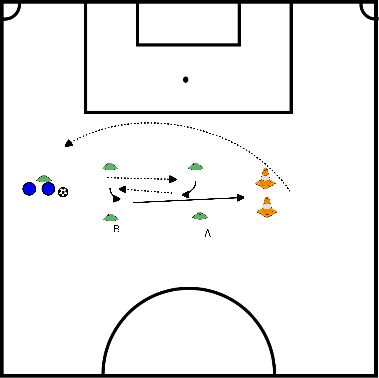
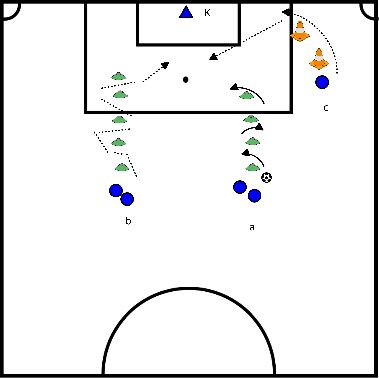
- Player A begins slalom with ball between hats.
- At 2nd hat, player B begins slalom without ball through hats.
- Player C begins running motion around cones.
- Players A and B attack.
- Player C and the goalkeeper defend.
- Finishing on goal.
Passing: A becomes C, B becomes K, K becomes A and C becomes B.
Duration: 8 minutes, while waiting their turn juggling the ball.
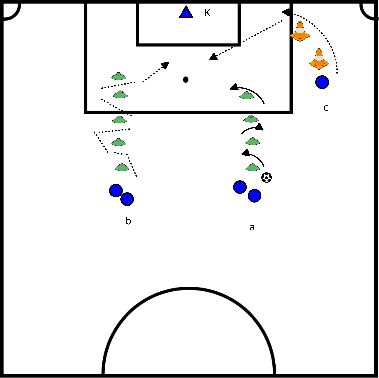
- Player A begins slalom with ball between hats.
- At 2nd hat, player B begins slalom without ball through hats.
- Player C begins running motion around cones.
- Players A and B attack.
- Player C and the goalkeeper defend.
- Finishing on goal.
Passing: A becomes C, B becomes K, K becomes A and C becomes B.
Duration: 8 minutes, while waiting their turn juggling the ball.
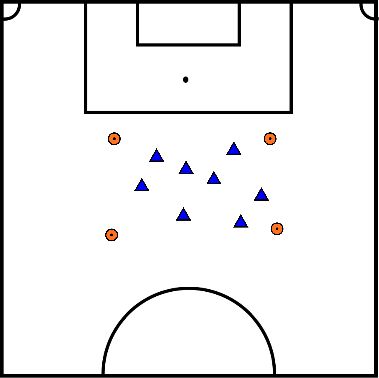
- Players dribble through the square with ball on foot for 3 minutes.
- Active rest of 2 minutes.
- Players dribble through the square with ball on foot for 3 minutes.
During 1 and 3, different sub-tasks can be given on a whistle:
- stop & go
- sit on ball
- put ball in the air
- ball back and forth between feet
Size of square can be adjusted according to level of group: the higher level, the smaller the space.
- Players Red and Blue leave together from starting point with ball on foot to inside cones.
- At first cone ball on outside hand -on side of cone-.
- They walk shoulder to shoulder through the cones.
- They try to keep their ball on the hand without it falling.
- Speed does not play a role, coordination and body control do.
- After last cone walk back with ball on foot.
- Rejoin your row.

Field 15 x 15 meters.
Goal 5 x 2 with 5 cones: outer 2 = 5 pt, next to them = 3 pt, middle = 1 pt
- Player A starts next to own goal and dribbles ball in through gate.
- Diagonal pass to player B.
- Player B takes on plays through to player C.
- Player C turns left or right away from defender or cone in his back.
- Player C shoots at goal and tries to score as high as possible.
Whoever gets the most points after several rounds of this exercise wins!
Passing through: A to B, B to C, C takes ball and joins on other side of goal. There the same exercise in mirror version.
Skills: dribbling, passing, taking on and passing, turning away from defender, targeted kicking, finding corners.
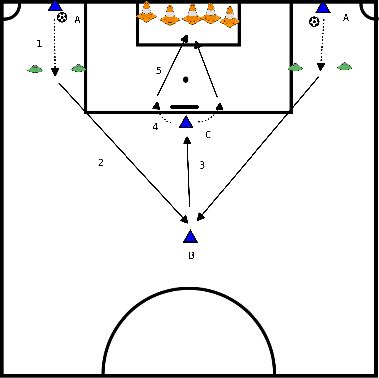
Players pass the ball diagonally and follow the ball.
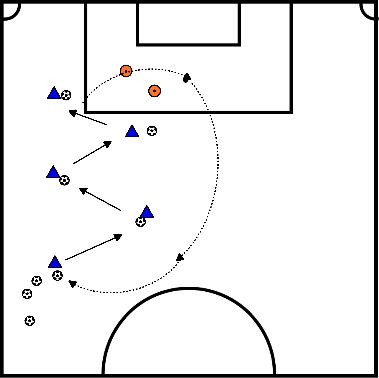
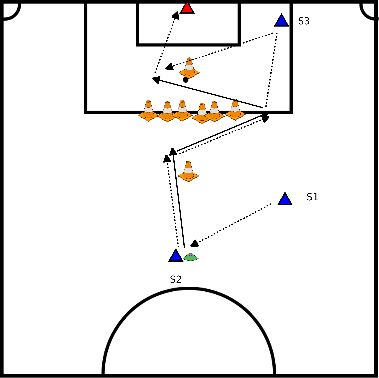
- S1 gives pass to S2.
- S2 dribbles to cones, makes 1x sharp angle, gives pass to S3.
- S3 runs free, gets ball and finishes on goal.
- With fixed goalkeeper then it stays, without goalkeeper then trapper takes the place of goalkeeper.
- Goalkeeper goes rebound and handler takes ball and slides on, S1 goes dribbling.
- Exercise can be done in two directions.
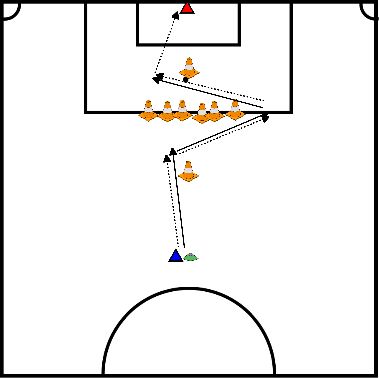
- S1 dribbles to cones. Makes 2x sharp angle and finishes on goal.
- With fixed goalkeeper it stays, without goalkeeper trapper takes the place of goalkeeper.
- Exercise can be done by free choice from 2 sides.
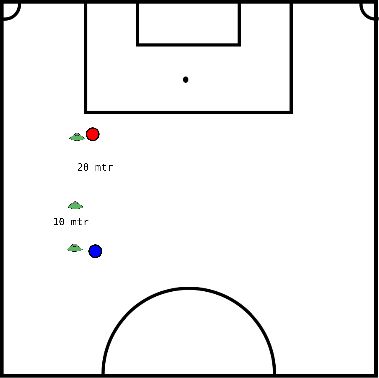
- At trainer's signal, both players start sprinting.
- Blue must run around first pawn and Red runs straight through to tap Blue.
- Red becomes Blue and flips over.
Players pass the ball and and put it in front of the goal where the other player tries to finish at once.
This type of exercise is a positional game in which the team with the excess number must press for the ball immediately after losing it.
The principle of play
What are your players supposed to do when the ball is lost somewhere on the field? If you want your team to put direct pressure on the ball in the transition from possession to loss of the ball, the following form of practice is very suitable to work on this. The playing principle that is central in this form of practice is 'putting pressure on the ball directly'. With 'putting pressure' I mean attacking the ball; actively moving towards the ball -and opponent- in an attempt to conquer it as soon as possible.
The practice form
The red team plays the ball around or plays for possession. The yellow team tries to get rid of the ball.
When the yellow team is in possession of the ball, they must try to score as soon as possible in one of the four goals.
By keeping the size of the field relatively small, it is easy for the yellow team to attempt a goal from all positions on the field.
The red team is thus forced to put pressure on the ball immediately upon loss of possession to prevent a goal/attempt.
Coaching
What can you pay attention to in this exercise? Since pressure on the ball is central, it is logical to look mainly at this:
- Is it pressured at all at ball loss?
- If yes, by whom and by whom not? If not, why not?
- If pressure is applied, how? Aggressively from the idea of capturing the ball immediately or from a shuffle pace?
Variations
Several variations are possible, some suggestions:
- If you have no goalkeepers, you can also work with small goals only
- Let the under team score by dribbling out of the field (possibly in combination with the goals)
- Award points to the outnumbered team by playing around x number of times
- Award points to the outnumbered team if the ball is recaptured without a goal attempt by the underdog.
- More/less goals
- Count goals from the under number more heavily
Naturally, the form can also be played with other numbers, as long as there is an over- and undercount.
Direct pressure is very effective when it works. If it is not successful and the opponent can play under pressure, it is very likely that large spaces will be created, which is a risk. Correct adjustment of the pressure requires training.
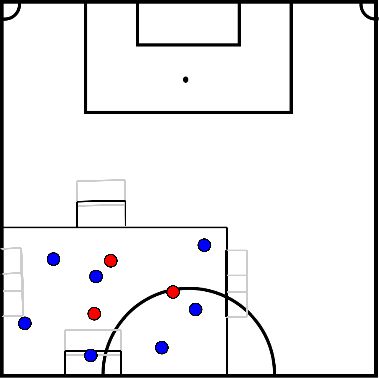
Distances:
- A-B 5 meters.
- A to goal 5 meters.
- Hat to line B 1 meter.
- Distance goal differs in age younger goal is bigger.
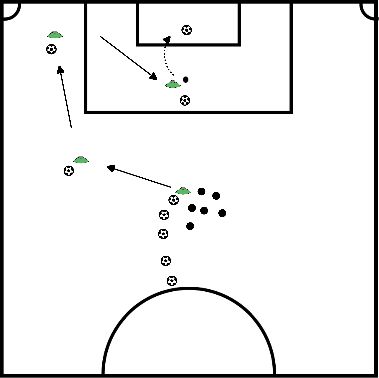
Player dribbles to line A, cuts the ball off, dribbles to line B, cuts off and shoots the ball at the goal, picks up the ball and runs around the outside back.
Variations:
Inside/outside foot cut off, cut off behind stand leg, dribble with left and right.
Coach moments:
Dribbling, touching the ball at each step, short turn off, cutting off line B and having the ball in such a way that you step through and shoot and not having the player first walk backwards for a run.