
Soccerexercises for u9

Passing Exercise 1
  • Player A passes the ball to Player B and takes over Player B's position. Player B is turned open, receives the ball, and passes it to Player C.
Key Points
  • Passing: Hit the ball in the centre so it stays low. Lift your shooting leg slightly for the correct technique.
  • Receiving: Be turned open with your body facing the player you are passing to and keep your eyes on the ball.
  • Clockwise: Receive with the left foot, pass with the right foot.
  • Counter-clockwise: Receive with the right foot, pass with the left foot.
Execution
  • Increase the pace if it becomes too easy. Remove the receiving step for more challenge; pass the ball directly.
Passing Exercise 2
  • Player B calls for the ball. Player A passes to Player B, who drops the ball back to Player A. Player A passes to Player C, who drops the ball back to Player B. Player B passes diagonally to Player D, and so on.
Key Points
  • After passing, the player must continue running to request the ball between the cones.
  • The player who returns the ball runs around their cone and requests the ball in the middle.
  • When returning the ball, the player must turn quickly towards the grid and not away from the play.
Execution
  • Switch direction after 8 minutes. Pass clockwise with the right foot, counter-clockwise with the left foot.
drawing Passing exercise with turning open
Passing Exercise 1
  • Player A passes the ball to Player B and moves to Player B's position.
  • Player B opens up, receives the ball, and passes it to Player C.
Key Points
  • Passing: Strike the ball in the centre so it stays low. Lift your shooting leg slightly for proper technique.
  • Receiving: Stand open, with your body facing the player you are passing to and keep your eyes on the ball. When playing clockwise, receive with your left foot and pass with your right. Conversely, receive with your right foot and pass with your left.
Execution
  • Increase the pace if it becomes too easy. If that is also simple, skip the reception and pass the ball directly.
Passing Exercise 2
  • Player B calls for the ball.
  • Player A passes to Player B, who lays it off to Player A.
  • Player A passes to Player C, who lays it off to Player B.
  • Player B passes diagonally to Player D, and so forth.
Key Points
  • The player passing must continue running and ask for the ball between the cones.
  • The player laying off the ball runs around their own cone to request the ball again in the middle.
  • When laying off, the player must make the correct turn and keep their eyes on the ball. The turn should be short towards the grid.
drawing Passing exercise with opening up
Content
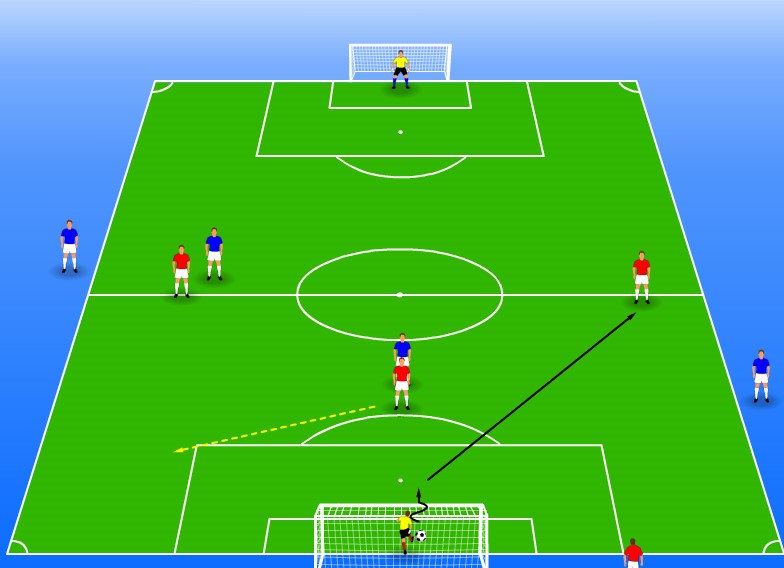
  • The goalkeeper takes a goal kick and plays the ball to player number 1 and 3, alternately.
  • Players number 1 and 3 perform a one-two with players number 2 and 4 and attempt to score.
  • The shooter retrieves the ball and places it ready for the goalkeeper.
Build-up
  • The goalkeeper takes a goal kick towards player number 1 and 3.
  • Players number 2 and 4 come to the ball and perform a one-two.
  • Players rotate from number 1 to number 4.
  • Two goalkeepers are used due to the workload.
  • Distances can be increased or decreased.
  • Eye contact and coming to the ball are important.
  • Start with a goal kick from the ground, later followed by a drop-kick.
Coaching
  • When players number 1 and 3 have control of the ball, players number 2 and 4 may come to the ball.
  • Ensure players do not play too close to each other, as this is easy to defend.
  • The goalkeeper plays the ball from the ground, possibly followed by a drop-kick.
  • Drop the ball from the hands and kick simultaneously as it hits the ground.
Execution
  • Divide the group into pairs and place each pair at a cone on the centre circle.
  • Leave the balls at the cones and have the group first run a few laps around the centre circle.
  • Ensure that each pair stands at a cone with a ball.
  • Player 1 dribbles the ball to the centre spot and places it there.
  • On the way back without the ball, Player 1 performs exercises such as high knees.
  • As soon as Player 1 returns, Player 2 begins the same exercises and then retrieves the ball.
  • Repeat this and be creative with the exercises.
drawing Warm-up in pairs
Setup
  • Players are divided into equal groups.
  • Each group tries to dribble the ball through the poles as quickly as possible.
  • The last player of each group must pick up the ball and place it on the cone.
Execution
  • Start with the first player of each group dribbling the ball through the poles.
  • The next player begins as soon as the previous player has handed over the ball.
  • The last player places the ball on the cone to complete the race.
drawing Dribbling race with speed
Formation
  • The team stands in two groups ready behind a marker.
  • Two players run simultaneously.
  • The next player departs when the pair has passed the first cone.
Execution
  • The players receive an activity from the trainer and perform it once.
  • On the way back, they run back and join the end of the line.
Activities
  • Jogging
  • Knees up
  • Heel-to-butt
  • Sideways left
  • Sideways right
  • Arm swings forward
  • Arm swings backward
  • Jump over cones with both feet simultaneously
  • Sprint to cone and run backwards
  • Shoulder push and sprint
Organisation
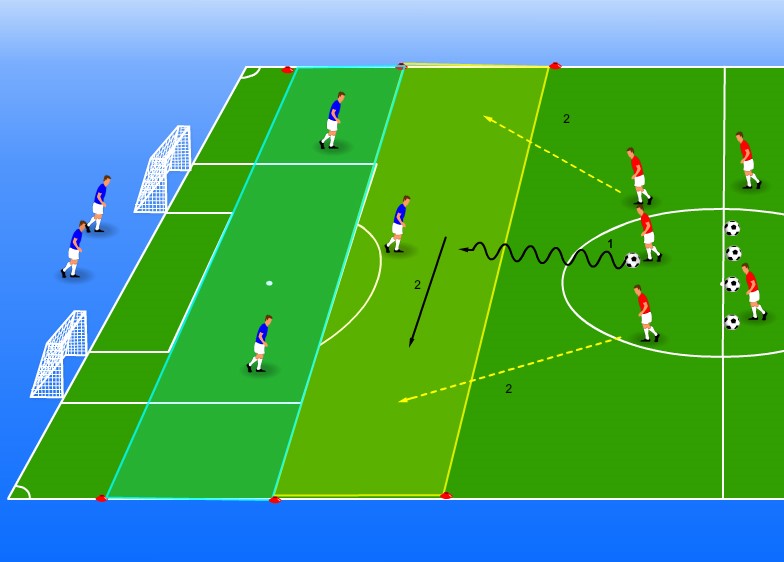
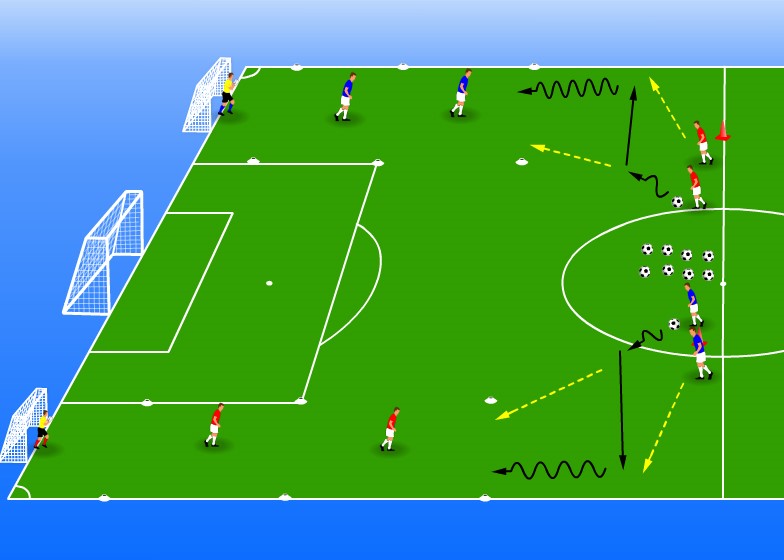
  • Play two against one. If there are two players left, they play one against one on a narrower field.
  • The duo tries to score on the two small goals.
  • After approximately 8 minutes, switch players.
  • If the duo finds it too easy, move the two goals closer together.
Remarks
  • Due to the many one against one duels, you can quickly see if they are performing well or less well.
  • Do not give instructions in the first match.
  • Give players the chance to improve themselves.
Points of Attention
  • Prevent the opponent from being able to shoot on goal.
  • Ensure you position yourself so that it is difficult for the opponent to pass to their teammate.
Field Setup
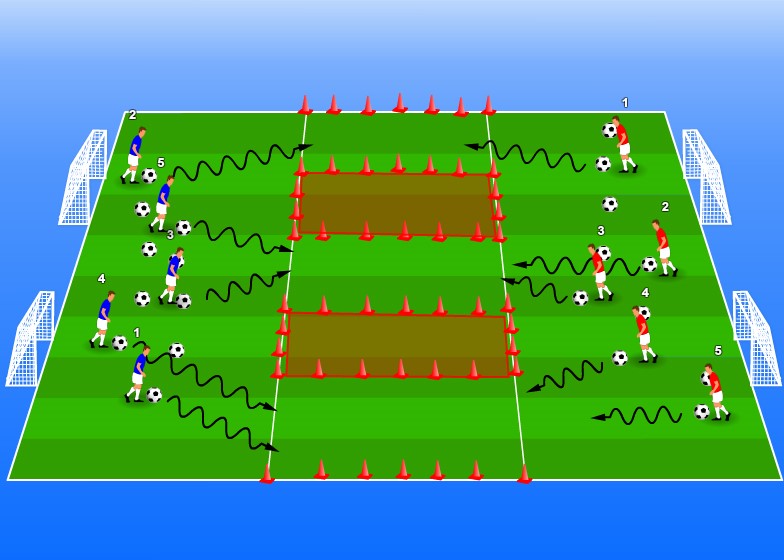
  • 2 x 4 x 2 cones or markers set up next to each other to form two lanes.
Game Progression
  • Players pass the ball precisely through the lane of cones or markers and sprint after it.
  • Another player (white) receives the ball and dribbles to the other lane.
  • There, this player repeats the action towards player 3.
  • Player 3 starts again at the same place as player 1.
Game Rules
  • The ball must go through the lane of cones or markers.
  • If a cone is hit, the player must sprint to set the cone upright and do three push-ups at the end.
  • The ball must pass all the cones before the receiving player can take the ball and dribble to the other position.
Field Setup
  • 2 large goals
Game Progression
  • Play in a formation of 4 against 4, 3 against 3, or 2 against 2.
  • Players may touch the ball a maximum of 2 times.
Rules and Tips
  • The ball may be controlled, but must then be played on in one touch.
  • After a goal or when the ball is shot over the line, possession goes to the other team.
  • Scoring from your own half is not allowed.
  • A player must always be passed before the ball can be played on.
  • If this is not adhered to, the opposing team receives a free ball.
Setup
  • Distances between cones: 10 metres long by 6 metres wide.
  • Goals: Distance depends on age group.
  • No bibs needed, as it is one-on-one.
Execution
  • Red dribbles into the area and plays the ball to Blue.
  • Blue tries to score on Red's goal.
  • If Red intercepts the ball, they score on Blue's goal.
  • After a goal or if the ball goes out of the area, join the queue at the opposite side where you started.
Coaching Moments
  • Defence: Ensure you stay between the opponent and the goal. Be patient, bend your knees slightly, and stay on your toes.
  • Attack: Maintain speed in your play. Once you stop, you are easy to defend. Unbalance your opponent with body movements. Tap the ball past your opponent and accelerate. Try to keep your body between the opponent and the ball.
drawing Dribbling and defending in one-on-one
Walk Straight Forward
  • Jog to the last cone. Keep your upper body upright. Hips, knees, and feet should form a line. Do not let your knees buckle inward. Run slightly faster on the way back. Repeat the exercise twice.
Rotate Hips Outward
  • Jog to the first cone. Stop and bring your knee forward and upward. Rotate your knee outward and place your foot down. Keep your pelvis horizontal and your upper body still. Repeat with the other leg. Jog back after the course. Repeat the exercise twice.
Rotate Hips Inward
  • Jog to the first cone. Stop and bring your knee sideways upward. Rotate your knee inward and place your foot down. Keep your pelvis horizontal and your upper body still. Repeat with the other leg. Jog back after the course. Repeat the exercise twice.
Walk Around Partner
  • Jog to the first cone. Shuffle sideways to your partner. Circle around each other without changing your direction of view. Slightly bend your hips and knees. Shift your body weight to the balls of your feet. Jog back after the course. Repeat the exercise twice.
Walk Jump with Shoulder Contact
  • Jog to the first cone. Shuffle sideways to your partner. Jump towards each other in the middle for shoulder contact. Land on both feet with bent hips and knees. Shuffle back to the first cone. Jog to the next cone and repeat. Jog back after the course. Repeat the exercise twice.
Accelerate and Decelerate
  • Run quickly to the second cone. Run backward to the first cone. Keep hips and knees slightly bent. Run two cones forward and one back each time. Jog back after the course. Repeat the exercise twice.
Execution
  • Divide your team into four groups of four players, each with one ball.
  • Players pass the ball around within their team in the designated area.
Quality
  • Players must remain in constant motion with frequent changes of pace to find space.
  • Each team should attempt to maintain a diamond shape.
  • Communication is essential; players must call for the ball and shout the name of the teammate to whom they are passing.
  • Passes must be precise, either into the space or to the feet of the teammate.
  • Players must not touch each other, and the balls must not collide.
  • This exercise requires great attentiveness from the players.
Progression
  • Add a passive defender who can defend any ball.
  • Add an active defender who is allowed to win the ball.