

Tennisexercises
- 2 rounds of slow pace running
- Rows.
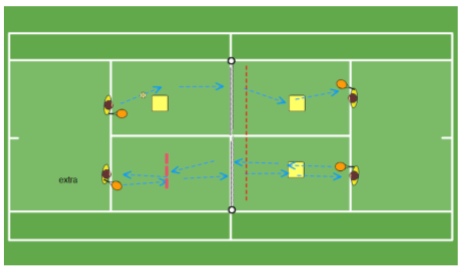
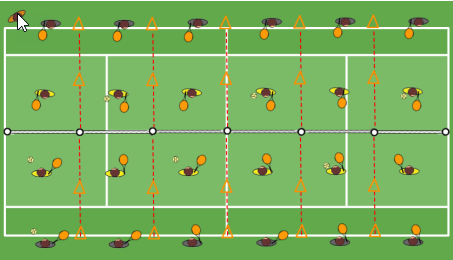
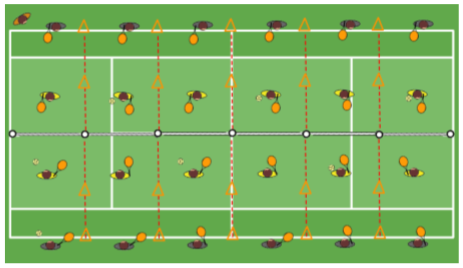
- Play-in mini field orange
- Pitch mini yellow
- Practice large field straight
- Play large field cross. change from cross side
Running training
- 30 sec jumping jacks
- 30 sec knee lifts
- 30 sec heels against buttocks
- 30 sec bridge with 1 foot on ball
- 30 sec jump-lunge with ball between legs 30 sec skating jumps
- 30 sec Russian-twist (feet off the floor)
Burpees
- Build up from 25
Plank workout (3 minutes)
- 30 seconds normal plank
- 30 seconds of alternating left and right leg lifts
- 30 seconds of side plank on right side, other arm extended
- 30 seconds side plank on left side, other arm extended
- 30 seconds of normal plank 30 seconds of spiderman plank
Bicycle Crunch
- 2 x 1 minute (rest 20 seconds)
Push-ups
- 3 x 8 pylo-clap push-ups
- The players start in the middle of the field (baseline):
- They get played a lower ball on their BH/FH.
- Deep slice along the line.
- Follow through to the net and volley finish (aim) at the turret balls. (cone)
- Do the same on other side or practice both sides at the same time.
- 1 set BH slice - 1 set FH slice - 1 set BH slice....
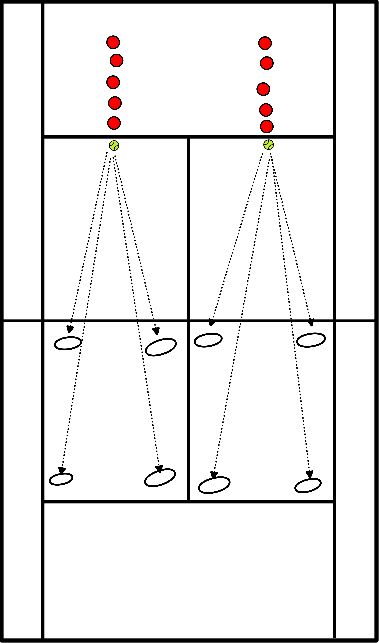
1. Obstacles are set up on the opposite side of the net.
2. Players throw balls and try to knock over as many obstacles as possible.
You are only allowed to run on the lines of, for example, a volleyball field. The person who's 'it' must try to tag one of the runners.
Handicaps:
- Turn right/left only.
- Knees high.
- Hopping.
- Backwards (don't fall!) etc.
Outside you can set up a closed course with hats or cones.
- Which pair can play the ball independently over the net most often?
- The tennis players are close to the net.
- You can make it more difficult by increasing the distance.
- Between the two tennis players are 2 hoops, about one meter apart.
- Try to get the ball into each other's hoop (who has the most hits).
- More difficult: between both tennis players. each on one side of the net, on each side of the net 2 hoops (hoops must be in the same place on both sides)
- Play the ball over the net and try to leave the ball in the other hoop.
- Which pair plays the ball with the forehand most times over the net in a certain period of time,
- You can count every good forehand stroke,
- If the ball goes wrong, you don't have to start again,
- You may now continue to count.
- Expansion possibilities are
- playing backhand only
- and/or use both techniques.
- Put the ball on the racket: let the ball roll over the strings, the ball must not roll off the racket
- keep the ball on the racket, while you touch the floor, sit down, get up, limp, run etc.
- Try to keep the racket at chest height at all times.
- Throw the ball up with the racket and catch it again with the racket
- Throw the ball a little bit in front of you
- Run after it and catch it again with your racket.
- throw ball up let it bounce once and then catch it with the racket
- keep playing up the ball, don't catch it anymore
- try to walk around when you play the ball up, who succeeds without mistakes and without touching anyone
- The teacher will recap briefly the previous lesson.
- What did we do and what did you learn?
- It was about serving and returning and the experience that tennis is not that difficult at all and can be quite intense.
- The instructor explains that today we will technically zoom in on forehands and backhands, tactically on point building and doubles and in general on cooperation and communication.
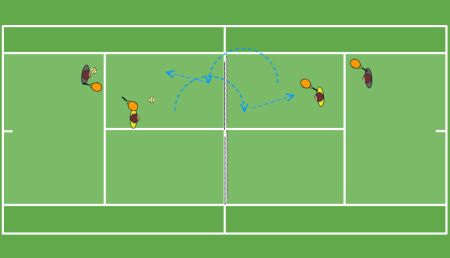
- Each pair tries to play over, with each student trying to rush the other by creating space and hitting the ball in space.
- The emphasis is really on trying.
- Besides using the space, they can experiment with hitting harder, taking the ball earlier and deliberately slowing down the game.
- The teacher gives different lengths of lane (using the lines present in the room) to experience how hard / soft / high / low / deep the ball should be hit to be able to play together within this assignment.
- After the ball has been hit wrong twice, the two of them will switch to the waiting two on their lane.
- The students who are waiting can check the assignment and 'play along' in their minds.
- Stay in the rally The student is able to:
- To strike forehand- and backhand techniques in doubles and singles in different ways.
- To indicate which principles apply when building up a point.
- To start up and maintain independent play and practice forms.
- To take part in the lesson with attention and understanding, focus, hungry for work and combativeness.
- To work and consult together.
- Apply knowledge of the rules.
- Stay in the rally The student is able to:
- To strike forehand- and backhand techniques in doubles and singles in different ways.
- To indicate which principles apply when building up a point.
- To start up and maintain independent play and practice forms.
- Participate in the lesson with attention and understanding, focus, hungry for work and combativeness.
- To work and consult together.
- Apply knowledge of the rules.
- We work in pairs.
- The ball is brought into play with a (forehand) service.
- The students play with forehands at each other, where the height (under a magic cord) and depth (newspaper) is controlled.
- Every time the newspaper is hit, you get a point.
- Who has the most points after X time?
- The teacher's example shows balance ('standing firmly') and the shape of a 'quiet swing'.
- Extra assignment there are three different newspapers for the students. (left-middle-right)