



Volleyballexercises for technique defense / passing / digging / diving / reception
Last update: january 2026
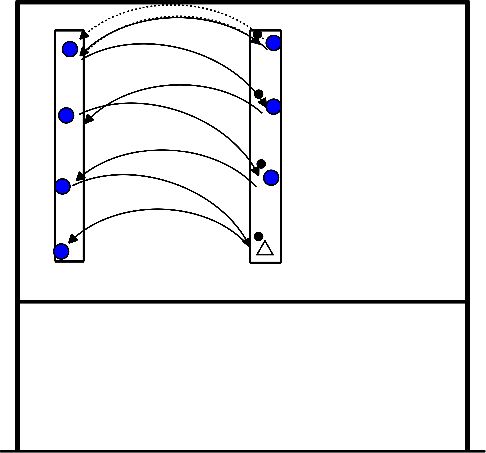
Preparation
- 2 benches side by side (A and B) 3 to 4 meters apart
- Players face each other on the bench
Course of play
- The A players throw the ball to the B players, who defend the ball overhead and play it back to the A player in 1 contact.
- 15 times
- Same as 1 but the other way around.
- The A players throw the ball to the B players, who defend the ball underhand and play it back to the A player in one contact.
- 15 times
- Same as 3 but the other way around.
- Idem 1 tem 4 but with the bench reversed (narrow side up)
Finish by passing the ball to each player until the end of the row.
Only completed when full row is finished.
Only completed when full row is finished.
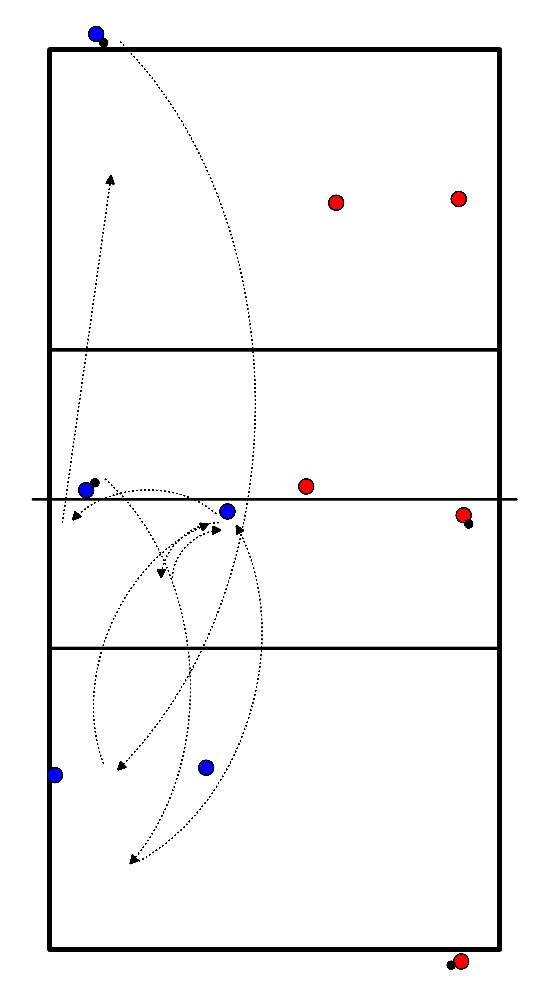
Organization
- Games are played on a half court
- 1 person in storage
- 1 person with ball at the net
- 2 people in reception
- 1 pass
- After a certain time, the game changes to another formation (mirror image)
Course of play
- Ball is served over towards 2 reception players
- Reception is taken towards pass
- Pass plays a short ball towards the reception line
- Reception goes back to pass and pass to attacker
- H & O attack from outside
- M attacks 1 or 2 at poor reception
- Player with ball at the net throws a deep ball over the net, it comes back to the pass and attacker (sowiso on corner) attacks
Pass Storage - Reception - Reception - Storage
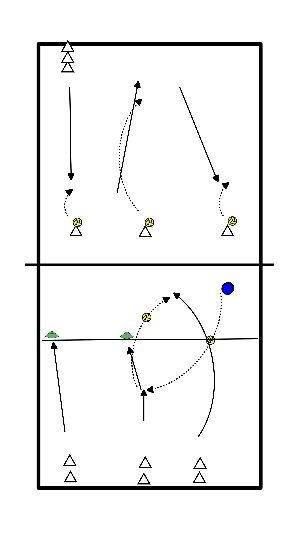
2 working groups:
Group 1 with trainer:
Group 1 with trainer:
- Make 2 Trios.
- 1st trio goes behind 7 meter line on belly.
- Trainer with ball carrier in corner of field.
Execution:
- Trainer claps on ball and immediately plays down field.
- First ball must be played in 3 meter zone, non-reception player catches ball in pass position
- other players stand on attacking home the moment ball is caught and call for pass.
Group 2
- 3 players with ball at the net.
- Others go to work, starting in corner of field
- Get short ball first, far ball and back a short ball.
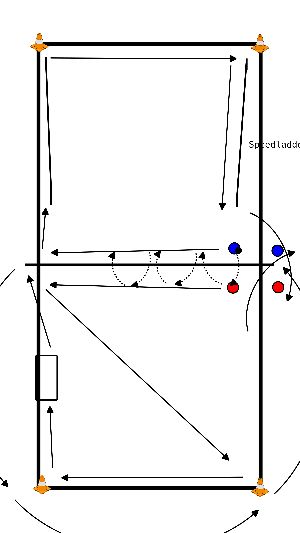
- Players start opposite each other at the net with 1 ball.
- Ball is thrown under the net during a lateral move. Staying low is important.
- Blue player leaves towards the back line.
- jumping exercise on the bench
- Sprint between the 2 cones
- Back towards the net through speed ladder
- Red player departs diagonally to the back line
- Dive to the corner of the field
- Hopping step with high knees from cone to cone
- Side plank movement across mat
- Ball waiting for players under the net and continue around the court
- Both players reconnect on the other side of the field and start another round.
3 - 5 rotations.
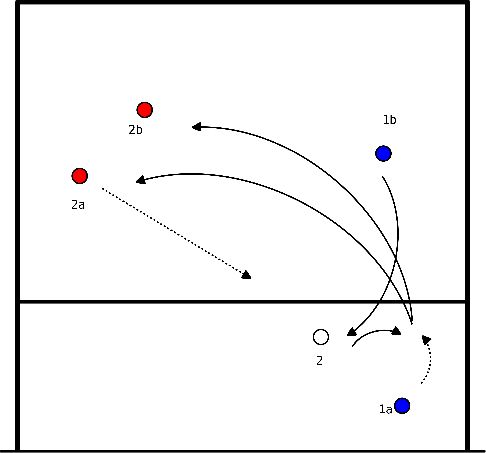
Equipment:
- Per group 1 ball
- Per group at least 4 players, preferably 5 players.
Short description picture:
- 1b plays ball to SV.
- Who gives Set up to 1a.
- 1a enters field to defend later.
- 1a calmly attacks to 2a/b who defend.
- The player not defending runs to the net.
- SV gives Setup to 2 who in turn calmly attacks 1.
- Then again. 1b goes under the net to help defend.
Variation:
- With 4 players the matching 2 to the next attack is matching 1.
- Quiet attack alternate with prod balls.
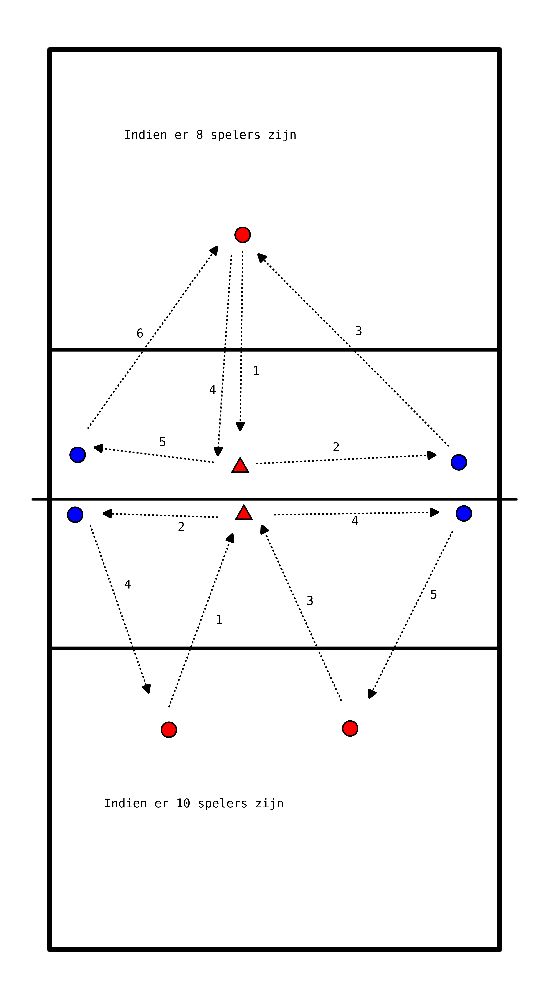
- 1 SV at mid position 3
- 1 player on position 2
- 1 player at position 4
- 2 passers backfield
Exercise starts
passer position 5 starts --> ball BH to SV - as soon as the SV sets this ball to position 4, the passer at position 1 plays the ball BH to SV.
BALROTATION:
- passer at position 5 --> BH to SV
- SV setup to player position 4
- passer at position 1 --> ball BH to SV
- SV setup backwards to player position 2
At 6 players --> see drawing top field BUT then SV plays only 1 way.
At 7 players --> see drawing top field and on bottom field then SV plays only 1 way.
In case of 8 players --> see drawing of upper field.
In case of 9 players --> see drawing of upper field and lower field.
In case of 10 players --> see drawing of lower field.
In case of 11 players --> then a substitute player as defender.
At 7 players --> see drawing top field and on bottom field then SV plays only 1 way.
In case of 8 players --> see drawing of upper field.
In case of 9 players --> see drawing of upper field and lower field.
In case of 10 players --> see drawing of lower field.
In case of 11 players --> then a substitute player as defender.
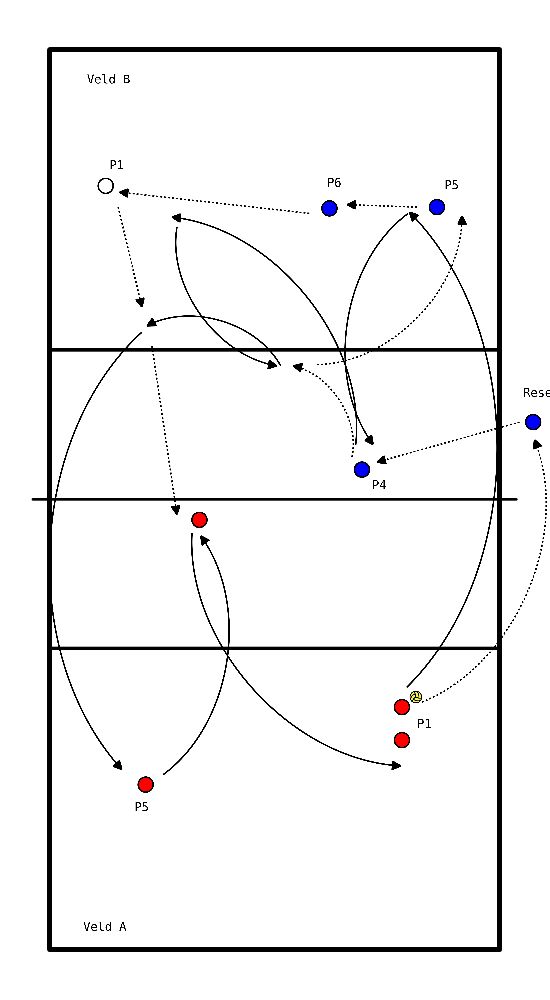
Organization:
- Players with ball on P1 on field A.
- Reserve player on P4 on field B.
- 2 passers -P5 and P6- on field B.
- 1 attacker on P4 on field B.
- 1 attacker on P4 on field A.
- 1 or 2 defenders on P5 -P6- on field A.
Execution:
- Hit/throw ball from field A -P1- to the passers on field B.
- Take position of reserve P4 on field B.
- Pass to attacker -P4- and at that moment the passers move to P1 and P6.
- Attacker hits/plays the ball to the passers and takes the position P5.
- Reserve becomes P4.
- Pass the played ball and hit that ball to defenders on field A.
- P1 on field A rushes under the net and takes the position of P4.
- P4 plays the defended ball to P1, where it is caught.
- Defender goes to P1 and connects behind and starts over.
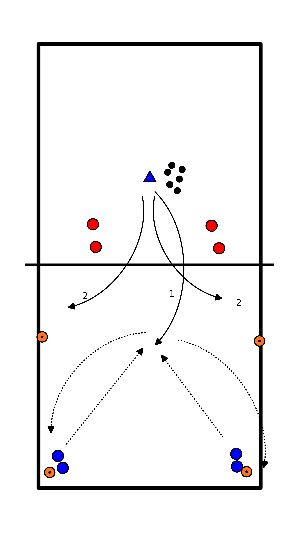
- Trainer throws ball OH on pos VI front play in split position, move low across field.
- 4 x each side, then switch.
- After play shuffle sideways to other side.
- Players always switch sides.
- Trainer throws ball OH on pos V and I in front, player starts potty and runs to front, shuffle to back, plays ball, does block and runs back.
- Tainer throws ball OH on pos VI in front, players leave from sideline. 3m shuffle on side, back to sideline.
- Player blocks and after block defends ball at pos VI / III.
- Players leave at position IV / III trainer throws ball behind them. Shuffle backwards and play.
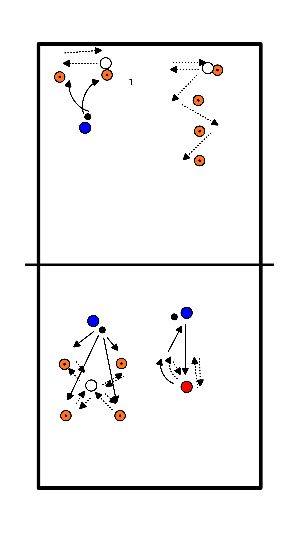
- Low stance, 10 x between 2 pot shuffle sideways and play ball.
Ball not thrown up too high. High pace. 1 shuffle step sideways. 2 x 10 times. - Same as 1 but crossover shuffle sideways. 2 x 10 times.
- 2 x 4 times diagonal shuffle. Stand still in correct posture.
- Square shuffle back to center 2 x 3 times.
- Square shuffle always back to center 2 x 3 times.
- Block jump - turn around & defense.
Throw on person and then smash.
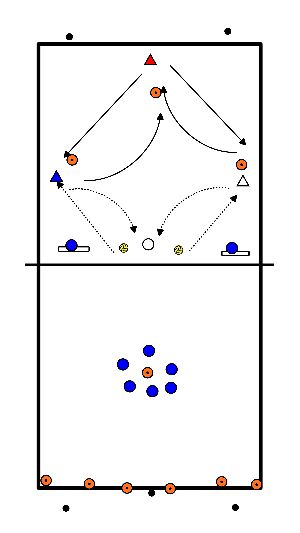
Exercise 1: Triangles
- Ball thrower starts at the net with the ball cart.
- 3 working players and the others catch balls. Can be done on 2 sides of the field.
- Thrower alternates throwing L & R balls at a brisk pace.
- Blue gets ball defended at position 1 and goes back to home position at 6. Then goes to defend at position 5 right.
Exercise 2: Balls
- 2 players stand on a plinth or rise with ball. They give a signal and then throw the ball up and play it over 'hard'.
- The field players tap the pancake in the middle. On signal they move to the right side in defense.
- Field players try to defend if possible they play the ball over the net to the skirting attackers.
Exercise 3: Dots
- 2 or 3 defenders between the gates. Players on the skirting board give signal and attack. Focus : going for the ball and communication.
- If defending then 1 player runs in and passes the ball into the net. Possibly in 3 times and then defend.
- The 2 other players do a block cover and defend the ball.
- New player on the skirting board, 3 others are ready between the gates + attack starts on the other side.
Variation: Can also be done with a serve + attack if full court is free. Also with continue play and realize majority situation.

Goal: score as many points as possible in the other person's tire.
- Duos facing each other with 2 bicycle tires with 1 ball.
- You score a point by throwing the ball into the opponent's tire, after which the ball cannot be caught by the opponent.
Variations:
- With multiple balls.
- Different type of ball.
- With or without pass to teammate.
- With several players.
- With more ties.
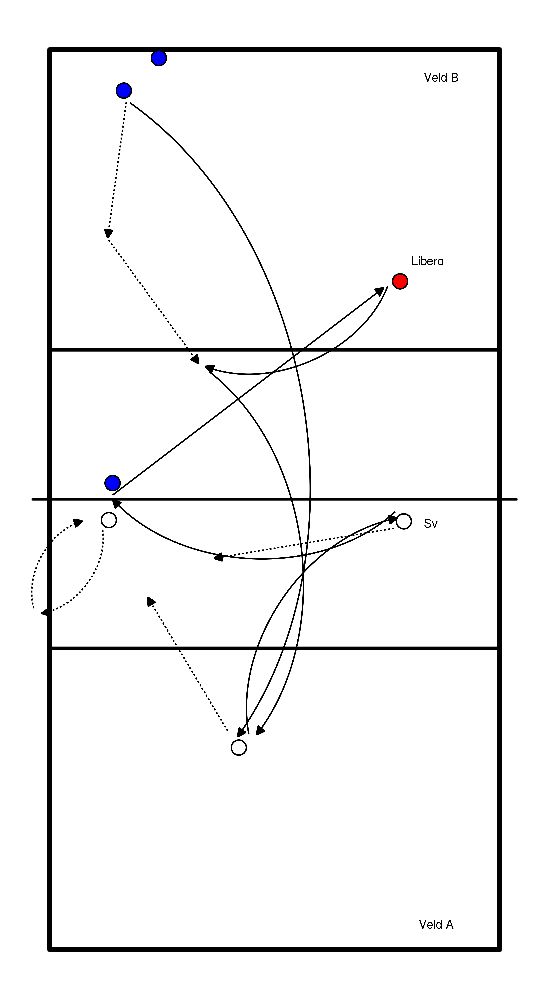
Organization:
- Field A passer on p6, Sv on p2 and attacker on p4 at the net
- Field B defender on p5, thrower/server on p1 and block on p2
Execution:
- Technical service on passer.
- Pass to SV and attack on p4
- Both SV and passer give attack coverage
- If block, defend and attack again
- If defending, pass to passer and attack again
- If scoring, switch.
- Maximum 3 attacks
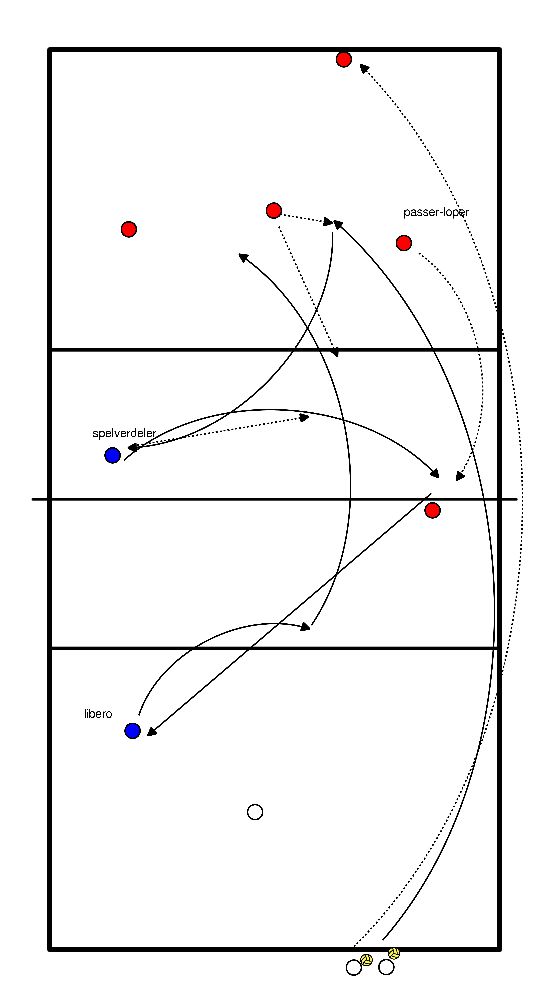
- Organisation:
- Serve from p1 on 2 or 3 players. (p1, p6)
- Sv on p2/3.
- Attacker on P4B opposite block P2A.
- Libero on P5A and defender on P6B.
- Execution:
- Process service pass into attack on 4.
- If score, serve again. (max 2x)
- If defended, pass to OH and attack again.
- Running:
- Passer becomes attacker, attacker becomes block, then defender, then server.
- Server goes to backup passer.
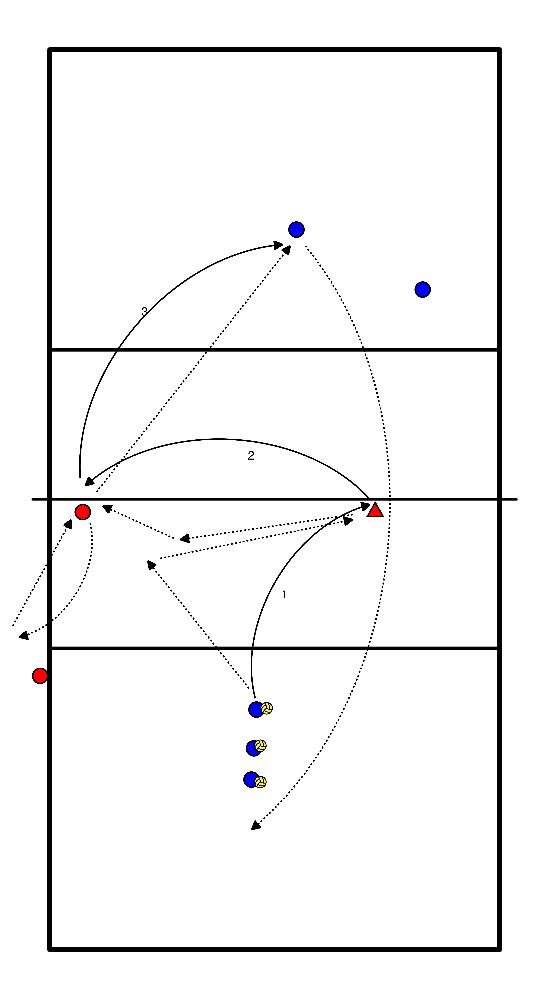
- Find out what the players can do.
- Organization:
- On field A 2 persons without the ball. 1 at the net and 1 at 3m. at position 4 and a SV at 2/3.
- Further on field A a row with ball on 6.
- On field B a defender on 6 and 5.
- Defending and (for now) catching and connecting on field A.
- Method of working:
- Player on 6 throws/plays the ball to SV.
- At the moment of set-up the player at 4 moves backwards at the net (a C-run) and attacks the passed ball.
- Both SV and player give attacking cover.
- The attacker takes the place of the passer.
- Later move attack to 3 and defenders to 1 and 5.
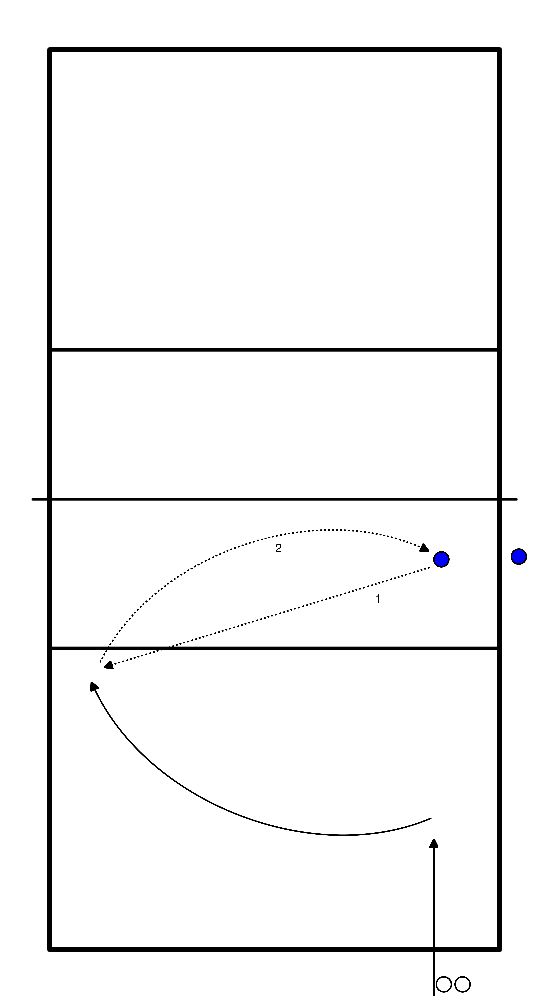
- Organization
- Ladder exercise.
- Sideways movement to between pos. 4 and 5, body turns towards attacker.
- Defence on attack.
- Variant ladder exercise:
- Variant:
- After defence, passer sets ball to pos 4 + attack.
- Pass can also go to blue player (attacker), white player then gets another free ball, on which she definitely gets the pass.
- After defence, the passer can play a move ball to either the white or the blue player, then pass to one of the two.
- Turn over:
- Defence => attack => ladder
- At least 2 reserve players on ladder and attack.
- In case of more players: add a block.
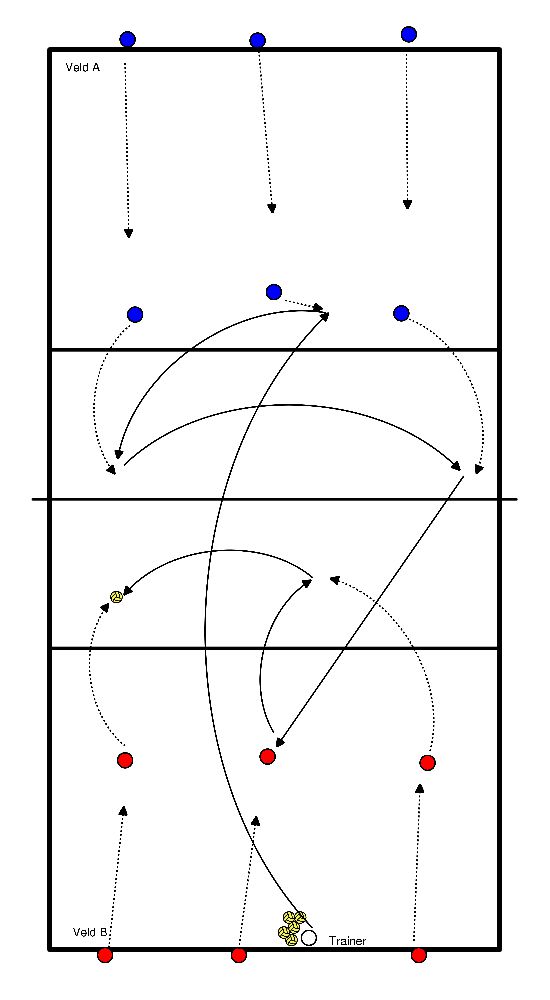
- Organization:
Make trios.
1 trio is on field A and 1 trio on field B.
On both fields one trio is on reserve
Trainer with the balls is on field B.
- Execution:
Tr. "serves" the ball to field A: pass-set-up-attack
On field B the ball is defended and caught in max 3 contacts
Ball is placed in the ball pit
After the service pass the trio runs on to field B and becomes a reserve
The trio on field A becomes a reserve on field A.
Immediately after the action the reserve trios enter the field.
- Expanding:
Now 2 trios on field B
Loop becomes: fitting trio becomes blocking trio
Blocking trio becomes defending trio
The defending trio becomes reserve on field A
The reserve on field A passes and attacks
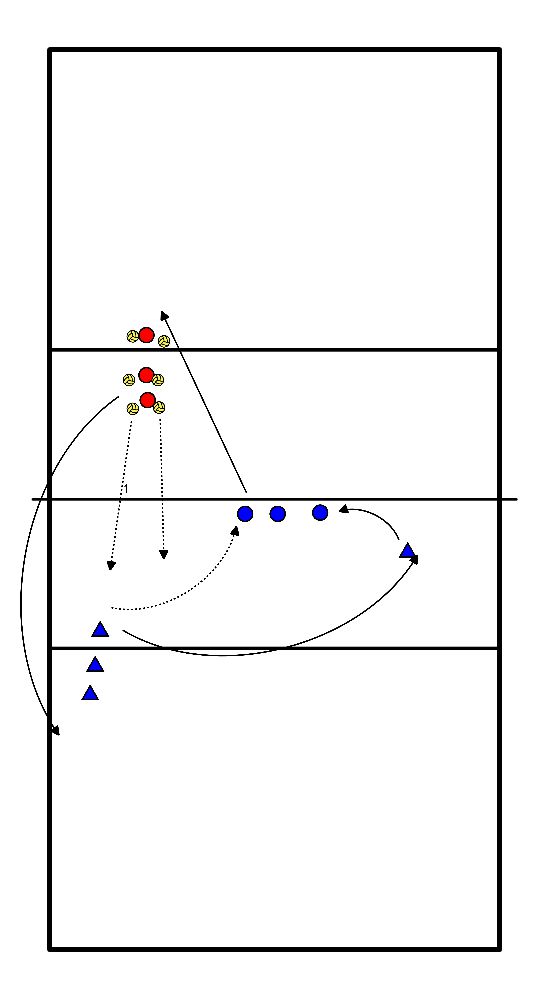
Based on: https://www.youtube.com/watch?v=QzHWyGDTMe4
- Red/round throws ball over net to triangle blue
- Triangle blue passes to circle blue
- Red/round throws his/her 2nd ball over the net
- Triangle blue passes to blue round again.
- Triangle blue sprints to position 2, sets up platform position and taps the ground.
- Rotation;
- Red around, joins passers (triangle blue)
- Triangle blue connects with catchers (round blue)
- Round blue joins round red.
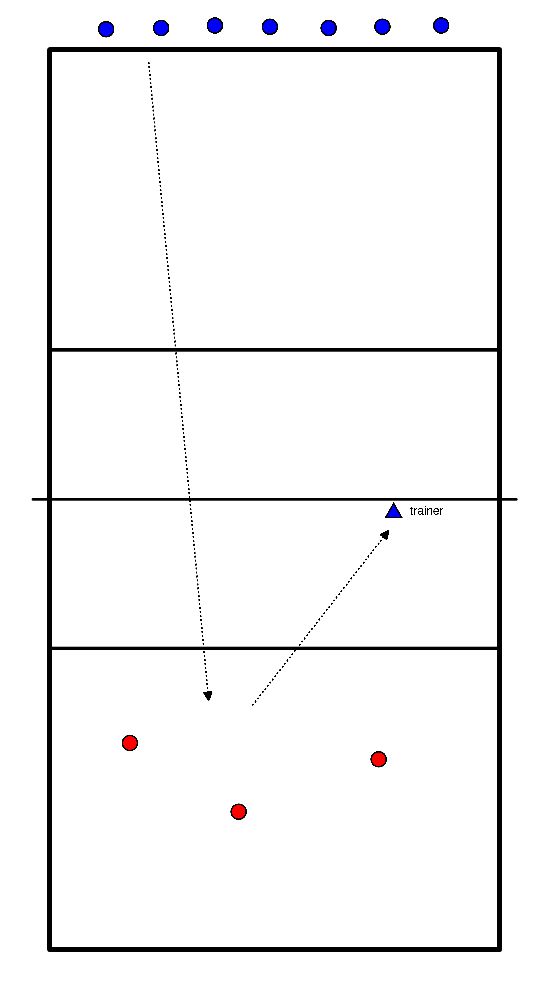
- 3 defenders at 1 side of the court the rest at the other side all with ball (server)
- Servers serve the ball, the defenders have to pass it to the TR (position 2/3)
- Change players regularly!
- Point count:
- Good serve and bad pass is 1 point, but wrong serve is deduction of one point --> servers
- Good pass is 1 point, but wrong pass is deduction of one point --> defenders
- Who is first to reach 7 points
- TR rolls the ball to the servers
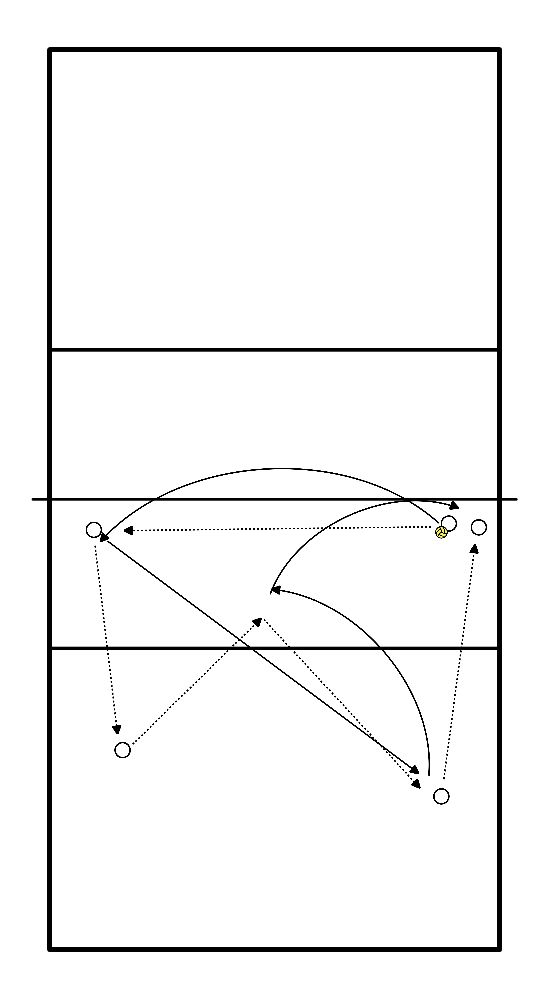
- Organization:
- Divide the group over the 2 fields.
- 2 players on pos 2 with 1 ball, 1 on 4, 1 on 5 and 1 on 1
- Execution:
- Ball is played from p2 BH to 4.
- On p4 the ball is hit technically to p1.
- The latter defends the ball at 3m p3 and at that moment the player on p5 comes and plays the ball Bh to p2.
- And it starts all over again.
- Walk:
- P2 to p4.
- P4 to p5.
- P5 to p1.
- P1 to p2.
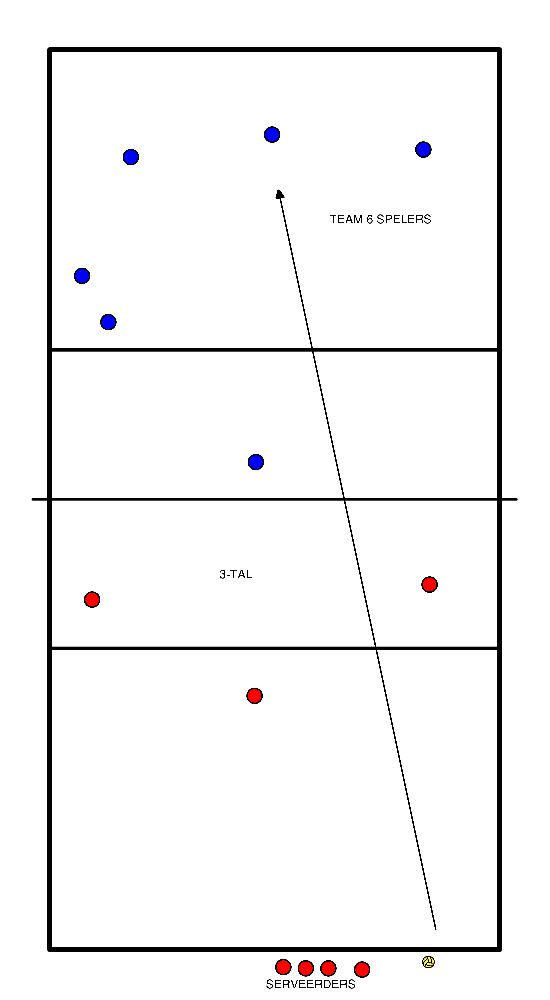
- On one side of the field there is a six in full formation.
- On the other side are 3 players.
- Behind the 3 players stand the servers.
- Exercise:
- Servers serve the ball, the 6 team defends this ball and plays out the rally.
- The 3-man team may defend and also rally.
- Point count:
- Service error, 1 point for the team that was set up.
- Ball on ground by the 3 team, point for the essayed team.
- Good service, but rally won by 3-player, point for 3-player.
- IF 3-TAL has 3 points three move on, if TEAM has 12 points, 3-tal and all servers must push up 5x.
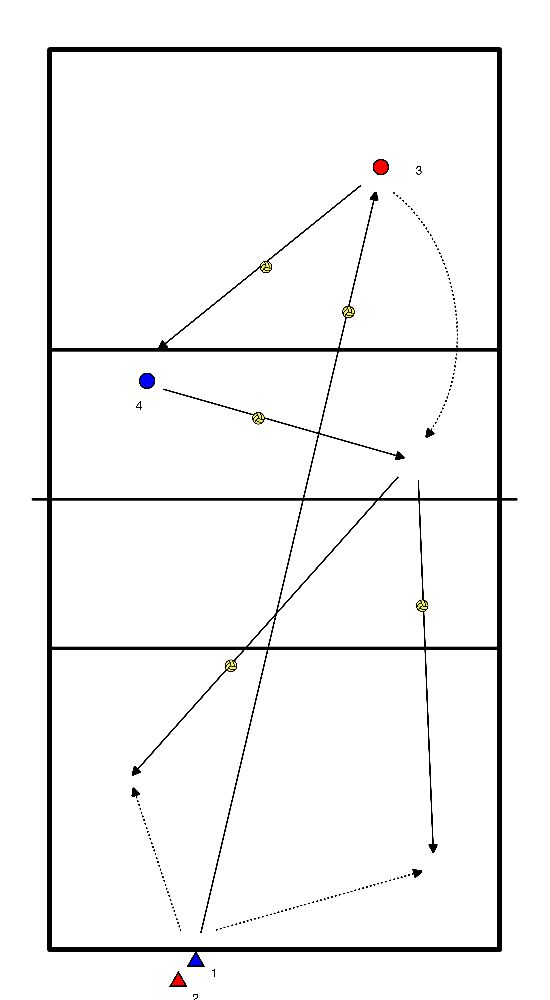
- Ball route:
- Player 1 serves to player 3.
- 3 passes the ball on 2/3 to player 4.
- Player 4 gives set-up.
- Player 3 comes for the attack.
- He hits straight ahead or diagonally.
- Agree on beforehand.
- Server (player 1) defends this ball.
- Walking route:
- After player 1 serves, player 2 serves.
- Player 3 and 4 exchange tasks.
- When one side has served twice (player 1 and 2).
- Player 3 and 4 start serving.
- Player 1 and 2 attack and defend.