



Volleyballexercises for technique passing / defense / reception
Formation
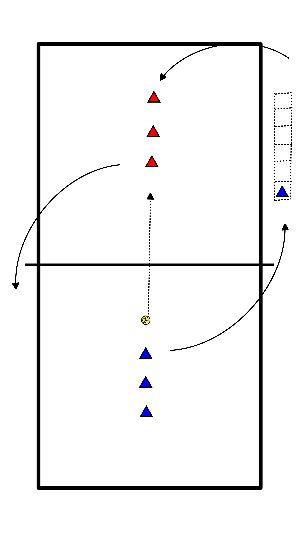
- Two lines of players: one line at left back and one line at right back.
- Create a virtual line with four cones where they must stand behind.
- The coach stands on the other side of the net.
- The coach throws the ball somewhere in the court.
- One of the two front players in the lines calls "MINE" or "I GOT IT" (agree beforehand).
- The player who calls it passes the ball to position 2 or 3.
- The other player catches the ball at position 2 or 3.
- The player who catches the ball returns it to the coach.
- Both players join the other line.
Execution
- The trainer throws the ball to the setter.
- The setter delivers a set-up to the attacker.
- The attacker must hit the ball.
- The block must be well set by the outside blocker and middle blocker.
- The defence catches the ball.
- After 10 times, the players rotate positions.
Execution
- Teams stand on either side of the court behind the baseline.
- Pairs enter the court.
- The trainer introduces the ball into play.
- The pairs attempt to score underhand against the other pair.
- The winning pair remains on the court, while the losing pair joins the back of the line.
- The team with the fewest balls on the ground wins.
Execution
- Estimate the ball trajectory.
- Shuffle backwards.
- Stand still and position shoulders correctly.
- Pass accurately to the catcher.
- 3 players stand at the net or on the 3-metre line.
- 1 player acts as the catcher.
- The trainer serves the ball.
- Players shuffle backwards and pass the ball to the catcher at position 2/3.
- The catcher catches the ball and places it in the bin.
- The passer becomes the new catcher, and the empty spot is filled by another player.
Execution
- Pass the ball in pairs.
- Use both overhand and underhand techniques.
Execution
- Divide the team into two groups.
- Have the players form two lines facing each other at the 3-meter line.
- Players pass the ball over the net and then run around the net post to join the other group.
- Place a speed ladder parallel to the sideline.
- Have the players perform a drill through the ladder before joining the line.
- Optionally extend with block jumps, attack passes, or strength exercises.
- The ball must not fall to the ground.
- Communication is essential.
- Optionally add a penalty if the ball falls to the ground.
- Alternate between underhand and overhand passing.
Execution
- Pay close attention to the execution: the pass must be high so that the player can catch the ball overhead.
- For a pass to the right, place the right foot forward.
- For a pass to the left, place the left foot forward.
- Keep the eyes and shoulders in the direction of play.
- The exercise is performed in groups of three with one ball.
- Player 1 and Player 2 stand next to each other, not too close to the net.
- Player 3 stands opposite Player 1 at the back of the court.
- Player 1 throws the ball straight to Player 3.
- Player 3 plays the ball diagonally to Player 2.
- Player 2 catches the ball and throws it straight back to Player 3.
- Player 3 plays the ball diagonally to Player 1.
- Player 3 moves after each action.
Execution
- Three players stand in the backcourt.
- The trainer stands at the net.
- The players must play the ball to the trainer.
- Use different techniques: overhead, underhand, short, deep to the back.
- Vary in power: hard balls and soft balls.
- The ball may be played in two touches.
Four Players Static
- Two servers at the service area, one receiver, one catcher.
- The server serves, the receiver passes the ball to the catcher, who catches the ball and rolls it back to the server.
- Same as static, but the player follows the ball.
- The server becomes the receiver, the receiver becomes the catcher, and so on.
- See four players.
- The server serves the ball and follows it.
- The receiver passes the ball to the catcher.
- The rightmost player becomes the catcher.
- The server shifts to the left.
- The catcher becomes the server.
- If this does not work, one receiver becomes a reserve.
Execution
- Warm-up hitting on the outside and middle positions.
- Except for the setter, the other players consecutively perform a pass, an attack, and a serve.
- Player 1 throws a firm ball to player 7.
- Player 7 passes the ball to the setter.
- Player 1 moves to the other line and joins at the back.
- The setter delivers a set to player 6.
- Player 6 spikes the ball straight onto the mat.
- Player 6 retrieves their hit ball.
- Player 6 serves the ball to the other mat.
- Player 6 retrieves their ball.
- Player 6 joins the line.
- This can also be done with a middle attack.
- After 10 minutes, a block is added.
Execution
- Alternately throw the ball to the partner.
- After throwing, touch the backline and return to the same place.
- When the throwing goes well, switch to underhand passing.
- Later switch to overhead passing.
Execution
- Line up players behind the end line.
- The first player lies on their stomach.
- The trainer stands on the opposite side of the net and hits the ball as a signal to start.
- The trainer throws the ball over the net.
- The player quickly stands up and passes the ball to the setter at the middle front position.
- The setter catches the ball or retrieves it and returns it to the trainer.
- The passer now becomes the new setter.
- Try to maintain a high tempo throughout the exercise.