




Handballexercises
Last update: january 2026
Objective
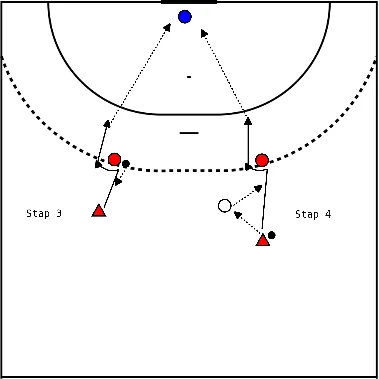
- Learn and refine a new variant of passing movement: turning to the left (against the shooting arm).
Execution
- Place a defender (pole, dummy, player).
- Use a goal or cones as a target, with a goalkeeper in place.
- Work in groups of 2 or 3 players.
- Start first without a ball, then with a ball.
Rules
- After throwing, retrieve the ball yourself.
- You receive the ball in the jump so that your two-foot landing counts as a zero step.
Points of Attention
- Technical: Right-handed player: after the two-foot landing, turn backward with the right leg and place it down. Take one step with the left towards the goal. In the turn, already bring your arm into shooting position (so lift it up). Stay as upright as possible. Push off with your left leg and make your jump shot at the goal. A left-handed player does this exactly the opposite way.
- Tactical: Make your zero step as much as possible on the right side (right-handed player) of the defender.
- Physical/Mental: Optionally create a line for left-handed and right-handed players, continue one after the other.
Build Up the Exercise in Difficulty
- Step 1: Without a ball (defender is a pole).
- Step 2: With own ball dribbling (defender is a pole).
- Step 3: Receive the ball from the defender (defender is a player).
- Step 4: Receive the ball from a teammate.
- Step 5: Two lines opposite each other. You cross in the middle and after the passing movement, pass the ball to the front player of the line and join the back.
Extra Challenge
- Players who can already do this well can also practice turning towards the shooting arm. Right-handed player: after two-foot landing, turn away with the left leg and make the last step with the right towards the goal. Left-handed player: after two-foot landing, turn away with the right leg and make the last step with the left towards the goal.
Execution
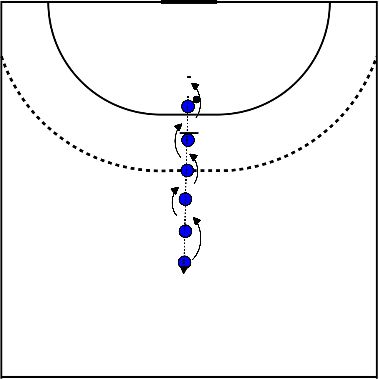
- All players stand in a row at approximately one arm's length apart with their legs wide.
- The first player rolls the ball between the legs of the others to the last player.
- Then everyone lies flat, and the last player jumps over everyone with the ball.
- When the player reaches the front, all players stand up again with legs wide, and the player rolls the ball to the back.
- This exercise can also be performed as a competition with two teams. Who can get all players to the front the fastest?
Setup
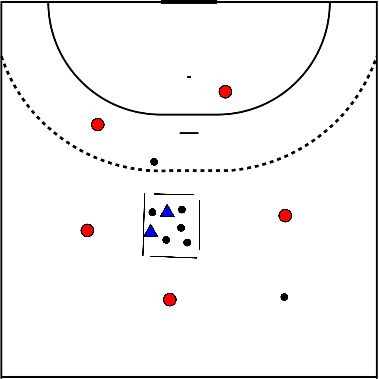
- Four benches form a square against each other.
- One to two players stand inside the cage (four benches) with ten balls.
- Four to six players stand outside the cage with ten balls.
- The players inside the cage try to throw all the balls out of the cage. They may only throw the ball once they step outside the cage.
- The players outside the cage try to get all the balls into the container by running or dribbling and placing the ball in the cage, not throwing it.
- The player with the fewest balls after one minute wins.
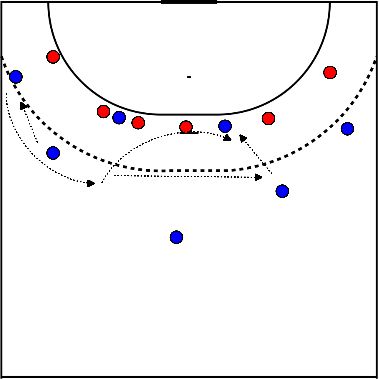
Execution
- The left backcourt player passes the ball with a bounce to the wing player.
- The wing player returns the ball to the left backcourt player.
- The left backcourt player puts pressure on the defence.
- The wing player moves behind and receives the ball.
- The wing player passes the ball to the right backcourt player and waits briefly.
- The wing player starts towards the circle between positions 3 and 2.
- The wing player receives the ball from the right backcourt player and finishes on goal.
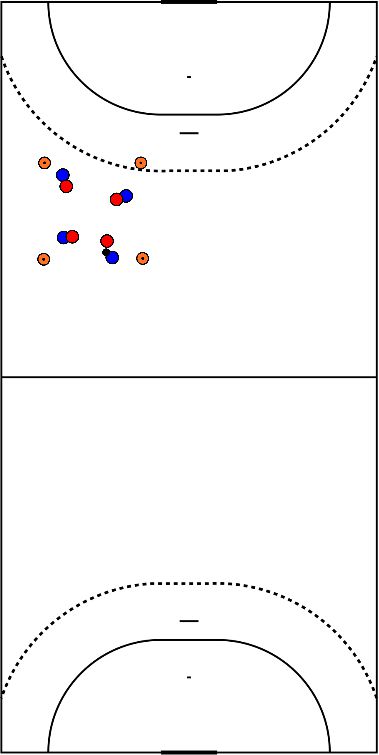
Description
- This game can be played as a final game, during training, or as a warm-up. It is appealing because it can be easily differentiated and changed.
Execution
- Two teams are formed in an area of approximately 10 by 10 metres. One team starts with the ball and tries to pass it 10 times to a teammate.
- The other team tries to intercept the ball and then also pass it 10 times.
Variations
- Make the field larger or smaller.
- Use a different way of passing, such as mandatory bouncing or through the air.
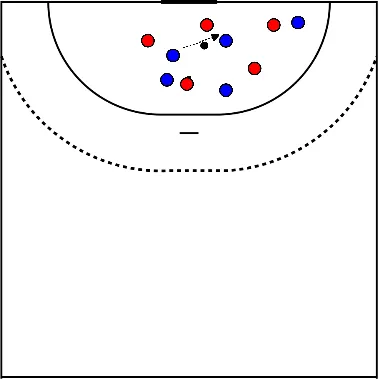
- This is best restricted to inside the 6 meters area.
- This game is best played with the same number of players in both teams.
- Make it harder by making the play between the 6 and 9 meters and the defenders can only do side step/shuffle Objective of the game:
- get the youth used to contact in handball Divide the players in two teams with roughly equal numbers and abilities (don't put all the big and good players in one team and the rest in the other)
- The players play the 10 pass game.
- No passbacks allowed.
- The defending team will try to stop the attacking team by placing 2 hands on their chest and arm and holding (measure the level of aggressiveness and adjust).
- If they are successful it's a turnover.
- Then start over with the same rules.
- Make it harder by instead of being two hands, being a tactical defence hug and holding 3 seconds.
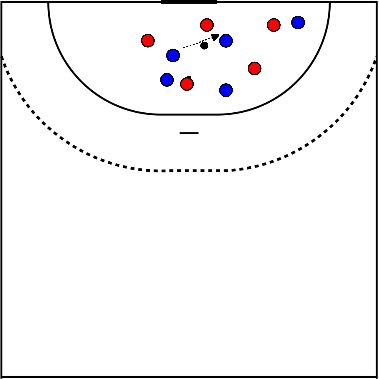
- This is best restricted to inside the 6 meters area.
- This game is best played with the same number of players in both teams.
- Make it harder by making the play between the 6 and 9 meters and the defenders can only do side step/shuffle Objective of the game:
- get the youth used to contact in handball Divide the players in two teams with roughly equal numbers and abilities (don't put all the big and good players in one team and the rest in the other)
- The players play the 10 pass game.
- No passbacks allowed.
- The defending team will try to stop the attacking team by placing 2 hands on their chest and arm and holding (measure the level of aggressiveness and adjust).
- If they are successful it's a turnover.
- Then start over with the same rules.
- Make it harder by instead of being two hands, being a tactical defence hug and holding 3 seconds.
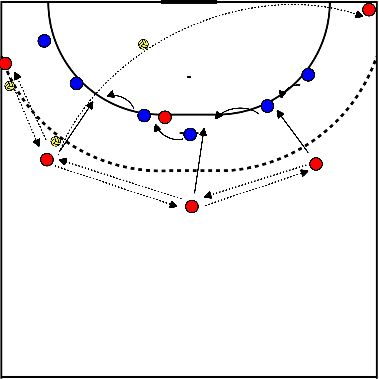
This is a coordinated minus tempo attack to create a lot of space on the wings and shoot freely.
- The back players rotate the ball wing to wing to displace the defenders.
- When the play gets called "Minus tempo Left/Right" this means it will be the left or the right winger to shoot.
- If the call is Minus tempo right, then it will be the right winger to shoot, as in the example below.
- The first step is the pivot places themselves on the 3 defender, near the left back, displacing the central defenders slightly to their right already.
- The right winger then goes deep to near the corner flag to open up as much as possible.
- The left back passes to the left wing, who passes back to the left back, passing to the centre, to the right back, to the centre back again, back to left back, and back to left wing. All these passes will create space by themselves.
- Once the ball leaves the left wing again, the left back makes a run to goal with the ball attacking between 2 and 3, the centre back does the same attacking around the other 3, and the right back as well attacking between 2 and 1, closer to 2.
- These runs have to be coordinated to displace all defenders. This will make it so the defenders 1 and 2 on the right side will close on the right back, and the wing will be free.
- The left back then jumps and passes across the court to the free winger who has started running and has enough momentum and angle to score.
- If the defenders don't move then there's several other finishing options. If the second 3 defender doesn't close the pivot, the pivot will be free.
- If the second 3 closes the pivot, but the 2 defender doesn't close on the centre back run, then the centre can score. If the 2 defender closes but the 1 defender doesn't close, then the right back scores.
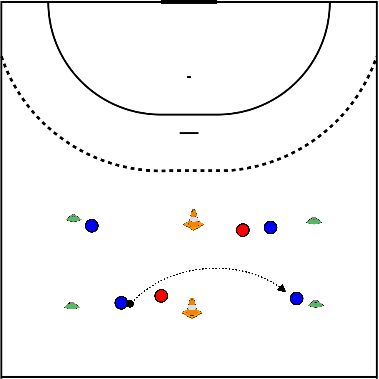
This can make use of an existing outline of a badminton field's lines, or be created with cones.
This serves 3 purposes:
This serves 3 purposes:
- Passing
- Moving to receive the ball
- Defense
- You will need 3 pairs of players.
- Two pairs on opposite ends of the delimited area trying to pass the ball to each other, and one pair in the middle intercepting.
- The pairs on each end, can not pass to their partner, they have to pass to the other pair at the other side of the court.
- They can not pass the centre point.
- The defending pair will either try to touch the person with the ball, or to intercept the pass.
- Once the defending team succeeds in one of these, then they swap.
- If the pass is out of bounds, they also swap.
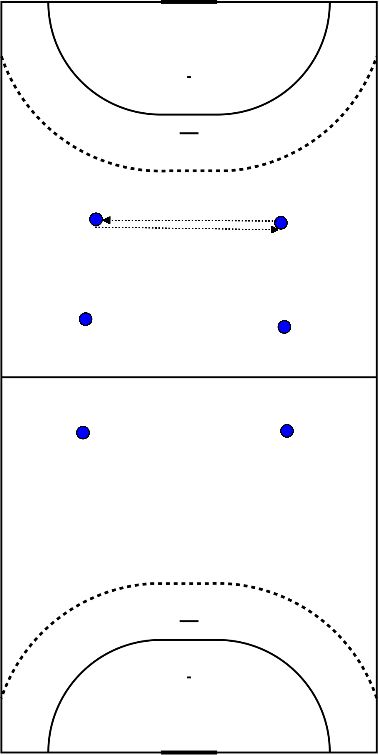
2 and 2 and 3 balls per group
- Start with 3 balls per group. 1 ball on the ground and played back and forth with the feet, while the other 2 are passed back and forth. Never hold the balls in hands for more than 1 second, always pass back immediately. Don't be nice to your partner, challenge them.
- Then have 2 balls, with 1 player holding the ball in hand. Throw the ball up and while it's in the air, pass the other ball back and forth once. Make it harder by trying to pass 2, then 3, then 4, then 5 times while the ball is in the air.
- 2 balls per group - 1 player starts with both balls. Throw 1 high ball and during that time, quickly pass the other ball. The second ball should be caught before the high ball is caught. Add the challenge of passing the quick ball back.
- 3 balls per group - 1 player starts with all the balls. Throw them in an arc, one by one. All 3 balls should be in the air at the same time and then caught by the receiver.
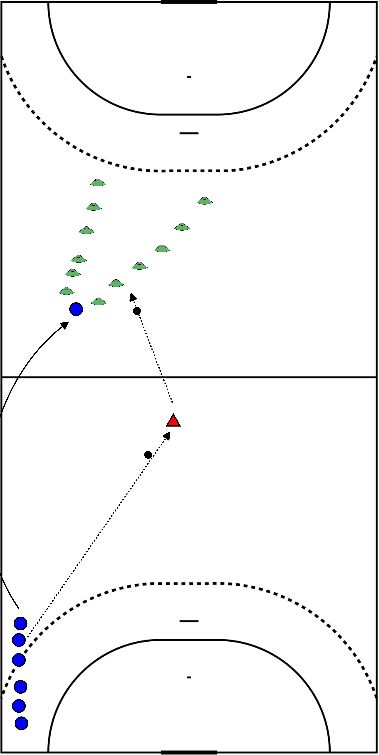
The players form a line at one end of the court.
- The 2nd player on the line passes the ball to the coach who will be between the centre of the court and the 12 meters.
- The 1st player on the line runs as soon as the pass is made.
- The coach will then pass the ball to the front of the 1st player who is running towards the opposite goal to receive the ball.
- The pass will not be towards the player's hands, but rather to a step in front of where they are, so they continue accelerating.
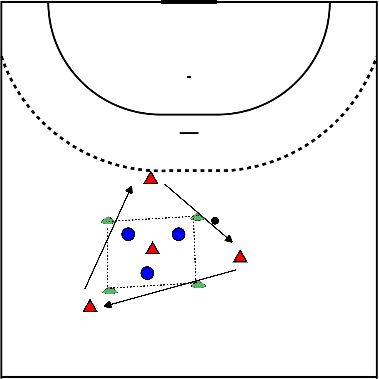
- This can be done with groups of 5 up to 9.
- Let's take a group of 7
- Delineate an area where 4 people can stand and move around with a bit (not too much) room. Place 3 defenders inside, plus 1 line/pivot.
- The remaining 3 attackers will pass the ball around outside the area, with no bounce, and they score a point by either:
- Passing the ball effectively to the pivot
- Placing the ball inside the area without being touched by a defender
- The attackers can move freely, but limited to the 3 steps, 3 seconds with ball in hand, and no bounce.
- If these rules are broken, they become the defenders.
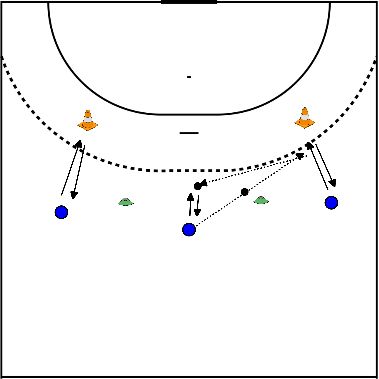
This can be done in groups of 2 or 3 players.
- This is to get used to receiving the ball in motion, facing the goal.
- This is a passing exercise as well.
- Let's take a group of 3 players.
- There will be two cones on the floor, at around 10 meters, on each side of the centre back, and 2 cones at the 7 meters in front of the half backs.
- The centre back has the ball, and for the half back to receive the ball, they need to start behind the cone of the 10 meters, and run in front of it.
- The centre back can only pass the ball in the direction after the cone. Once the half back receives the ball, they will do two/three steps towards the 7 meter cone, stop, and pass the ball back to the centre half who must start before the 10 meter cone and receive the ball after it.
- The half back then returns to their spot and the centre back continues the exercise with the other side half back.
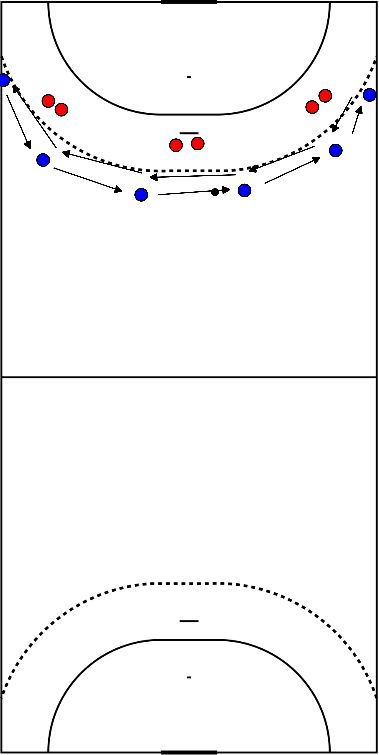
- Depending on how many players there are you can use the full 6/9 meters or just a part of it.
- The defending players will hold hands two by two (so if there are 6 players, there will be 3 groups of 2).
- The attacking players will pass the ball around between themselves and around the area trying to "destabilise" the defence and find a gap so they can run in and touch down with the ball in the area.
- If the 2 groups of the defending players touch the attacker, the point does not count.
- if only 1 of the groups of the defending players touch the attacker, the point counts.
- If none of the groups of the defending players touch the attacker, it counts 2 points.
The goal is to get to 8/10 points (depending on how many 2 points they score) and then swap.
- If there's few players, shorten the court and if there's an uneven number, the defence stays with one less.
Pay attention:
- No lob passes
- No more than 3 passes
- No bounce (if possible)
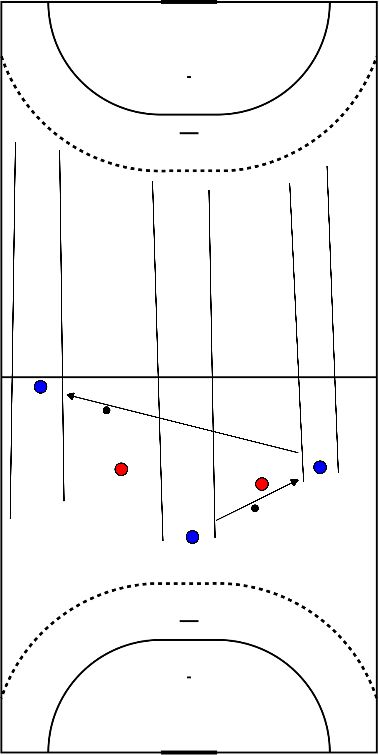
This can be done with groups of 3 to 7 - odd numbers ideally.
- Let's assume a group of 5 players.
- We'll have 3 attackers and 2 defenders.
- The 3 attackers will have a delimited running corridor in a straight line and they will have to pass the ball from one to the others while the 2 defenders will have to try and intercept the passes. The defenders have freedom of movement.
- The exercise can evolve in the types of passes in order to foster movement without the ball.
- First all types of pass, then no lob passes, then only bounce passes.
If the defenders intercept the pass, they continue the exercise acting as the attacking players in numerical inferiority. The 3 attacking players now have no restriction of movement.
This is to be done slowly at first, not as a fast break, to instill the idea of moving without the ball first. The speed can be adapted as the exercise goes on.
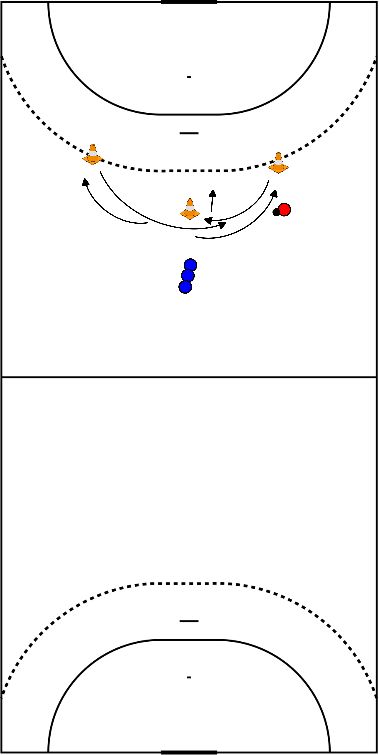
- You put 1 player at the 1 meter, of the 9 meters, at the buildup position.
- Put 3 pawns:
- 1 pawn on the center 2 meters from the 9 meters.
- 2 pawns left and right on the 9 meter line, 3 meters from the middle pawn.
- Player starts in to the right pawn with ball, plays off to the builder.
- Runs backwards around the middle pawn and receives the ball between the 2 pawns.
- Plays the ball back, comes around the middle pawn, gets the ball back and rounds off with a jump shot high.
Everything in high tempo.
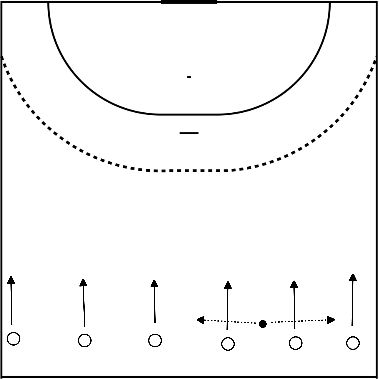
Ball moves from left to right and back again as the group moves on 1 line to the other side of the field.
Additional extension of this exercise:
Additional extension of this exercise:
- Trainer names a player.
- Player calls left or right player by name and switches positions. Fellow player crosses behind.
- Both with and without ball.
The players learn in this way to coach each other, to see each other and not only to pay attention to the ball. Can be used as warming up as well as coaching training.
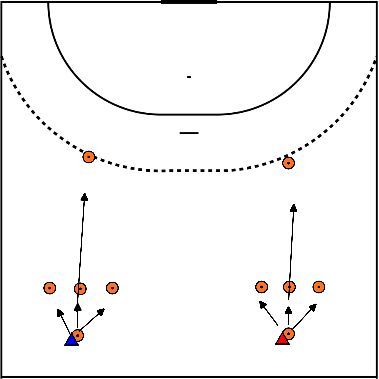
- Line up at the center line
- 2 players start at the same time
- Fast forward to the first pawn on the left, tap and reverse
- To the other pawn on the right, tap and go backwards
- To the pawn in the middle tap and go backwards
- Go around the starting pawn
- Sprint to the other side
- Then make 2 teams > relay race. When you reach the other side, go back outside and tap the next one. Ready is sitting.
- 2x without ball
- 2x with ball;
- 1st time only to the other side and back is bouncing.
- 2nd time also to the other 3 pawns.
The team that loses performs an exercise that the winning team comes up with. Such as; push-ups, frog jumps, abs, jumping squats, etc.
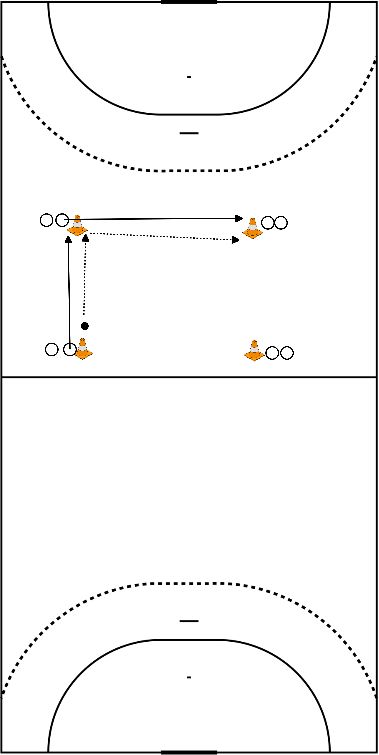
- You plot a square with the desired distance to fit.
- Each corner has a pawn.
- 1 ball is needed.
- One player starts and throws the ball clockwise to the next corner. Then runs to the next corner chasing the ball.
- This is how the square goes around.
Possible challenges:
- Throwing clockwise and running counterclockwise.
- With 2 balls.
- With 2 balls throwing diagonally and crossing. Beware of other players.
- With bounce.
- With connecting passes to the next corner.
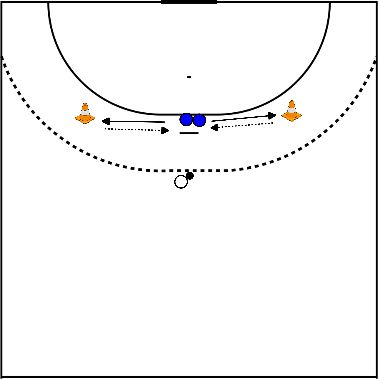
- 2 defenders slide toward the cone
- Defenders slide back toward the middle
- Defenders block the shot of the center player
- Repeat exercise until all players in the middle have had their turn
Variation:
- Depending on the size of the group
- Place 2 players on the build-up position
- Defenders step out on the build-up position
- Make contact with the throwing hand
- Move back to the middle to set up a block together
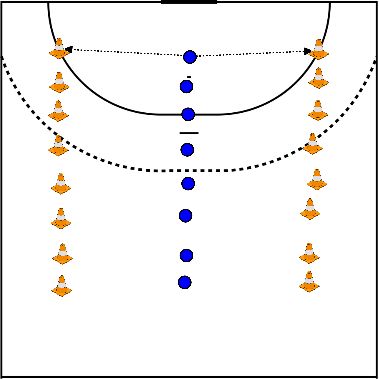
- All players stand back to back in the center of the playing field.
- Each player has a pawn or hat on either side.
- When instructed by the trainer, players move into place at a fast pace.
- At a whistle and direction from the trainer, players sprint to a pawn and back to their starting spot.
- Repeat several times, sprinting various directions.
- Rest.
- And repeat the exercise one more time or times depending on the level of the players.
- Option: With ball.
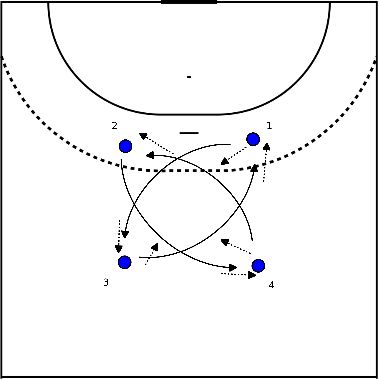
The exercise starts from player 1.
- Player 1 starts around toward player 3, receives the ball from player 2 and passes to player 3.
- Player 2 starts around toward player 4, receives the ball from player 3 and passes to player 4.
- Player 3 starts around toward player 1, receives the ball from player 4 and passes to player 1.
- Player 4 starts around towards player 2, receives the ball from player 3 and passes to player 2.
- etc.
Variation:
- 2 balls.
- Change direction.
- Pass behind the back or with a jump throw or with a bounce.
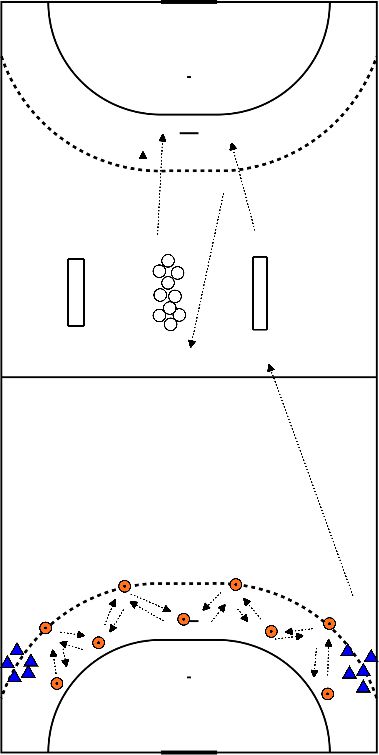
- Both sides start with a medicine ball in extended arms stepping out onto the pawns.
- When you get back to the corner you run to the bench, there you grab a ball and sprint onto the bench with two legs at a time.
- When jumping off the bench the bench is between your legs.
- You have your arm in a shot position.
- When you have had the whole bench you take three steps and shoot at goal.
- Quickly get the ball again and then jump into the hoops with two legs in each hoop.
- Then shoot at goal again and get the ball.
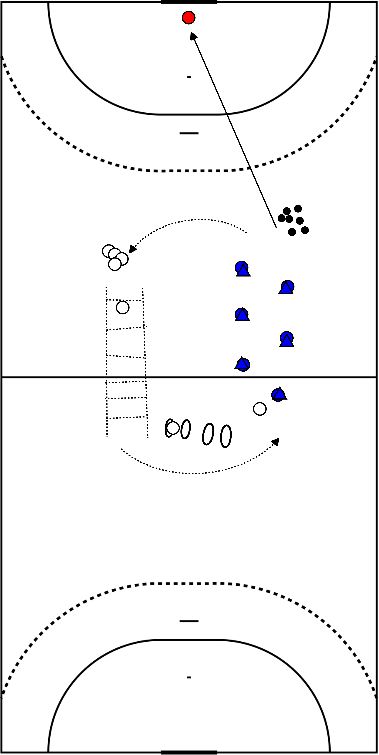
As a child, it is good to learn young how to jump up or what fast footwork is, in this exercise you can use both.
- A player starts at the running ladder,
- Here, he or she carries out the task which is explained.
- Then after the step ladder, the player continues to the next obstacle,
- Here, the player jumps over the jump with one or two legs at the same time.
- Then the next obstacle, the player continues to the pawns,
- Here, he or she goes sideways past the pawns.
- If there is a goalkeeper present, you can choose that the children, after moving the cones, take a ball and may throw it in a 1 against 1 with the goalkeeper.
- Then the ball is put back and they join in at the back.
There are different variations to think of for each obstacle, so it remains attractive and you can keep doing it for a reasonably long time.
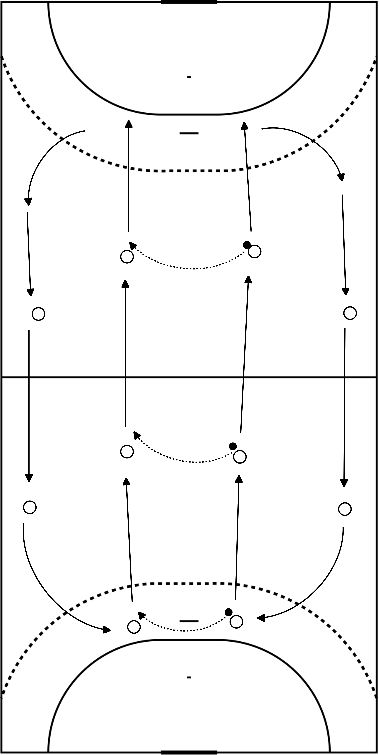
- You make pairs.
- Both persons stand on the circle at the same height as the poles.
- You run with 1 ball per pair to the other side of the circle.
- While running to the other side you throw the ball to each other.
- When you're on the other side you run back to the other side.
- Variation:
- Overhand throw.
- Knee-down passing.
- Passes with jump shot.
- Sideways jump to the opposite circle.
- Cross pass to the opposite circle.
- Accelerated pass. (50, 60, 70, 80 %)
- Sprint.
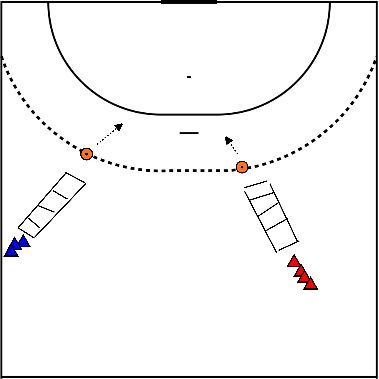
- From the left and right set-up positions, two ladders are laid out diagonally.
- The group is divided over the ladders, the goalkeeper stands on goal.
- The group on the left hand side starts with the ladders.
- After the last ladder they make a zero pass and finish on goal with a jump shot.
- When the first of the left group has reached the halfway point, the first of the right group starts.
- Variation in the laddering:
- 2 legs high speed through the ladder
- 2 legs in the ladder, then out ( jump )
- 2 feet on the ladder, 2 feet next to the ladder (dribbling).
- 2 passes to the front 1 to the back
- You can also place a passive defender for the players to shoot over.
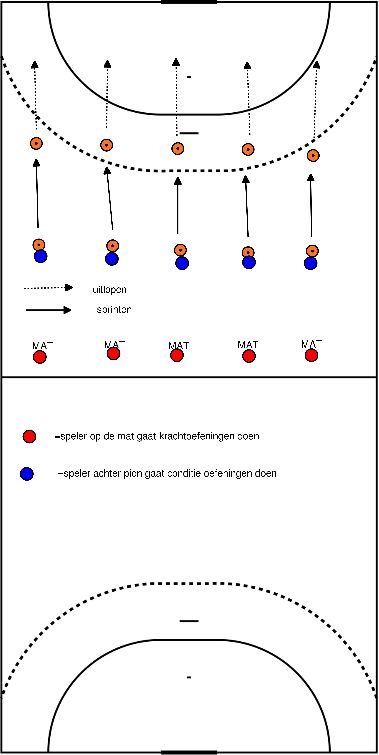
- One mat in pairs or one mat for everyone if there are not too many players
- You work in pairs or alone
- One is mainly working on fitness, the other on strength.
- You do it for 15 min.
- The one doing strength is leading, the other is working on the condition until the one doing strength is done you continue with your condition exercise.
- 20-18-16-14 etc.
- person power has the mat:
- squat with weight
- abdominals,
- push-ups.
- planks
- abs sideways / on the side supported by foot and forearm / first one side then the other can
- condition
- sprint between 2 pawns then calmly walk out / repeat a few times