





Handballexercises for technique attack / offense
Last update: january 2026
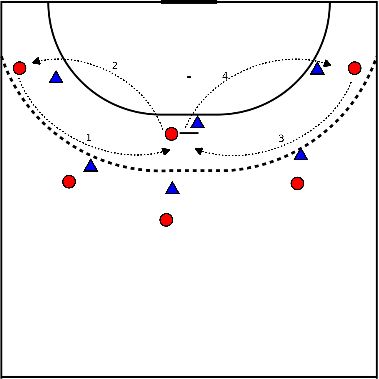
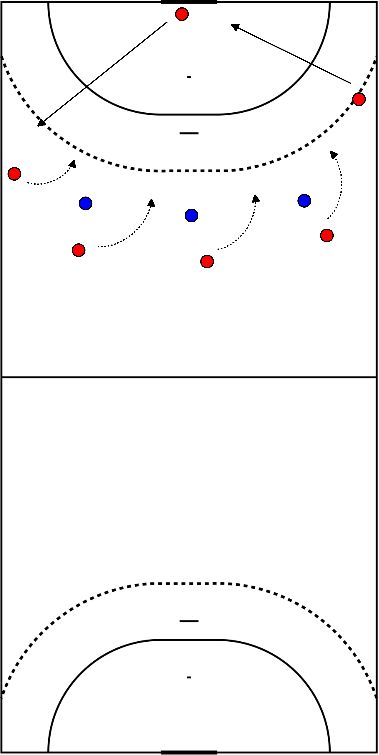
- Little 8 is the change of circle with the corner players.
- Middle build-up indicates which system is started. At small 8 the corners and circle start running;
- The right corner takes the initiative and runs towards the position of the circle (can be with or without ball!), the circle runs towards the corner and perhaps takes a defender with it. This may free up the circle which can be played through the build-up. If not, the substitute moves on to the other corner, until either a goal is scored or everyone is back in his/her own place.
- Important is watching each other's timing, not getting in each other's way and correct passing with bounce by the builder.
- Practice start with passive defenders, then active
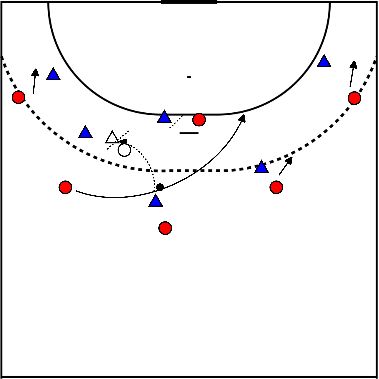
- Middle build-up indicates moment and system starts at Left corner
- Right corner goes deep
- Right corner takes up its position more to the right and applies pressure
- Left corner puts pressure
- Left corner puts pressure and walks backwards
- Center structure puts pressure on the left with the aim of taking center defender with it and then barricading/holding it with it
- Circle runner secures circle defender
- Left post runs behind Center post and receives the ball
Note: Right corner and Right build-up also put pressure to the right to keep defender with them so that Left build-up gets space
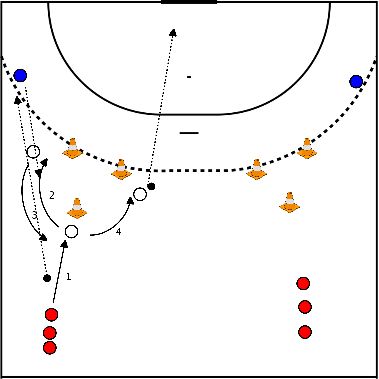
Goal of the exercise
- In this exercise, we improve our footwork during pressure and in rounding.
Exercise
- On the buildup positions, 3 pylons are in the point to the back.
- The 2 front pylons are at the 9 meter mark.
- One focal point stand beyond the pylon in the middle.
- Players play the point of attack and run without the ball towards the left pylon, in the forward motion they play the ball, in the backward motion they get it back.
- Players run around the back pylon and push again, this time they finish on goal
Variation
- Exercise can be performed at left build and right build position at the same time.
- After finishing, switch sides.
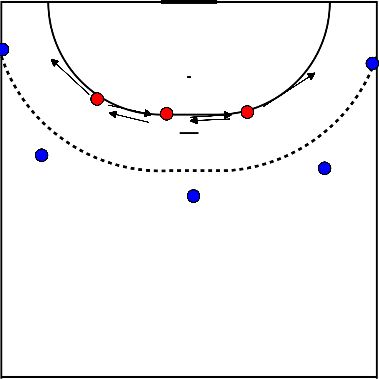
- 5 attackers and 3 defenders
- The ball starts at the left corner which puts pressure and from there the pressure continues.
- The defenders make considerable contact with the attackers by pushing the hands on the shoulders/ hip.
- The attackers pass in time and keep the ball high.
- When there is not enough defense, the attacker continues.
- Eventually the corner rounds the corner.
- Then the ball goes from the other corner and pressure is played.
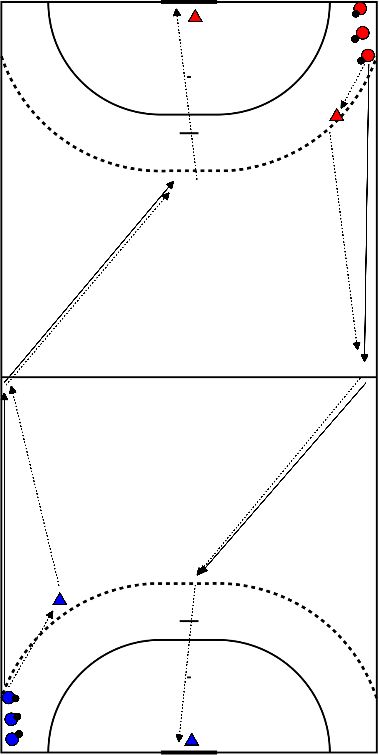
- Group split into the left corners next to the 2 goals.
- All players have a ball.
- The front player in the line gets to roll her ball away and chooses position on the 9 meter and starts to function as the point of play.
- The front player of the line plays the point of play, paces towards the center line, gets the ball back just before the center line.
- Catches the ball with 2 hands, makes 3 passes and then starts to tip.
- See drawing for correct running direction.
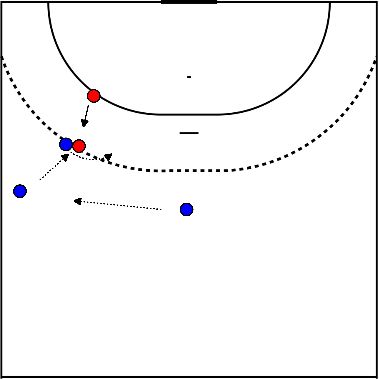
- 1 defender on the build-up position
- 1 attacker on the build-up position
- 1 center builder
- Builder throws ball to the middle builder, middle builder puts pressure to the middle and plays the ball to the builder coming in at speed
- Builder keeps 1 to 1.5 meters distance from the defender
- Steps with left, body moves with him, then to the right past the defender fires with left and finishes.
- This must be done at speed.
- Other feints are also allowed as long as they are quick and convincing.
- Other feints are also allowed as long as they are quick and convincing.
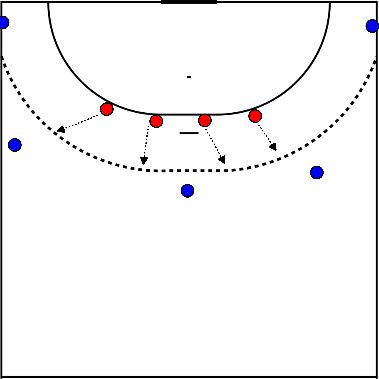
- All players in usual position - no circle
- The remaining players are in the defense
- The ball comes from the corner and it puts pressure between 1 and 2
- Construction puts pressure between 2 and 3
- Thus the ball continues to the other corner.
- Defenders may really defend to about 8 meters.
Points of attention:
- Left - and right builders put good pressure and go right back again at 11/ 12 meters and sideline.
- Pass the ball at pace without being caught.
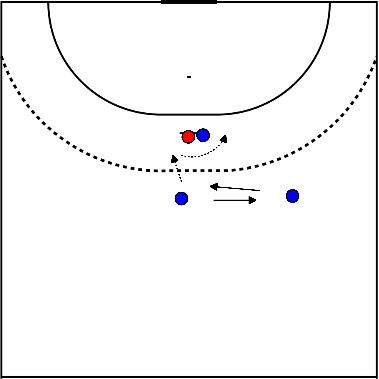
1 defender and 1 circle at center.
1 center builder and right builder
- Middle has the ball and plays to the right build-up player, who gets the ball back at pace.
- Makes feint to left and passes to right.
- Defender steps out and circle tries to barrage.
- Circle prevents the defender from reaching the middle player.
- Middle builder passes at speed and rounds.
Variation:
Circle player runs diagonally back after the barrage and receives the ball from the middle builder with a bounce and rounds.
Circle player runs diagonally back after the barrage and receives the ball from the middle builder with a bounce and rounds.
- In pairs facing each other.
- Defend by walking toward each other and:
- bringing hands to shoulder height
- tapping each other in the air with the hands - jumping
- touching each other in the air with the chest
- stopping each other with the hand in the side
Exercise 2:
- 3 defenders: left builder, left player, right builder.
- 2 attackers at each position.
- The ball leaves on the corner running in, passes to the Left builder.
- This Left builder passes pass to Center player.
- Defenders go out to attacker and shuffle back off to place.
- Attackers run backwards and may not stand still.
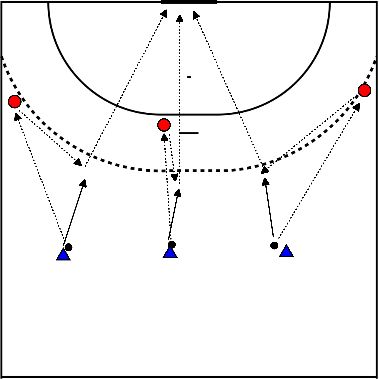
- 1 player per corner without ball as a focal point
- 1 circle player without ball as a focal point
- Distribute the rest of the players with ball over the construction positions
- Ball owner plays in motion to point of play, runs on, gets the ball back and shoots from outside the 9 meters at goal
- Initially shoot from a run or long shot, then with a jump shot
- For rounding, pylons can be placed in the corners of the goal
- For aiming high, the goal can be imaginary divided into 4 areas, with aiming in the top 2 areas
- Give lots of shots and then 1 on 1 tips for improvement
- The goal is to try a lot
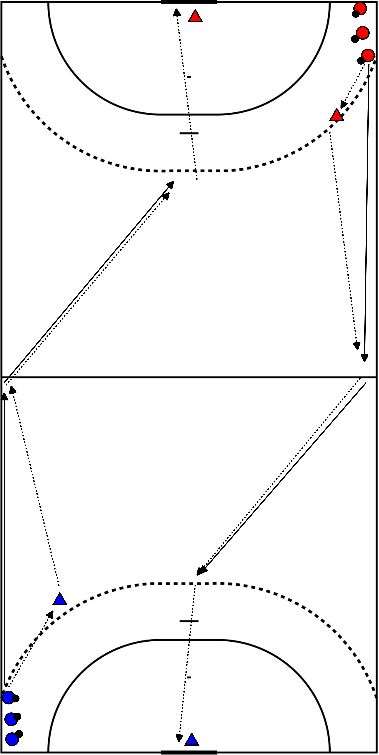
- Group split into the left corners next to the 2 goals.
- All players have a ball.
- The front player in the line gets to roll the ball away and chooses position on the 9 meter and starts to function as the point of play.
- The then front player of the line plays the point of play, makes pace towards the center line, gets the ball back just before the center line.
- Catches the ball with 2 hands, makes 3 passes and then starts to tip.
See drawing for correct running direction.
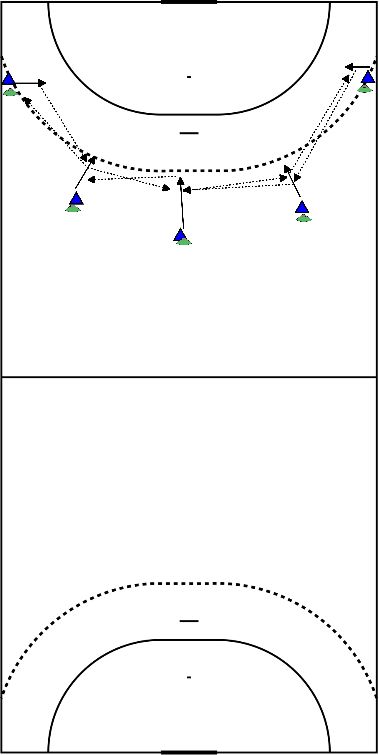
- Except for the circle, occupy all offensive positions.
- The ball starts with the middle builder.
- The middle builder starts in toward goal and plays off to one of the players next to him/her.
- The player next to him/her is already moving toward the goal while catching the ball.
- The player stays in the forward motion and then plays through to the corner player next to him/her.
- The ball again passes through the builder back to the center.
- Then the ball goes to the other corner.
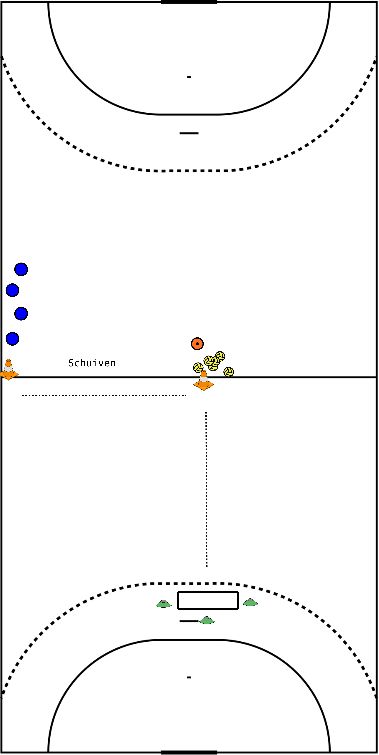
- All balls at the center line.
- Make 2-pairs.
- On the sides of the center line at the edge of the field there will be 2 Pylons, in the middle near the balls there will also be a pylon.
- You calmly roll/bounce the ball to the goal side. Throw the ball in such a way that the players can still catch it!
- After you have thrown or rolled the ball, the players on the sides of the field must first slide across the center line toward you. From the post in the middle they may only start running towards the ball.
- If you score, your team has a point; the first to 10 points wins!
- If 1 person is left, have the person catch the balls and always pass them to you.
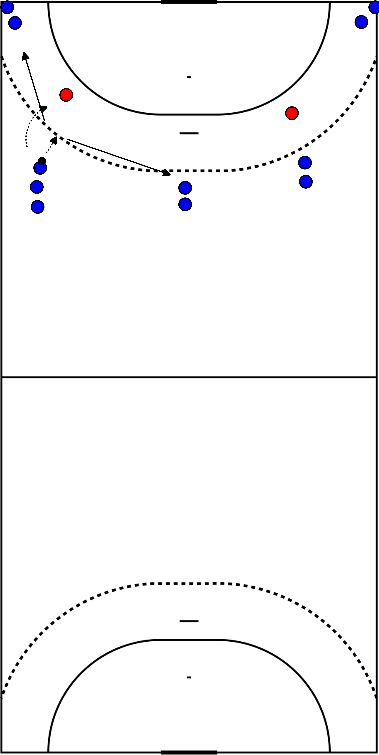
- All players divide into the corners and buildup positions.
- There are 2 defenders, 1x LO and 1x RO. They defend first passively and later actively.
- The left builder:
- Plays the ball to the corner.
- Starts in and gets it played back.
- Plays through to the middle at pace.
- Runs diagonally back to the sideline.
- Starts in and makes a passing move past the defender.
- The same happens on the right side.
- The left builds up:
- Plays to the corner.
- Gets it back and plays through to the middle.
- Middle starts up as does the builder.
- Corner starts in and gets the ball (with or without bounce).
- Defender defends passively.
- Corner tries to pass.
- Same on the other side.
- The left builder:
- Plays ball to the middle.
- Gets it back and plays to the corner.
- Corner starts putting pressure and so does the builder.
- Middle finishes by jump shot or passing move.
- Defender is active right away. If ball goes through LO, LO defender is active, and vice versa.
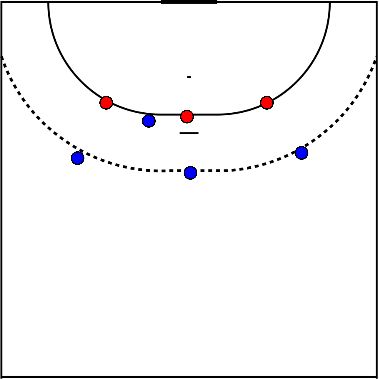
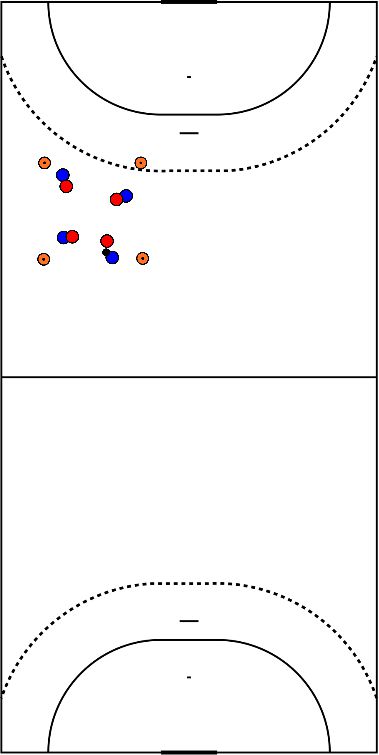
- 3 defenders, 3 attackers, 1 circle player.
- So you are playing 3 against 4.
- The attackers threaten to go towards goal and go for each other.
- They try to score with a jump shot or to play the circle runner.
- The circle runner tries to set a barrage and the attackers play around at a high pace.
- Defenders get out and keep an eye on the circle runner.
Explain in advance that what a barrage means and in what ways you can barrage.
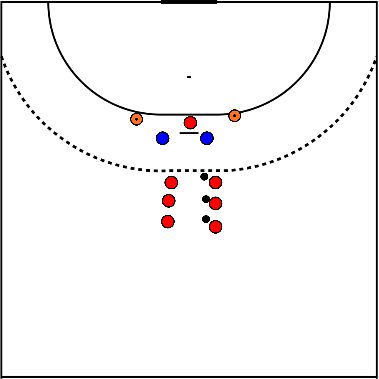
- An attack is played between 3 attackers and 2 defenders.
- The attack is played on a slightly wider field than the posts (about 6 meters)
- The goal of the attackers is to complete the attack, this can be done via an action or via the circle.
- The goal of the defenders is to prevent the attackers from finishing.
- The circle player stands on 2 and tries to get the builder to finish.
- The set-up player should not come too far inside the circle so that she does not end up in the middle.
This game can be played as an end game but also during training and as a warm-up, which makes it appealing, especially since you can differentiate and change it well.
- Two teams are made in a square of about 10 by 10.
- One team starts with the ball, the goal of this team is to pass the ball to a teammate 10 times.
- The goal of the other team is to intercept and pass the ball 10 times.
This game comes in different situations.
Examples are:
- Larger/smaller field
- Different way of passing (MUST via bounce, MUST through the air).
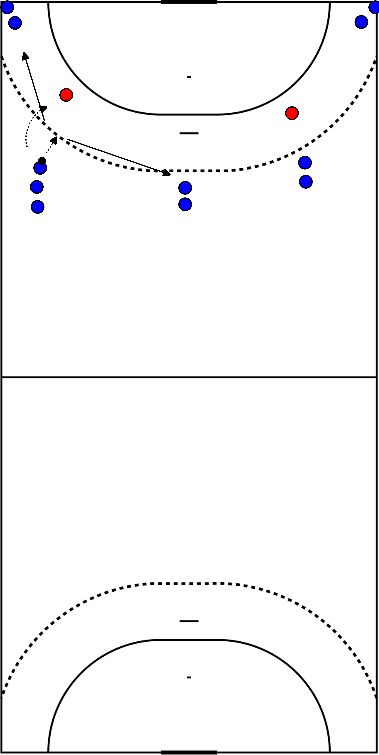
- Everyone divides up into corners and build-ups.
- There are 2 defenders on the left and right set-up positions. They will first defend more passively and then more actively
- 1. The left wing formation:
- Plays the ball in the corner,
- Starts in and gets it back,
- Passes at pace to the middle.
- Runs diagonally back to the sideline,
- Starts and makes a passing move past the defender.
- Same thing happens on the right side
- 2. The left formation:
- Plays to the corner,
- Gets it back and passes to the middle,
- Middle goes on a pass as does the setter,
- Corner starts in and receives the ball (with or without bounce).
- Defender defends passively.
- Corner tries to pass.
- Same on the other side.
- 3. The left-hand formation:
- Plays ball to the middle,
- Gets it back and plays the corner,
- Angle starts to pressure and the builder also.
- Centre finishes with jump shot or passing move.
- Defender is active immediately
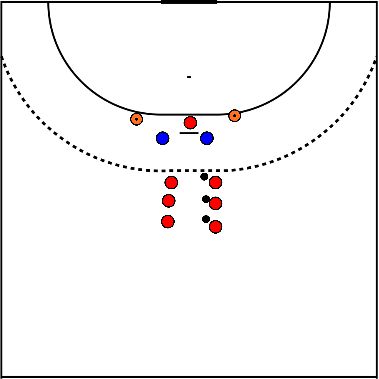
- An attack is played between 3 attackers and 2 defenders.
- The attack is played on a slightly wider field than the posts (about 6 meters)
- The goal of the attackers is to complete the attack, this can be done via an action or via the circle.
- The goal of the defenders is to prevent the attackers from finishing.
- The attackers play the ball quickly from left to right and try to provoke the defenders.
- If a defender steps, they can lay the ball off to the circle,
- If a defender doesn't step, they can play over or make their own move past the defender
- When a defender steps out, the second defender must step into the circle, the defence moves with the attack.
- If an attacker makes a move past the defender, the defender must try to get the attacker out of the 'zone' (the hats).
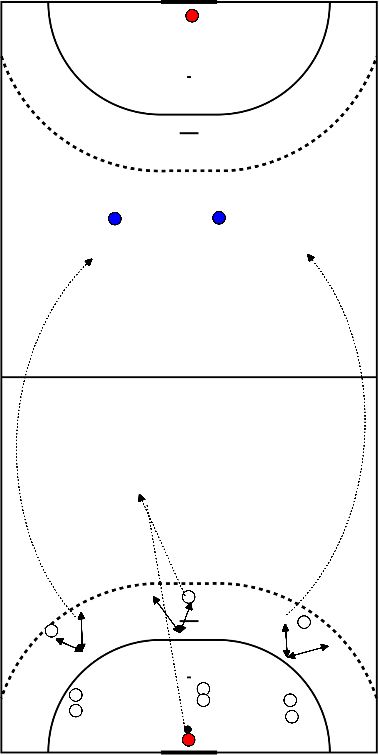
- 3 Players start shuffling between the 6 meter and the 9 meter line,
- When the signal is given, they start walking.
- The player in the middle receives the ball from the goalkeeper and plays it to his/her left or right
- At the end, you can choose to make a change.
- The attackers finish near the goalkeeper
- The aim of the outer build-up is to run wide and create a lot of space for themselves and the rest of the team
- When the rounding is completed, the players wait at the other end until everyone has been through and then they do the same.
- After a while, two defenders come up and try to intercept early on
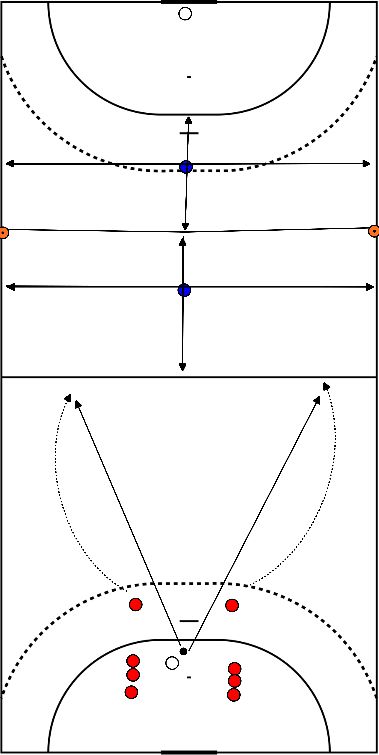
- 2 players stand on 1 side of the field.
- They play the ball to the goalkeeper and run wide in the direction of the other goal,
- Still on their own half of the field, they receive the ball from the goalkeeper.
- The 2 attackers must follow the normal rules of the game in terms of running but may not bounce the ball.
- Between the 6 and approx. 20 metre line, they meet a defender
- They must try to play the ball in pairs without bouncing it.
- After a while, a second defender comes along, between 20 and 40 metres, and the attackers have to get round this too
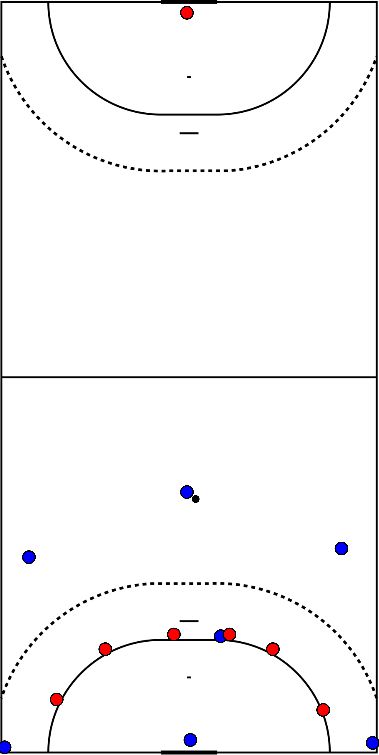
This is a 'normal' game of handball, however there are 2 twists to the game.
The rules are introduced in turns, after a few minutes the second rule is introduced.
Rule 1:
- If 1 of the 2 teams scores in a fast-break or quick attack, they get the opportunity to execute their attack again after they have already made a point.
- This gives them the chance to score 2 points as a reward for their quick attack.
Rule 2:
- When a player has scored, that person must remain at the spot of the shot for 5 seconds,
- This gives the opposing team at least 5 seconds of overtime and a chance to score in a quick attack from a goal against.
- If a goal is scored, the opposing team does not have to stand still but can continue with their second attack.
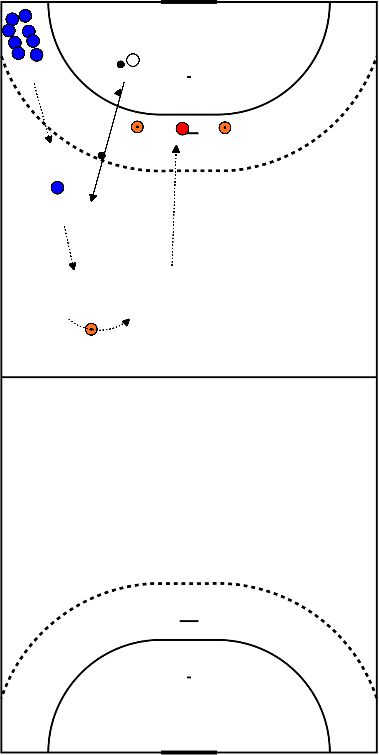
- 1 Defender on the 9-metre line between 2 pawns
- 1 Pawn close to the half way line
- 1 Thrower
- The rest of the children in the corner in a row
- The player runs in the direction of the pawn on the half way line and
- Gets the ball from the thrower,
- Dribbles with the ball towards the defender, passes,
- Finishes with a shot and
- Goes to defend
- The defender takes the ball and joins the back of the line.