




Handballexercises for seniors
- In pairs, bring the ball to the other side and score.
- The red team brings the ball to the other side and attempts to score.
- Pairs start from the back line.
- At the moment the red team attempts a goal, the green team may start to score a breakout on the other side.
- The red team then defends back.
- Once the green team has attempted a goal, they must return to defend against the other two red players.
- These red players start at the moment the green team attempts a goal.
- The exercise can continue in a flow form, as players keep returning to their own side.
- Without bouncing.
- You do not start with the ball yourself, but throw the ball to the goalkeeper who must initiate the breakout.
- The goalkeeper must first try to stop the ball and then immediately throw a breakout.
On follow order is completed:
- Right corner: round off with lop
- Right formation: round off with underhand shot (possibly 2 boxes with mat to create opening)
- Center formation: round off with jump shot over an F goal/mat (this is at 9 m)
- Left formation: round off with a dummy around the post
- Left corner: free choice of rounding
- Circle runner: turn and jump with 2 legs at the same time
Goalkeeper gets a vest which he/she throws up, holds up ball and must catch the vest before it hits the ground. (or holds balloon in the air during exercise) Pay attention to goalkeeper posture (hands high, knees bent)
- Work in pairs or threesomes
- Place 2 pawns about 2 meters apart
- Player A stands between the pawns
- Player B has a pile of hats in his hands
- Player B throws the hats towards player A between the cones
- Player A tries to dodge the hats and not get hit
- Each hat hit is 1 mission
- Example: hit 5 hats? Then player A does 5 squats/push ups/sit ups
- Throw the hats only toward the feet
Play with a good bouncing ball (hard handball/ goalcha ball/ beach handball/ tennis ball/ volleyball etc.)
Rules:
- You may only touch the ball with your body (arms/legs/feet/head) 2x in a row. After that you may not touch it again until another player has touched the ball.
- You may therefore both play football and hit the ball
- If you touch the ball a 3rd time, the ball is for the opponent (free ball)
- Try to score on 1 of the goals
- Scored? Ball for the opponent
- Play 2 or 3 balls at the same time (depending on the size of the group)
- Link rules to the different balls
- Example: football only heading, handball only playing with your foot etc.
- Link rules to the different balls
- Vary the places where the goals are placed (mat/duck out/advertising board).
- Vary the number of places where goals can be scored
- Put everyone in a circle with the ball in their hand and hold it high above their shoulder.
- They start with dribbling on the spot in high speed, after 30 seconds you do another exercise.
- Skipping (2 times on 1 leg then on the other leg)
- Jumping forward (2 legs at the same time) and back again
- Stepping to the left and to the right
- Shuffle forwards and backwards
- High speed dribble
- If this is too easy, extend the exercise by 45 seconds or 1 minute
- LO a line with ball
- RO a row
- In every deep corner 1 defender
- As soon as the builders start to run, the two defenders move to the middle as quickly as possible
- The team builders who are competing with the defenders are going to pressure well next to the man
- The defenders pay attention to a good defence, stepping out on the player with the ball and immediately back to the 6 when the ball is to the other player
- After rounding on the goal, the attackers become defenders. Do not go and get the ball!
- Defenders go into the deep corner again and two new attackers start
- Row of LO with the ball
- Two in the middle (every now and then new players in the middle)
- LO puts pressure and passes the ball to the MO who is starting
- LO runs backwards again with a good arc and keeps an eye on the game
- The MO puts pressure and passes the ball to the incoming LO who shoots at the goal
- The LO has to time the ball well. Do not start too quickly or too late.
- Everyone is allowed to round off a few times on the LO
- Trainer stands on the 6 on the middle on 3
- 1 defender at 2
- We do the same as before, but now the LO goes 1 on 1 with the defender
- At the moment that the MO puts pressure, the trainer says YES and the defender has to move aside quickly to tap the trainer.
- Then the LO starts to duel with the defender.
- When you have shot at the goal, you immediately stand up to defend, so do not go and get your ball!
- The previous defender joins behind the line LO and gets a ball from the goalie
- The two MO's have to be exchanged every time
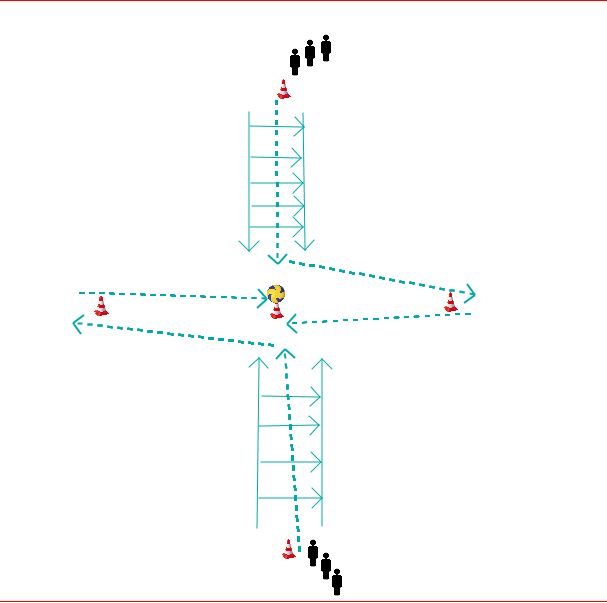
- 2 ladders opposite each other,
- 2 high cones in the middle (on the sides) between the running ladders,
- 1 pawn with a ball in the middle between the running ladders.
- From behind the ladders, 2 players start at the same time;
- Walk down the running ladder,
- Then move to the side around the pawn and back to the pawn in the middle,
- The one who catches the ball first wins.
- As soon as the jacket is taken, the next 2 players can start.
- 3 build-up rows
- 1 defender on the 6 on the left side and
- 1 defender waiting inside the circle with the trainer
- Left build-up row has the ball.
- The left row builds up pressure towards the goal and passes the ball to the middle constructor.
- The middle build-up puts light pressure towards the goal and passes the ball to the starting right build-up.
- The right hand build-up makes an 0 pass inside and passes the ball to the starting middle build-up.
- The middle build-up now applies good pressure and at this moment, the coach says yes and the defender who is standing in the circle has to move backwards quickly, tap the coach's hand and move back quickly.
- When you return to the circle, the left-hander goes one-on-one and rounds the goal.
- When it is your turn you have to move 1 position and join the back of the circle.
- Defenders take turns.
- When they have been one on one a few times:
- Then alternate two new defenders.
- Then alternate two new defenders.
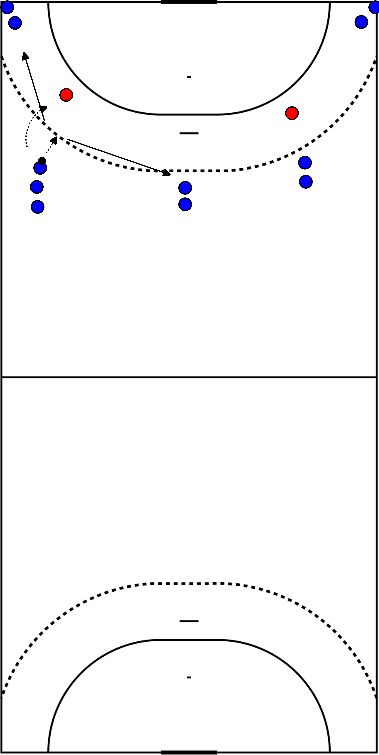
- Everyone divides up into corners and build-ups.
- There are 2 defenders on the left and right set-up positions. They will first defend more passively and then more actively
- 1. The left wing build-up:
- Plays the ball in the corner,
- Starts in and gets it back,
- passes at pace to the middle.
- Runs diagonally back to the sideline,
- Starts and makes a passing move past the defender.
- Same thing happens on the right side
- 2. The left formation:
- Plays to the corner,
- gets it back and passes to the middle,
- middle goes on a pass as does the setter,
- Corner starts in and receives the ball (with or without bounce).
- Defender defends passively.
- Hoek tries to pass.
- Same on the other side.
- 3. The left-hand construction
- Plays ball to the middle,
- gets it back and plays the corner,
- Angle starts to pressure and the builder also.
- Centre finishes with jump shot or passing move.
- Defender is active immediately
- Everyone makes 2 groups of somewhat equal level.
- Both stand on the line and the ball is in the middle.
- At a whistle they sprint to the ball and dribble a few metres further.
- Variation:
- Sitting and looking at the ball
- Turned around (standing up)
- Turned sitting
- Make 2 teams,
- One stands 2,5 meter in front of the other.
- The last one throws the ball 5 to 6 metres ahead.
- Who gets to the ball first?
- The one without the ball tries to defend and take the ball away.
- Train with the goalie separately on a goal.
- Set out 6 hats at different heights.
- The goalkeeper gets a ball.
- Throws it back to the trainer and then runs to one of the hats and back to the middle of the goal.
- For low balls, hand towards the ball and for half high balls, the leg as well.
- Roll the ball to different corners.
- The goalkeeper picks up the ball as quickly as possible and throws it to the trainer.
- It is important to be in the right position as soon as possible.
- The trainer throws a ball in one of the corners.
- After that this is repeated.
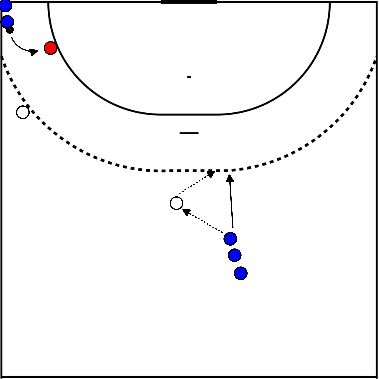
- Divide the groups into builders and corner players.
- The builders position themselves in the middle and the corner players on the left and right.
- Set-ups will practise the running shot
- There is 1 point of attack (alternates) who you play to.
- You receive the ball in the run and finish with a running shot
- It is important that you get the ball in the top corner and keep on running
- In this way, you can surprise the defence with your shot
- Do not take 3 big steps towards the run first, but keep to the rhythm of your run
- When you have fired your shot, walk through and bend your upper body slightly forwards.
- With this shot, it often happens that you stand with your wrong leg in front, this does not matter.
- The corner players will be working with various feints
- 1 feint for an outside pass and 1 feint between 1 and 2
- The ball is played to a corner player who feints an inward or an outward move (of your own choice, but alternate)
- There is a passive defender who, after a few times, starts to defend more and more
- It is important that you pressure the inside (or outside) and then quickly go around it
- You can also do this with a turn
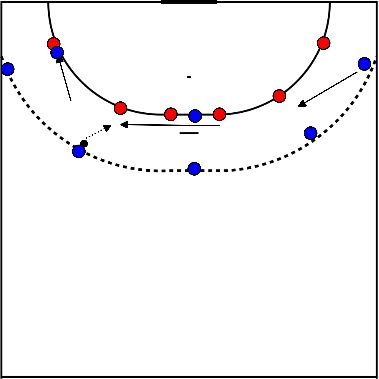
- Right corner player runs towards the outside defender on the other side and puts a back barrage.
- Left build-up with ball threatens on the 2nd defender.
- Makes a threat and jumps to the middle and plays to the blocking player or shoots at goal himself
- Optionally, the ball can also be played into the circle if the middle defender gets out/closes up.
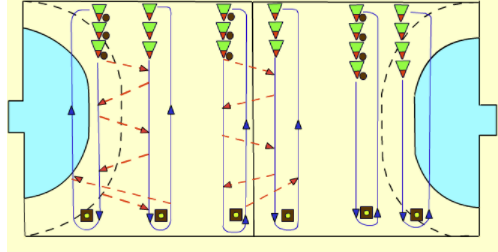
- This exercise is shown for 3 groups.
- Each team does a different exercise.
- This is done to show the possibilities and variations.
- The passes are only shown on the way out.
- Players continue with passes on the way back to their starting position. (5-10 passes are possible).
- The 1st group plays side passes inside the pylons and turns to the outside around the pylons and then plays long passes on the way back.
- The 2nd group plays side passes on the right side of the pylons and both turn left around the pylons and then play side passes again on the way back.
- The 3rd group runs (dribbles) around the pylons.
- All passes are possible, but the exercise is best for the quick, precise side pass. Also a good exercise for training acceleration.
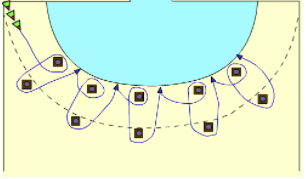
- LH starts from the corner
- Goes by sliding passes to the left around the 1st pylon
- Then you go backwards around the pylon, which is on the free throw line.
- From there forward again to the circle and sideways to the left around the next pylon.
- Then go backwards around the pylon, which is on the free throw line. Etc.
- The next LH does not have to wait until the first one is on the right side,
- But he must wait until there is enough space so as not to bump into the previous LH.
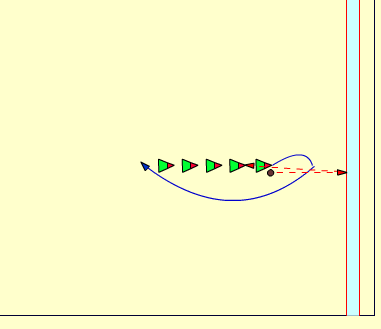
- Players stand back to back facing the wall at a distance of 4 to 5 feet.
- The first player throws the ball and gets out of the way of the second player who has to catch the ball.
- Then the second player throws and the third player catches the ball, etc.
- Variation:
- Larger run distance for being back in line.
- Put the pawn behind the row formed, they must first go around it before they can join the row.
- The first player has the ball.
- The ball is thrown against the wall and the first player jumps over the ball with their legs spread wide.
- The next player catches the ball and throws it against the wall.
- The first player joins the back of the row. Etc
- The exercise can also be performed as a competition.
- In which case the player who cannot catch the ball or jump over it must disappear from the line.
2 or 3 teams depending on the size of the group.
- Start all behind the pawn
- The first one starts and goes with 2 feet at the same time through the ladder, sprints to the pawn, goes around it and runs back to the group (not through the ladder again)
- Ticks the next player and he does the same.
- The team that is sitting down first has won.
Differentiation:
- Inclined through the running ladder ( face right or left)
- Backwards through the ladder
- Without ladder with ball and slalom (tipping)
- Slalom with the wrong hand (tipping)
- Pass the ball in pairs with various exercises (2 balls per pair)
- 2 teams bring up the ball and pass back on the outside
- Bringing up a 3 team ball with 2 balls (middle player always rebounds)
- Bringing up a 3 ball team witha 2nd phase change whiskey (long change)
- Keepers warm up
- Star from the middle
- Bring up the ball at pace from 9 meter; defender starts from 6 meter
- Break in two:
- LO and LH run break together.
- Goalkeeper throws to LO or LH (assignment by trainer)
- 4 men bring up the ball
- Goalkeeper throws to LH.
- Ball away LH-LO-RO-RH who completes (RH goes deep and RO has to hold back a bit to speed up)
- RH puts pressure back
- Waves!
Players make a square and make sure two corners are double occupied.
BASIC:
Ball is played around clockwise. Players follow the ball. Receiver starts slightly in.
- Playing out of the run
- Play with jump shot
- On signal exercises turn
VARIANT 1:
Ball is played around clockwise. Players go counter-clockwise. Receiver starts slightly in.
- Playing out of the loop
- Play with jump shot
- On signal exercises turn
VARIANT 2:
Ball is played around clockwise. Players cross diagonally. Receiver starts slightly in.
- Playing from the run
- Play with jump shot
- Turn on signal exercises
1. Players line up opposite each other. facing each other.
2. Goalkeeper has the ball and throws the ball to the center line.
3. When the players see the ball, they go for it.
4. The player who has the ball is the attacker and the one without the ball is the defender.
5. The players engage in the duel, where one may finish on goal.

- Place a flag in the middle of a circle.
- Provide the circle with pawns spaced every 75-100 cm, depending on the level of the player/players.
- See also:
- Distribute the players around the circle between the cones;
- Start by 'jogging'between the cones (snake movement);
- Arms take turns (warming up)
- At the signal of the trainer ( whistle) short sprint to the flag in the middle and back again;
- 2x whistle sprint to the outside
- Next exercise :
- Zig-Zag (left to right) between the cones,
- Run sideways outside, and make rainbows (knee up) with the left foot over every cone
- Run sideways (inside) and make rainbows (knee up) over each cone (with right foot);
- Short dribble with the feet forwards and backwards between the cones, but keep on turning.
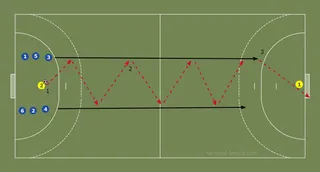
- Players line up against each other.
- One of the players throws the ball to the goalkeeper who has the ball and starts running.
- The goalkeeper plays the ball to one of the two players.
- The two players speed across to the other side.
- The player who receives the ball +/- 2 metres before the dotted line rounds on goal.
- Players line up against each other.
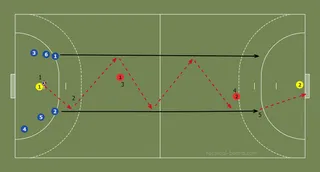
- One of the players throws the ball to the goalkeeper who has the ball and starts running.
- The goalkeeper plays the ball to one of the two players.
- The two players speed across to the other side.
- A player can do this by dribbling once.
- The player who receives the ball +/- 2 meters before the dotted line, shoots at goal.
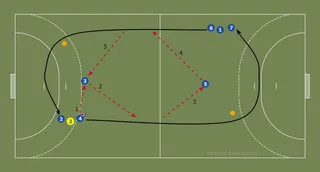
- Two players line up in the middle of a handball half (nr3 and nr5 on the picture)
- The other players divide themselves against the pawns.
- The first player has the ball and plays it to the one in the middle (nr 3) and starts running
- The player who started gets the ball back and passes it to the other player (nr5) in the middle
- The player goes around the pawn and joins the other group
- At the moment the player in the middle (nr 5) is in the middle.
- Receives the ball starts at the other side
- The next player starts running and receives the ball
- He passes the ball to the other player
- In the middle (No. 3), another player starts running and the exercise is repeated.
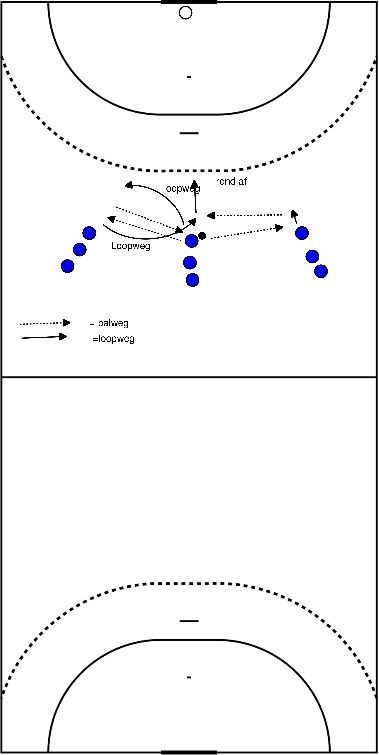
- Ball away MO-LO-MO-RO
- when MO passes to RO, MO runs to LO, LO runs behind MO and receives the ball from RO and rounds at 9m
- Play this also on the other side.
- if MO passes to LO, MO runs to RO, RO runs behind MO and receives the ball from LO and passes to RO at 9m
- VARIATIONS:
- first with 1 player in the cover = blocking the jump shot
- then with 3 defenders where passing players even option must see what to do, pass, even go...
- 3 defenders, 4 attackers = MO,LO,RO +circle