



Hockeyexercises
Last update: january 2026
Description
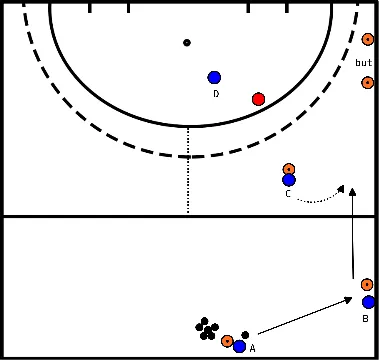
- A passes the ball to B.
- C moves towards the space on the sideline and accelerates in that direction.
- C receives a strong pass from B.
- C and D play a two against one against the red defender.
- Improve coordination and teamwork in situations of numerical superiority.
- If the defender recovers the ball, attempt to score in the small goal on the side.
Execution
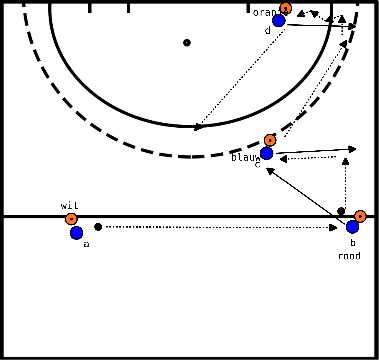
- Player A passes the ball wide across the entire width to the right.
- Player B receives the ball openly and plays it deep to Player C, who has run towards the line.
- Player C immediately plays the ball wide back to Player B, who positions themselves there.
- Player B passes the ball to Player D, who positions themselves from outside the circle.
- Player D runs with the ball along the baseline back into the circle and plays the ball to the top where Player A is now positioned.
- Player A shoots at the goal.
- B to A
- A to C - white to blue
- C to D - blue to orange
- D to B - orange to red
- B to A - red cone to white
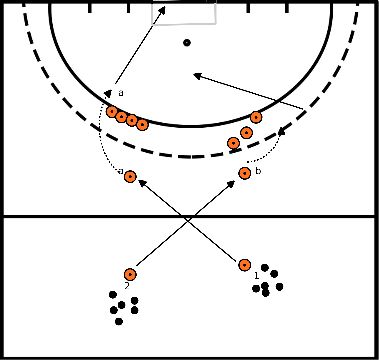
Execution
- Player 1 passes the ball to Player A.
- Player A receives the ball and dribbles around the cones.
- Player A finishes on goal.
- After the shot, Player A positions themselves immediately for the second ball.
- Almost simultaneously, Player 2 passes the ball to Player B.
- Player B dribbles the ball around the circle and passes to Player A.
- Timing: Pay attention to when Player 2 starts.
- After the shot, Player A must switch immediately and position themselves.
- Player A must be passed to in stride/motion.
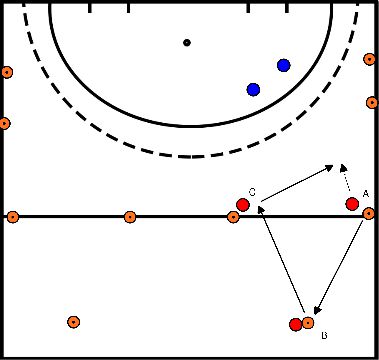
Execution
- Player A starts with the ball and passes to Player B.
- Player B receives the ball and passes to Player C.
- Player C receives the ball and plays it wide to the advancing Player A.
- Player A receives the ball, creating a 3 versus 2 situation against the defenders.
- Defenders start in the circle and may step out as soon as Player C has received the ball.
- Attackers attempt to score on the large goal.
- Defenders score in the small goal at the sideline.
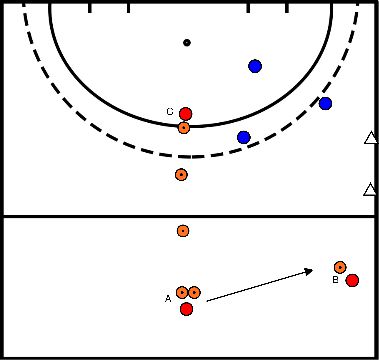
Execution
- We play a 3 versus 3 match with an emphasis on communication between attackers and defenders.
- How do you position yourself and how do you get open for your teammates?
- Players A, B, and C form a team. The first pass goes to player B, from where the 3 versus 3 begins.
- The defenders apply pressure on the ball and try to prevent the attackers from playing through the centre of the field.
- They ensure that the axis of the field is well defended.
- If they win the ball, they score in the small goal on the side of the field.
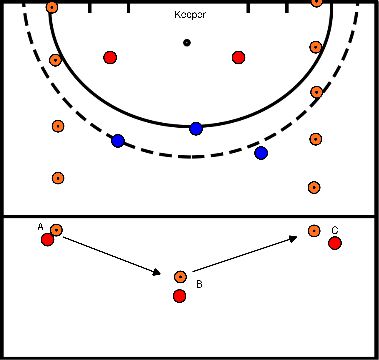
Execution
- A switches the ball to B.
- B switches the ball to C.
- Once C has received the ball, the 5 versus 3 begins.
- Maintain speed.
- Ensure the ball can always be returned.
- Pass over the backhand side of the opponent.
- Keep the field wide and long.
- Communicate with each other.
- Use in-out movements to receive the ball.
- Close the centre axis.
- Block forward passing lines.
- Communicate with each other.
- Keep them outside the circle.
- If they enter the circle, apply pressure on the ball.
- If it is too difficult, allow a tackle back runner to participate.
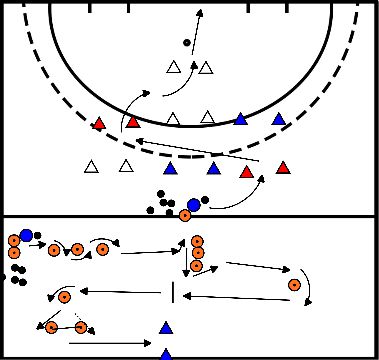
Execution
- The player starts with a ball. The trainer calls out a colour, for example, RED. The player dribbles through the two red gates.
- After the gates, the player goes through the white gate.
- The player strikes the ball with a push pass towards the goal.
- The player starts with the ball and performs a slalom.
- Dribbles further and executes a dummy move at the cones.
- Dribbles around the cone.
- Dribbles towards a small barrier on the ground and lifts the ball over it.
- Dribbles further and goes around the cone.
- Performs a drag flick trick at the cones.
- Pushes the ball towards the goal afterwards.
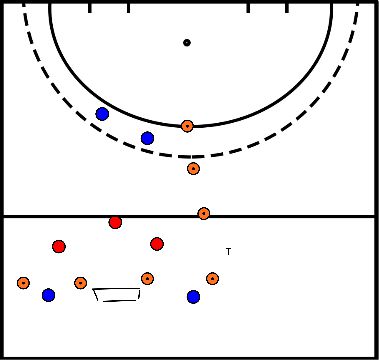
Execution
- The trainer throws the ball to the attacking team (red players) who attack against 2 defenders.
- If the defenders intercept the ball, they attempt to pass it to their 2 teammates behind the line.
- When successful, the roles reverse and the 4 players attack to score on the large goal.
- The 3 defenders try to play the ball against the rebound board.
- If the attackers score at the start, the trainer throws a new ball to the players behind the line and the game continues from there.
- The defenders must close off the centre and block the passing lanes between the attackers.
- The aim is not to take the ball directly but to guide the attackers until they make a mistake and the ball can be intercepted.
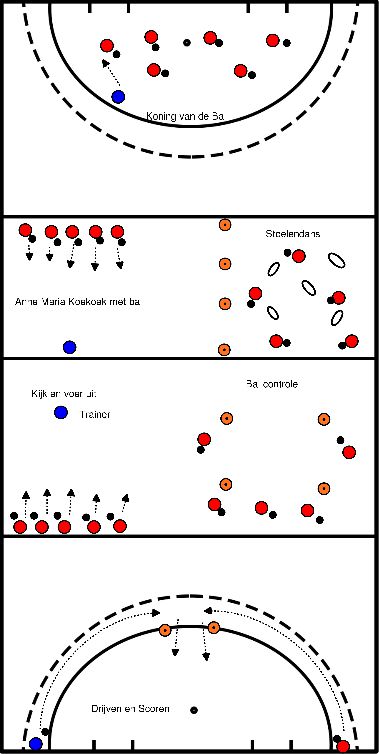
King of the Ball
- Mark out an area or use a circle.
- Give everyone a ball, except for one player.
- The player without a ball tries to take the ball from someone else.
- If the ball is taken or goes out of the field, that player helps with taking the balls.
- Place all players on one line with a ball.
- Have one player stand on the other side and call "Red Light, Green Light".
- The players may walk, but the ball must remain still when the caller turns around.
- If the ball is not still, the player goes back to the start.
- Give all players a ball.
- Let them dribble and drive through the area with the ball.
- Call "Yes" and let them drive as quickly as possible to a hoop or cone.
- Start with enough hoops/cones for everyone, then remove one each time.
- Place all players with a ball on one line.
- Let them drive with the ball while you indicate the direction by pointing.
- They must look ahead and not only at the ball.
- Give each player a ball.
- Let them drive within a marked area with the ball.
- Call "Yes" and let them drive straight to the other side.
- Ensure they keep watching each other to avoid collisions.
- Create two teams and give all players a ball.
- Let them start at the back line outside the circle.
- On your signal, they drive with the ball along the circle's edge.
- At the cone, they may score in the goal.
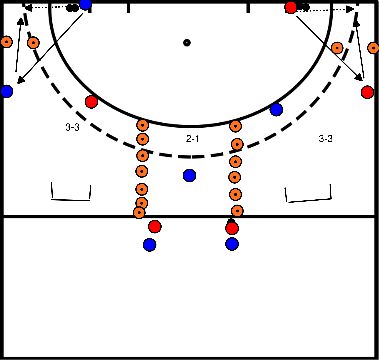
Objective
- Improvement of fitness and transition.
- Play out a two-versus-one situation through the centre with a shot on goal.
- In case of a foul or goal, a three-versus-three follows at the side towards the centre line.
- A guard pass is mandatory in this situation.
- There are 10 seconds available to create a shot in the two-versus-one.
- There are 10 seconds available for the three-versus-three.
- With a guard pass in the three-versus-three, the new two-versus-one begins immediately.
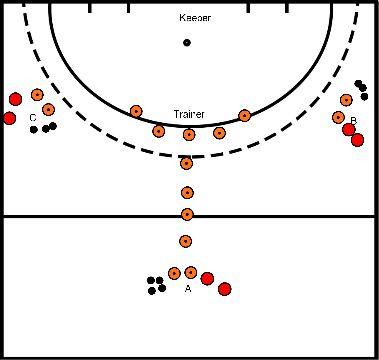
Execution
- Player A begins by weaving through the cones and does this at speed.
- At the end, they are instructed whether to go left or right around the cones and accelerate with the ball on the stick.
- Player A aligns the ball and strikes at the goal.
- They turn around and receive a ball from Player B on the forehand.
- They control the ball, align it again, and finish.
- Immediately turn around and receive a ball from Player C, align, and finish.
- The players rotate from A to C, from C to B, and from B to A.
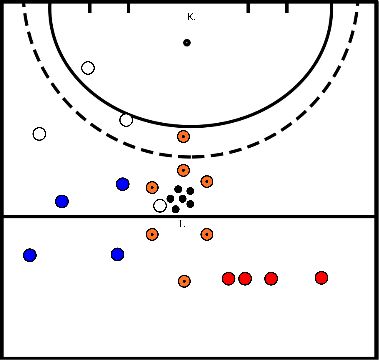
Setup
- 3 teams: blue, red, and white.
- Each team has 3, 4, or 5 players.
- The attacking team (A) has 1 extra player (e.g., 3:2, 4:3).
- One player from the defending team (B) is positioned with the trainer.
- The non-playing team (C) is positioned at the centre line.
- If team A scores, they defend with one player less.
- Team B positions itself at the centre line and goes on the attack.
- The trainer introduces the ball into play.
- Alternate left and right sides.
- Attack from the left: Blue attacks, white defends, red is ready on the right.
- Attack from the right: Blue defends with one player less, red attacks, white is ready on the left.
- Attack from the left: White attacks, red defends with one player less, blue is ready.
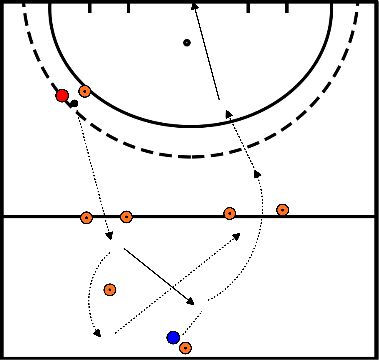
Execution
- The goalkeeper stands in his position.
- Place two gates made of cones on the 23-metre line, to the left and right of the goalposts.
- Player in red starts at the top of the circle and accelerates with the ball through the gates.
- After passing through the gates, red plays the ball to player in blue.
- Red sprints around a cone to put pressure on blue or to take the ball away.
- Blue receives the ball, accelerates, and runs through the gates.
- Once blue is through the gates, red may no longer take the ball away and returns to the cone.
- Blue accelerates to the top of the circle and finishes on goal.
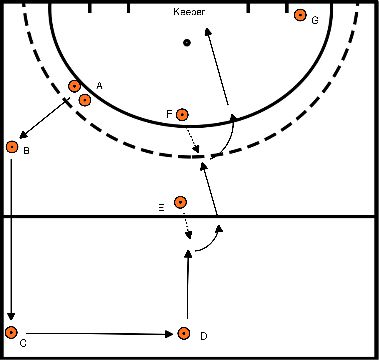
Execution
- A gives the ball with a push pass to the forehand of B.
- B receives the ball with an open body position and plays a drive pass to C.
- C receives the ball with an open body position and plays a drive pass to D.
- D receives the ball with an open body position, makes eye contact with E.
- E runs towards the ball, receives it on the move, and turns right with the ball on the stick.
- E makes eye contact with F.
- F runs towards the ball and receives a hard push pass to the forehand from E.
- F receives the ball on the move, turns left, and dribbles with the ball on the stick into the circle.
- F lines up the ball and strikes at goal.
- G can be added later for a tip-in from F if the execution goes well.
Team Composition
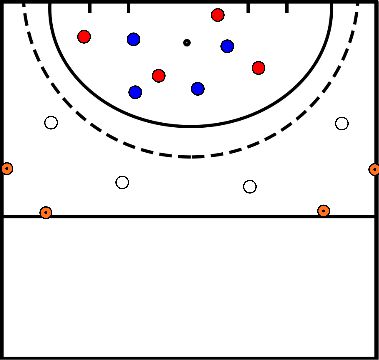
- Create 3 equal teams.
- Team 1: Defenders inside the circle.
- Team 2: Attackers inside the circle.
- Team 3: Players outside the circle as the "bowl".
- The "bowl" quickly passes the ball around and looks for an opportunity to pass to the attackers inside the circle.
- To receive the ball, the "bowl" must look ahead and know where the attackers are or will move.
- After an attacker receives the ball, they pass it back to the "bowl" and may enter the circle to score.
- The other players in the "bowl" do not participate in the attack but can regain the ball, after which the play starts over.
- One defender is allowed to leave the circle to put pressure on the "bowl".
- The remaining defenders stay inside the circle.
- The attackers are not allowed to leave the circle.
- If the defenders gain possession of the ball, they may score in one of the two goals on the side.
Instructions
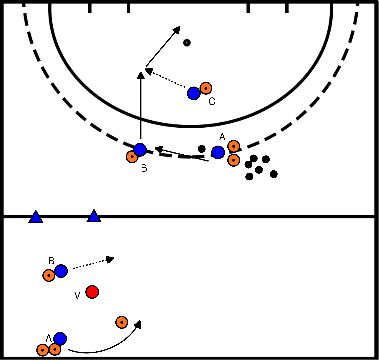
- A starts with the ball and gives a push pass to B.
- B receives the ball and sees that C is running into depth.
- B gives a push pass to C.
- C receives the ball and shoots at goal with a slap shot.
- A starts with the ball and dribbles around the cone.
- From that moment, the defender may try to take the ball away from A.
- A and B want to score together in the goal.
- Try to have them run and give a depth pass.
- Let them try a few times first, then explain what you as a trainer want to see.
Description
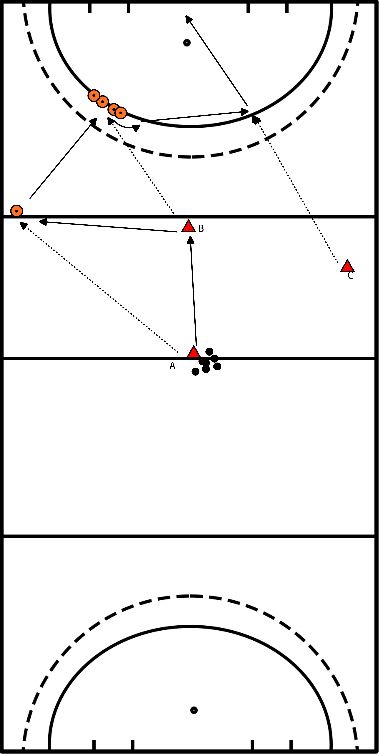
- Player A passes the ball to Player B.
- Player A runs deep to the first cone (running path).
- Player B passes back to Player A and moves quickly towards the circle (short quick action).
- Player A returns the ball to Player B.
- Player B receives the ball on the forehand and turns away over the backhand of the opponent (cones).
- Player C sprints towards the top of the circle (timing).
- Player B passes to Player C, possibly with a backhand sweep pass.
- Player C receives the ball, brings it into the circle, and finishes.
- Perform two actions, keep the ball under control, and finish.
Execution
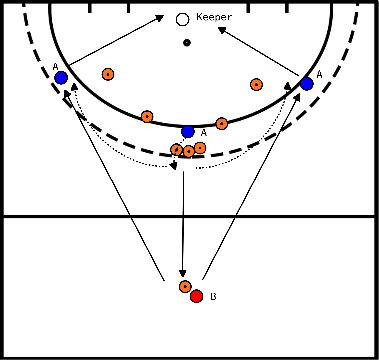
- Player A maneuvers through the cones.
- Player A delivers a firm and accurate pass to Player B.
- Player A moves away from Player B.
- Player B passes back to Player A, who receives the ball on the move.
- Player A takes the ball into the circle and finishes.
- Ensure quick, firm, and accurate passes.
- Receive the ball while moving.
- Maintain speed throughout the exercise.
- Optional: Add a defender in the circle for additional challenge.
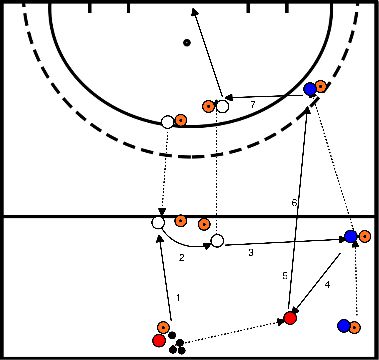
Execution
- Depending on the level, the playing field can be set up larger or smaller. It can also be executed in mirror image, possibly with finishing on the backhand.
- The ball starts with the red player. The white player runs back to offer themselves and receives the ball.
- Upon receiving, the white player accelerates with the ball to the side where the blue player has positioned themselves.
- The red player forms the tip of the triangle backwards and receives the ball.
- The blue player runs deep away and the white player moves to the top of the circle.
- The blue player receives the ball and passes it to the player at the top of the circle who scores.
- Accelerate upon receiving.
- After a passing action, follow with a running action.
- Maintain a high ball tempo.
- Observe what happens and anticipate.
- Seek eye contact.
- Optionally expand to situations such as 3 versus 1, 2 versus 1, or 3 versus 2.
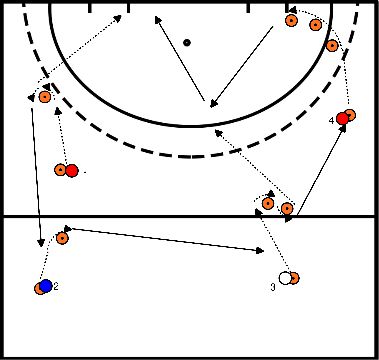
Execution
- Player 1 starts with the ball and moves towards the backline. There, he turns tightly and passes the ball on the move to player 2.
- Player 2 moves towards the 23-meter line, turns to the right, and pushes the ball to player 3.
- Player 3 attempts to move to the top of the circle, but retrieves the ball at the ion and passes to player 4.
- Player 4 runs towards the backline and passes the ball to the top of the circle.
- Player 3 continues after the pass and positions himself between the top of the circle and the center spot. From here, player 3 chooses between finishing or playing for the deflection.
- Player 1 is ready for the tip-in.
- Turning direction is in chronological order.
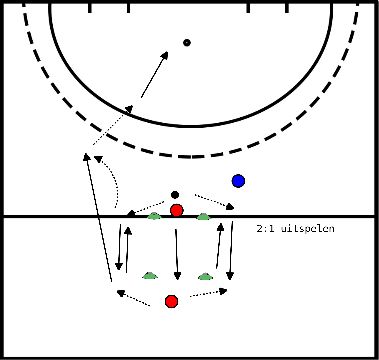
- Part 1:
- The player with the ball passes it to the player closest to the center line.
- This one takes the ball in motion to the outside.
- Makes a 1-2 with his teammate on the outside.
- Then runs into the depth.
- Gets the ball after the sticklead.
- Finishes on goal.
- Part 2:
- After the player in coverage gets the ball the 2-on-1 starts.
- Part 3:
- A pair, attacker and defender, also starts in the circle.
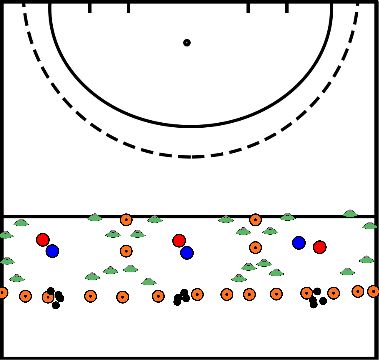
- On the sides of the courts are balls.
- Each goalt in the corner of the field has its own color.
- In each field stand 2 players.
Exercise
- The players start in the middle of the field.
- When the trainer calls a color, the players must grab a ball from the side of the field as quickly as possible.
- The player who grabs the ball first must score in the color goal called by the trainer. The other player then goes to defend.
- If the attacking player scores in the said color goal, the players start again and the trainer calls another color and so the exercise repeats itself.
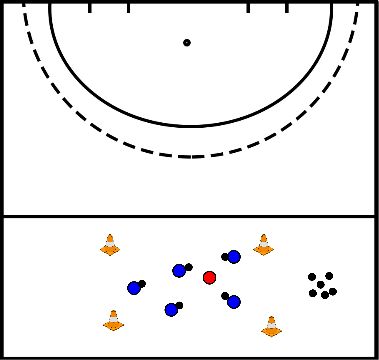
- Except for one player -red-, all players -blue- have one ball.
- The red defender tries to work all balls out of the box.
- If a blue player loses his/her ball and it has been played out of the box, she/he stands with her/his legs apart.
- The player can be redeemed by another blue player; This one plays the ball through the legs -panna- and blue has a player back in the box.
- Continue until all players are off.
Points of attention:
- If it takes too long or you notice in advance that one defender is too little, appoint an extra defender.
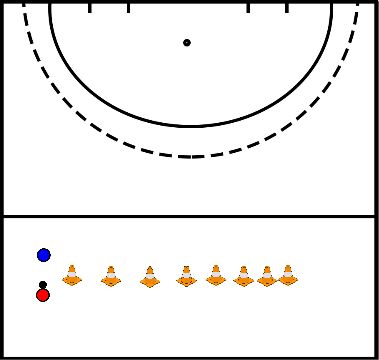
- Set out the exercises two or three times depending on the number of players.
- Make pairs and place the pawns closer and closer together.
- Players red and blue stand close together and tap the ball up and down between the pawns.
- You start with a 2-touch so assume -> pass, maximum 2 touches.
- If the ball hits a pawn, a pawn is skipped or a player touches the ball more than 2 times, you are out.
- If you are finished, start the exercise again.
- If you have made it to the end of the pawn row a number of times, try everything in 1-touch -no more than 1 touch, that is.
- Is this also successful, you can keep track of time -> Improve your record each time.
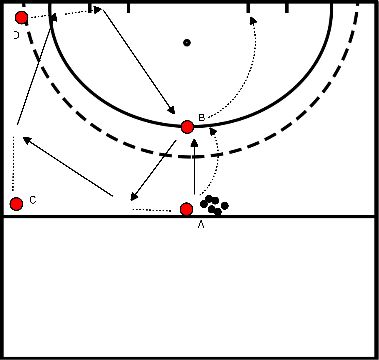
Goal :
- To take on and pass at speed in movement.
Execution:
- A pushes to B,
- A runs along the 23 meter line and gets the ball back from B.
- A takes on the run and passes immediately to C who comes up the sideline and passes immediately to D on the back line.
- If there are only 3, C runs to the back line.
- D takes on the ball and dribbles into the circle.
- D passes to head of circle (A)
- A gives a hard pass to B for tip in.
Variations 1. start on the other touchline so that the whole width of the field is covered. 2. do the same exercise the other way 3 A shot on goal and gets another rebound ball from B
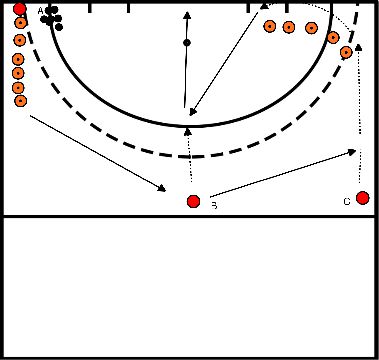
Goal :
- Transfer , quick assumptions and passing
Execution :
- A does Indian dribble at the pawns
- Pass to B.
- B takes open and passes immediately to C who comes up along the sideline.
- C runs on to the back line and runs via the back line in the direction of the goal.
- C passes back to A at the head of the circle.
- A scores.
Points of attention:
- Clean passing
- Quick passing and
- Correct passing in the run
Variations :
- From the other side
- Instead of dribble 3 D, introduce aerial dribble or passing moves (drag, dummy).
- B takes closed take instead of open take.
- C can come up unhanded along the back line,
- C, after taking the ball, passes straight to the far-post area where A goes.
- Bring in the rebound
- From B to C a high ball.