



Korfballexercises for technique defense
Last update: january 2026
Formation
- 4 or 5 players per korf
- 1 feeder
- 1 defender on the feeder
- 2 attackers
- The feeder attempts to get into position while the defender applies front defence.
- Attackers must play in such a way that they can pass to the feeder and put the defender out of play.
- Continuously shift the play.
- If the feeder can be passed to, make a move and switch roles.
- Play the feeder out by passing the ball over them.
- Or move away to behind the korf.
Setup
- Player 1 starts 6 metres from the post.
- Player 2 stands between Player 1 and the post, 2 metres from Player 1.
- Player 1 runs for a running-in shot.
- Player 2 must prevent the running-in shot by bending their knees well and moving immediately when Player 1 starts running.
- If Player 2 does not react immediately, Player 1 will no longer be able to be caught up.
- The objective is to prevent the running-in shot.
Setup
- Create a square where an attacker is constantly moving.
- A defender follows the attacker.
- Other players stand around the square.
- The attacker starts with the ball and throws it to a player on the side.
- The player on the side throws the ball back to the attacker.
- The attacker then throws to another player on the side.
- The defender tries to intercept the ball.
- If the defender intercepts the ball, they throw it back, and the exercise starts again.
- The attacker continuously tries to find space, while the defender tries to intercept the ball.
Formation
- Form two groups. The attacker receives a bib.
- The attacker starts with one defender.
- Within a playing area, the attacker must try to get free.
- At the front of the playing area stands the feeder, who must ensure the ball reaches the attacker well.
- The remaining players stand along the side.
- If the attacker receives the ball successfully without the defender intercepting it, an additional defender joins.
- Get free
- Throwing
- Avoid contact
Setup
- 3 players per korf.
- Player A starts as the attacker in front of the korf.
- Player D starts as the defender at a distance of 1.5 arm lengths from the shooter.
- Player C begins with the ball in the rebound position/support position.
- The attacker (A) attempts to score by engaging in a one-on-one duel.
- The method of scoring (long shot, evasive move, running-in shot) does not matter.
- The task of the defender (D) is to follow the attacker at a distance of 1.5 arm lengths.
- When the attacker has the ball, the defender must close in.
- The defender is not allowed to tap away or block the ball but must allow the shot.
- The defender can place her hand just above the shoulder of the attacker to show presence.
- After 1 minute, the players rotate roles.
Setup
- Each group has one korf and one ball.
- Preferably set up the korfs in a circle or rectangle.
- All groups should be approximately the same size.
- Make 10 running-in shot goals.
- The player who scores the last goal retrieves the next assignment from the trainer.
- The trainer asks which assignment was just completed and gives the next one.
- Which group completes all assignments first?
- 10 running-in shots.
- 15 penalty shots.
- 5 shots from 4 meters.
- 10 running-in shots from behind the korf.
- 10 shots from 3 meters behind the korf.
Starting Formation
- Two groups at the first two cones.
- The first in line runs to the hoop and goes through it from the bottom, so the hoop goes over their head.
- Then they move in a defensive stance to cone two and spin around it four times.
- Finally, they run to cone three and score before they can run back to cone one and tag the next person in line.
- Move backwards and bend through the knees with your arm raised.
- Hoop from cone 1: 5 meters.
- Cone 2 from hoop: 5 meters.
- Cone 3 from cone 2: 5 meters.
- Post from cone 3: 4 meters.
This exercise is best performed with 12 people.
Divide the group into 4 triplets.
The groups will play 3-on-3 with the defending side being given a specific task:
Divide the group into 4 triplets.
The groups will play 3-on-3 with the defending side being given a specific task:
- Group 1: Defending behind with pressure within the 6 meter zone on the ladies;
- Group 2: Forward defending;
- Group 3: Give 100% Pressure on the gents and the ladies are going to try to steal balls;
- Group 4: Gives 1 gentleman and 1 lady 100% pressure. The remaining team members should support both.
One 3 per pole. The exercises must be done at 100%. Each exercise lasts 2.5 minutes. The intermediate exercises take a specific time. The goal is to generate the most goals as a group.
- Shots in front of the basket from 6 meters where the shooter gets a repeat shot then switch.
- (intermediate assignment 1: 25 push-ups)
- Walk-through balls from 10 meters on the front and back of the post.
- (Intermediate assignment 2: 30 sit-ups)
- Short chances, If the ball falls to the ground you start again at 0.
- (Intermediate assignment 3: 3-on-3 game where you can choose a basket as the attacking side)
- 4-side shooting from movement at 5 meters.
- (intermediate assignment 4: 15 burpees)
- Dodging ball with the obligation to make a through ball when passing in through the ground. Player is played the ball, plays in on the pass, makes a dodge ball, is played the ball and plays in via a pass on the ground and makes a through ball.
- (Intermediate task 5: 3 against 3 in which only finishing is allowed by means of a shot).
- Shots back of the basket from 6/7 meters with repeat shot.
- Timing of pass - do not go straight to the end, need to build this up one piece at a time, several moving parts to master individually
- Make contact, step out, pass into space, receiver watches and moves to receive at last moment. Defenders remain static, but arms in motion. Reset and pass back the other way. After two minutes swap attackers and defenders, Are you getting better at timing reception of pass?
- Repeat exercise but now defenders lose use of arms but can move bodies to make this more of a challenge, same reset and repeat and change after two minutes
- Final variation, defenders now try to stop pass and stop reception, same reset and repeat and change after two minutes
Have the players play a game with defenders.
- Mention in advance that they should play around and then set up a support and rebound.
- Also mention that the support stays until a follow-through or shot comes. Because if the ball is spent for a shot and the defender gets to it in time then the ball can be played back on the support.
- The support remains until the defender gets in front of the support to avoid the returning pass
- Thus, the defenders must learn that after a spent pass is returned immediately in front of the support.
- The shooter plays the ball into the support.
- The shooter receives the ball back after a short movement to the left or right.
- The shooter shoots at goal.
- The intercepted ball is immediately played back to the shooter.
- The shooter plays to the passer again.
- The shooter is released again in almost the same place as the first shot.
- After scoring twice, change positions. Each player takes each position 3 times.
- The exercise can also be played with 4-pairs.
- In the catch the duel is between 2 catchers.
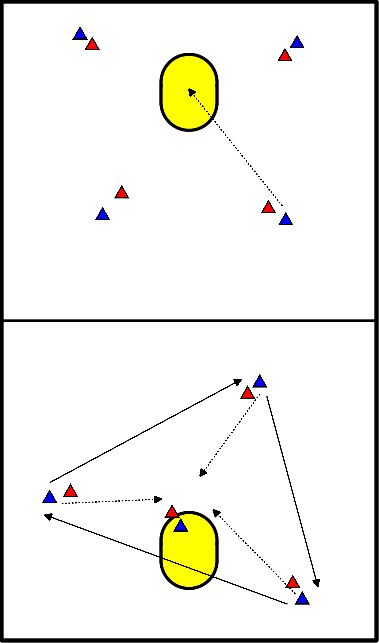
4 attackers and 4 defenders.
Practice:
Practice:
- The attack plays the ball around, puts down rebound at given moment and tries to cut in to support position or to chance from the 3-1.
- The defenders must give pressure on the outside and prevent the cut-in moment.
- Do not yet defend in the ball line and do not take over from each other.
Variant exercise:
- Like the previous exercise but the defenders must now pay extra attention to the following points:
- To-coach from basket zone overview.
- Maintain defensive triangle in basket zone and in front court.
- Sit low and hand high.
Variant exercise:
- Same as the previous exercise but the defenders may try to steal the ball by putting more pressure on the ball lines.
Do each assignment 6 minutes, after 3 minutes switch positions.
Versatile match exercise 4 against 4
- Make 2 teams of 4 players maximum.
If you have more players than 8, make 2 pairs and change quickly after each or after 2 goals. - Team 1 starts attacking at 1 basket, team 2 defends.
If team 1 scores, they may continue attacking, but start again at the starting pawn.
If team 2 intercepts the ball they have 1 shot opportunity to try to score on basket 2 or 3.
If the defence scores after 1 shot, they become the new offence team and may start at the starting pawn, to attack basket 1. - Which team has scored the 5 goals first? You can vary this.
- Change when there are more than 8 players: after 1 or 2 goals quickly change.
4 or 5 players per basket
1 attacker, 1 defender on the attacker, 2 attackers.
- Attacker tries to get into position while defender defends.
- Attackers must play in such a way that they can draw on the attacker and thus put the defender offside.
- Therefore, continuously shift the game.
- If a forward can be played into, make a move and change positions.
Variation:
- Play attacker over the ball or pull away to the back of the basket.
- Play 4 against 3 on 2 posts (don't make the field too big).
- One player is assigned to be the attacker, who attacks for both teams.
- Change them regularly.
- The attackers receive a maximum of 3 to 5 passes to create an opportunity. No chance, ball for the other team.
Too easy to shoot for the attacker:
- The extra player is not allowed to score.
- The same attacker is not allowed to shoot twice in a row.
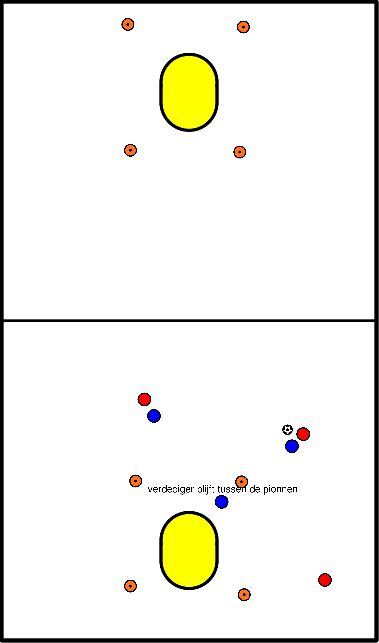
Objective:
- Playing together and scoring on your own basket
- Or play together and prevent the opposing team from scoring as few goals as possible
Rules:
- Two teams in threes against each other (can also be played in fours)
- Around the basket there is a section where the defending side has a defender. The defender is only allowed to move in that section while defending. If the team is attacking, this player is allowed to join the attack. In this way there is always a surplus in the attack.
- Korfball rules are in force
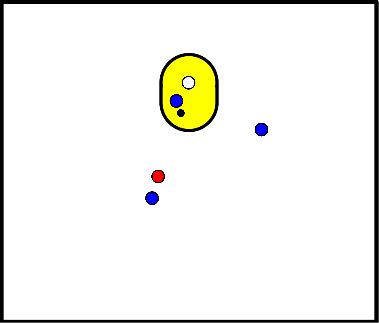
1 attacker, 1 defender and 2 assistants.
- As assistants, try to pass as many balls as possible under the basket or next to the attacker without allowing the defender to interfere with the passing.
- Keep eye contact.
- Pass the attacker freely by directing non-verbally or verbally.
- Keep the ball up high to be able to play faster and better.
- Swap after 4 good chances.
Sponsors may also pass the ball between themselves to free the attacker.
The aim is always to play within shooting distance, so that every pass or action is targeted.
- Player 1 starts at 6 meters from the basket.
- Player 2 stands between player 1 and the basket at 2 metres from player 1.
- Player 1 starts running for a through ball.
- Player 2 has to prevent the through ball.
- So player 2 must bend his knees to be able to move immediately.
- Also, the player must move immediately when player 1 starts to run.
- If this is not done, you are too late and you will never catch up with player 1.
- The goal is to prevent the walkthrough ball.
Objective:
Set up attacks in overtime situations
Rules:
- Make sure the offense always has 1 more person than the defense (3-2, 4-3, 4-2 etc.)
- Gives the offense a task:
- E.g. score within 5 passes, score after setting up an action, score from the rebound.
- Gives the defense a task:
- E.g. intercept the ball within 5 passes, defend in front.
- Decide if you can go for a defensive goal.
- Indicate with cones where the lines are.
- Agree when offense switches with defense:
- After X minutes, after X goals, after X interceptions.
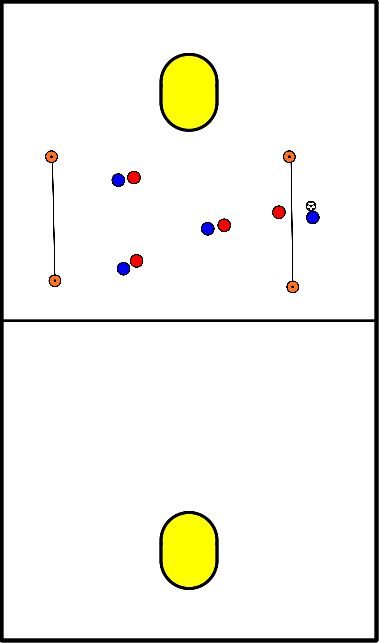
Objective:
- Earn a point by catching the ball over the line.
Rules:
- A party starts from behind the line with the ball.
- Intercepted ball is ball first to your own line and then to the other side for a point.
- Balls out count.
- When a point is gained, the opponent gets the ball from there.
Points of attention:
- For defending.
- Play on the side by moving on one leg.
- Play at tempo.
- Watch each other and your opponents place.
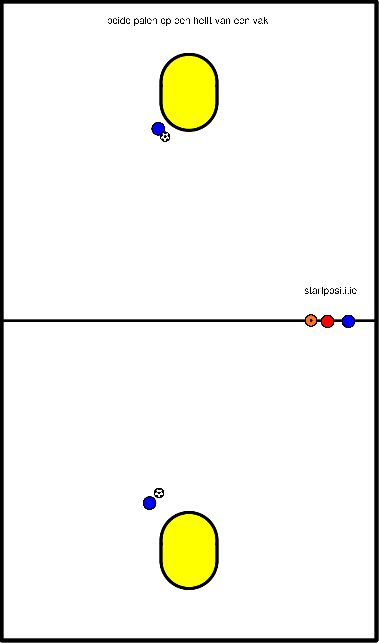
Task:
- Attack:
- Try to score as much as possible on baskets.
- Defense:
- Try to prevent as many scoring opportunities as possible without getting sidelined.
Rules:
- Attack:
- After each goal attempt, return to the starting pawn.
- It is not allowed to shoot defensively.
- Defence:
- If you cause a penalty throw (indicated by the declarer), you get one point in your rounds as attacker.
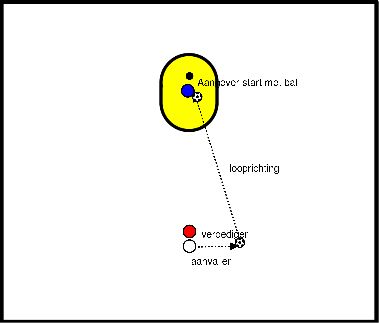
- You need a 3 or 4 team to defend the run through.
- One person under the basket with the ball and possibly also a catcher.
- In front of the basket, an attacker and a defender, at about 5-6 meters from the basket (at far shot distance).
- The person under the basket (attacker) has the ball.
- The attacker runs sideways (right or left) and gets the ball from the person in charge.
- The attacker throws the ball back to the attacker and goes in a straight line to the basket and makes a run through or in out shot (if the run through is too well defended).
- The defender stays in the right place to prevent the run through.
- Point of attention defense:
- Stay close to the attacker
- Keep your knees bent
- Do not turn around when the ball is thrown
- Do not run after your opponent
In short: practicing various shooting variants in a fun competition form.
- Organization: per group a basket and a ball, the baskets are preferably (but not necessary) arranged in a circle or rectangle.
- The number of persons per group is less important (but all groups are about the same size).
- The first assignment for the groups is: score 10 goals.
- When you have completed this assignment, the person who scored the last goal runs to the trainer to pick up the next assignment.
- Which group completed all assignments first?
- The trainer walks around, encouraging, or correcting.
- He has a piece of paper with him with a row of assignments on it.
- When someone comes to pick up the next assignment, first ask which one has just been done (this can vary considerably over time) and then hand out the next assignment.
- An example list: 10 walk-through balls, 15 penalty shots, 5 8-meter shots, 10 walk-through balls from behind the basket, 5 dodge balls next to the pole, 10 6-meter shots.
- Everything is possible of course, a lot of momentum is gained if the number of goals to be scored is kept small.
- 10 walk-through balls
- 20 small oppertunities
- 6 remote shots
- 10 penalty throws
- 1 backwards
- 3 attackers against 2 defenders.
- Attack within a radius of about five metres around the basket.
- All attackers may shoot.
- The defenders must try to score as few goals as possible.
- 5 x 1 minute. After each minute turn around.
- If the number is right, you can specifically train zone defence during the game: Zone defending.
- The defenders let go of their opponents as soon as they get further than about six metres from the post.
- The defender then has only one task: intercepting the ball by grabbing the rebound.
- This also includes letting the attacker shoot from distance.
- After all, if they do not shoot, they cannot catch the ball.
- Instruct certain attackers to give more pressure than others.
- The art of collective backfield defending is to give the pure shooters so much pressure that they prefer to leave the shot to a teammate who is as free as a bird (but who is deliberately left free by the defence because it is known that he 'can't shoot anyway').