



Korfballexercises for technique general
Last update: january 2026
Objective
- Score in one attempt in the other field within the lines.
- Two teams of up to four people.
- One ball.
- Two people stand in the field on each side, other players stand behind the baseline.
- Start with a simple underhand serve.
- We play underhand tennis, so the ball must go over the net in one attempt.
- A difficult ball may bounce once but must then be returned with: one hand, a foot, or the head.
- In case of an error: the player leaves the field to the baseline and a new player takes over.
Setup
- Divide the entire group into equal teams of 2, 3, or 4 players.
- Each team has one post as their "Home Base".
- Start with one ball in play.
- Teams attempt to score on each other's baskets.
- If a basket is scored upon, that team is eliminated.
- The game continues until only one basket remains.
- The team with the last remaining basket wins the game.
- Introduce additional balls into play to increase the pace as needed.
Game Rules
- Form groups of 2 people per korf. Each group receives three playing cards. The playing cards are shuffled in advance, and the numbers 2 through 5 are removed from the deck.
- With the three received playing cards, the groups must try to get as close as possible to 31. The value of the cards is as follows: Six = six, Seven = seven, Eight = eight, Nine = nine, Ten = ten, Jack = ten, Queen = ten, King = ten, Ace = eleven.
- Examples: nine + jack + queen = 29 points or ace + jack + queen = 31, jack + jack + jack = 30.5.
- If the players have completed a series, they may exchange one of their cards for a new one to get closer to 31.
- The trainer sets a timer and says "stop" when it goes off. The team that is then closest to 31 wins.
- Running-in shots: three goals in a row.
- Short chance: four goals in total.
- Distance shot behind the korf: two goals in a row (4/5 meters).
- Penalty shots: three goals in a row.
- Round the korf: four goals on each side of the korf (3 meters).
Summary:
- Exercises focused on catching balls at the right moment when they bounce or roll.
Organisation:
- One ball per pair or trio.
Execution:
- Pairs:
- a) Number 1 rolls the ball a few meters away. Number 2 must acquire the ball as quickly as possible, pick it up, and throw it back. Switch after 5 times.
- b) Number 1 throws the ball with a small arc so that it bounces approximately 4 meters away. Number 2 tries to catch the ball as quickly as possible after the bounce.
- c) Number 1 drops the ball from a height of 1.5 meters directly in front of number 2. Number 2 tries to catch the ball as quickly as possible after the bounce. Note: place your hand on the ball as soon as it rises.
- Trios:
- d) The passer stands in the middle and rolls the ball a few meters away. The others may run as soon as the ball is released. Who catches the ball first? Switch after 3 times.
- e) As in d, but now the passer throws the ball with a small arc so that it bounces approximately 4 meters away. Who catches the ball first?
- f) As in e, but now from under a korf. The one who catches the ball first may make a turnaround shot.
- g) As in b, but now with trios. Who reacts the fastest?
In Brief
- A nice shooting exercise with a lot of running.
Organisation
- The korfs are placed in a circle.
- At each korf, there is a feeder with a ball.
- The rest of the players stand in the middle of the circle.
- Aim for 2 korfs per 5 players.
Execution
- Part a: The players in the center circle take running-in shots at one of the korfs. Those who are not fast enough must wait. Each player retrieves their own running-in shot and then looks for a free korf again.
- Part b: As in part a, but who scores 10 goals first?
- Part c: As in part b, but who scores a goal at each korf first?
- Part d: As in part b, but with overhead running-in shots.
- Part e: As in part b, but with a passing situation. The runner plays the ball back to the feeder who has moved away from the post. Who scores 5 goals first?
- Part f: As in part b, but the runner takes dodge shots. The feeder retrieves the shot and then tries to score themselves. Who scores 5 times first?
- Part g: As in part f, but after the dodging movement, no shot follows. The ball goes back to the feeder who shoots with a quarter/half turn.
Variation
- Add defenders. Which attacker scores 10 running-in shots or 5 goals from dodge shots first?
Execution
- The passer throws the ball to the person in front of the korf.
- The receiver takes a shot.
- If the ball is caught under the korf, the player moves inside for a running-in ball.
- Finally, the player takes a short chance.
- Shot counts for 2 points.
- Running-in ball counts for 1 point.
- Short chance counts for 1 point.
- Play until someone reaches 20 points first.
- Or play for 1 minute and see which korf has the most points.
- 1 declarer throws the ball to the person in front of the basket
- He then takes a shot
- If the ball is caught under the basket, he goes inside and takes a through ball
- Finally, he then takes a short chance
- Exchange by.
- The person who aimed goes to indicate.
- The declarer closes in behind.
- Point count:
- Shot counts 2x
- Walk through counts 1x
- Short chance counts 1x
- You can play this as follows e.g. who reaches the 20 first
- Or 1 minute and then see who has the most points per basket
- 2 poles facing each other (each at 7 meters from the center line 4 poles side by side ).
- Each post has its own 2/3 team.
- The 2 players going for a through ball run towards the other pole.
- In the middle they run around the pylon (or around the center line).
- The players sprint back to their own post and take a through ball 40x scoring
Variants
- Instead of a through ball a pull away ball behind the post. 20x scoring
- instead of a through ball you take an away ball at max 3 m from the post 20x scoring
- instead of a through ball you pass the post and get the ball in front of you and shoot from the back 20x score
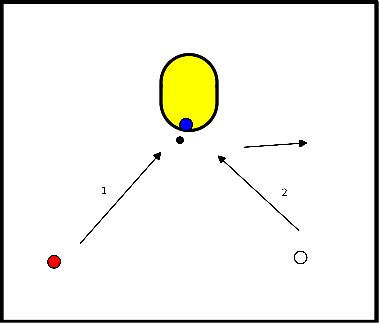
Per 2 or 3 players:
- Timing is important. Work with fixed function
- With 3 players, player blue is the declarer, player red is going to take a through ball, player white makes sure the action for the shot is started at the right moment.
- Then player red also goes to drop in again at the right moment.
- Exchange after 10 actions.
- With 2 players, the shooter of the ball is also the one who catches the ball.
- After a rebound, the ball is passed to the shooter and the player under the basket goes out again.
- Ball is played laterally and support is called again for the through ball.
- Change after 7 chances -2x-.
Assignments for 3 teams: always take turns taking chances
- Together score 9 go-arounds in a row.
- In pairs make 6 go-arounds.
- Together score 6 run-throughs in a row.
- Basket from 2 to 4.
- Together score 6 run-throughs, then together score 4 shots from movement from about 6 feet. Switch through after 2 shots.
- Basket from 2 first together, score 4 through runners, then score together 4 shots from motion from about 4 meters behind the basket, change after 3 shots.
- First each score 1 through runner, then each score 2 penalty throws.
- At basket of 2, someone scores 2 follow-throughs.
- First each score 1 follow-through, then each score 4 short chances under the basket.
- At basket of 2, someone scores 2 through runners, and then each scores 6 short chances.
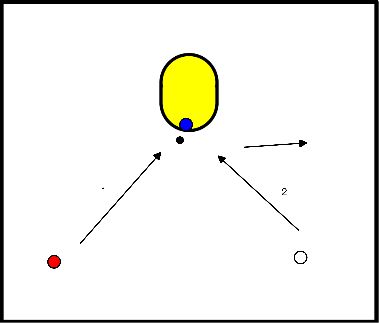
- Per 2 or 3 players.
- Timing is important.
- Work with fixed function.
- Per 3 players:
- Player Blue is the declarer/ rebounder.
- Player Red takes a through ball.
- Player White makes sure that at the right moment, after the rebound the action for the shot is started.
- Step away in time or swerve from the opponent.
- Then the player Red, who has dodged away again, also drops in at the right moment.
- Change after 10 actions of the shooters.
- Runner goes to rebound.
- Shooter goes through,
- Rebounder becomes shooter.
- Each 2x all functions.
- Per 2 players:
- Taker catches the ball.
- Operator keeps moving and after the catch makes a fierce move to get free for the shot.
- After catch, the ball is passed to the shooter again and the player under the basket goes out again.
- Ball is played to the off shooter who plays the ball right back and goes in for the through ball.
- Change functions after 10 chances - 2x.
1 attacker, 1 attacker and 1 rebounder: (with 2 without rebounder)
Always work alternately left + right laterally.
This assignment consists of 2 parts:
- Passer with ball under the basket, attacker makes lateral run and gets the ball on the outside:
- Spin the ball around your body and replay to the declarer who brings a new support active (at 3-player, the rebounder comes in as the new declarer)
- Take a walkthrough ball
- Pass through for a shot opportunity behind the basket
- Attacker with ball under the basket, attacker makes lateral run and gets the ball on the outside:
- Throw the ball behind your body over your shoulder and catch it again, pass to the attacker who brings a new support into play (in case of a triple, the rebounder becomes the new attacker).
- Go via an evasive move to the shot and then fall in.
- Inside-action is not played on, but starts in the backfield
- Instead of shooting, you bring the ball around your body, pass to the attacker again and make a through ball
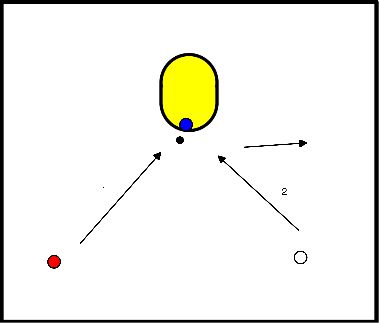
Per 2 or 3
:Timing is important. Work with fixed function
:Timing is important. Work with fixed function
- Per 3
- Player blue is the attacker, player red is going to take a pass, player white makes sure that the action for the shot is started at the right moment.
- Then player red is going to attack again at the right moment.
- Change after 10 actions
- By 2
- Run through ball is caught by the player, the ball goes out to be shot.
- After catching the rebound, the ball is passed to the shooter again, and the player under the basket goes out again.
- The ball is played laterally, and support for the through ball is called again.
- Change function after 7 chances (2x).
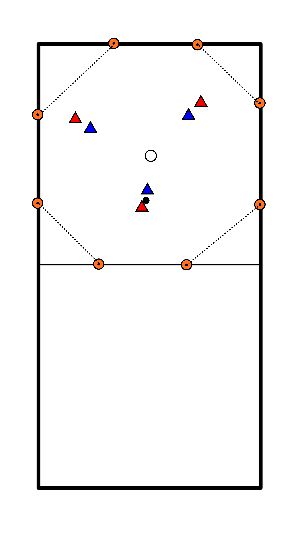
- The game is played on 1 basket, in the middle of a half court.
- 3 against 3 or 4 against 4
- When the ball is intercepted, it must first be worked towards one of the corners (in possession of the ball, 1 foot in the corner).
- When working out, a shot may not be made all of a sudden, but at least one ball must be passed through first.
- When the ball has gone outside, a foul is committed by the attacking team, or when the team resumes play after a goal, the ball does not have to be worked out but the position changes automatically.
- When a goal is scored from one of the corners, it counts for 2p. Every other goal counts for 1p.
- 2 poles opposite each other.
- Each pole has its own 2/3 team.
- The two players who are going for a walk-through walk towards the other pole.
- In the middle they circle each other.
- The players sprint back to their own goalposts and make a turnover.
Variations
- Instead of a through ball, a dodge ball.
- Instead of a through ball, a pull-away ball behind the post.
- If necessary, post to post, whoever scores X number of goals first.
- Attacker with ball under the basket, attacker in front of the basket:
- Attacker starts wide:
- Gets the ball on the outside, ball is turned around the body, and played in again for a DLB.
- Without ball inside for deflection, then run in for DLB.
- When you have the ball, turn it around the body and finish.
- Attacker takes a shot, then starts in towards the backfield where the ball is played, ball around the body towards DLB. (pass behind the back)
- Work in pairs. (unless there is no other way)
- Shot from 4 meter from stand.
- Shot from movement right 4/5 meter.
- Shot from movement left 4/5 meter.
- Short chance left at 3 meter.
- Short chance right at 3 meter.
- Penalty throw.
- Walk-through ball.
- Shot at 6 meter.
- Working with 2 teams you let every player shoot for 2 minutes, after that you switch functions.
- You are 4 minutes per round.
- Note the scores on a list, so you can see if there is improvement later in the season.
- Working with 3 teams, you work 1 minute per shot.
- Make groups of 3 to 4 cows.
- Start at the side and stop at the other side.
- Number 1 throws to 2,
- 2 to 3
- and 3 to 1 again.
- Always about 3 mtr and kk are instructed to use diagonal running lines.
- Pay attention to throw for the lady and show the hand which has to be thrown.
- Number of times without opponent and then with opponents.
- You get one point for reaching the line.
- When the ball is intercepted, everyone stands on the same height as the player with the ball and then they can start.
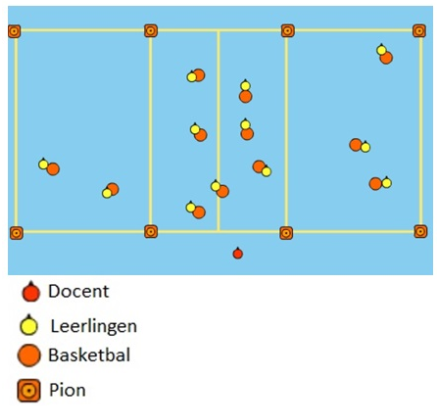
- The teacher sets out three areas of approximately equal size with pawns.
- It is best to use the volleyball lines (see map).
- There are three sections (see map):
- Left: barons square (losers square)
- Centre: princes section (neutral section)
- Right: king of the court (winner section)
- All students stand in the middle section.
- With a signal from the teacher the game starts.
- All pupils have to try to tap/strike the ball of another pupil out of the box.
- If you succeed you move one square to the right.
- If your ball is knocked away you move up one square to the left.
- If you hit/tap someone's ball out of the box on the right you score a point.
- If your ball is knocked out of the winner's box you lose all your points.
- If your ball is knocked out of the left box nothing happens and you stay standing.
- When the teacher gives the final signal the person with the most points is king of the court and he/she has won.
- There are three players standing at a pole.
- Player 1 starts with the ball and throws to 2, 3 runs first short and then long, then gets the ball from player 2 and shoots.
- Player 1 catches and throws to player 2, player 2 throws to 3 and then player 1 runs the long line.
- This is how the process repeats itself.
Variations:
- Instead of shooting, player 1 cuts in and throws number 3 in and comes for the through ball
- Same as above, but then player 3 does not take a walkthrough ball but pulls player 1 away and takes a short chance
In short: exercises in catching balls that bounce or roll at the right moment. This is to learn how to catch a ball as quickly as possible.
Organisation: One ball per pair.
- The numbers 1 and 2 of each pair stand next to each other.
- The trainer throws, rolls or bounces the ball a few metres away.
- Number 1 and 2 have to get the ball, pick it up and pass it back as fast as possible.
- The one who does this the fastest wins. After 5 times change.
In short: exercises in catching balls that bounce or roll at the right moment. This is to learn how to catch a ball as quickly as possible.
Organisation: One ball per pair.
- The numbers 1 and 2 of each pair stand next to each other.
- The trainer throws, rolls or bounces the ball a few metres away.
- Number 1 and 2 have to get the ball, pick it up and pass it back as fast as possible.
- The one who does this the fastest wins.
- After 5 times change.
- The remaining players take shots, free balls and penalty shots in the meantime
- while the other two are busy with the reflex training.
- At pawn 1
- touch the groundTouch the ground, jump up and stretch all the way. We do this 5 times.
- RUN TO THE FIRST POLE.
- Pole 1
- Then you take a dodge at pole 1.
- RUN TO POLE 2.
- Pole 2
- 5 sit ups.
- RUN TO POLE 2.
- Pole 2
- run through the pole 2.
- Pole 3
- 5 squads.
- Pole 3
- Score 1 small chance
- We do this 3 times, then change under the pole
In short: nice shooting exercise with a lot of running.
Organisation:
- The baskets are placed in a circle.
- At each basket stands a server with a ball.
- The rest of the players stand in the middle of the circle (the middle must be clearly recognisable.
- There is often a circle in the hall,
- A pylon must be placed on the field).
- The number of baskets is very precise:
- Aim for 2 baskets per 5 players.
Execution
- The players in the centre circle get the assignment to make a run through ball on one of the baskets,
- It does not matter which one.
- As there are more players in the circle than there are free baskets, it is important to find a free basket quickly.
- When you are not quick enough, you have to wait a bit.
- And when Johnny is already on his way to a basket, but is passed at the last moment by Marietje, who is running faster, Johnny has to go back to the centre circle and try again from there.
- Everyone catches his own ball.
- After passing the ball, each player runs through the centre circle or around the pylon to find a free basket again as soon as possible.