



Korfballexercises for seniors
Last update: january 2026
Execution
- Set up the situation twice. The first obstacle is a speed ladder. Move sideways through the ladder by standing with two feet in the ladder and one foot outside the ladder.
- Next, you will encounter three hurdles that increase from low to high. Jump over these hurdles.
- On the way, take a small bag from the bucket. Which team can get all the bags to the other side first and then sprint as a team to the other side first? The final sprint can only begin once the last bag is in place!
Execution
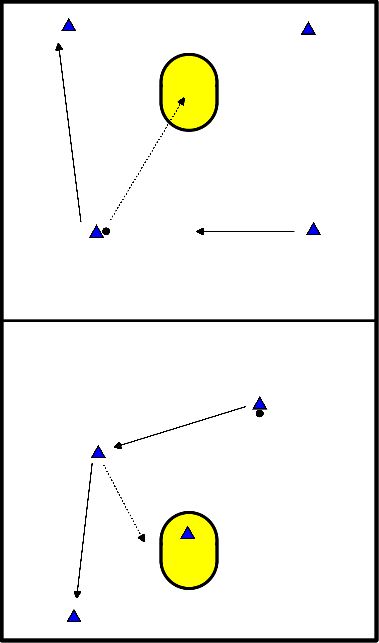
- All four corners are occupied, the ball starts at the left front.
- The ball is passed around once.
- When the ball is back with the first player, player three moves to the support position.
- The ball goes inside, player four moves into position for the rebound.
- Player one crosses with player two and takes a shot.
- Player two remains in motion and takes a short-range shot.
- Player one finishes with a running-in ball.
- The movement into position should not take too long.
- The crossing must be executed precisely.
- The passing must be accurate.
Pawn Tag
- Divide the team into groups of 3 to 4 people
- Place pawns at different distances (for example, 4 meters, 8 meters, 12 meters and 20 meters)
- One player per team starts
- The player runs to the first pawn, taps it and runs back to the starting point
- Then the player taps the second pawn, and so on
- When the first player has touched all the pawns and is back at the start, the next player in the group starts
- The first team to get all the players wins
Player starts under the post with ball.
- 1 player in front of the post without ball
- Player moves sideways and is played the ball and makes short-chance.
- Player moves to the other side is played the ball again and shoots.
- Player runs deep and gets the ball and shoots.
- Change of position
Important:
The movement in front of the post happens at speed and stays within the 3 meter zone.
The movement deep at speed and the shot takes place in the 4 meter zone.
The movement in front of the post happens at speed and stays within the 3 meter zone.
The movement deep at speed and the shot takes place in the 4 meter zone.
Place at least half the number of players participating in baskets distributed in a circle on field.
- One player stands under each basket with ball
- The remaining players stand in the middle between the lined up baskets
- Have players walk to a basket and pull a hook and then shoot.
- If the ball is in, on a regular basket, the player gets 1 point.
- Is the ball in, on a shooter's basket, then you get 2 points.
- If the player has scored, he walks to the center and chooses another basket to shoot at.
- If the player did not score, then you switch with the passer.
- Play like this to a self-selected number of points.
variation:
- follow-through
- pull away ball
- Move sideways through the ladder at a fast pace, moving your arms with you.
- Stand in front of the speed ladder and make spreading jumps with one leg in the ladder each time.
- Stand in front of the speed ladder and jump into the ladder with two feet, then jump right out again to a squat position. Make sure your upper legs are horizontal and keep your torso upright.
- Stand in front of the speed ladder and step into the ladder, always keeping one foot in the ladder and one foot outside the ladder.
- Stand in front of the speed ladder and step into the ladder first with two feet in the ladder alternating with two feet outside the ladder.
- Move sideways through the ladder at a fast pace, moving your arms with you.
- Stand in front of the speed ladder and make spreading jumps with one leg in the ladder each time.
- Stand in front of the speed ladder and jump into the ladder with two feet, then jump right out again to a squat position. Make sure your upper legs are horizontal and keep your torso upright.
- Stand in front of the speed ladder and step into the ladder, always keeping one foot in the ladder and one foot outside the ladder.
- Stand in front of the speed ladder and step into the ladder first with two feet in the ladder alternating with two feet outside the ladder.
These exercises over a maximum of 20 meters, at stop exercise 3 stops.
- Side jump, as fierce as possible push off on left or right leg and away on 1 leg - side feint/ swerve
- Cross-over side jump, find balance after each stride. Left and right.
- Walk forward with stop, standing completely still.
- Backward slide with sometimes left front and sometimes right front. Can be done on command.
- Side hopping with connecting feet.
- Walking backward.
Training objective:
Picking up the shot directly in a duel between them.
Shot duel
Per 2-team a ball and a post.
Picking up the shot directly in a duel between them.
Shot duel
Per 2-team a ball and a post.
- Making 2 out of 5 distance shots from 6 meters.
- Then you get one chance from 4 meters.
- You must score the one from 4 meters to earn a point.
- Your opponent can undo this point by also scoring the 4-meter chance.
- Score 3 out of 5 short chances from 4 meters.
- Then score 2 penalty throws, on 2, to earn a point.
- Your opponent can undo this by also scoring both penalty throws.
- Score 2 out of 5 shots behind the basket at 5 meters.
- Then score 3 through balls, from 3 chances, to earn a point.
- Your opponent can undo this by also scoring 3 through balls.
- Score 1 out of 5 distance shots at 8 meters.
- Then score 3 out of 4 chances under the basket.
- Your opponent can undo this by scoring 3 out of 3 chances under the basket.
Put at least half the baskets of the number of players participating.
- One player with ball stands under each basket
- The remaining players stand in the middle between the set up baskets
- Have the players walk to a basket and pull a hook and then shoot it
- If the shot is on a normal basket the player gets 1 point
- Is the shot in at a shooter's basket then you get 2 points
- If the player has scored, he walks to the center and chooses another basket to shoot at.
- If the player did not score then you switch with the passer.
- Play to your own choice of points
- Work with 3 or 4 teams per basket.
- The players move in and out continuously from 5 meters.
- The player with the ball chooses 1 of the outrunning people and throws the ball in tight.
- The player who gets the ball shoots, the declarer catches off.
- The ball is played out and the others make in/out moves again. Now another is played on, who shoots immediately.
Goal of the exercise is: continuous movement, being ready to shoot and tight passing.
Objective:
The base is a standard running form exercise, where you have players move back and forth in different ways to train general motor skills.
The tap game element adds responsiveness by having players react as quickly as possible and determine what they are going to do.
The tap game element adds responsiveness by having players react as quickly as possible and determine what they are going to do.
Description:
- The players stand on a line and are given a way by the trainer to run across each time, see also running forms.
- All players have a ribbon on, 1-3 players with the same color.
Occasionally, while walking back and forth, the trainer calls out the color of 1 of the ribbons. These then become the tickers. The tickers get 10 seconds to tap as many of the remaining players as possible. - Then all return to the same line and start a running form again.
- The idea is to start the tagging round immediately when the trainer calls a color and to quickly start the next running form when the tagging round is over. Keep up the pace.
Variations:
Instead of running forms where players walk back and forth, you can do movement exercises standing in the same spot. Examples include Jumping Jacks, sitting/lying and getting up again, jumping forward and backward, etc.
The trainer occasionally gives the next movement assignment and calls a color to start a tap round.
Running Forms:
Standard
- Running / Running backwards
- Hopping / Hopping backwards
- Sideways with front right / Sideways with front left
- Small steps
- Hopping on right / Hopping on left
- Cross pass
Jumps
- Jumps as large as possible.
- Medium-sized jumps and always balancing on 1 foot for a while before taking the next jump.
- With two feet side by side.
- With two feet side by side a big jump forward and another small jump back.
- With two feet zigzagging.
Arm movements to be combined with the above forms.
- Swing 1 arm forward or backward.
- Swing both arms forward, or both backward.
- 1 arm forward and 1 arm backward.
- Holding another body part with 1 or both arms.
As animals
- Frog; jumping on hands and feet.
- Crab; on hands and feet, with belly up.
- Kangaroo; jumping on two legs.
- Flamingo; hopping.
- Duck; crouching walk.
The trainer occasionally gives the next movement assignment and calls a color to start a tap round.
Running Forms:
Standard
- Running / Running backwards
- Hopping / Hopping backwards
- Sideways with front right / Sideways with front left
- Small steps
- Hopping on right / Hopping on left
- Cross pass
Jumps
- Jumps as large as possible.
- Medium-sized jumps and always balancing on 1 foot for a while before taking the next jump.
- With two feet side by side.
- With two feet side by side a big jump forward and another small jump back.
- With two feet zigzagging.
Arm movements to be combined with the above forms.
- Swing 1 arm forward or backward.
- Swing both arms forward, or both backward.
- 1 arm forward and 1 arm backward.
- Holding another body part with 1 or both arms.
As animals
- Frog; jumping on hands and feet.
- Crab; on hands and feet, with belly up.
- Kangaroo; jumping on two legs.
- Flamingo; hopping.
- Duck; crouching walk.
The goal is for each team to score 500x all together in the next 5 tasks. After each assignment there is an intermediate exercise for variety:
- Assignment 1: Walk-through balls: score 120x
- Intermediate task 1: match between3 posts of 5 minutes.
- Assignment 2: Front basket shots from movement: score 80x
- IntermediateAssignment 2: Take 2 minutes of walk-through balls with your group. What is the largest number you score in a row?
- Assignment 3: Short chances with intermediate pass: score 120x . So play in and get back.
- Intermediate assignment 3: which group scores the most goals from 6 meters in 3 minutes.
- Assignment 4: Penalty throws: 100
- Intermediate Assignment 4:
- At each post there is one fixed shooter with a fixed rebounder.
- In each round the shooters, within the time limit, must score one goal.
- If a goal is scored, the ball is held.
- If no goal is scored, within the time, the shooter is out of the game.
- Games are played in the following rounds:
Round 1: 10 seconds.
Round 2: 5 seconds.
Round 3: 3 seconds or 1 chance. - No shooter is changed until all rounds have been played.
- Do all players miss in a round? Then the round will be played again!
- Intermediate Assignment 4:
- Assignment 5: Shots back basket from movement: 80. Rotate posts 180° if necessary.
For each pair/trio, set out a 2 meter by 1 meter rectangle with four different colored hats.
- 1 player stands in the box, the other watches.
- Put two lines on each side of the rectangle.
- The players in the box have their feet move - dribble - in place.
- The players are always given commands to respond to.
- Each time you name a color of a hat, they must touch that hat with their hand.
- The command line means they must sprint to one of the sidelines. At that point, the other of the pair/triplet enters the box and then does the commands.
- Each does this 10 times.
Assignments can include jump, squat, touch heel, touch knee, hop right, hop left, sit, plank, push-up, etc.
You alternate these assignments with a color of a hat.
You alternate these assignments with a color of a hat.
Target
- Pure shooting and build fitness.
- Which pair will be the first to achieve 0 up and down runs.
Rules
- You start by sprinting up and down the width of the hall 5 times as fast as possible.
- Then you shoot 10 times within 2 meters and count how many times you score. You shoot alternately, so 5 times each.
- If you have scored 5 or more times -half your number of single sprints- then you may sprint up and down the hall one less time, so 4 times.
- Then you start shooting again and count how many times you score. If this is half or more than the number of times you have run, then you are allowed another up and down.
Same as pawn looting, but now you may loot people when you run out of pawns in the middle.
Game rules:
Game rules:
- Teams play against each other.
- Each team has its own basket.
- Instruct which shot is to be made, if this shot is in place then you may take a pawn from the middle
- Are the pawns gone then you may take a person from another team.
Goal
- Which team has robbed the most pawns/ players at the final signal.
or - Which team has robbed all the players at its basket.
In short: shooting practice (-game) in which you shoot from different sides of the basket.
Organization:
- Per basket one pair with a ball, or in case of lack of sufficient baskets 2 pairs each with a ball.
- At each basket, four pawns or other markers: one in front of and one behind the basket and one to the left and right of the basket, always at a distance of about 6 meters.
- One of each pair starts under the basket.
- The other is instructed to score a goal as quickly as possible from each pawn.
- Then switch positions.
- Which pair will finish 'the trip around the world' the quickest?
Variation:
- The distances can of course be made larger or smaller at will.
- Or: score 2 goals at each pawn.
Variation:
- Instead of shooting from standstill, it is possible to shoot from movement,
- Or simply: take evasive balls.
Variation:
- There are 2 pairs per basket.
- The two shooters are now instructed to score two goals together at each pawn, no matter who scores the goals.
- So there is a change of function after 4 times 2 goals have been scored.
- At which basket is the first to go around 2 times (and therefore has scored 16 goals first)?
The main consideration behind the above exercises is the fact that shooting is usually preferred from in front of the basket. And since a large part of the box is next to or behind the basket, it is necessary to practice from those spots as well. And shooting from there is really different: not only because the baskets usually hang slightly forward, but also because the attachment to the post is clearly visible to the shooter, which affects the estimation of the correct distance and height.
Clean shooting is always important of course, but here it comes down very much to scoring goals. When players play this game for the first time, they are initially quite vocal and there may be reactions like "this is impossible!" or "I don't like it". These reactions disappear after a short time, people start to shoot with great concentration and scoring improves by leaps and bounds. What seemed impossible at first, turns out to be possible after all!
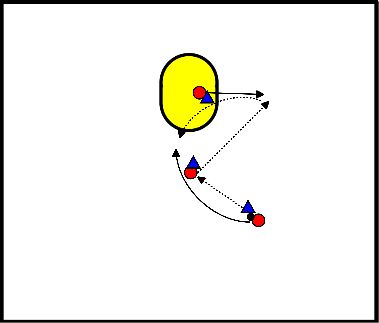
- Ball is played into the support.
- The lady under the post moves away to the side from where the ball is played into the support.
- In the meantime the first passer has run towards the support, after which the support player plays the ball to the outgoing pole lady and she steps with the ball threatening to run inside.
- The first passer runs around the block and gets the ball from the side and takes the through ball.
- Play this in the 3:3 as often as you can and do this on all sides of the post.
- The third trio practices free balls and penalty throws. The starting ball can also be practiced new. (Similar to above)
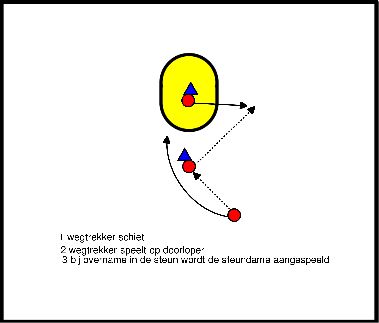
- The lady in the support is played from the left or right of the front court.
- The lady in the rebound pulls away to the side of play and gets the ball out of the support.
- The first times there will be no sharp running along and she can shoot herself.
- The player runs around the support and catches the ball.
- If there is good defense, the outgoing rebounder plays the ball to the player who runs around the support and takes a through ball.
- (Sometimes there is cutting, often the defender is not short enough. If the declarer steps out when throwing, the other attacker runs past the defender and there is no cutting)
- If the lady is taken over the support, the ball goes to the support who then shoots herself.
- From 4-0 to 3-1: shot directed and to 2nd chance, also from rebound
- Intermediate to pass --> filling space and to shot
- Defender on shooter (80%)
- Intermediate to pass --> searching for 2nd attacker
- Defender on shooter (80%) --> timing to release
- Intermediate and rebound change: rebounder draws from basket to chance
- Defender on rebound: do not let go in support --> recognized by attackers in front court
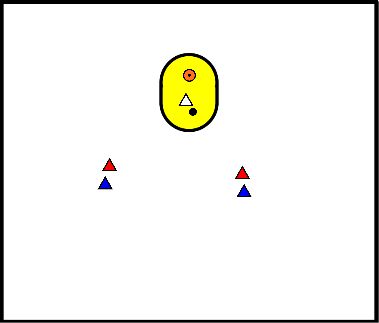
2 attackers with one defender each try to take chances.
The attacker under the basket makes sure they can create chances.
The attacker can also rebound, but stays in the basket zone.
Getting free becomes easier, but make sure you have the right timing. Make
sure that the attackers are always turned towards the basket.
The attacker under the basket makes sure they can create chances.
The attacker can also rebound, but stays in the basket zone.
Getting free becomes easier, but make sure you have the right timing. Make
sure that the attackers are always turned towards the basket.
- Start with the assist from under the basket.
- Extra: also leave space in front to free each other.
- Extra: if an attacker gets the ball from under the basket, he may not pass to the attacker again. --> stimulate the assist from space.
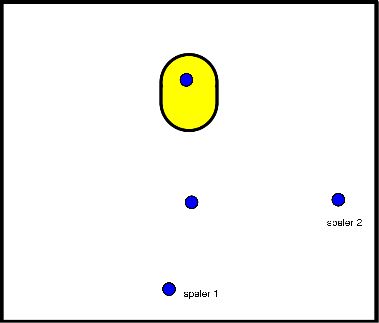
Objective:
2 runners on support create a distraction, so that they can pull away from under the basket and shoot.
Game:
2 runners on support create a distraction, so that they can pull away from under the basket and shoot.
Game:
- 2 attackers high in front of the basket.
- 1 support high in front of the basket.
- 1 attacker under the basket.
- Attacker 1 plays over with support a maximum of 2 times, while moving.
- Attacker2 runs in in such a way that he can also go in for a run after those two throws.
- Attacker 1 runs through at high speed; if no run through can be made, player 2 comes through.
- At the same time, player 1 moves away from the basket to the side where the run through is coming from.
- If player 1 is free, he may score; if he is well defended, he may pass to the player under the basket who is pulling away.
- If the ball cannot be passed to the support, check if player 2 is playable.
Agreements:
- Attackers 1 and 2 do not stand still.
- No more than 2 throws back to the support by the same person.
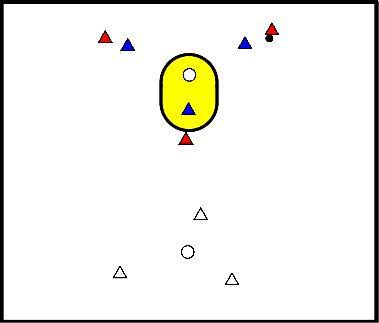
Play 3 against 3 on 2 poles
- Mission is to get as close to the basket as possible. No support or rebound. If you are free, you have to shoot
Most probably a lot of passes will be given without chances.
Adjusting: take every ball with the intention of shooting
- From the moment you are in the 3v3, you must shoot within 4 passes It is therefore important to effectively run free, and you should also start shooting. (The passing becomes important now)
It is important to only throw the pass when you think someone is going to shoot
It is also important to only pass when you think your team-mate is ready to shoot You should also be able to free up everyone in every position So keep the ball up high
And when everything is right, everyone tries to get free As a result, every defender is occupied with his attacker, and there should be no static rebounds In this way, everyone can be dangerous.
What is important to score? Shooting.
What is important in order to score? Free running
What is important when you are free? Being ready to shoot! Toes and shoulders pointing towards the basket Actually, you are walking in a circle around the post.
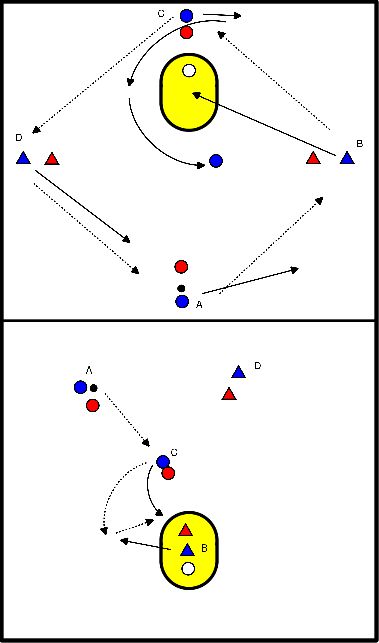
- Ball 1 (with or without defenders)
- Player A passes to B and keeps moving in front.
- B passes to C and starts rebounding.
- C passes to D and keeps moving in the back.
- D passes to A and both stay in front at a good distance from the basket until player C runs in the support.
- Player A passes to C.
- C waits in the support position for just under a second.
- Player B pulls away from the rebound position.
- Player C passes to B and turns on her axis to immediately fold in.
- B passes directly back to C for the through ball.
- When C misses, it is C's task to rebound immediately and adjust the free running player B for a possible 2nd chance. (short chance).
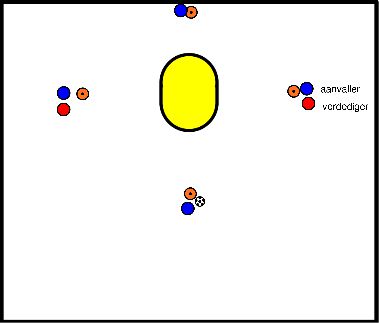
Basic rules:
- The attackers' first shot is 'free'.
- It may not be defended.
- Take the first shot, each attacker tries to stay in possession of the ball.
- If the defender takes the ball after the first shot, the attempt is over.
- If the defender does not take the ball after the first shot, the defender must try to prevent the second shot as soon as possible.
- If the attackers get the ball after the first shot, they may play freely.
- The attacker has, after the first shot, two choices: shoot himself or get the assist
- The exercise lasts a maximum of 10 seconds.
- Forces to act fast.
Task:
- Try to stay in possession of the ball after the first free shot by one of the attackers.
- If you don't, and the defender grabs the ball, your attempt is over.
- If you do, you can play freely (3-1 or 2-2).
- If a goal is scored or the ball is intercepted, the attempt is over.
- After each attempt, the attackers start at a pawn and another attacker takes the first shot.
- After 3 attempts, it is changeover time.
Forms of play:
- 2-2, then two of the attackers are always defenders and everyone starts at their own pawn.
- 4-2 or 4-3, next to the attacker who makes the shot, no one is a defender.
- After the shot, anyone can be defended.
- 4-4: There is one defender and one attacker on each teammate.
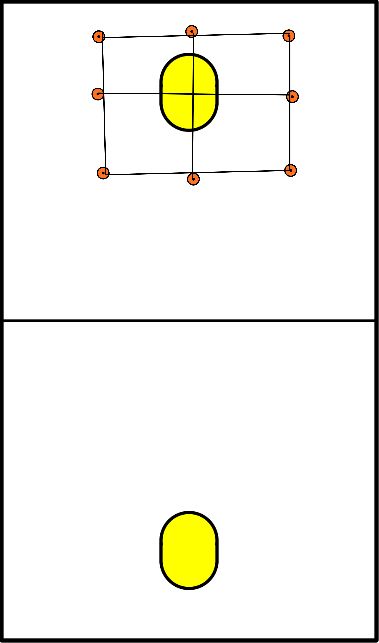
- Reduce the attack space and divide into four squares.
- Players split into the four squares
- They play the ball around and change sides or diagonally
- They switch sides and diagonally. (attacking)
- Place one defender in the van and play on the second chance. (action after the shot)
- Two defenders, no manning under the basket when shot. (running rebound)
- Putting diagonal passing into play. (defenders attacking from the back).
- Change boxes during the game.
- 4/3 same assignments
- 4/4 set up NO REBOUND. Tackle the backfield (the backfield is the space where no attacking takes place).
- Take care of the signal.
- Dare to take the second chance.
- You can vary with time or ball contacts.