



Korfballexercises for technique shoot / score / shot
Last update: january 2026
Duration
- 30 minutes
With Pairs and 5 Baskets
- Players numbered 1 receive 3 cones
- Players numbered 2 receive 2 cones
- Players numbered 3 receive 1 cone
- Continue until all cones are distributed
With Trios and 3 Baskets
- Players numbered 1 receive 2 cones
- Player numbered 2 receives 1 cone
- Continue until all cones are distributed
Exercises
- 8 running-in shots: Cone at 7 metres in front of the basket. Switch after each running-in shot.
- 4 evasive shots to the right: Cone at 6 metres. Change roles after shooting twice.
- 15 small chances: Shoot in turns.
- 4 evasive shots to the left: Cone at 6 metres. Change roles after shooting twice.
- 6 half-turn shots: Cone at 4 metres. Switch roles after each shot.
- 6 distance shots from behind the basket: Cone at 4 metres behind the basket. Change roles after shooting twice.
- 5 free shots to the right: Cone at 2.5 metres. Change roles after shooting twice.
- 10 penalty shots: Cone at 2.5 metres. Switch roles after each shot.
- 5 free shots to the left: Cone at 2.5 metres. Change roles after shooting twice.
Execution
- Place the cone at 5 metres. If you score a goal, you may steal a cone from another group.
- You only shoot again when your partner is back at the basket to rebound.
- Switch roles every two shots.
- Continue until a group has no cones left.
Objective
- The objective is for each team to score 125 times in the following 5 tasks.
Task 1: Running-in Shots
- Score 30 times.
- Intermediate task 1: 20 sit-ups.
Task 2: Shots from the Front of the Post in Motion
- Score 30 times.
- Switch every 3 shots.
- Intermediate task 2: 20 push-ups.
Task 3: Shots from 6 Metres without Moving Around the Post with Intermediate Pass
- Score 30 times.
- Switch after 2 shots.
- Pass and receive back.
- Intermediate task 3: 30 squats.
Task 4: Penalty Shots
- Score 2 times.
- Intermediate task 4: 30 jumping jacks.
Task 5: Shots from the Back of the Post in Motion
- Score 25 times.
- Optionally rotate the posts 180°.
- Switch every 3 shots.
Organisation
- Pairs per korf. One fixed feeder and one fixed shooter, for example, four metres in front of the korf.
- The shooters are tasked with scoring 10 points as quickly as possible.
- A goal counts for two points.
- If a shot is missed, one point is deducted from the total (the total remains at 0 points if you are at 0 and miss).
- As soon as someone reaches 10 points, the players switch roles.
- For less advanced players, you can reward a goal with, for example, 3 points.
- For advanced players, you can make it more challenging by awarding only 1 point per goal.
- The distances can be increased or decreased as needed.
Organisation
- 3-5 players per korf with two balls.
- Marker cone approximately 6 metres in front of the korf.
- Players are numbered and stand in order behind each other at the marker cone.
- Numbers 1 and 2 have a ball.
- Number 1 starts shooting and retrieves their own ball.
- If they score, they pass the ball to the next player.
- If they miss, they shoot again from the spot where they retrieved the ball until they score.
- The shooter joins the back of the line and waits for their next turn.
- Number 2 starts shooting as soon as number 1 has taken a shot.
- Number 2 continues shooting until they score, then passes the ball to the next player and joins the back of the line.
- If someone scores before the person who started before them, that person is out.
- Who remains the longest?
- There are 4 participants.
- Number 1 scores immediately, passes the ball to number 3, and joins behind number 4.
- Number 2 misses, and the ball rolls away.
- Number 3 scores, number 2 is out and no longer participates.
- Numbers 2 and 3 pass the ball to numbers 4 and 1.
- Number 1 waits to shoot until number 4 has taken their shot.
Objective
- Improve shooting accuracy and build fitness.
- Which pair will be the first to complete 5 runs back and forth?
Rules
- Start with 10 sprints back and forth.
- Then shoot 10 times and count how many goals you score.
- If you score 5 or more times (half of your number of sprints back and forth), you may sprint one less time, so 9 times.
- Then shoot again and count how many goals you score.
- If this is half or more than the number of times you have run back and forth, you may reduce the sprints by one more.
Objective
- Accurate shooting and building stamina.
- Start by sprinting up and down the width of the hall 5 times as quickly as possible.
- Then shoot 10 times from within 2 meters and count how many times you score.
- Alternate shots, so each person shoots 5 times.
- If you score 5 or more times (half of your number of single sprints), you may sprint up and down one less time, thus 4 times.
- Then shoot again and count how many times you score.
- If this is half or more of the number of times you have sprinted, you may reduce the sprints by one again.
Setup
- There is a pair at each korfball post. The number of posts depends on the size of the group.
- Everyone starts by scoring twice on the korfball post.
- After scoring twice, they move to the next post.
- It may happen that there are two pairs at one post, as not everyone needs to rotate.
- The pairs only rotate when they have scored twice themselves.
- Place a marker in front of the post at a suitable distance for your team.
Objective
- Shooting exercise where shots are taken from different sides of the korf.
Organisation
- Per korf, one pair with a ball, or if there are not enough korfs, two pairs each with a ball.
- At each korf, place four cones or other markers: one in front, one behind, one to the left, and one to the right of the korf, each approximately 6 meters away.
- From each pair, one player starts under the korf. The other player scores a goal from each marker. Then they switch roles.
- Which pair completes the 'journey around the world' the fastest?
Variations
- The distances can be adjusted as desired, or two goals can be made from each marker.
- Instead of shooting from a standstill, shots can be taken on the move, or dodge shots can be used.
- Two pairs work per korf. The two shooters must score twice together at each marker, regardless of who scores the goals.
- Roles are switched after four times two goals.
Execution
- The exercise encourages shooting from different positions around the korf.
- It is important to shoot accurately, especially since shooting from the side or back is different due to the angle of the korf.
- Players may be noisy at first but quickly become focused and significantly improve their shooting skills.
Execution
- One player is active and stands approximately 3-4 metres in front of the post.
- The rebound player stands with the ball under the post.
- The active player receives the ball, shoots, and immediately runs to the back of the post.
- There, the player shoots again from a distance of 3-4 metres.
- Repeat the process by continuously moving from the front to the back of the post.
- After one minute, switch roles between the rebound and active player.
In Brief: Practicing various shooting techniques from a supporting position.
- Organisation: Two players per korf: one fixed person under the korf and one in front. Switch after approximately 1 minute.
- Execution:
- a) The passer stands about 6 meters in front of the korf, the shooter begins under the korf. The shooter starts diagonally backwards, receives the ball and shoots immediately. The passer catches the ball.
- b) As in a, but the shooter feints a shot, causing the defender to jump in, and follows with an 'underhand pull shot' from about 5 meters diagonally behind the korf. The passer catches the ball.
- c) The shooter has a defender. The defender determines the opportunity: reacts too late (shot follows) or follows aggressively (opportunity for the pull shot).
- d) As in b, but the shooter moves sideways and makes a turn of almost 180 degrees towards the korf to take the pull shot. Can also start from a standstill.
- e) As in d, with a defender on the shooter. The defender rushes in aggressively.
- f) The shooter stands half a meter in front of the korf, defender between shooter and post. The shooter throws the ball with two hands backwards into the korf.
- g) The shooter stands half a meter behind the korf, with the defender in front. The shooter makes a feint throw, then shoots as soon as the defender turns around.
- h) The passer deliberately shoots over the korf. The shooter under the korf catches the ball and shoots immediately in one smooth motion.
- i) As in h, but now the person under the korf shoots directly from a jump.
- j) The passer shoots over the korf. The catcher lets the ball go over them, runs after it, and shoots with a half turn.
Execution
- Each player has their own ball.
- There are 3 to 4 korfball posts in a row, depending on the number of players.
- All players start at the same post.
- After the countdown, they all begin shooting.
- If a player scores a goal, they may move to the next post.
- If a player misses, they remain at the current post until they score.
- Depending on the skill level, it can be agreed that players must have been at each post 1, 2, or 3 times.
- Use cones to create a circle outside of which the players must shoot.
- Players may only enter the circle to catch the ball.
In Brief
- Shooting game where shots are taken from different sides of the korf.
- One pair per korf with a ball. If there are not enough korfs, two pairs with one ball each.
- Four markers per korf: front, back, left, and right at approximately 6 meters distance.
- One player starts under the korf, the other shoots from each marker.
- Switch roles after each round.
- Which pair completes the 'around the world' first?
- Distances can be increased or decreased.
- Make 2 goals at each marker.
- Shoot on the move or take dodge shots.
- With 2 pairs per korf, score 2 times together at each marker.
- Complete the task within 2 minutes, otherwise a penalty round.
- Shoot from different positions to get used to various angles and distances.
- Ensure variation in shooting positions to avoid favouring any team.
- Accurate shooting is crucial for success.
- Players become more focused and improve quickly.
Setup
- Three players at the korf: one passer with the ball under the korf and two attackers.
- The attackers move from left to right in front of the korf.
- The passer alternately passes to the attackers.
- The minimum shooting distance is 5 meters.
- The goals are counted.
- The attacker who scores 3 goals first remains in front of the korf.
- The losing attacker takes the place of the passer.
The chaos game is fun for younger children, but can also be played with older ones.
- In the chaos game, the idea is for each child to have a ball, and 3 to 4 poles (also depending on the number of players)
- Line up in a row.
- Each player starts at the same pole,
- There is a countdown and then they all start shooting,
- If they score, they move up one pole,
- If they don't score, they stay at the post until they do.
- You can agree in advance whether they have to pass each pole 1, 2 or 3 times depending on the level.
- Variation: you can use pawns to mark a circle outside of which the players must shoot,
- They may enter it only to catch the ball.
- Materials below are for 4 people (hat = pawn)
The goal is to score 125 times per team all together in the following 5 tasks. After each assignment there is an intermediate exercise for variety:
- Assignment 1: Walk-through balls: score 30 x
- Exercise 1: 20 sit-ups
- Assignment 2: Front basket shots from movement: score 30 x. Change every 3 shots!
- Intermediate assignment 2: 20 push-ups
- Assignment 3: shots 6 meters sin around the basket with intermediate pass: score 30 x. Exchange after 2 shots So play in and get back.
- Intermediate task 3: 30 squads
- Assignment 4: penalty throws: 2
- Intermediate task 4: 30 jumping jacks
- Assignment 5: Back basket shots from movement: 25 . Rotate posts 180° if necessary. change every 3 shots.
Shooting game where they get to take a card when they have scored.
- Each playing card shows a "color": clubs, spades, hearts or diamonds.
- Each color represents an exercise:
- Hearts: through-ball
- Spades: penalty throw
- Clubs: shot front side
- Diamonds: shot back side
- If they took a card, number is what the card indicates
- For example, Hearts 4 = 4 through balls
- Ace is 1 or 11 own choice
- The first group with 50 points has won.
- 2 people at a pole.
- Each player has a color hat
- Player 1 starts and has 2 attempts of 2 meters to score. If player 1 scores then they may move the hat 1 meter back.
- Swap and then player 2 starts at 2 meters with 2 chances. Does player 2 score within the 2 chances then he may also move the hat back one meter.
- Are missed within the 2 goal attempts then the hat goes 1 meter forward.
- Whoever makes it to the 8 meters on the front and back first.
- If a player has passed the 8 meters on the front then in the next round he goes to the 2 meters on the back. If this is missed then he goes to the 8 meters in front again.
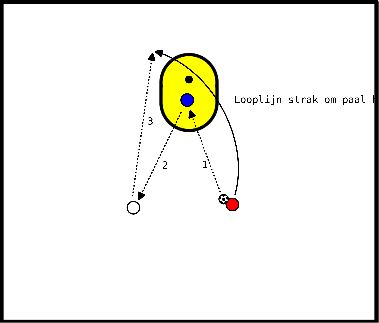
- Player red throws the ball to the blue player under the basket.
- The blue player passes the ball to player white.
- Player white then throws the ball deep behind the basket.
- From the moment player red has thrown the ball to blue, he cuts around the basket to accept the deep thrown ball for the shot.
- Player white may throw the ball deep immediately after receiving the ball.
- It is up to player red to be ready in time.
- Dotted line: ball lines - Black line: running line
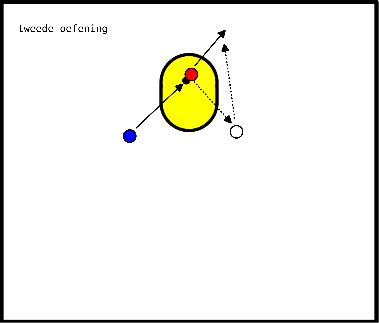
- Score 15 through balls without missing
- Red plays to white and runs away diagonally to the back.
- White plays back to red who shoots.
- Blue catches, who then plays the ball back to white.
- White plays through to red and blue pulls away diagonally at the posts, gets the ball from red and makes a shot.
- White catches off, plays to red, and so on.
- Score 15 swerve balls, keeping all 3 moving all the time. When the ball appears to be in possession of the rebounder, the next shooter steps away.
- score 20 distance shots from movement and do this from all sides.
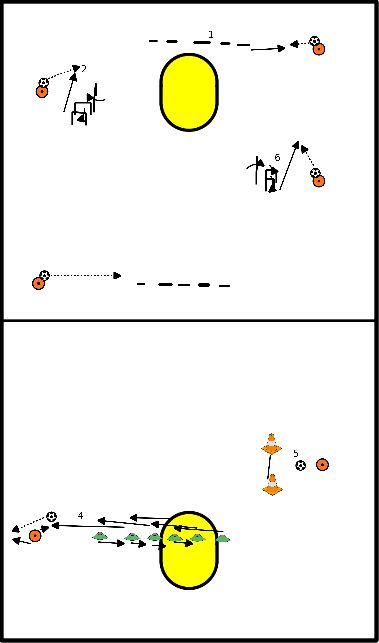
- Start with 1 leg in the ladder, other leg in the ladder and then next to it the legs alternately out. Rhythm in-in_out-out.
- A defender walks backwards in the opposite direction. After the ladder, take a through ball.
- Jump forward over the hurdle with both legs and then sideways over the other hurdles, make a sideways move to the right, get the ball and score.
- Go through the speed ladder with a ski move, at the end get the ball and shoot directly.
- 2 hat forward, 1 hat back, make a run-through move, get the ball and play the declarer, who steps out.
- 5 sprint back and forth between the two hats 2x, make a penalty throw.
We work with 3 or 4 teams and each exercise lasts 4 minutes.
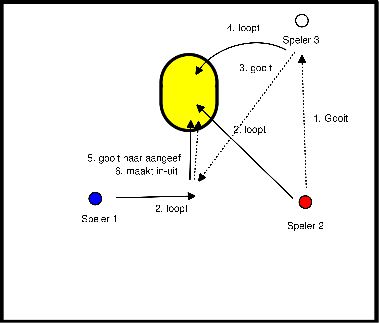
- Player 1 is the attacker
- Player 2 is the receiver
- Player 3 is the forward
- Player 2 starts with the ball, who throws it to player 3 and then immediately runs to the basket, taking the catch.
- Player 1 runs simultaneously to the middle of the field where player 3 throws the ball back to player 1.
- Player 3 immediately runs to the short where the one becomes the server.
- Player 1 immediately throws the ball back to player 3 who is now under the basket.
- Player 1 makes an in out shot.
- 5-10 goals.
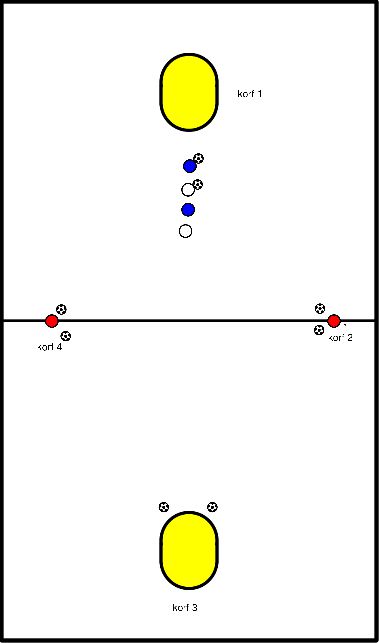
Game:
- Team stands in a row at basket 1.
- Participant 1 starts shooting, then participant 2 starts shooting immediately.
- If participant 2 scores before participant 1 then participant 1 is off and goes to basket 2.
- Participant 2 joins behind.
- If participant 1 scores earlier, she goes to the back.
- Participant 3 joins the shooting. If she shoots before participant 2, then she joins at the back and participant 2 goes to basket 2.
- This game continues on all four baskets until there is a winner on basket 1.
Agreements
- You may interfere defensively, but not knock the ball away.
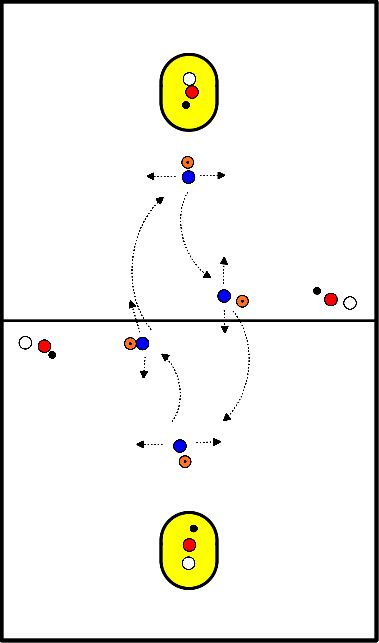
- Under each post is a declarer with the ball. In front of each post stands a shooter.
- The shooters in front of the basket keep shooting until one of the shooters has scored two goals.
- When one shooter has scored two goals, all shooters move to the next post.
- All shooters add to the number of goals they have scored. When 1 shooter has scored 4 goals, everyone rotates again.
- The first shooter to score 10 goals wins.
Change-over: There is a change-over when one shooter has scored 2, 4, 6, 8 or 10 goals.
Afterwards the shooters become attackers and vice versa.
Let the winners, completed with the other highest scores, play a final.
Let the winners, completed with the other highest scores, play a final.
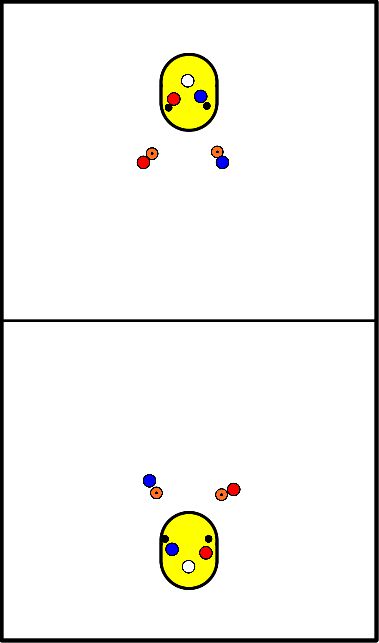
Per basket 2 teams of 2: (mark shot distance with cones)
- Per team a declarator/rebounder and shooter
- The aim is to score 5 times as shooter, then you earn 1 point for your team
- When 1 of the 2 teams has a point, both teams switch functions and start again with the goal to score 5x
- The team which has 3 points first, wins
Pay attention to the basic technique of the shot. Important to execute well. Often players have the tendency to shoot fast under time pressure.
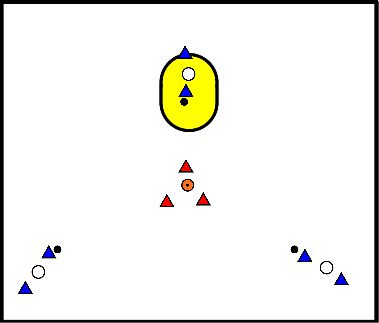
Series 1:
- Walk-through ball without ball after tapping cone.
- Dodge shot (left and right alternate).
- Action inside;
- Short handball and short chance (left and right alternate).
- Throwing the ball from the basket with backspin; running to the back and turning quickly; passing the ball and taking evasive action for the shot.
PAUSE: 4 minutes of shooting in light movement.
Series 2:
- Open left and walk through with ball
- Open on the right and make a break for the shot (alternate between left and right)
- Open left; basket comes out opposite; find and shoot
- Open on the right; basket ends opposite; short-long and to the shot
Work alternately for 2 minutes.
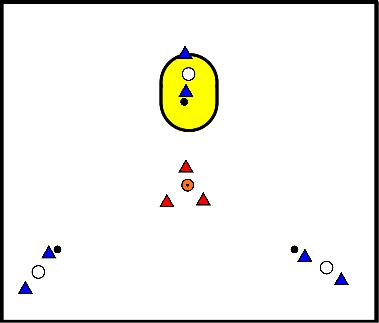
Series 1:
- Walk-through ball without ball after tapping cone.
- Dodge shot (left and right alternate).
- Action inside;
- Short handball and short chance (left and right alternate).
- Throw ball from basket with backspin; run in behind and turn quickly; play ball and take evasive action for shot.
PAUSE: 4 minutes of shooting in light movement
Series 2:
- Open left and walk through with ball
- Open on the right and make a break for the shot (alternate between left and right)
- Open left; basket comes out opposite; find and shoot
- Open on the right; basket ends opposite; short-long and to the shot
Work alternately for 2 minutes.
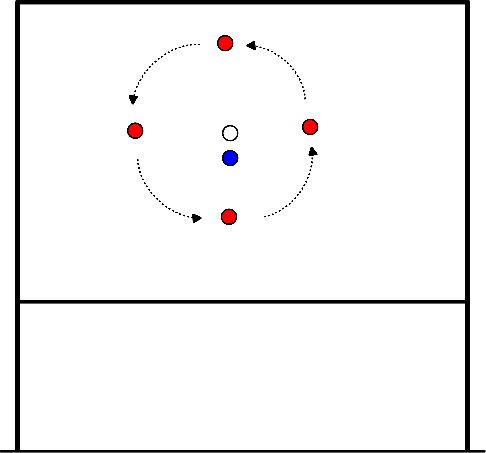
- Shooting exercises:
- 5 - rounds (turn around basket)
- Round 1:
- The shooter takes 4 shots of 3 to 4m from the front, back and sides of the basket. (clockwise).
- Round 2:
- Quick wide movements and pass (2 hands) on 3 meter. Pass 3 times and then shoot.
- Round 3:
- The shooter takes 4 shots from 3 to 4m from the front, back and sides of the basket. (counter clockwise)
- Round 4:
- Quick wide movements and pass (1 hand) at 6 meter. 3x pass then shot.
- Round 5:
- Starting at 1m from the basket, scoring = step back.
- Miss twice in a row = change.
- Who will score first at step 5?