



Korfballexercises for u10
- It is the same as water-and-fire but in a korfball form.
- On the taggers' side are 5 poles.
- On the attackers' side are 10 balls.
- The attacking side must try to score 2 goals on all the poles.
- Then this pole is free and may not be used.
- But the tappers may tap the attackers.
- If a ticker taps an attacker, he is out.
- If he does not tap an attacker, the attacker is out.
- If an attacker is tagged when he just scored, all players who were tagged off are allowed to play again.
- If two players score on the same goalpost, all attackers are free again.
- When someone has scored, that ball is out of the game, so there are less and less balls and poles left, which makes it easier for the taggers and harder for the attackers.
- If all attackers or all tappers are finished then we turn the functions around.
- This game was invented by a boy on my team.
- He always wants to do water-and-fire, but we think we can better do another game that has to do with korfball, so throwing, catching, shooting etc. So he came up with this idea and I did. So he came up with this idea and I must say, it is hard to explain, but it looks very nice.
- The children learn to shoot further than they normally do, because they don't want to be tapped.
- They also learn to move as soon as they shoot, because there might be a ticker behind them.
- The aim of the game is to be the first to write down the numbers from 1 to 100.
- Two players play against each other.
- The first one to score 2 goals
- The trainer chooses which way to start writing.
- The trainer chooses which way he wants to play.
- The other player scores 2 small chances in the meantime.
- The other player scores 2 small chances. If he/she succeeds, he/she calls STOP and takes the pencil or pen and also writes down the numbers from 1 to 100 on his/her piece of paper.
- The other person will now take small chances.
- This continues until someone reaches 100.
- Who of the two wins?
- This can also be done with a shot from 3 metres or in threes with passing balls.
- Let the children divide themselves over 3 poles.
- More poles if there are many children
- One person may start shooting from 1 meter if the basket is hit within 2 attempts, the player may continue shooting from 2 meters.
- If they can't hit the basket in two attempts, it's the next player's turn.
- In this way we can see which children can shoot from far and less far.
- You can also see which children are stronger in their arms, so that you can pay attention to that next time you make groups.
- 5 men per basket.
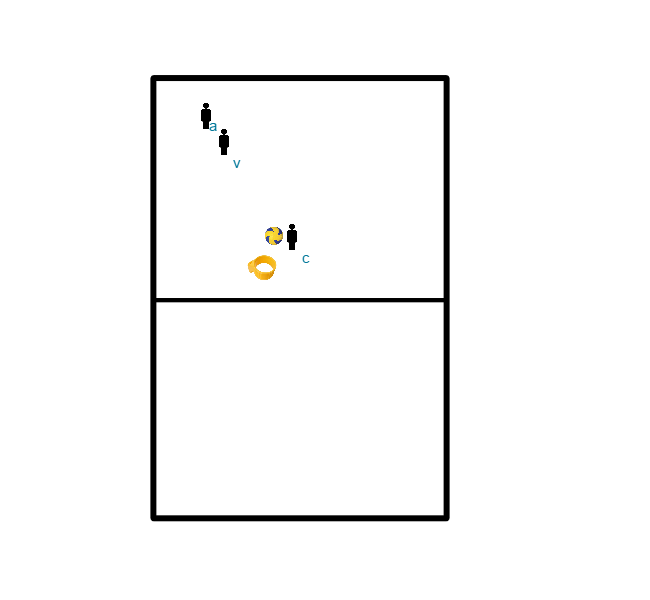
- Players A start as attackers in front of the basket.
- Players V start as defenders, 1.5 arms' length away from the shooter.
- Player C starts with the ball in the box.
- Attacker A must try to score through the 1 on 1 duel.
- It does not matter how (distance, evasion, dlb).
- When the attacker has the ball in his hands, the defender has to close the gap. D
- he defender is not allowed to tap or block balls.
- The V must show that she is with the attacker, but must allow the shot.
- This can be done by the defender placing her hand just above the attacker's shoulder.
- After 1 minute, the V has to change position.
What people often try with the older youth is a trick under the basket.
- There is 1 support with a defender
- behind that a catcher with 1 defender.
- The support plays off to the attacker in front of the basket, who first sprints to the side of the basket.
- Depending on which way the attacker sprints to the other side, the catcher must run up but then around the support to get rid of the opponent.
- The attacker plays under the basket to the released catcher under the basket.
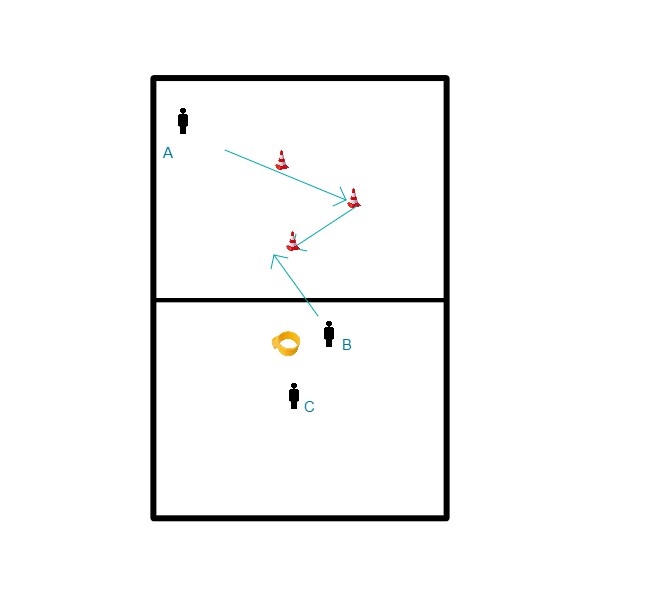
- 3 men per basket
- Player A starts as shooter at the first pawn.
- Player B starts to pass the ball under the basket
- Player C starts as catcher under the basket.
- Player A runs with fast movements around all the cones.
- At the last pawn, player A stops and stands ready to shoot.
- The passer (player B) throws the ball and the shooter (player A) shoots.
- Player C catches it
- The passer (B) is going to shoot, and the archer is going to catch.
- Make 15 together and everything on high speed.
Split the group into two.
Goal is to collect as many pawns as possible before all players are tapped out.
- Group A behind the line. In front of each player stands a pylon.
- Group B comes running.
- As soon as the first player of group B steals a pillon all players have to sprint over the line.
- Group A is allowed to run. Whoever gets caught is out.
- If the one with the pillon makes it, they have stolen one pillon.
- Repeat this until all players are caught.
Then turn around. Points for each pillon.
Free running
Goal:
To learn to make a free run so that the player is ready to play the ball.
Points of attention
The moment of free running is important, it has to happen at the moment the ball can be thrown. The feint enters the picture. The feint suggests that you are going to do something to which the opponent is going to react, after which the final movement is carried out For example, a body movement is made to the left, the defender moves to the left but the attacker does not complete the movement and moves to the right The result is that the attacker is free.
Organisation:
The game is played in teams of four with a basket and a ball. Two people stand about 6 to 8 metres from each other, an attacker and a defender walk between them. The attacker must try to play together with the people on the fixed position. The basket is placed just outside the line of the regular players. The aim is that the attacker passes on the ball as much as possible to the regular players within a certain time. The defender must try to intercept the ball.
Variation:
1. The attacker may score on the basket after passing the ball several times2
. If he also scores, he gets an extra point. If the defender intercepts the ball, there is a change of position.
Continuation:
1. There are two baskets with a supporting player underneath with the ball. Between the baskets are an attacker and a defender. The attacker may score on both baskets.
2. A supporting player stands about 6 to 8 meters in front of the basket. An attacker and a defender stand between the basket and the supporting player. The defender is only trying to intercept. The attacker tries to get free so that he can play the ball. If he succeeds in doing so, he can score freely at the basket. So it is important to get free close to the basket.
Tip for the coach:
1. Always try to make a rotation schedule so that the winning or scoring players are rewarded. But also the weaker brothers must be able to practice.
2. Keep it attractive by offering different forms that give a chance to score or win, there must be an element of competition in it. Then it remains exciting.
3. Try to put players of the same level together. Fair competition.
4. It is also important that children experience success, which means that they feel that they can do something (well). If everything always fails, it's no fun.
Use of space
Goal
Make the players aware of the space within the field of play and how to use it.
Points of attention
Choosing a useful position so that the player can play and/or score.
Organisation:
Within the playing field there are two circles (often there are already lines in the hall, e.g. for basketball), the circles are playable all around (just like the basket). A goal can be scored when a player bounces the ball in the circle and a teammate catches the ball. Further rules are the same as for korfball.
Variation:
1. It is also possible to play with one circle. After this, the party may attack.
2. After a score, the ball may be played on by the party that has possession of the ball.
Continuation:
1. Both parties may score at both circles, this allows you to move the attack to the other circle. This offers many new tactical possibilities, also in terms of use of space and insight.
2. It is also possible to play with for example 4 circles. When playing with multiple circles, the circles can also be smaller, such as a hoop or a bicycle tire. The overview that the players have becomes more and more important.
Tip for the coach:
1. Pay attention to the timing of throwing and free running.
2. The space for free running is also determined by the defenders (the opponents).
3. Try to make a connection between the forms of practice and games, e.g. throwing two-handed was taught, the final game is hunter ball where you have to throw with two hands.
4. Make sure you build up the training material from easy to more difficult.
Rules of the game:
The defender may try to block the ball by provoking the attacker to throw against his hand. The defender's arm may not move in the direction of the attacker, but only in the path of the ball. The ball does not have to be released by the attacker during blocking.
Inshort: practise various forms of walking, stopping, turning and jumping while running.
Organisation:lay out a 'course'onthe field (with pawns or baskets in a large circle). In the hall we just walk around. A whistle is very handy, especially on the field.
Walk around in a quiet pace, spreading the group out over the entire course. The space thus created must be maintained as much as possible during the entire exercise. At the sign of the trainer turn quickly and walk in the other direction.
The same, but now turn the other way. The first steps after the turn are done with a small sprint (short steps).
Walk backwards. At the sign of the trainer turn around again and walk backwards in the other direction. Alternately turn both ways.
Walk around with cross passes. Also the other way around.
Run around. At sign of the coach quickly sit (or lie down), stand up again, make a short sprint and continue running.
Tempo slightly higher than run. When the whistle is blown once, then a sprint is made. If the whistle is blown twice in quick succession, run backwards a few metres. Be careful, collisions can happen!
Run around. When the whistle blows, try to touch the person in front of you. After a maximum of 20 metres, continue sprinting at the same pace.
The players walk closer to each other, the distance between them is about 1,5 meter. At the sign of the trainer the last one in the row sprints to the front, zigzagging around the others. The trainer whistles every 2 or 3 seconds. Can you catch up with the person in front of you?
At the sign of the trainer the players make a high jump. Left and right turn in turn.
As i., but now the arms must also be raised when jumping up, like when catching a ball under the basket. Make sure you keep jumping high!
The players go round on their right leg, limping. After about half a minute, limping on the left leg.
Like k., but now the jumps must be made as big as possible. Try to get around in as little jumps as possible!
The players may alternate between limping on the left and on the right leg a few times. The players are numbered, alternately 1 and 2. The numbers 1 stand up. The numbers 2 jump over the numbers 1 until they are back on their own place. Then the other way around.
At the sign of the trainer, the players bend their knees and jump up high (push off with two legs, swinging their arms up as support).
Organisation: The players all line up on one side of the pitch.
Before starting these exercises, first perform a good warming-up (see above) with stretching exercises. The sequence was demonstrated by Margriet Poiesz (who is both an athletics and korfball coach) during one of the in-service training sessions of the North district of the NKTV
Steigerungen: running to the other side, whereby the pace is gradually increased to near-sprint speed
Skipping: a form of knee lifting at a very high tempo. The torso is in running position and is certainly not hanging back. The feet are reaching for the ground. This exercise focuses on the front swing phase.
Heels / buttocks or heel strike in high tempo (exercise for the back swing phase). The knees hang down, the trunk is in the walking position
Walk to the other side with long jumps (exercise for the back swing phase). Pay attention to a powerful, long push off. In this exercise, the feet also touch the ground, as it were.
simple running exercises for warming up, in which concentration and reaction also play an important role. Organisation: Pairs in an empty, marked out space.
Walk behind each other in a steady pace, criss-crossing the whole room. Number 2 follows every movement of number 1 as fast as possible, keeping about 1 metre distance. After a while change.
As a., but now the front runner tries to lose the back runner by sudden feints and/or tempo changes.
As a., but now other movements are also allowed: cross passes, jumping, lying down quickly and getting up again, etc.
Variations:
- Perform the same exercises with music
- Do the same exercises in groups of three or four. In this form, 'comical' situations will certainly occur now and then. It doesn't have much to do with korfball then.
- No more pairs: everyone walks freely through each other. The players walk towards each other, feint and then pass to the left.
- Like d., but now passing on the right
- Like d., but now they turn around each other and walk back.
- Special exercise for getting used to the hall: walk criss-cross through the whole hall, but not touching any line. Especially in halls with a lot of lines on the floor this is a good and fun exercise to get the 'contact with the hall' back in the legs.
- Like g., but now keep walking on the lines.
In short:
start and sprint game.
Organisation:
Pairs on either side of a line in the middle of the hall. The numbers 1, standing slightly left of the line, are the rats and the numbers 2, standing half a metre right of the line, are the ravens. Between the rats and the ravens there is a space of 1 meter. The trainer now calls continuously 'rats' or 'ravens' in random order. When 'rats' is called, the rats run as fast as possible to their side of the room. The ravens must then try to tap the rats.
* Who has their personal opponent tapped the most times?
Clue:
To keep it exciting, roll the 'r' for a good long time or make it a short story.
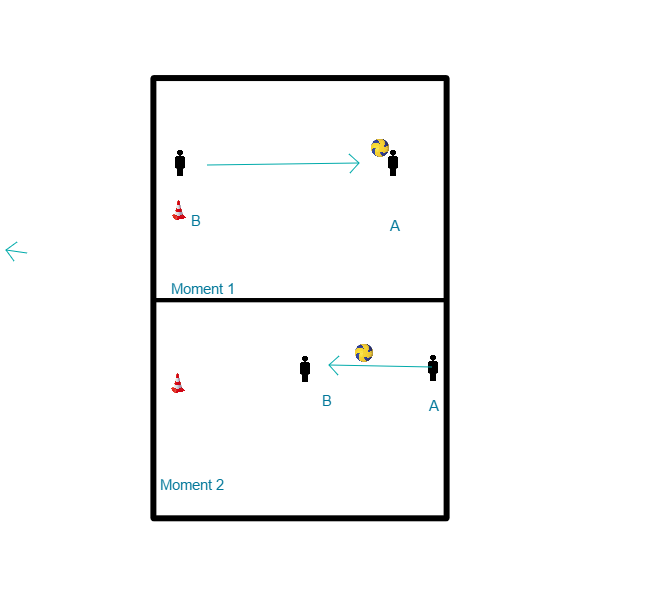 2 teams. Per pair 1 ball and 1 pawn. Player A stays on his spot. Player B starts with the pawn, which is about 10 meters away. Player B runs to player A. Player A throws (with 1 hand) the ball to player B. Player B keeps running until he has caught the ball and then stops. B throws the ball back and runs to the pawn to start the exercise again. after 10x change.
The whole group walks a circle around the yellow lines in the middle in a line. When the trainer calls 'yes', the person at the back of the line starts running as fast as possible. The children do this by pulling a sprint.
Options:
The children run after each other around the yellow lines in a line. The person at the front of the line can do whatever he wants for example: heels buttocks, sprints, lifts his knees etc. Whenthe trainer calls 'yes' the person at the back of the line starts to run as fast as possible and can choose what he wants to do. It must be something other than normal running/jogging, it may be sprinting.
Children will be divided among the poles, up to three children per pole.
Pole:
Two children stay by the pole. You have a declarator and a shooter, the shooter stands near the pawn at about 3 metres distance.
The shooter has to score 4 times and then there is a rotation.
Pawns:
There are two pawns facing each other at a distance of 10 meters. The other children stand near the pawn and run back and forth. When 4 times are scored by the shooter, there is a rotation.
Rotation:
The shooter becomes the runner.
The runner becomes a catcher.
The catcher becomes the shooter.
Variation:
The distance increases from the shooter.
The runner's distance increases.
Walk-throughs, short chance, penalty throw, etc. are taken.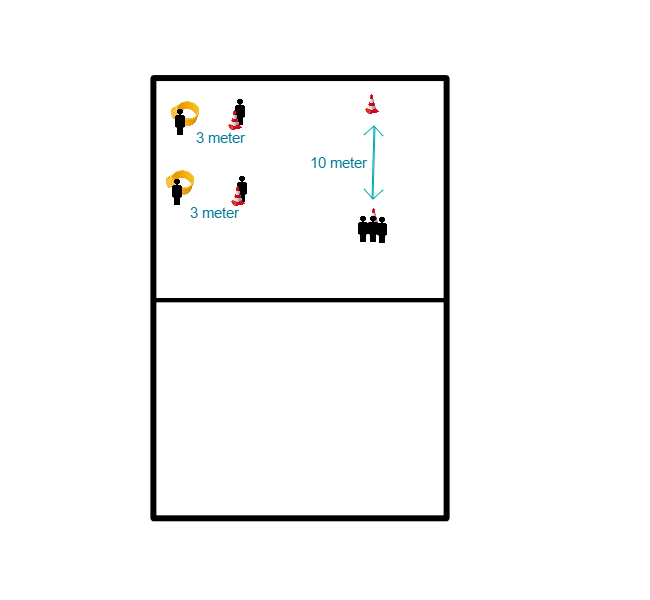
You put four pawns in a square with a distance of 8 metres. Then you let the children make pairs. The children may take turns rolling the dice. You have three different rounds:
Round 1:
The children roll the dice. For example, if a group throws 4, each group must run 4 laps around the pawns.
Round 2:
The children first say who they are going to roll the dice for and then they get to roll passes. So they pick a group, say group 2 and roll the dice for that group.
Round 3:
The children first get to roll the dice and then they pick a group. This is almost always the most fun round. 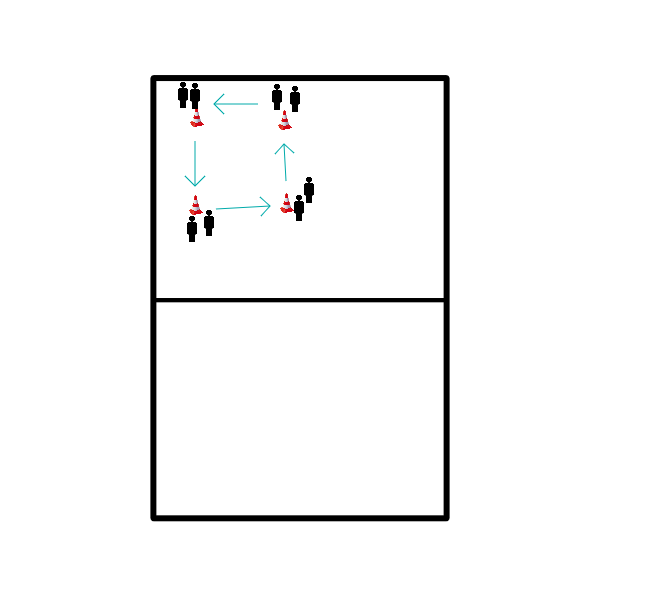
You put up three poles in a triangle, in the middle of the three poles you put a pawn. Three children are placed as attackers and the other children stand near the pawns.
First, you can choose that the attackers have to run through the poles. It doesn't matter which pole they hit, they can hit the same pole twice in a row. You can choose for this, so they have to run a lot. Also the children have to score 2 times, the person who scores first can trade with a declarator, the other children can trade with a declarator.
After that you can choose to letthe children do free balls, penalty throws, foul balls etc.
The whole group walks a circle around the yellow lines in the middle in a line. When the trainer calls 'yes', the person at the back of the line starts running as fast as possible. The children do this by pulling a sprint.
Options:
The children run after each other around the yellow lines in a line. The person at the front of the line can do whatever he wants for example: heels buttocks, sprints, lifts his knees etc. Whenthe trainer calls 'yes' the person at the back of the line starts to run as fast as possible and can choose what he wants to do. It must be something other than normal running/jogging, it may be sprinting.
3 men per basket. Player A starts as attacker in front of the basket. Player V starts as defender at 1,5 arm's length from the shooter. Player C starts with the ball in the box. Attacker A must try to score through the 1 on 1 duel. It does not matter how (distance, evasion, dlb). The defender's task is to follow the attacker at 1,5 arm's length and when the attacker has the ball in his hands, the defender has to close the gap. The defender is not allowed to tap or block balls. The V must show that she is with the attacker, but must allow the shot. This can be done by the defender placing her hand just above the shoulder of the attacker. After 1 minute, the V has to change position.
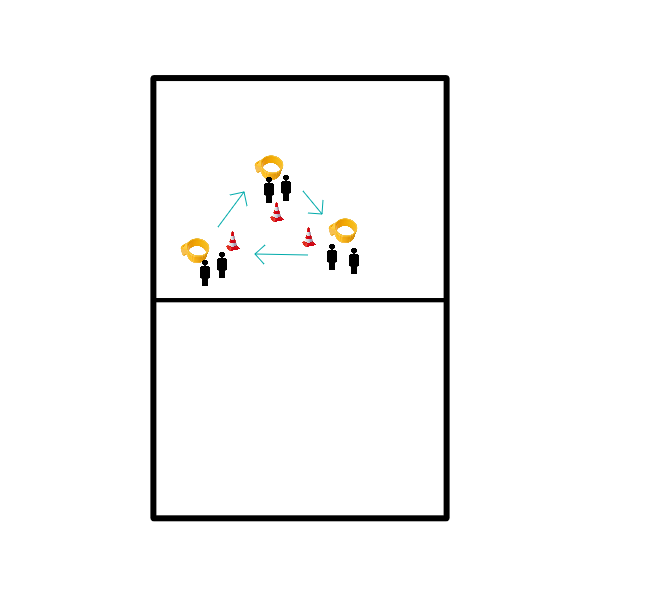 You have a pair at each pole, so the amount of poles depends on the size of the group. Everyone starts with scoring twice on the pole, when they have done this they go to the next pole. It can happen that two groups are standing at the same pole, this is because they don't all have to turn. The pairs only have to pass when they have scored twice.
Place a pawn in front of the pole at a good distance for your team.
Everyone stands in a circle. One person is the loafer and stands in the circle. Everyone is going to throw the ball over, but the dummy has to try to take the ball away from him. The person with the ball can do this by intercepting the ball or by tapping the person who is holding the ball. When the lummel has taken the ball away, the lummel changes to the next player.
3 men per basket. Player A starts as shooter at the first pawn. Player B starts to pass with the ball under the basket. Player C starts as catcher under the basket. Player A runs with fast movements around all the pawns. At the last pawn player A stops and gets ready to shoot. The passer (player B) throws the ball and the shooter (player A) shoots. Player C catches the ball. The passer (B) is going to shoot, and the shooter is going to catch.
2 teams. Per pair 1 ball and 1 pawn. Player A stays on his spot. Player B starts with the pawn, which is about 10 meters away. Player B runs to player A. Player A throws (with 1 hand) the ball to player B. Player B keeps running until he has caught the ball and then stops. B throws the ball back and runs to the pawn to start the exercise again. after 10x change.
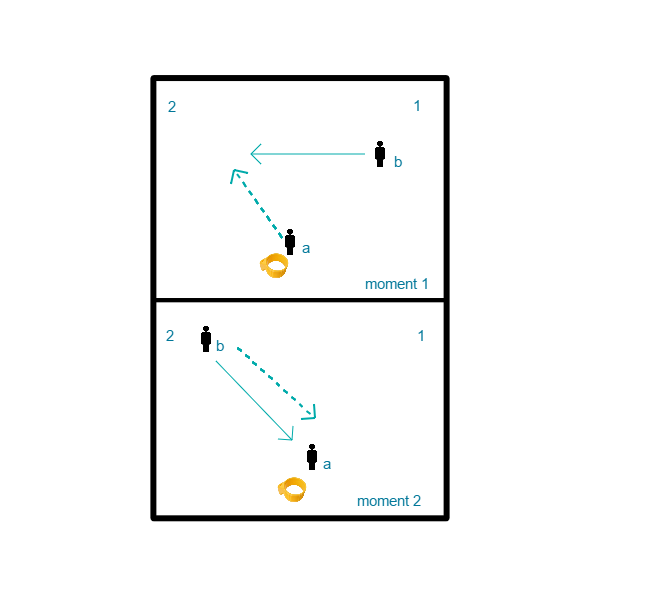 2 men per basket. Player A starts left in front of the basket with the ball. Player B starts right in front of the basket. Player B runs from her starting position in a straight line to the basket. She stretches her outer hands to show where she wants to receive the ball. Player A throws (from space) the ball to player B. Player B takes a walkthrough and catches his own ball. Player A goes to the left front, B throws to A( not to run with the ball), B goes to the right front and gets the ball back, A now takes the through ball.
3 men per basket. Player A starts as attacker in front of the basket. Player V starts as defender at 1,5 arm's length from the shooter. Player C starts with the ball in the box. Attacker A must try to score through the 1 on 1 duel. It does not matter how (distance, evasion, dlb). The defender's task is to follow the attacker at 1,5 arm's length and when the attacker has the ball in his hands, the defender has to close the gap. The defender is not allowed to tap or block balls. The V must show that she is with the attacker, but must allow the shot. This can be done by the defender placing her hand just above the shoulder of the attacker. After 1 minute, the V has to change position.
In short:
start and sprint game.
Organisation:
Pairs on either side of a line in the middle of the hall. The numbers 1, standing slightly left of the line, are the rats and the numbers 2, standing half a metre right of the line, are the ravens. Between the rats and the ravens there is a space of 1 meter. The trainer now calls continuously 'rats' or 'ravens' in random order. When 'rats' is called, the rats run as fast as possible to their side of the room. The ravens must then try to tap the rats.Â
* Who has their personal opponent tapped the most times?
Clue:
To keep it exciting, roll the 'r' for a good long time or make it a short story.
1. Place four pawns in a 7x7m square and let three players play together. One player is the hunter who wants to intercept. Play for 30 seconds, the interception is a point. Release them by either running towards or away from the ball, depending on their position. This depends on the position relative to the hunter, the distance to the ball and the available space to play in (feasible throwing distance and free space). Stop the game to suggest where to run. Teach the ball handler not to throw if the pass is risky (better no pass than a wrong pass). Sometimes a curve ball is needed, sometimes a tight pass. A mock pass can sometimes be useful. Slowing down, speeding up the running pace and changes in direction are the means of free running.