



Korfballexercises for u14
You have 1 shooter and 1 declarer.
Goal for shooter:
- Score as much as possible from the number of attempts.
- Correctly point and quickly catch.
You get 10 attempts and try to score as many of them as possible. It is not about speed, but accuracy. Try to correct your shot and shoot every ball on technique.
- Distance shot 4 meters.
- Walk-through ball 6 meters.
- Distance shot 3 meters -behind the basket.
- Dodging ball to the right.
- Penalty throws.
- Free ball to the left.
- Tap basket, step back and shoot.
- Deflection ball to the left.
- Small chances.
- Free ball to the right.
- Goal counts for 1, but if the ball hits the ground it is -1.
In pairs and 5 baskets
The numbers 1 get 3 pawns, numbers 2 get 2 pawns and numbers 3 get 1 pawn. Continue until all pawns are forgiven.
In threesomes and 3 baskets
The numbers 1 get 2 pawns and the number 2 gets 1 pawn. Continue until all pawns are forgiven.
Exercises:
- 8 through balls
- Pawn at 7 meters in front of the basket. You change after each through-ball.
- 4 passing balls to the right
- pawn at 6 meters. Change position after 2x shots.
- 15 small chances
- You take turns shooting.
- 4 dodge balls to the left
- Pawn at 6 meters. After 2x shooting switch functions.
- 6 half turn shots
- Pawn at 4 meters. After each shot change functions.
- 6 distance shots from behind the basket
- Pawn at 4 meters behind the basket. After 2x shots change functions.
- 5 free balls to the right
- Pawn at 2.5 meter. After 2x shots change positions.
- 10 penalty throws
- Pawn at 2.5 meters. After each shot change positions.
- 5 free balls to the left
- Pawn at 2.5 meters. After 2x shots change functions.
If you score a goal you may steal a pawn from another group.
You don't shoot again until your partner is back at the basket to make the catch.
You switch functions every 2x shots.
We continue until one group has no pawns left.
This is an isolated drill to practice dynamic rebounding.
- Players have to estimate from the movement where the ball will end up and grab it as fast as possible.
- The ball starts under the basket and is thrown to the player in front of the post.
- He shoots.
- The player in front of the post runs to the cap and back and tries to catch the ball within 1 bounce.
- When the rebounder has succeeded in catching the ball after at most one bounce, he can shoot again.
- Move the cap further away.
- Challenge players to catch the ball without a bounce.
Rules explain:
- The person taking it stands with 1 foot exactly behind the dot and the other foot stands behind the perpendicular line on the center line, from the dot.
- Everyone stands outside the imaginary line.
- Attackers stand 2.5 metres from each other.
- Defenders stand 2.5 metres from the dot, but do not have to.
- When person with ball moves, defenders may enter circle, attackers only when ball has been touched by person or is outside circle.
- Persons under the post have their feet on the same side of the post.
- An attacker or defender may not place his foot between those of the opponent.
- Defender always stands between attacker and post, except under the post when attacker is against the post.
Everyone stands in base position.
Learn variations:
- Play ball back to the person who took it out.
- The person who takes the ball decides by looking at the defenders if he passes to the side or under the basket.
- Ball is played to player moving away under the basket.
4 poles and 8 players, each pole 1 contributor with a ball. 4 players start from the middle.
1 - Run through from the centre and immediately swap with the attacker, who is the first to score 10 points?
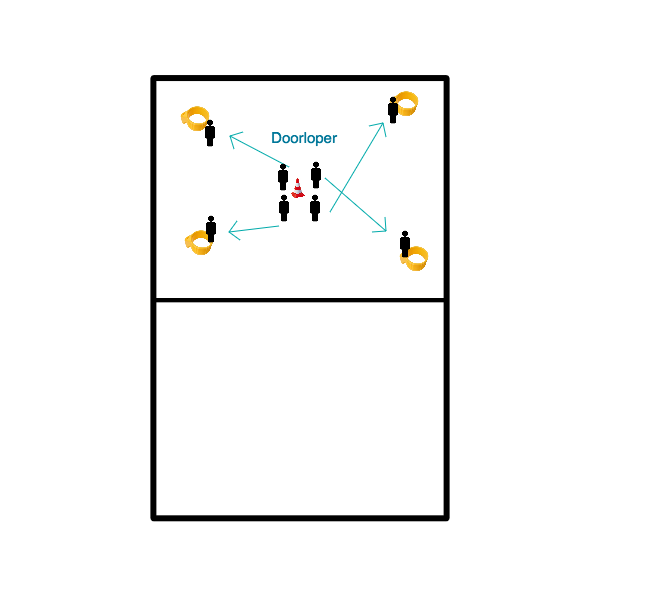
2 - Same exercise but now a run through (no shot), declarer pulls back and shoots. Who is the first to score 10 short chances?
3 - Addition to 2, from the middle a runthrough, stays behind (no shot), plays the ball again on the new incision and makes an evasion.
In short: various games of tag.
Organisation: Mark out an area that is not too big (20 by 10 to 20 metres) with the help of baskets or cones. If there are more than one, give each of the taggers a ribbon.
Off with the ball. One of the players has a ball. The ball is passed around randomly. The ticker must try to tap the player who has the ball in their hands. If the group is large, then split it into two (and thus also work with two tickers).
- We have poles, cones or caps placed 8 metres apart in a square.
- The team divides itself over the poles, cones or caps.
- Next, they are going to sprint 100% for a few seconds.
- They start with:
- 30 seconds sprint.
- 1 minute rest.
- Sprint for 45 seconds.
- 1 minute rest
- 60 second sprint.
- 1 minute rest.
- 75 second sprints.
- 1 minute rest
- 60 second sprints.
- 1 minute rest.
- 45 second sprint.
- 1 minute rest.
- 30 second sprints.
- END
- 30 seconds sprint.
- They start with:
Start line-up
Three groups at the first pawns.
Exercise
The first in line runs to the hoop and goes through the hoop from the bottom, so the hoop goes over their head. Then he goes through the defense stance to pawn two. Turn around and make short passes (left, right) to the next pawn. From there, start to pass the ball. After that, go to the pole for a shot. Then back to the start, tap, next. There are two points per person. First team with six points wins.
Defensive stance:
Back out and through the knees with your arm up.

Start line-up
Two groups at the first two pawns.
Exercise
The first one in line runs to the basket lying on the ground and goes through it, so the basket goes over their head. Then he runs through the defence posture to pawn two and turns around it 4 times. Finally, he runs to pawn 3 and tries to score (3 attempts) before he can run back to pawn 1 and hit the next one in line.
Defensive stance:
Backwards and through the knees with your arm up.
Distance setup:
Hoop from pawn 1: 5 meters.
Pawn 2 from hoop: 5 meter.
Pawn 3 from pawn 2: 5 meter.
Pole from pawn 3: 4 meters.
- The trainer sets up two (parallel) rows of an equal number of players evenly spaced apart.
- Both rows face a basket.
- The ball starts with a player under the basket.
- The person in charge plays a short pass to the first in line in front of him, the receiver catches the ball and turns around to pass it to the next in line.
- When the ball has reached the last player in line, he passes it back to the player 2 spaces ahead of him, etc., until the ball has reached the player in front of the basket, who takes a short shot.
- The shooter then takes the place of the declarer who then closes in behind as quickly as possible.
Variant:
- When the ball has reached the last in line (farthest from the basket), the declarer comes to support (high, depending on distance).
- The last player in line passes the ball to the attacker and starts a sprint for a walkthrough.
- The player is allowed 1 rebound attempt.
- A scored walkthrough ball is worth 3 points, a short shot 1 point.
The team that scores the most points wins. The teams learn to discover that the BALANCE between pace and precision is important. Those with pace are likely to get more chances, but those in a hurry pass inaccurately and may not finish the chances, requiring even more time. A fun game with a competitive element!
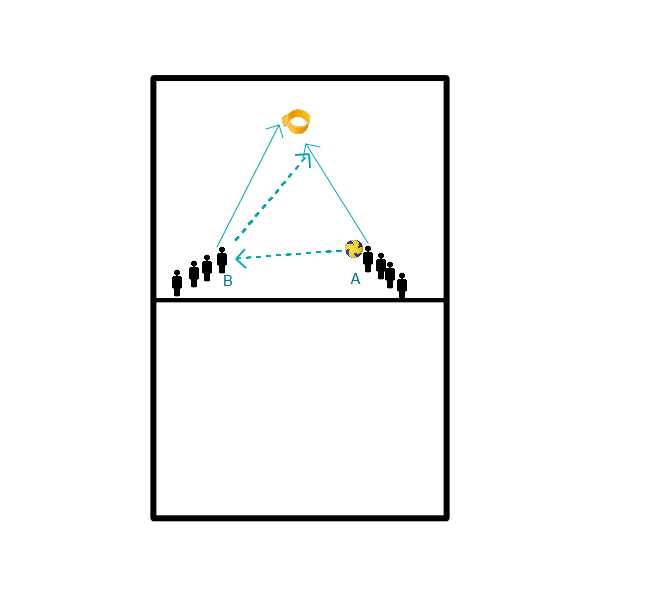
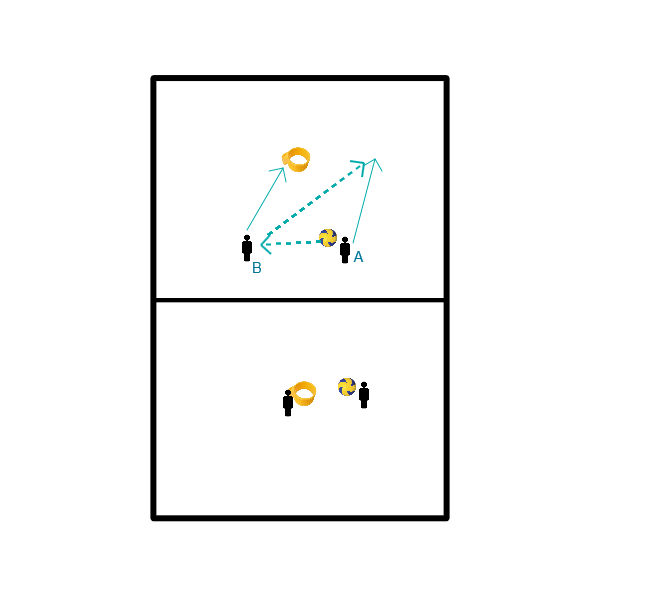
- Put a pole in the middle and divide your team in 2 groups.
- One group starts on the left, the other on the right (the right group (A) starts with the ball).
- Throw the ball to player B who stands left and walk directly to the basket for a walkthrough ball.
- You get this ball from the space of player B.
- Player B is going to catch.
As an alternative:
- You can start the ball at Player B.
- Throw to Player A and walk to the basket for support.
- Player A throws the ball to Player B and runs on for a walkthrough.
- See above but then Player A gets the ball for a walkthrough but does not take it but plays to Player B for a short chance. (Player B must then pull away).
Make two pairs.
- Start both at the front of the basket.
- Player A throws to player B and immediately runs a long line.
- Player B passes to the long line and goes to catch.
- Player A shoots, Player B catches.
Things to coach for:
- Make sure players are deflecting the long line toward the basket.
- Coach on throwing the long ball, make sure it is tight and arrives well.
- Try to shoot quickly so that your opponent is not right in front of you.
You can alternate this exercise by
- Don't let Player B catch the ball, but cut in for support.
- Let player A catch the ball first, throw it back immediately and then run the long line.
- Have Player B catch and then pull away for a short chance under the basket.
Divide your team into two teams.
You will stand by a basket per pair and follow exercises that your trainer indicates.
Exercises can be:
- 3 laps of passing balls (catch your own ball) (depending on the number of baskets you can make more or less laps)
- 3 laps in out shot (pass to the outside)
- 3 laps of short chance
- 3 laps pass balls late (take overhead)
- 15 dots per person (per 2 on 1 basket)
- 10 free balls per person (per pair on 1 basket)
- 10x shot from standstill
- 10x shot from movement (try on 1 leg)
Start line-up
Two groups at the first two pawns.
Exercise
- The first in line runs to the hoop and goes through the hoop from the bottom, so the hoop goes over their heads.
- Then he runs through the defence posture to pawn two and circles this in 4 circles.
- Finally, he runs to pawn 3 and scores before he can run back to pawn 1 and tap the next one in line.
Set-up distance:
Hoop from pawn 1: 5 meters.
Pawn 2 from the hoop: 5 meter.
Pawn 3 from pawn 2: 5 meter.
Pole from pawn 3: 4 meter.
- Make 2 squares of 4.
- The attack takes the ball from the trainers.
- When the defence has intercepted the ball, they first pass it back to the trainers.
- When a goal is scored, the team gets a bonus and can take the ball back out.
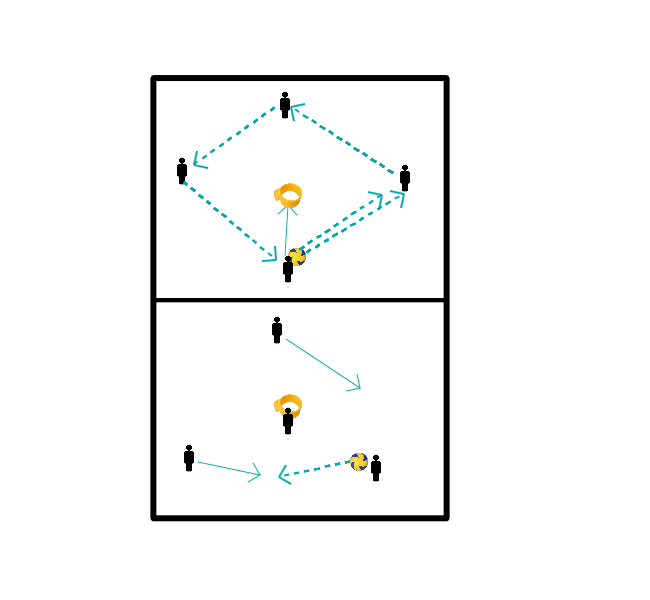
Do give orders, for example:
- Start in a diamond. Let the ball go around 1 time.
- The player in front throws the ball next to him/her one more time and catches it.
- The other players continue playing. The player who has the ball now chooses whether he wants to throw to the left or to the right. The other players run to the ball to pick it up. The ball is thrown and the player immediately runs a long line.
The long line is nudged and the thrower comes alongside. The other player walks behind the basket to walk into the support. The other two are going to attack.
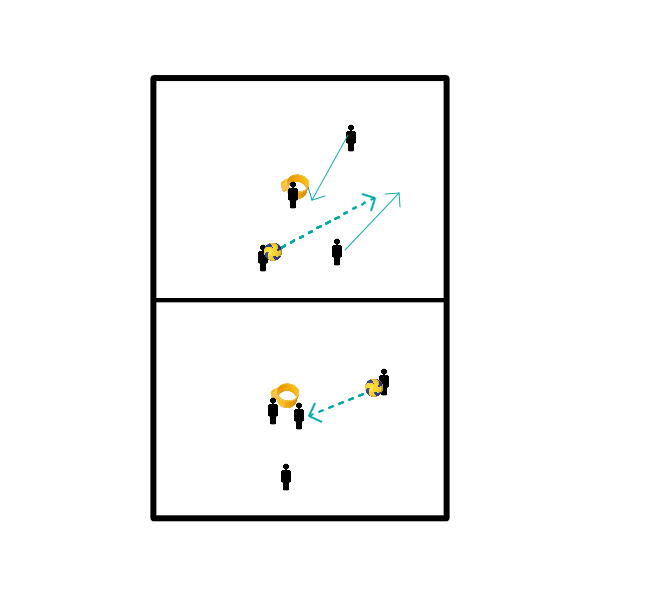
Inshort: exercises in catching balls that bounce or roll at the right moment.
Organisation: one ball per pair or trio.
(a) The numbers 1 and 2 of each pair stand next to each other. Number 1 rolls the ball a few metres away. Number 2 has to get the ball, pick it up and throw it back as fast as possible. Change after 5 games. Make sure the players 'get' the ball as soon as possible by putting one hand on it as soon as possible.
b ) As a., but now number 1 throws the ball away with a small curve, in such a way that it bounces on the ball at a distance of about 4 metres (and then makes a bounce of about half a metre high). Number 2 must try to get the ball as soon as possible after the bounce.
c ) As b., but now number 1 drops the ball from a height of 1.5 metres just in front of number 2. He/she has to try again to get the ball as soon as possible after the bounce. It will appear that almost everyone lets the ball rise a little and then catches it. Wrong (in the meantime an opponent can quickly put his/her hand on the ball). At the very moment that the ball is about to come up, the hand should be placed on the ball Take the ball!
Start line-up
Two groups at the first two pawns.
Exercise
The first in line runs to the hoop and goes through the hoop from the bottom, so the hoop goes over their heads. Then he runs through the defence posture to pawn two and circles this in 4 circles. Finally, he runs to pawn 3 and scores before he can run back to pawn 1 and tap the next one in line.
Distance set up:
- Hoop from pawn 1: 5 meters.
- Pawn 2 from the hoop: 5 meter.
- Pawn 3 from pawn 2: 5 meter.
- Pole from cone 3: 4 meter.
Inshort: exercises in catching balls that bounce or roll at the right moment.
Organisation: One ball per pair or trio.
- The numbers 1 and 2 of each pair stand next to each other. Number 1 rolls the ball a few metres away. Number 2 has to get the ball, pick it up and throw it back as quickly as possible. Change after 5 games. Make sure that the players 'get' the ball as quickly as possible by putting one hand on it as soon as possible.
- Like 1., but now number 1 throws the ball away with a small curve, in such a way that it bounces about 4 metres away (and then makes a bounce of about half a metre high). Number 2 must try to get the ball as soon as possible after the bounce.
- As 2, but now number 1 drops the ball from 1.5 metres just in front of number 2. Number 2 must again try to get the ball as soon as possible after the bounce. It will appear that almost everyone lets the ball rise a little before catching it. Wrong (in the meantime an opponent can quickly put his/her hand on the ball). At the very moment that the ball is about to come up, the hand should be placed on the ball Get that ball!
- Three teams, the person who gives the information stands in the middle. He rolls the ball a few meters away. As soon as the ball is loose, the other two may run. Who has the ball first? After 3 substitutions.
To teach and improve the technique of defending 1 against 1.
Points of attention
Although the technique is always applied as a whole, the attention of the trainer can be focused on a part of the technique. Which part depends on the phase of development of the player, but also on the development of the opponents!
First the four parts will be mentioned, each part will be worked out separately.
The parts are
: a. posture b
. 'moving'
c. foot position d
. arm usage.
a. stance
From an upright position, with the feet spread (foot position will be discussed in 'c'), the player bends his knees slightly. There is also a slight bend in the hips. The upper body tilts slightly forward as a result. The centre of gravity of the body is situated 'between' the feet. In this way, the defender can best keep his balance. The distance between the attacker and the defender is just a little more than 'arm's length
For the trainer, the points of attention are: centre of gravity remains 'between the feet', upper body slightly flexed.
Common mistakes are
:• Upper body too stiffly upright•
Upper body too much bent forward, so that the centre of gravity is too much on the front foot. As a result the defender has difficulty getting going again quickly and has problems with changes of direction, because the upper body has to make the 'whole' turn.
Organisation:
The starting point is working in the complete execution. Defending 1-1 can only be practised with an opponent. And always make sure there is a basket nearby. It is important for the defender to be able to keep this point of orientation (even if he cannot see it!).
So: a basket with a person passing on. Outside the basket, an attacker and a defender are running.
The attacker is instructed to move 'slowly', in such a way that the defender can follow 'sliding'. The posture exercises can be combined with those of 'moving'. The attacker is regularly called upon to shoot. When the attacker has the ball, the defender moves closer so that a possible shot can be defended. When shooting, the defender extends his body and arm. The attacker can shoot, and the defender will allow the shot.
Variation:
Try to train in match situations as quickly as possible. Coach the players on their posture.
1. In teams of five, two main attackers with defenders and a supporting player. The defenders will have to adjust their stance to the attacker's position. When there is a threat of a shot, defend closer to the attacker and stand up straight; when there is a threat of a break-through, bend the knees more and take up some distance.
2. Party formation, this can be 3-3 or 4-4.
Follow-up:
Follow-up exercises are mainly about increasing the pressure from the attacker by working at a higher tempo, with more changes of direction from the attacker.
Tip for the coach:
1. This facet of 1-1 defending is often dealt with by the C-youth. Especially in combination with running up to an opponent on an evasive ball.
2. It is almost impossible to separate the exercises from the second aspect of defending, especially when the tempo is low, i.e. sliding.
3. Defending 1-1 is an 'isolation' from the whole of 'preventing' and should always be seen in relation to the whole of attacking and defending in practice!
4. When training 1-1 defending to players, the starting point is to offer the whole of the technique. In practice it will then appear that a player has not or not sufficiently mastered a particular element. Then offer suitable training material. So don't start too soon with the elements, but see which element has to be improved. Each player may have to be trained differently.
5. Always give instructions one at a time, then the children can concentrate on the correction (with older children more instructions can be given at the same time, but never more than 2 or 3). Instructions should always be repeated, within the training, a week later, etc., until they are good.
Laws of the Game:
Basic rule is: A defender may not obstruct the attacker in the free use of his body; obstructing intentionally or accidentally does not matter, both result in a foul!
1. A defender may not defend with spread arms or legs. A defender is not allowed to defend with spread arms or legs, forcing the attacker to make a detour or literally holding him back. The attacker is prevented from creating goal-scoring opportunities.
2. A defender must not suddenly move into the attacker's trajectory, so that a collision becomes inevitable.
In short: various games of tag.
Overlap. The players stand on one long side of a rectangular area (about the size of a gymnasium). The rat runs somewhere in the middle of the area. When the trainer tells them to, all players must run over to the other long side. The scapegoat tries to catch as many players as possible. When they get through the area, they have to wait for the next signal to go back. Who is not tagged in 6 times? This game of tag can also serve as a playful exercise in defending.
- There is a pawn 8 meters from the pole.
- By this pawn:
- Pawn 1, they do 10 taps on the ground
- and then jump up and stretch their arms out.
- Then they sprint to the pole, pole 1, and take a dodge; shooting on one leg.
- There is another pawn and pole next to the other pawn and pole.
- The pawn is also 8 meters from the pole.
From pole 1, they sprint to pawn 2 and press 10 times.
Then they sprint to the post and throw the declarer under the post and he makes a short chance behind the post.
They have 10 minutes to make a total of 15 with the whole group. If they don't make it, there is a consequence.
- 50 second full sprint,
- 10 push-ups,
- 10 abdominal crunches,
- 10 leg raises,
- one lap around the entire field.
- We have poles, cones or caps placed 8 metres apart in a square.
- The team divides itself over the poles, cones or caps.
- Next, they are going to sprint 100% for a few seconds.
- They start with:
- 30 seconds sprint.
- 1 minute rest.
- Sprint for 45 seconds.
- 1 minute rest
- 60 second sprint.
- 1 minute rest.
- 75 Seconds sprint.
- 1 minute rest.
- 90 Seconds sprint.
- 1 minute rest.
- 75 second sprint.
- One minute rest.
- 60 second sprints.
- One minute rest.
- 45 second sprint.
- 1 minute rest.
- 30 second sprints.
- END
- 30 seconds sprint.
- They start with:
- We have poles, cones or caps placed 8 metres apart in a square.
- The team divides itself over the poles, cones or caps.
- Then they sprint 100% for a few seconds.
- They start with:
- Sprint for 15 seconds.
- Rest 1 minute.
- Sprint for 30 seconds.
- 1 minute rest
- 45 second sprint.
- Rest 1 minute.
- Sprint for 60 seconds.
- Rest 1 minute.
- Sprint for 75 seconds.
- Rest one minute.
- Sprint for 60 seconds.
- Rest one minute.
- 45 seconds of sprinting.
- Rest 1 minute.
- 30 seconds sprint.
- Rest 1 minute.
- Sprint for 15 seconds.
- END
Nice variation of the original 'tag'. One child is the ticker. The rest runs away. The catcher tries to tag someone. When a child is tagged, he or she puts his or her hand on the spot that was tagged. Now the ticked child is the new ticker. If another child is ticked, he may take his hand away from his spot.
For example:
Child A taps child B on the shoulder. Child B puts his hand on the shoulder and tries to tap the next one. He taps child C on the upper arm and can again release his hand and just run away. Child C puts his had on his upper arm and starts tapping.
Start line-up
Two groups at the first two pawns.
Exercise
The first one in line runs to the hoop and goes through the hoop from the bottom, so the hoop goes over their head. Then he goes through the defense posture to pawn two and turns around it 4 times. Finally, he runs to pawn 3 and scores before he can run back to pawn 1 and tap the next one in line.
Defensive stance:
Backwards and through the knees with your arm up.
Distance setup:
Hoop from pawn 1: 5 meter.
Pawn 2 from hoop: 5 meter.
Pawn 3 from pawn 2: 5 meter.
Pole from cone 3: 4 meter.
The penalty throw is often a starting exercise for the through ball. In this folder, we deviate from that and treat the through ball separately. The Penalty Throw is the only goal opportunity that does not depend on the position of the opponent and always has the same starting position. Only at outdoor matches, the weather conditions can influence the way the penalty throw is taken.
Starting Position
A slight stance with knees slightly bent and body weight on the front leg. The ball is held with both hands in front of the body at hip height. The hands hold the ball as described for the distance shot.
Progression
The movement is started by stretching the front leg and bending the body forward at the same time, thus moving the body towards the basket. The back leg functions as a swinging leg. The smoothly extended arms are raised and guide the ball in its trajectory towards the basket for as long as possible to increase accuracy. Landing on the swing leg, arms and fingers point the ball after.
Penalty throw
Common mistakes
- Arms not stretched enough, so the ball is not guided long enough.
- Offset is too powerful, resulting in a loss of shooting balance.
- Arms are not stretched out with the same force
- The back foot hits the ground before the ball has left the hands, because the push-off movement is too short (breach of the walking rule)
- Body weight is not kept sufficiently on the front leg during the initial stance, the tendency to move the front foot is also a violation of the gait rule.
Exercise 1
The penalty throw can be practiced immediately in its entirety. The pressure of having to score at the penalty throw can be imitated in different ways: scoring ten in a row and counting again if the throw is missed. Which group has the highest
the highest series of penalty throw scored, score 2 points and miss 1 point â'¬ who has 20 points first, which player scores the most in 10 attempts. This exercise is all about technique. Also in the match only the technique is decisive whether or not a score is made. There is no time factor or defender. Set up the exercises so that it is not the time but the efficiency that is important.
Starting situation
The game is played with two teams of four ladies and four gentlemen each. The field is divided into two sections of 20 by 20 metres each (adapted for pupils, 15 by 15).
Goal of the game
Which team will score the most goals? Attacking (scoring and playing together to score) is separated from defending (preventing the ball from being scored, disturbing the build-up and intercepting the ball) by the division of the field into sections.
Rules
Do not run with the ball, do not play alone, only attempt goals from free position. Change after two goals or after five minutes.
Approach
The trainer gives instructions all the time. Points of attention for coaching are
- Targeted free running in the attack to score or to help play the ball towards the goalpost (build up and/or catch). There can already be a first division of tasks. A distribution of tasks in the box implies a distribution of positions, which can change after each action. In korfball terminology: free running in the post zone, attacking at shot distance, supporting (indicating) at the post, catching (taking rebound) under the post.
- Free running in the attacking zone to receive the ball from the defensive zone. The problem is that all players want to get to the line (to the ball). Only continuous coaching helps here. Again, there may be a division of labour. Who will pick up the ball and who will run free in the post area?
- Running free in the defence to transport the ball to the attacking team after an interception. Central instructions are: don't throw the ball too far and aim at a teammate.
throw to a team-mate who is free and closer to the attacking zone. Do not throw towards the basket in the defensive zone.
- When defending, the coach coaches the defenders to prevent them from scoring goals by having them follow their opponents. At the same time he coaches them on intercepting the ball by having them follow the ball. Goal avoidance and interception should be learned in combination by the young player.
- The trainer influences the use of good technique. In particular, he gives instructions on the correct execution of the overhead stretch on a stationary and moving player. Pay attention to the use of the right hand in combination with the standing leg in relation to the direction of play.
- The techniques, the means by which a fun game can be created are:
- Distance shot, walkthrough ball and penalty throw
- Overhanded stretching throw, in free position and with a defender
- Two-handed catch, stationary and in the run
The skill is only really mastered, when the techniques in the game situation are applied correctly and at the right time.
- In the game, special rules can be introduced, which are aimed at technique improvement or at division of labour, such as:
- Playing together is only allowed with one hand
- If a team drops the ball, it goes to the other team
- Players are assigned special tasks: supporting, catching, attacking.
- The trainer remains the trainer, even when he takes part in the game. During the game he can also give directions
What can you see?
- In the beginning the players play close to each other, 'clumps of basket ball'.
- Bringing the ball up in the direction of the attacking box after an interception is often done by throwing wildly in that direction instead of aiming at a team-mate.
- The attackers stand and wait for the ball at the line.
- Many technique errors due to pressure from the opponent.
Starting situation
The game is played in a square of 20 by 20 metres. In every corner of the box a triangle is marked with short sides of 7 metres. The basket is in the middle of the box. There are four players in each team, the other players are substitutes.
Goal of the game
Which team will score the most points? Try to get in scoring position by playing together. Try to prevent the other team from scoring many points.
Game rules
You are not allowed to run with the ball, you are not allowed to play alone, you are not allowed to take the ball out of the hands of your opponent or team-mate. You are not allowed to shoot defensively. If a team scores from the marked triangle, the score counts double. When the ball is intercepted, it must be played to one of the four corners before it can be attacked. Any player may substitute from the changeover area. Players may be brought back into the game.
Approach
The trainer divides the group into two teams. The trainer can limit himself to giving instructions and encouragement. Depending on the size of the group, several fields can be laid out. The game can be played without much preparation. The trainer can adapt the rules of the game to the level or experience.
What can you see?
Lots of action, practising many elements of korfball in a functional way. Rewarding the score from the triangles can have consequences for the defensive tactics if there are a lot of shots from distance. The game can give rise to pre-defending and a strict 1:1 duel.