



Korfballexercises for u16
- 4 defenders stand at the post and look at their opponent who stands at a hat. (Hats in the corners of the box)
- From the centre line, the ball is placed in a corner.
- The foursome in the corners try to score as quickly as possible and use the (temporary) overtal situation.
- The defender of the player who gets the ball makes a circle from the basket before he may defend.
- The three other defenders try to prevent scoring.
- Be careful not to infringe, as there is always a lady free. (This exercise is about insight and overview).
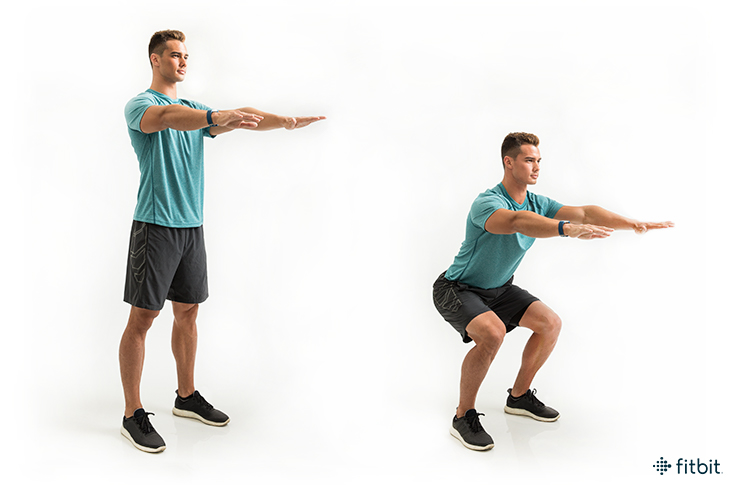
- The basic squat.
- Place your feet hip-width apart and keep your feet on the ground.
- Slowly lower yourself as far as you can by bending your knees--keep your back as straight as possible and keep looking forward.
- Come back up to the starting position. Begin with 3 sets of 10 squats.
- Squats with weights.
- Place your feet hip-width apart and place two handbells on the floor between your feet (start with 2.5kg - 4kg, depending on what you can handle).
- Kneel down as you would for the basic squat and grasp the weights.
- Then stand with the weights in your hands and let them hang by your sides.
- Lower yourself back down.
- Repeat. Do 3 sets of 5 repetitions.
- Jump up from the squat.
- Stand with your feet hip-width apart and bend your knees until your thighs are parallel to the ground (no deeper). Instead of coming up slowly, jump up with force from the kneeling position and try to turn 180 degrees.
- As you land, sink through your knees again into a squat position--spring with the movement and try not to land straight up.
- Repeat and keep changing directions while jumping so you don't get dizzy (so turn right the first time and left on the next jump, and so on). Start with 3 sets of 5.
- Ladies and gentlemen each at a post, two shooters in front of the basket at 7 metres.
- One rebounder and one defender under the basket.
- Two pawns at the side of the basket at 4 metres.
- The rebounder has to sprint away to touch one of the pawns and run back to the basket to get the rebound.
- The defender has to follow the rebounder to the pile, also touching the pile and trying to make it easy for the rebounder.
- The rebounder gets to run away five times? Who catches the most of the five times? The rebounder or the defender?
- The players walk from under a basket to the next basket on a whistle, whereby they change function when they miss a through ball or a shot.
- Four players walk to the next basket at the same time.
- Here we look who has scored the following goals first: Pay attention: whistle twice at the dodge ball:
- 1 time at the start of the run (whistle softly) and once to indicate the evasion move (whistle loudly).
- Poles in a square.
- Under each pole stands a lady.
- Two gentlemen are going to defend the other two gentlemen.
- The attackers must try to take a through ball on any pole.
- The defenders' task is to make it as difficult as possible for the attackers.
- Goal: Learning to take a walkthrough ball with a defender.
- In a game we are often hindered by the opponent when taking a walkthrough ball.
- But in training you are usually not hindered, hence these exercises.
- Boxes together, two players (men/ladies these are A(anvaller) and V(erdefender) in front of the picture) in the left corner in front of the basket.
- One player left (left behind the basket) next to it and one player right (right behind the basket) next to it.
- In the pair is an attacker and a defender.
- The attacker has the ball, places it next to him (left or right) and takes the rebound.
- The defender is going to make the rebound difficult but gives it away initially (this one defends in front).
- The player who does not get the ball fills the place of the attacker/rebounder.
- The two players in front of the basket take a shot after one or two doubles.
Who will get the most rebounds out of the five shots?
- The baskets in a square.
- Pairs at a pole.
- Together they score on their pole:
- 4 penalty throws
- 4 pull-aways (from under the basket to the front)
- 4 neighbourhood balls
- 4 shots on 5 meter
- Repeat this 3 times on the same pitch.
- The first time, the trainer keeps track of time.
- The second time, the players have to finish faster than the first time, otherwise they have to sprint around the poles for three rounds.
- The same is true for the third lap with respect to the second lap, unless the first lap was faster than the second.
- In that case the time of the first run should be used as a guideline.
- The baskets in a square.
- Pairs at a post.
- Together they score on their pole
:* 4 penalty shots*
4 pull-away balls (from under the basket to the front)
* 4 neighbourhood balls*
4 shots from 5 metres - Repeat this 3 times on the same pole.
- The first time, the trainer keeps track of time.
- The second time, the players must finish faster than the first time, otherwise they will have to sprint around the poles for three rounds.
- The same is true for the third lap with respect to the second lap, unless the first lap was faster than the second.
- In that case, the time of the first lap must be used as a guideline for the third lap.
Variant A.
- Make groups of as equal numbers as possible and divide them over baskets with some space between them.
- Let the next player in line take a penalty throw.
- Let them all take the penalty throw at the same time at your indication (with or without whistle), this simulates the pressure that is present in a competition environment.
- The group that scores 5 penalty throws first gets a bonus life (see variant B).
- You can repeat this variant a few times (depending on the size of the group).
Variant B.
- You now move on to shooting; the pressure to score a penalty throw increases.
- Starting position is the same as variant A, however, the player who misses the penalty throw is now out.
- Unless a bonus life previously earned by the group is used.
- That means the group shrinks.
- The last two groups with 1 person left, will compete against each other on 1 central basket.
- The players who were shot earlier form a (large) circle around the scene.
- The remaining players take turns to score a penalty throw; the one who manages to score two penalty throws before his opponent manages to score at all, gets the honorary title of king (or queen ) of the week.
- At x-moment you can deliberately introduce some disturbing elements, such as loud music, or an extra ball in the field to get the players out of their concentration. Explain clearly what the purpose of this is.
The exercise starts in the 4-0 formation.
- The ball is passed from player 1 to player 2, after which player 1 fills the rebound-position.
- Player 3 fills the gap left by player 1 by connecting to the front.
- This creates space for player 4 to connect behind the basket.
- With this the 3-1 is realised, players 2,3 and 4 form a triangle around the basket.
The next step is to make a pass, so towards the 2-2.
- Player 2 passes the ball to player 3, and player 4 passes to him.
- Timing is very important here.
- Player 4, the attacker, must pass to the attacker just in time.
- If he is too early, his defender can pass to him, if he is too late the defender of player 3 can recover his defensive position.
- The perfect timing is therefore that player 3 can pass the ball as soon as he receives it, and that player 4 is not waiting for the ball.
- As soon as player 4 with the ball is in the passing position, both shooters, players 2 and 3, have to make an action to get a shot.
- This can be a dodging move or a wide move.
- The initiator, player 4, chooses a shooter (in the video player 2) and passes the ball to the shooter.
- The shooter takes a shot, and the rebounder, player 1, catches the ball.
- The player who did not make the shot (in the video, player 3) keeps moving and gets the ball as soon as he is caught by player 1, and still makes the shot.
- This can be called the bonus shot. Why is this shot important?
- It forces both players to keep moving, and they get a reward in the form of a shot. Player 1 catches the ball again, and the exercise is over.
Everyone turns one spot and the exercise can start again.
The exercise starts in the 4-0 formation. The ball is passed from player 1 to player 2, after which player 1 fills the rebound-position. Player 3 fills the gap left by player 1 by connecting to the front. This creates space for player 4 to connect behind the basket. With this the 3-1 is realised, players 2,3 and 4 form a triangle around the basket.
The next step is to make a pass, so towards the 2-2. Player 2 passes the ball to player 3, and player 4 passes to him. Timing is very important here. Player 4, the attacker, must pass to the attacker just in time. If he is too early, his defender can pass to him, if he is too late the defender of player 3 can recover his defensive position. The perfect timing is therefore that player 3 can pass the ball as soon as he receives it, and that player 4 is not waiting for the ball.
As soon as player 4 with the ball is in the passing position, both shooters, players 2 and 3, have to make an action to get a shot. This can be a dodging move or a wide move. The initiator, player 4, chooses a shooter (in the video player 2) and passes the ball to the shooter. The shooter takes a shot, and the rebounder, player 1, catches the ball. The player who did not make the shot (in the video, player 3) keeps moving and gets the ball as soon as he is caught by player 1, and still makes the shot. This can be called the bonus shot. Why is this shot important? It forces both players to keep moving, and they get a reward in the form of a shot. Player 1 catches the ball again, and the exercise is over.
Everyone turns one spot and the exercise can start again.
- Form 3 teams at the basket
- Person 1 stands 3 to 4 meters in front of the basket near the pawn.
- Person 2 will stand 3 to 4 meters behind the basket near the pawn.
- Person 3 stands under the basket as catcher
- Person 1 starts shooting, person 3 catches the ball and throws it to person 2.
- Person 2 shoots, person 1 catches and throws to person 3. Always change.
Exercises with distance shot, penalty throw and walkthrough.
Inshort: practise various forms of the shot in a fun competition format.
Organisation: each group a basket and a ball, the baskets are preferably (but not absolutely necessary) arranged in a circle or rectangle. The number of people per group is less important (all groups should be about the same size).
Pawns set up at 1,3,5 metres
The first assignment for the groups is: make 10 goals. When you are done, the creator of the last goal goes to the trainer to get the next assignment. Which group will have completed all assignments first?
The trainer walks around the room, encouraging or correcting the players. He has a piece of paper with a list of assignments. When someone comes to get the next assignment, first ask him which assignment he just completed (after a while this can vary considerably) and then give the next one. Here's an example: 10 walk-through balls, 15 penalty shots, 5 shots from 8 meters, 10 walk-through balls from behind the basket, 5 dodgeballs next to the post, 10 shots from 6 meters. Everything is possible of course, a lot of momentum comes from keeping the number of goals to be scored small.
Tasks:
- 6 scores from 2,5 meter in front of the basket
- 6 scores from 1 meter in front of the basket
- 6 scores from 6 meter in front of the basket
- 6 scores from 2,5 meter behind the basket
- 6 scores from 1 meter behind the basket
- 6 scores from 6 meters behind the basket
In short:
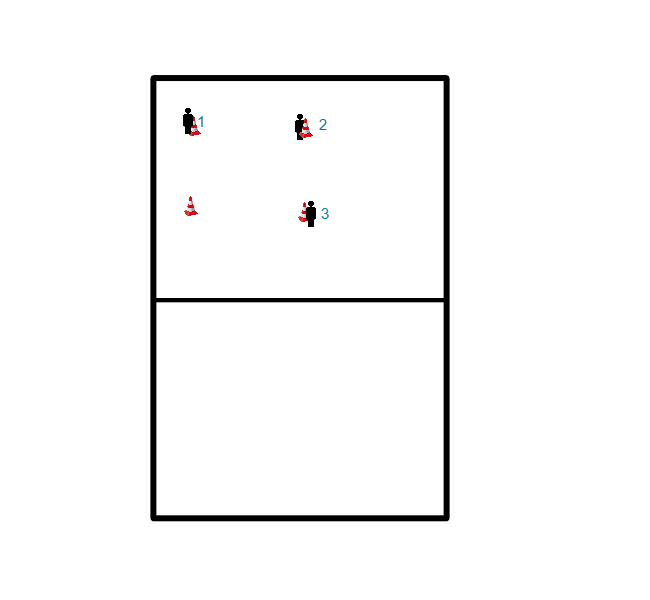
A trio has to pass the ball to each other in a square.That is tricky yes, because one is always missing....
Organisation:
Three players stand in an imaginary square about eight metres from each other. One corner remains unoccupied. The middle player (number 2) of the three has the ball.
Start in square. In from (basic
) Later: 1 under the post.
Basis: always offer sides. Not in a clump, not too early, not too late.
Setup: O v * * = pilon O = basket
* v O
[Make
sure that they first pass the ball before passing it.
Distance between the pile and the basket is +/- 10 meterAt
each pile there is one person with the ballAt
+/- 4 meter from the pile there is one defender.
The player tries to pass the ball. By changing tempo she tries to pass the defender first. Defender follows, but lets her pass. From pole 1 the attacker moves on to pole 2 and makes a new attempt at pole 2.
Variation:
- 2 attackers at the same time
- When scoring twice, switch to pass.
- Defender goes for preventing shot.
- Attacker can choose for walk through, dodge and/or distance with step behind
- adjust time
- multiple posts/pillars/players
Inshort: simple catching and throwing exercise with a lot of running for foursome.
Organisation: The four players form a square (distance about 10 metres, depending on the level), one of the four has a ball. If there are people left over, one or more foursomes can be formed and stand in a pentagon. Almost all parts of the exercise described above can be practised in this form of organisation.
The procedure is as follows:
Player A throws the ball to B, runs after him, gets the ball back and throws to C. He gets the ball back, plays to D, gets the ball back and throws to B over quite a distance, and finally takes his original place again. In the meantime B has already started his round. When everyone in every foursome has had 3 turns the next exercise comes.
Variations:
- The players walk the other way.
- The attackers move slightly to and fro.
- Which foursome will finish fastest? (everyone has to walk three times).
- Make sure that the distances do not suddenly get smaller!
Setup: O v * * = pilon O = basket
* v O
- Distance between the pile and the basket is +/- 10 meter.
- At every pole stands 1 attacker with the ball.
- At 1 meter from the pylon stands 1 defender (you must be able to touch the attacker by the shoulder).
- The player tries to pass the ball.
- By changing tempo she tries to pass the defender first.
- Defender follows, but lets her pass.
- From pole 1 the attacker continues to pole 2 and makes a new attempt at pole 2.
- We do this for 1 to 2 minutes per person.
Variation:
- 2 attackers at the same time
- When scoring twice, switch to pass.
- Defender goes for preventing shot. Attackers can choose for walk through ball, dodge and/or distance with step behind.
- adjust time
- Multiple posts/pillars/players.
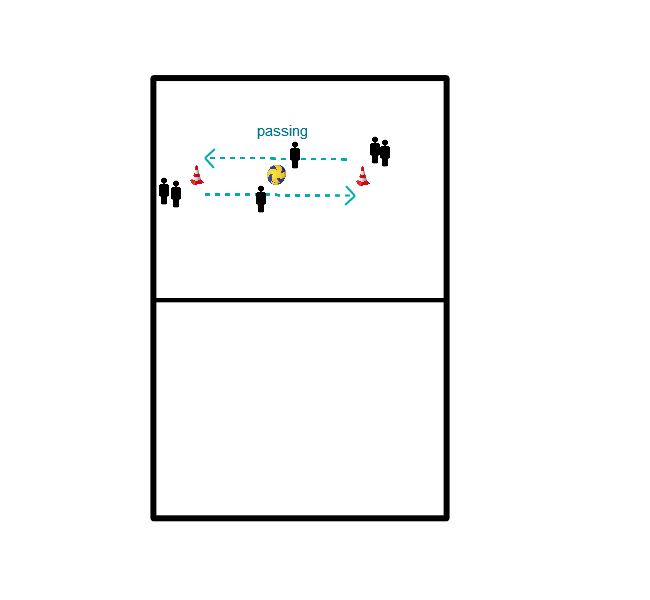
- Place the hats about 6 meters apart. Divide the group in 2.
- In case of five a group of three and a group of two.
- Goal is to keep the ball in the middle of the hats at all times.
- As soon as a player receives the ball, the player from the other side must be at the same level as the middle.
- After passing the ball, join the back of the queue at the other side.
- NB: nobody stands still and estimate well.
- Do not arrive too early or too late.
- Throw from the move.
- After five minutes also go the other way (left hand side).
! Form groups of 2 people per basket
Each group receives three cards. The cards are shuffled beforehand and the numbers 2 to 5 are taken from the packet. With the three cards they receive, the groups must get as close as possible to 31. The values of the numbers and pictures are shown below:
- Six = six
- Seven = seven
- Eight = eight
- Nine = nine
- Ten is ten
- Farmer = ten
- Wife = ten
- King = ten
- Ace = eleven
So nine + jack + queen = 29 points or ace + jack + queen = 31, but you can also get jack + jack = 30.5
When the players have completed a series, they may exchange one of their received cards for a new one, to get closer to 31. The trainer sets a timer and says stop when it rings. The team that is closest to 31 wins.
Series:
- Pass balls: three goals in a row.
- Short chance: four goals in total.
- Distance shot behind the basket: two goals in a row (4/5 meters).
- Penalty throw: three goals in a row.
- Around the basket: four goals, one on each side of the basket (3 metres).
! Form two groups. The attacker receives a vest.
This is louging in a korfball way. One person is the attacker, she/he starts with one defender. Within a playing area she/he must try to get free. In front of the box is the attacker. She/he has to make sure the ball gets to the attacker in the box. The other players stand aside. If the attacker receives the ball without the defender intercepting, a defender comes on board.
- Running free
- Throw
- Contact
! Make 3 groups and let the players divide into person 1, 2 and 3. After two rounds, switch one person by.
1.
Form 3 teams near the basket. Person 1 stands 6 metres in front of the basket near the pawn, person 2 stands 6 metres behind the basket near the pawn. Person 3 stands under the basket as catcher. Person 1 starts with e.g. a pass, then goes back to the pawn. Person 2 takes a passing ball in the meantime, as person 3 has caught the ball. This is how you do all the exercises.
Exercises:
- Pass ball
- Pass ball right
- Dodge ball left
- Diverting ball past the basket
2.
The three teams are now positioned differently. The pawns are moved to the side of the basket, where a player stands near both pawns. The other player stands in front of the pawn at 4 metres from the basket. Person 1 and 2 stand near the cones and are playable as a passer. Player 3 stands near the pawns and determines his action. Player 3 must pass at least 2 times before he can take a shot. The shooter stays in front of the basket with the shot.
- First take the shot while person 3 is walking towards the ball, later only walk away from the ball and take the shot.
- If necessary, repeat behind the basket.
3 teams change 1 for 1
# 4 teams swap 2 by 2
- 2 groups of max 4. Distance between 2 groups is +/- 5 mtr
- 2 baskets/rings next to each other at 6 mtr from both groups. In the basket +/- 3 hats/buds etc.
- 1 pylon in a straight line opposite each group at 12 mtr
Each group takes one hat from its own basket, runs around the pylon at 12 mtr and puts the hat in the basket of the opponent. In this way they try to empty their own basket or they try to have less than the other team after e.g. 4 minutes.
VARIATION
- distance between pawns and/or basket
- time
Inshort: practise various forms of the shot in a fun competition format.
Organisation: each group a basket and a ball, the baskets are preferably (but not absolutely necessary) arranged in a circle or rectangle. The number of people per group is less important (all groups should be about the same size).
The first assignment for the groups is: make 10 walkthrough ball goals. When you are done, the creator of the last goal goes to the trainer to get the next assignment. Which group will have completed all assignments first?
The trainer walks around the room, encouraging or correcting the players. He has a piece of paper with a list of assignments. When someone comes to get the next assignment, first ask him which assignment he just completed (after a while this can vary considerably) and then give the next one. A list of examples: 10 walk-through balls, 15 penalty shots, 5 shots from 8 meters, 10 walk-through balls from behind the basket, 5 dodges next to the post on the right, 10 penalty shots, 10 shots from 3 meters behind the basket, 5 dodges next to the pair on the left, 10 shots from 6 meters. Everything is possible of course, a lot of momentum comes when the number of goals to be scored is kept small.
1. 5 chances to score from close range, then across the field around the pilot and back. Again 5 chances to score from close range and back and forth around the pilot. Then blow the whistle to signal the substitution (time saving exercise).
2. Take balls from 8m onwards.
3. Take penalty throws (2,5m)
4. Shooting calmly from behind the basket (4m) from pilot to pilot (3m)
5. Shooting on the move at 6m from pilot to pilot (5m)
6. District shot 8m (left and right alternate) always start at the pilot (2m)
7. Turn around the basket for a short chance and start at the pilot (4m).
8. Quick goals
The organisation in the following exercises is that two players face each other. One ball per pair. The distance can be varied, but players should not practice at maximum distance. Do not let the players stand too 'stiff', they must be able to move freely and relaxed.
Exercise 1
Players throw the ball to each other with two hands and catch with two hands. Position at chest height. Pay attention to either throwing or catching, not both at the same time.
Variations: which pair can throw back and forth 25 times the fastest, who can pass the ball over the most without dropping it.
Exercise 2
As exercise 1, but pass the ball a little higher, not so high that you have to jump, so just above your head. Pay special attention to the catch and the position of the thumbs, a little closer together than in exercise 1.
Exercise 3
Like exercise 1, but the ball is played at knee height. Pay special attention to the pins, slightly closer together and pointing to the ground.
Exercise 4
Have the players stand a little closer to each other and bounce the ball over.
Exercise 5
Players alternately throw the ball high, low, with a bounce or at chest height.
Variations
The same exercises can be performed at a greater distance. A nice variation is to have the players start close to each other and after 3 good tosses take a small step further apart. After a while the players
they will get far apart and the maximum distance will be reached. Let players throw at most 3 times at maximum distance, certainly not more or further.
Setup: O v * * = pilon O = basket
* v O
Distance between the pile and the basket is +/- 10 meter.
At every pole stands 1 forward with ball
At +/- 4 meter from the pool stands 1 defender.
The player tries to make a through ball. By changing speed, she tries to pass the defender first. Defender follows, but lets her pass. From pole 1 the attacker moves on to pole 2 and makes a new attempt at pole 2.
Variation:
- 2 attackers at the same time
- When scoring twice, switch to pass.
- Defender goes for preventing shot. Attackers can choose for walk through ball, dodge and/or distance with step behind.
- adjust time
- Multiple posts/pillars/players.
In short: nice shooting exercise with a lot of running.
Organisation: the baskets are placed in a circle. At each basket stands a server with a ball. The rest of the players stand in the middle of the circle (the middle must be clearly recognisable).
In the hall there is often a circle, on the field a pylon must be placed). The number of baskets is very precise: aim for 2 baskets per 5 players.
a ) The players in the centre circle are instructed to shoot through balls to one of the baskets, it doesn't matter which one. Since there are slightly more players in the circle than there are free baskets, it is important to find a free basket quickly. When you are not quick enough, you have to wait a bit. And when Johnny is already on his way to a basket, but is passed at the last moment by Marietje, who is running faster, Johnny has to go back to the centre circle and try again from there. Everyone catches his own ball. After the signal everyone runs through the centre circle or around the pylon to find a free basket again as soon as possible.
b ) As a., but now with the assignment: Who will score 10 goals first? Even the players who first thought: 'Never mind, he runs faster than me' will now try to be the first to get to the free basket. Make sure that the players do not 'cut off' by not going through the centre circle or around the pylon.
c ) Like b., but with the assignment: 'Who will be first to score a goal at each basket?
d ) Same as b., but with overhead walkthroughs.
e ) As b., but a 'takeover situation' follows: the runner from the centre circle, after having received the ball, plays the ball back to the declarer who started away from the post. The original declarer must try to score from this start. Who scores 5 goals first?
f ) As b., but the runner takes balls out of the way (left or right, distances not too great). The declarer also catches the shot. The runner runs to the basket and gets the ball from the receiver, who will hurry to try again from the centre, because: who has scored 5 times first?
g ) As f., but after the dodge no shot follows: the ball goes back to the receiver who started at the basket. He shoots with a quarter/half turn. The shooter runs back to the middle, the other person (of course) catches the ball. Variation: The exercise can also be done with defenders present. The defenders have a thankless task: the attacker has a choice of a large number of baskets. Which attacker will be first to score 10 walk-throughs or 5 goals from ducks?
Most korfball players find the above a nice relaxed exercise, which is very suitable to start a training session with, they can use as much energy as they need. When the time has come to really put everyone to work, the next step is to score a goal:
At a distance of +/- 15 meter make two sections with 4 hats of 1,5 x 1,5 meter.
Make two teams with an equal number of players.
Each team has its own section.
The other team tries to conquer the box of the other.
This happens when one attacker stands in the box of the other and gets the ball from a teammate.
They get 1 point. No other players are allowed to stand in the box.
When the defence intercepts the ball, they may immediately open the attack on the compartment of the opposite team.
variation:
- on time
- on points
- from both teams 1 player allowed in the box
- no limit on number of defenders in section
- no limit on number of attackers in section
- adjust size of section
- distance between squares