



Korfballexercises for u9
Exercise:
Pairs, not too far apart, 1 ball per pair. Throw the ball over with your preferred hand (let them catch it with 2 hands). Pay attention to the following
- right leg in front (right throw=left leg in front, left throw=right leg in front)
- Hold the ball on the hand with spread fingers
- Start by holding the ball as far back as possible.
- Throw the ball with after pointing
- Step forward while throwing
- not too hard, not too soft, but tight
- Aim at chest of fellow player
N.B.; Start with a distance of a few metres, if it goes well you can go further.
Walk straight to the basket.
Place your right foot slightly to one side, bend your knees and then step out to the left.
Make a 90-degree angle to the left.
When throwing the ball to the net, make a cross pass and then come out on the outside leg.
Take the ball with spread fingers, so that you can shoot directly.
The cross passes with one leg in front of the other. At the same time you turn your body towards the basket.
Make a pass to the side or slightly backwards and turn the body further in, so that the body is facing the basket.
Attention !
Your shoulders are straight towards the basket.
Your feet are straight towards the basket.
You process the shot like we discussed in the previous section on shot from stand.
Prior to the technique of the penalty throw (the eventual ball) is the run. This
This is done with the hopping step.
Walk in a line from 6 to 7 metres towards the basket and continue until you receive the ball.
Pass the ball to the receiver.
Start the hop, keeping the ball close to your belly.
Hunk, arms bent slightly, step.
Hold the ball straight in front of your body at belly height.
Straighten your body and look at the basket, raise your knee and stretch your arms.
Keep your body nice and straight in relation to the basket.
Let go of the highest point, stretch the body, come down with the other foot and check the ball, keep walking and do not jump.
Stand still after releasing the ball.
You finish the ball past the basket.
Legs about 20 cm apart and diagonally across.
Face towards the basket
Arms slightly bent.
• Good foot forward so you can make the best push-off (one child can push off better with his/her left leg and the other with his/her right leg).
  child with his or her right leg)
Hands close to the ball, with thumbs towards the basket (you put the ball on your hands).
Shoulders straight to the basket. Feet straight to the basket.
Weight on your back leg.
Shift your weight (i.e. your body) to your front leg and then push off in the direction of the basket.
Jump up towards the basket at an angle, lifting your knee well upwards so that the ball comes close to the basket (following your knee).
Jump after your knee)
Extend arms.
Let go of the ball at the highest point and point to it.
Straighten and lengthen your body
Check the ball
Legs side by side, slightly spread, about 1 foot between both feet (so the archer stands firm and balanced).
Fingers spread, thumbs and index finger in a triangle.
Ball in front of your face, looking just over the ball.
Shoulders straight to the basket.
Feet straight to the basket.
Body straight to the basket.
Elbows outwards, approx. 15 cm from the body.
Knees and then jump straight up (the power of the shot comes from the legs).
Extend your arms in the direction of the basket.
Shoot the ball in an arc towards the basket.
Point the ball in the direction of the basket.
 • Come back to the same place with both legs as you kick off.
Keep watching and pointing the ball until it hits the basket (to improve your next shot).
When throwing with the left, put the right leg in front (when throwing with the right, put the left leg in front).
Hold the ball on your hand behind your head with spread fingers.
Other arm forward
Left or right foot max. 30 cm to the front
Look at the direction you want to throw the ball.
Body rests on right leg, shifting weight to left.
Turn your body.
Throw the ball in a straight line past your head.
Pointing in the direction of throw.
You determine the speed and curve from the wrist.
Your body should end up in a straight line with your team-mate (shoulders straight, feet and navel in the direction of your team-mate).
Catch with 2 hands
Thumbs behind the ball
Fingers spread
Thumb and index finger in triangular shape (to prevent overshoot).
Feet crossed at an angle with a space of about 30 cm (shoulder width or just outside).
Receive the ball with arms almost stretched out.
Squeeze the ball lightly on reception.
Bring the ball up to chest height with your arms bent (to get the speed out of the ball).
Place the hats in a square with about 5 m between them.
Two players are the catchers, the rest move inside the square.
The 2 scapegoats can tap the other players with the ball. The catchers are not allowed to walk with the ball.
By throwing over the ball the taggers can tap the other players.
If you are tapped or outside the square you are finished and may leave the square.
Variation:
When players are out, they belong to the taggers instead of being out of the box.
The chaos game is fun for younger children, but can also be played with older children.
- In the chaos game the intention is that every child has a ball, and that there are 3 or 4 poles (also depending on the number of players).
- lined up.
- Each player starts at the same pole,
- there's a countdown and then they all start shooting,
- if they can score, they proceed one pole
- if they don't score, they stay at the pole until they do.
- You can agree in advance whether they should have been past each pole 1, 2 or 3 times depending on the level.
- Variation: you can use pilons to mark a circle outside which players have to shoot,
- they're only allowed in to catch the ball.
- The materials below are for 4 persons (hat = pilon)
- You put pilons in a square.
- In the square you put a number of balls (one less than the number of players).
- The players run around the square and then the trainer yells YES.
- If the trainer says YES, the player takes a ball as quickly as possible.
- If you have a ball, you score 3 goals.
- The remaining player continues to run around the square until someone finishes shooting.
- Place 4 posts in a square.
- The whole group runs around the posts in a row.
- If the trainer shouts "yes", the person at the back of the row will run to the front of the row as quickly as possible.
- The children do this by sprinting.
- Options:
- The children follow each other around the posts in a row.
- The person at the front of the row can do what he wants, for example: heels to the back, sprinting, lifting knees etc.
- If the trainer shouts "yes", the person at the back of the queue gets to the front of the queue as soon as possible and can then choose what he wants to do.
- It has to be something else than running/jogging, it can be sprinting.
PURPOSE: Warm-up (concentration and reaction)
ORGANISATION: groups of two, three or four in a defined space.
RUNNING THE GAME: slowly run behind each other, crisscrossing through the entire space. Number 2 always follows every movement of number 1 as quickly as possible and keeps a distance of about 1 meter. Switch positions after a while.
VARIATIONS:
- now the front runner tries to get rid of the back runner by sudden feints and/or tempo changes.
- But now other movements are allowed as well: cross steps, jumping, lying down and getting up again etc.
- No more groups: everyone runs freely. The players run towards each other, make a feint and:
- then pass each other on the left.
- pass each other on the right
- turn around each other and run back
- 1 shooter stands in front of the post, distance is indicated by the trainer
- At least 1 receiver, but it works better with 2 or more receivers
- 2 balls per post, as soon as the shooter has shot a ball the 2nd ball will be passed to the shooter.
- Shooter gets X minutes to score as many goals as possible
- Goal is to keep shooting fast, but also to keep shooting well
- Can be done several times and try to improve the number of goals each time
- divide the group into groups of 5 (it's also possible to have a different number, but adjust if necessary).
- make a box, for example 8/8 or 10/10 or 12/12.
- Of each group of 5, 1 person is a catcher, the others are the field players (if you have more than one group, you can put the catcher(s) of one group into the other group).
- The catcher tags 1 or 1½ minute and you count how many tags have been made (one player can't loose and stays in the game).
- The catchers that start tagging (recognizable because of the jacket / ribbon) and
- distribute the other remaining children per group in the box with a ball. They pass over the ball and walk free.
- The catchers try to tag someone who doesn't have the ball, so someone who has the ball is not allowed to be tagged.
- The player approached by the catcher must get the ball as quickly as possible.
- You make a box, with an attacker in it,
- the attacker must keep moving in the box, while a defender is following.
- The other player is standing outside the box.
- The attacker starts with the ball in his/her hands and throws it to someone on the side and the person on the side throws it back to the attacker and then throws it back to someone else standing on the side.
- The defender tries to take the ball.
- When the defender takes the ball, he throws it back you will try again
- The attacker always tries to run free and the defender tries to intercept the ball
In short: practicing various shooting variations in a fun competition form.
Organization: per group a post and a ball, the posts are preferably (but not necessary) arranged in a circle or rectangle. The number of people per group is less important (but all groups are about the same size).
- The first task for the groups is to score 10 goals.
- When you have completed this assignment, the person who scored the last goal runs to the trainer to pick up the next assignment.
- Which group completed all the assignments first?
- In the meantime, the trainer walks around encouraging or correcting where necessary.
- He has a piece of paper with him with a row of assignments on it. When someone gets to get the next assignment, first ask which one has just been completed (this can vary quite a bit over time) and then give the next assignment.
- An example list: 5 walk-through balls, 5 penalty throws, 5 4-meter shots, 5 walk-through balls from behind the post, 5 shots behind the post.
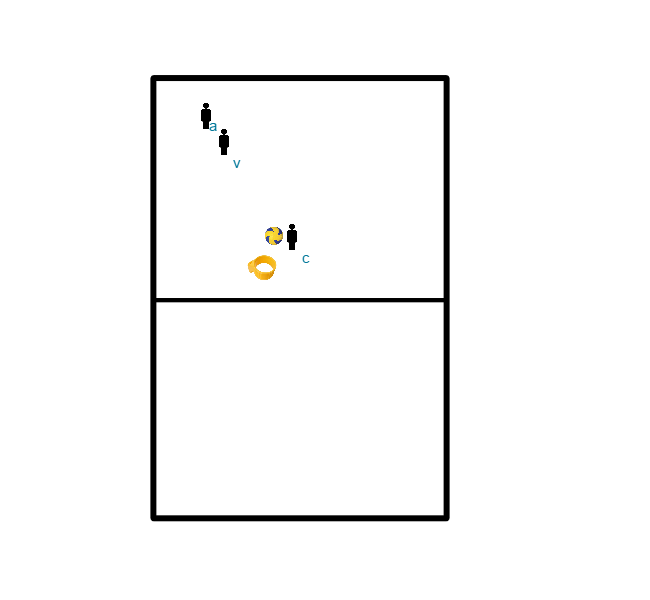
- 3 men per post.
- Player A starts as attacker for the post.
- Player V starts as defender at 1.5 arm's length from the shooter.
- Player C starts with the ball as catcher/feeder.
- Attacker A must try to score in a 1 to 1 duel.
- It doesn't matter how (distance, dodge, dlb).
- The job of defender V is to follow the attacker continuously at 1.5 arm's length.
- If the attacker has the ball in his hands, the defender must close.
- The defender must not tap or block the balls.
- The V must show that he or she is near the attacker but must allow the shot.
- This can be done by the defender placing her hand just above the attacker's shoulder.
- Switch positions after 1 minute .
- Two players stand 7 meters in front of the post and eight meters apart.
- A player with the ball under the post and a receiver slightly behind the post.
- One player in front of the post takes the through-ball that is passed, after the other player in front of the post has received the ball.
- The ball is caught by the receiver.
- A1 becomes A2,
- A2 becomes A3,
- A3 becomes A4 and
- A4 becomes A1.
What can you see?
- The passer learns that the shooter can only take a through-ball if the throwing is calmly prepared, is thrown in front of the shooter and the ball is passed at the right height.
- The speed and trajectory of the shooter can be regulated by the speed of throwing, ball trajectory and ball speed.
- Learning to control problems such as timing requires a lot of repetition and sometimes adjustment of the distances used.
- The problems for the shooter, the starting position of the ball is different because the body is twisted for ball reception, lead to impure actions. Stay attentive to this.
- The action speed must be increased.
Variant: - Just like exercise 12, but the passer throws the ball to a shooter who dodges to a position diagonally behind the post.
- There is a ball through the centre where the passer must consider two opponents, his direct opponent and the shooter's opponent, as they are not far from the ball line.
Variant: - The marksman makes a feint shot and passes the ball to the player below the post indicating a through-ball.
- You put up four poles in a square,
- in the middle of the four poles you put down a pilon.
- four children will be passers at the poles and
- the rest of the children will stand by the pilon in the middle.
- First, you can choose that the attackers have to take through-balls at the poles.
- It doesn't matter which pole, they may run at the same pole a maximum of 2 times in a row.
- You can choose this, so they have to run a lot.
- The children also have to score twice, the person who does this first may definitely switch positions with a passer, the other may switch as well as soon as they score twice.
- After that you can choose to let the children do free balls, penalty throws, dodge-balls, etc.
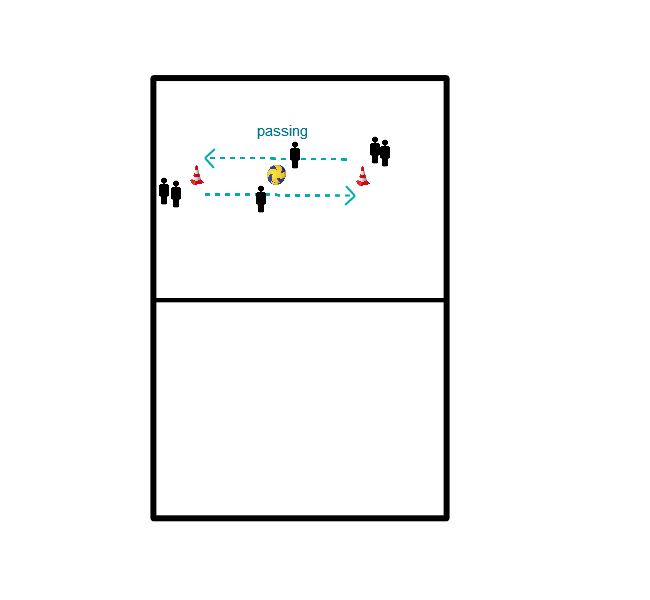
- Put pilons about 6 meters apart. Divide the group into 2.
- In the case of five, one group of 3 and a group of two.
- The goal is to keep the ball in the middle between the pilons at all times.
- As soon as a player receives the ball, the player must be at the centre of the other side.
- After you have passed the ball, you join the back row on the opposite side.
- NB: Nobody stands still and tries to see what happens at all times
- Do not arrive too early or too late.
- Throwing while moving.
- After five minutes switch side (left hand).
- Make pairs, at each post a pair.
- We are now going to use the posts lengthwise, namely one player of the pair attacks the post opposite to him or her.
- One player of the opposite post does the same.
- How does this work?
- Of each pair there is a number 1 and a number 2.
- Number 1 is going to defend his post for a minute and a half against the other number 1 of the post opposite to him.
- When the number 1 of a post has had a chance, the other number will attack and so there will be a change of function (and of post, because everyone is defending his own post).
- So there is always a change of function if the attacker has lost the ball.
- As a player, you are attacking as well as defending for a minute and a half
At a distance of +/- 15 meters from each other, make two compartments with 4 pilons of 1.5 x 1.5 meters.
Make two teams with an equal number of players.
- Each team has its own compartment.
- The other team tries to conquer the other team's square.
- This happens when 1 striker is standing in the opponent's square and the ball is played by a team-mate.
- They get 1 point. No other players are allowed in the box.
- When the defence intercepts the ball, they may immediately start the attack on the opponent's square.
Variation:
- on time
- with points
- of both teams 1 player is allowed in the box
- no limit on the number of defendants in box
- no limit on the number of attackers in box
- customize size of box
- distance between boxes
- 4 children are standing next to each other, about 5 meters apart.
- 1 child is going to do the exercise:
- Receives the ball at the first pilon, returns it to the player on the other side, and moves on to the second pilon and so on.
- At the back pilon he returns with a full sprint.
- Then switch, everyone moves a place, number 5 does the exercise now.
- Everybody has their turn. Possibly everyone could go 2-3x.
- Work in groups of 2-3 or 4 and a post.
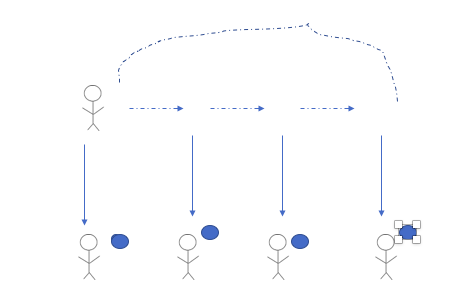
- Players stand in front of each other and throw the ball to each other.
- Player A throws to player B.
- Player A runs towards player B, but then backs away towards the post and gets the ball from player B (deep pass).
- Player A shoots the ball into the post.
- Make sure you run close enough to the post.
- Don't stop running too early and the pass must be precise.
- You can extend the exercise further by passing the ball back to player B instead of taking a shot,
- then it's important that player B makes a running action to become available for a pass.
- you've got four kids per post.
- 3 are the attackers,
- 1 is the defender.
- The attackers must try to score and the defender must prevent it.
- Swap when the attackers have scored 3 times or if they miss off or if it's intercepted by the defence.
- then change roles.
- If the scoring is too easy, you provide a second defender or the attackers must pass first before shooting again.
- If the shooting is too difficult, provide an extra post or the defender must keep one hand on his back or the attackers may run with the ball.
- Player 1 throws the ball to the oncoming player 2 who is not running straight into the ball,
- but diagonally to the right of the player.
- Player 1 runs to the other side, receives the ball halfway from player 2 and throws it to the pilon he came from, player 4, and connects behind the other pilon where only player 3 is.
- Player 2 connects behind player 4.
- Player 1 must make a quarter turn to be able to throw the ball from player 2 to player 4, this turn must be done airborne.
- Arrange a square with a distance of about 10 meters.
- For larger groups, pentagons can be used.
- Player 1 throws the ball to player 2, runs after the ball and gets the ball back to player 2.
- Player 1 throws the ball to player 3, runs after the ball, receives and throws it to player 4.
- Arrivin at player 4, player 1 should throw a long diagonal ball to player 2 and player 1 can take up his original position.
- Player 2 continues the exercise.
- This exercise should be done twice each and then be done in the other direction.
- Who is first to finish the exercise?
- Watch out for uneven distances.
- Pilon 1
- Tap the ground 6 times and jump up and stretch out all the way. RUN TO POST 1.
- Post 1
- then you take a dodgeball at post 1.
RUN TO PAWN 2.
- then you take a dodgeball at post 1.
- Pilon 2
- jumping lunge
RUN TO POST 2.
- jumping lunge
- Post 2
- take a through-ball at post 2.
Run to a pilon
- take a through-ball at post 2.
- Pilon 3
- 6x push-ups
RUN TO POST 3.
- 6x push-ups
- Post 3
- short chance behind the post
RUN TO PAWN 4.
- short chance behind the post
- Pilon 4
- 6x squad
RUN TO POST 4.
- 6x squad
- Post 4
- dodge to the other side
Run to PAWN 1
- dodge to the other side
- This is repeated 5 times
- but change every time under the post.