




Soccerexercises for technique attack / offense
Last update: january 2026
Objective
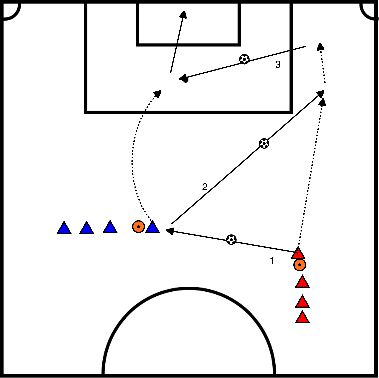
- Learn to move after making a pass.
- Combination of crossing and finishing.
- Suitable for boys aged 7-8 years.
- Red player passes to blue player and runs towards the corner flag.
- Blue player returns the ball into the deep towards the corner flag.
- Red player delivers a cross to the incoming blue player.
- Blue player finishes.
- Good initial pass.
- Move towards the ball for the return pass.
- Return pass into the deep.
- Do not run in too early when finishing.
Objective
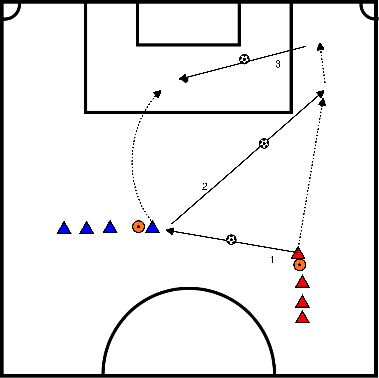
- Learn to continue moving after a pass.
- Combination of crossing and finishing.
- Red player passes to blue player and runs towards the corner flag.
- Blue player returns the ball into the space towards the corner flag.
- Red player delivers a cross to the incoming blue player.
- Blue player finishes the ball.
- Good initial pass.
- Move towards the ball for the return pass.
- Return pass into the space.
- Do not run in too early when finishing.
Execution
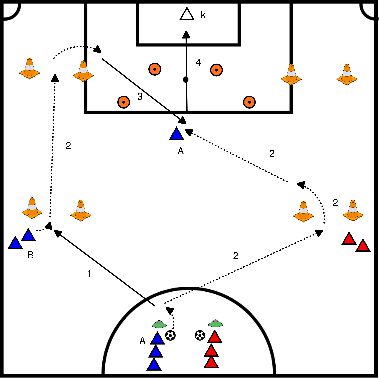
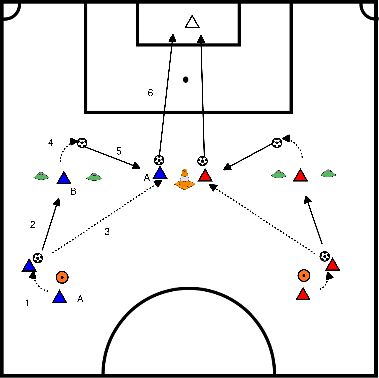
- Player A frees themselves from behind the cone and passes to Player B.
- Player B dribbles with the ball through both gates towards the goal line.
- Meanwhile, Player A runs through the right gate to the centre, just in front of the penalty area.
- Player B passes the ball to Player A through the gate.
- Player A finishes on goal.
- Player B retrieves the ball and joins the red side; Player A becomes the red Player B and vice versa.
- The exercise is alternately performed on the blue and red side; red starts when the diagonal pass from blue is given.
Execution
- First left, then right, or both sides simultaneously if there are enough players.
- Encourage using the left foot on the left side, right foot on the right side.
- Player A turns open to the outside behind the opponent.
- Player A passes forward to player B between the cones.
- Player A runs diagonally to the cone in front of the goal.
- At the same time, player B cuts or turns out of the cones towards the goal line.
- Player B passes diagonally back to player A who is now at the cone.
- Player A shoots at the goal.
- Player A becomes player B, player B joins the starting position.
Objective:
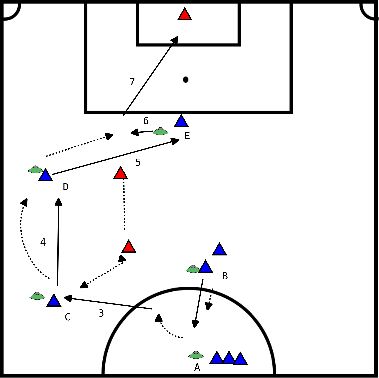
- To teach building backwards in set patterns (with resistance)
Who stands where:
- All spread out across the field, give them tips, directions, and most of all let them try to figure things out for themselves!
- Everyone can stop the game!
Exercise:
- B plays on A
- B puts pressure on A
- A dribbles a little bit, gives good ball to C
- C plays on D
- D plays on E
- E rebounds or turns and finishes
- D passes to C
- C finishes
Variation possible due to previous agreements, and depending on defender ( see below)
Task defender: ( jayden - Jelle/ Lucas alternate together)
Task defender: ( jayden - Jelle/ Lucas alternate together)
- Defender chooses way of putting pressure.
- Pressing the back, or shielding the ball line to left outside or striker
Swap through:
- Swap to the next Pylon
Coaching:
- Movement without Ball
- Good leg and tight passing
- Coach each other by shouting name
- Let them make choices and mistakes
Style of play:
1-4-4-3
A= 3-4
B=6
C=5
D=11
E= 9
1-4-4-3
A= 3-4
B=6
C=5
D=11
E= 9
Goal:
Building up from behind in set patterns teach without resistance
Exercise:
Building up from behind in set patterns teach without resistance
Exercise:
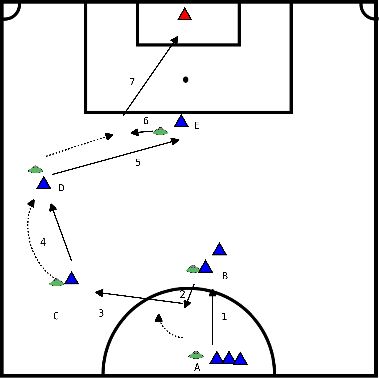
- A plays on B
- B passes to A
- A dribbles a little, gives good ball to C
- C dribbles next hat
- C plays on D
- C plays on D
- D rebounds on C - or spins through
- E rebounds on D or spins and shoots
Swap through:
- A-B
- B-C
- C-D
- D-E
- E retrieves ball and joins A
Coaching:
- Movement without Ball
- Good leg and tight passing
- Coach each other by calling out names
Style of play:
1-4-4-3
1-4-4-3
- A= 3-4
- B=6 - 8
- C=5
- D=11
- E=9
Goal:
Improve playing out of a stall situation to the opponent's goal with the goal of making the right choices in attacking play and scoring goals.
Improve playing out of a stall situation to the opponent's goal with the goal of making the right choices in attacking play and scoring goals.
Organization
- Field of 32 meters long, double sixteen-meter area, and 25 meters wide.
- 1 large goal
- 2 small goals
- 15 field players + 1 goalkeeper
- Sufficient pylons to mark out the field
- 10 balls distributed between the two goals
- 2 trainers per organization
- The line of the sixteenmeter area is the offside line
Contents
- Team (A) playing from the small goals starts with dribble
- 1 player (A) dribbles with the ball towards the opponent's goalkeeper (B) and must finish in front of the sixteen meter line (1 against 0 we call this)
- As soon as the ball is out of play, goes into the goal or into the hands of the goalkeeper, as soon as possible 2 players of this team (B) with 1 ball enter the field to play 2:1.
- Again, if the ball is out of play, enters the goal or is in the hands of the goalkeeper then 2 new players from the other team (A) enter the field to play 3:2.
- This continues until the situation where 8:7 is played by team A
- after this 8:7 situation the last player of team B enters the field and 8:8 is played until a goal is scored
- After this the whole form starts again, only now it is team B that starts
- The total number of goals is counted to determine the winning team
Coaching
- It is all about making the right choices to score goals. These choices are different in every situation and so each overtime requires specific coaching
- 1:0 - a free shot from the '16 should always be between the posts
- 2:1 - patience on the ball, being playable by the teammate and thus getting free in front of the goalie
- 3:2 - patience on the ball, fielding-> big and wide. 1:1 means 2:1 at the other end. Running action without ball to force opponent to make choices
- 4:3 - patience on the ball, fielding-> big and wide. High ball tempo, play moves and multiple runs without ball. Create 2:1 or play out 1:1 to create a chance
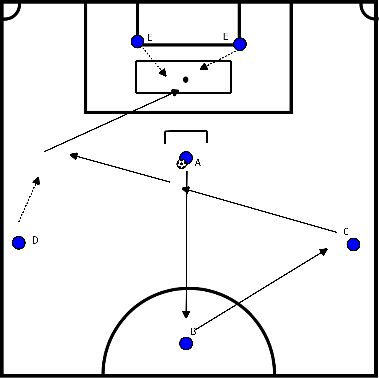
Keeper is in the goal standing just outside the 16. This is to add some surprise. He does know if the ball is coming over the left or right. But either striker can be the one finishing.
- We start at the number 10 position A.
- The attack is "dead" there, so we get the ball out and play back to our 6 B.
- Our 6 now looks for the half player at C or D.
- If C, takes on with the right and turns open and, possibly through the number 10, looks for the other side.
- If D, takes on with the left and turns open and searches, possibly via the number 10, the other side.
- The half player then plays into the box near the strikers waiting at the corners of 5 meter area.
- One of the players works off and joins A, the other striker remains standing.
Passing is done alphabetically. Positions D and C are double for turnovers.
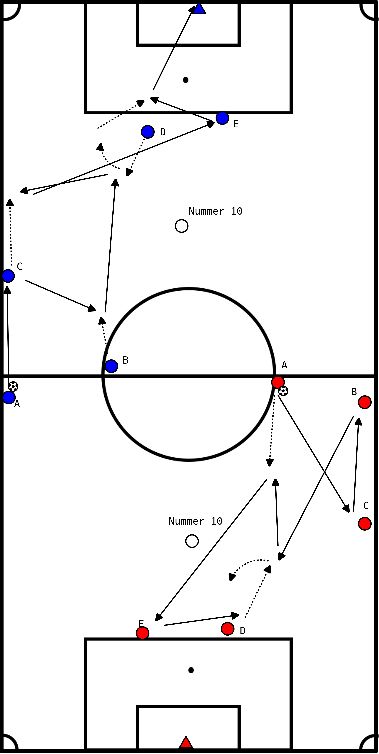
Players Blue:
Match-oriented positions:
Match-oriented positions:
A = Left back
B = Central defensive midfielder
C = Left half
D = Striker 1
E = Striker 2
- Left back plays into the left half.
- Central midfielder gets free in the axis and is played on by the left half.
- Striker 1 sinks out a bit for the handball.
- Striker 1 drops ball to left half.
- Striker 1 turns away so that ball could possibly be stabbed to him.
- Left half leaves depth ball and plays Striker 2 tight in foot.
- The rebounds him half deep to the incoming Striker 1.
- Striker 1 works off.
Players Red:
A = Central defensive midfielder
B = Left back
C = Left half
D = Striker 1
E = Striker 2
- Central midfielder plays into left half.
- Left half drops to left back.
- Striker 1 drops out.
- Left back plays into striker 1.
- Striker 1 drops to pass-through central midfielder.
- Central midfielder looks for striker two.
- Striker 1 gets under the ball.
- Striker two drops to Striker 1.
- Striker 1 finishes.
Always pass alphabetically.
Variation opportunity in advanced situations:
-Add a number 10 -see white player- to the situation to create additional opportunities.
-Have the left half run action into the corner to receive and cross as an additional opportunity.
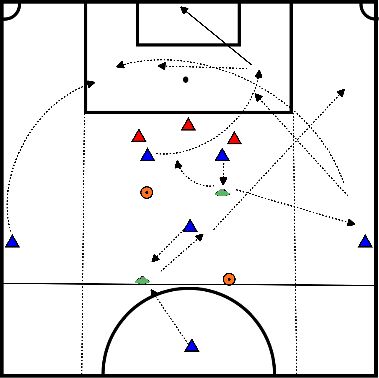
- Starting in circle center line.
- Number 10 offers but chooses which side.
- Other players must therefore pay close attention. Depending on that choice, we assume left at green hat or right at orange hat.
- In this example the green hat is on the left.
- Number 10 offers and passes the ball to number 6. He immediately passes to the right sacked striker.
- At the moment the sagging striker is played in, the other striker begins his run.
- The striker again has a choice:
- Dropping on the returning number 10
- Immediately play into the flank.
Continued if choice 1:
- Number 10 pokes the flank midfielder away by a deep pass towards the corner.
- The other flank midfielder starts his run to eventually end up at point 16, about the time the cross is going to be delivered.
The crosser then has 3 choices:
- First post -> run-through 'cross' striker.
- Second post -> passed flanker
- Edge 16 -> runaway sagging striker
Continued if choice 2:
- The sagging striker plays the ball tightly into the feet of the midfielder trapped on the touchline. The midfielder is then left with two options:
- A stab pass to the crooked second striker who has run out behind the sagging striker.
- An early cross toward the far point 16, here the other midfielder connects and lays the ball wide to the striker.
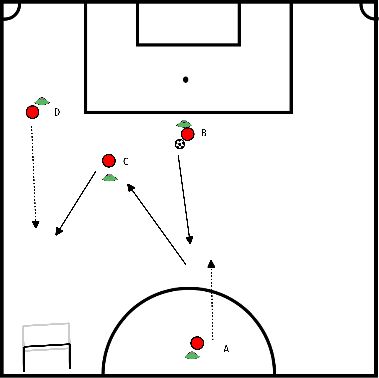
Goal:
- Improve building from behind
Contents:
- Improve building from behind
Contents:
- A does for action and asks for the ball from B
- B plays ball to A
- A plays ball to C
- D starts to run forward
- C passes ball in the run to D
- D finishes on the small goalmouth
- A = 6
- B = 3
- C = 3-4
- D = 2
Coaching:
- Communicate with your players
- Keep moving continuously
- See where your fellow players are standing
- Run on time
CAUTION!!!
Exercise is done in two groups so there is no need to stand still for long periods of time!
- Communicate with your players
- Keep moving continuously
- See where your fellow players are standing
- Run on time
CAUTION!!!
Exercise is done in two groups so there is no need to stand still for long periods of time!
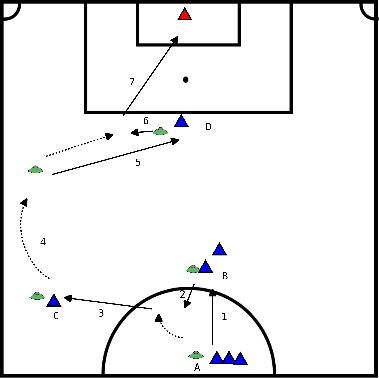
Goal:
Building up from behind in set patterns teach without resistance
Exercise:
Building up from behind in set patterns teach without resistance
Exercise:
- A plays on B
- B passes to A
- A dribbles a little, gives good ball to C
- C dribbles next hat
- C plays on D
- C runs on without ball
- D passes to C
- C works off
Changeover:
- A-B
- B-C
- C-D
- D retrieves ball - becomes A
Coaching:
- Movement without ball
- Good leg and tight passing
- Coach each other by calling out name
Playing style:
- 1-4-4-2
- A= 3-4
- B=6
- C=5
- D=9
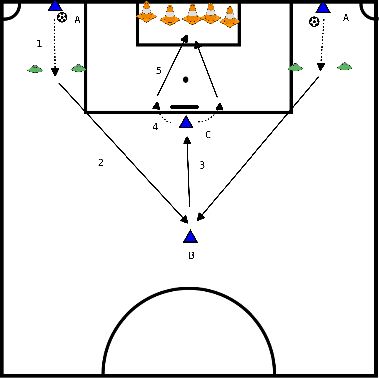
Field 15 x 15 meters.
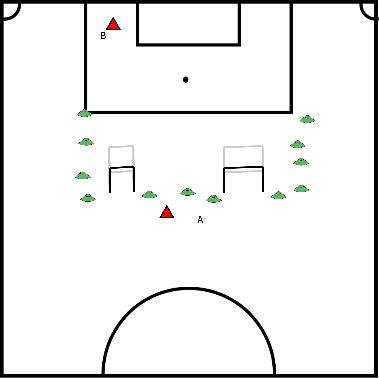
Goal 5 x 2 with 5 cones: outer 2 = 5 pt, next to them = 3 pt, middle = 1 pt
Goal 5 x 2 with 5 cones: outer 2 = 5 pt, next to them = 3 pt, middle = 1 pt
- Player A starts next to own goal and dribbles ball in through gate.
- Diagonal pass to player B.
- Player B takes on plays through to player C.
- Player C turns left or right away from defender or cone in his back.
- Player C shoots at goal and tries to score as high as possible.
Whoever gets the most points after several rounds of this exercise wins!
Passing through: A to B, B to C, C takes ball and joins on other side of goal. There the same exercise in mirror version.
Passing through: A to B, B to C, C takes ball and joins on other side of goal. There the same exercise in mirror version.
Skills: dribbling, passing, taking on and passing, turning away from defender, targeted kicking, finding corners.
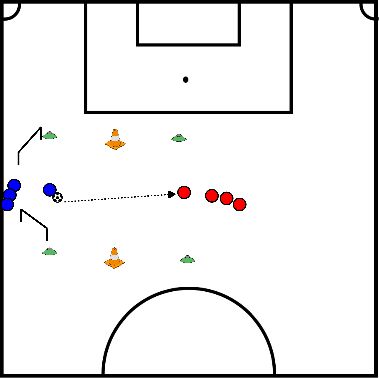
It is a 1 against 1 exercise where the defending blue side plays the ball in to the attacking red side and the latter thus looks for a 1 against 1. Blue has the task of defending 2 goals.
Rules
- When you have gone, you switch sides
- Score over the center line
- If the defender has the ball or shoots, it is finished
Points of attention
- Let the attacker pace and use body movements
- Let the defender defend forward
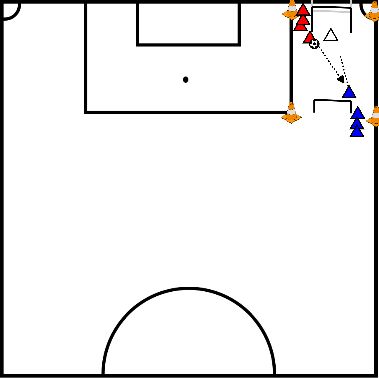
A 1 vs. 1 exercise in which the defending red team plays the ball in to the attacking blue team.
- When the attacking blue side has the ball, it looks for a 1 vs. 1 with the player from team red.
- If either team scores, both players switch sides so player red goes to blue and player blue goes to red.
- It may be that a red player takes the ball away. In that case, they may score on team blue's small goal.
- Team blue must score on a big goal that also has a goalkeeper.
- The players keep track of their own points and the three who finish last do 10 push ups.
Game rules:
- Ball out are 2 new players.
- If the goalkeeper catches the ball, it is play on so it is a 2 against 1 situation.
- Goal is also 2 new players.
Points of attention:
- Make sure the attackers dribble in at a high pace.
- Make sure the defenders defend forward.
- Make sure the defenders have a good stance.
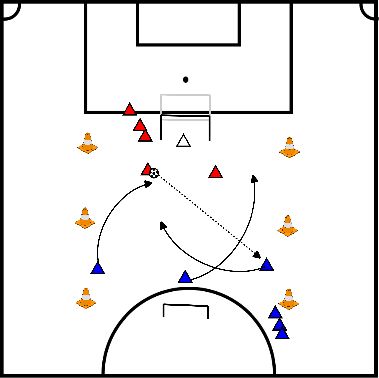
The purpose of this exercise is to play out of overtime.
- The 2 defenders of team red play the ball diagonally to a player of team blue.
- Then it is a matter of scoring and making sure they play out the overtal.
The teams just stay put and you have them switch sides after 6 minutes.
If the red team takes the ball away, they can score on a little goaltending by team blue.
Rules of play.
If the red team takes the ball away, they can score on a little goaltending by team blue.
Rules of play.
- Ball out is switch.
- Keeper the ball is play on.
- Scoring is switching.
Points of Attention
- Have the defenders defend on a line.
- Let the attackers make runs.
- Play the ball around at a high pace.
- If they can shoot, they should shoot.
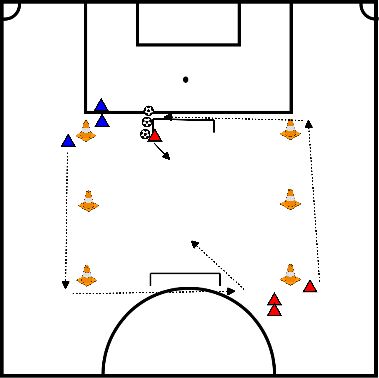
- This 1 vs. 1 exercise begins when the players have run around half the field.
- They must first go around the hat in the corner and then pass behind the goalie to start the 1 v 1.
- The attackers - red - pick up a ball when they have passed behind the goalkeeper and go on the attack.
Points of attention
- Pay attention to the attitude of the defenders.
- Make sure the attackers have pace.
- Don't make it too complicated. So one action on pace and score.
Rules
- Score over center line.
- If the player has been then switch sides.
- Pay attention to the attitude of the defenders.
- Make sure the attackers have pace.
- Don't make it too complicated. So one action on pace and score.
Rules
- Score over center line.
- If the player has been then switch sides.
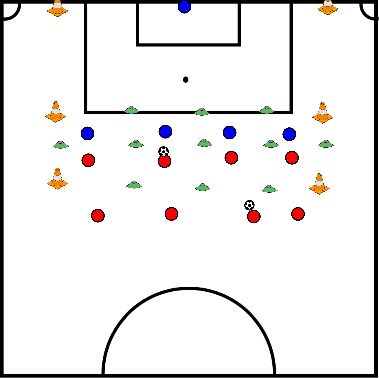
Distance: to the goal 16 meters
Size of squares: 3 by 3.
Assignment:
The defenders try to make it impossible for the attackers to score by shielding the pass lines.
Again, the defender, who has the attacker in front of him, presses with the ball and the rest squeezes in.
The attackers try to get the ball into the 16 to finish.
Rules of play:
Size of squares: 3 by 3.
Assignment:
The defenders try to make it impossible for the attackers to score by shielding the pass lines.
Again, the defender, who has the attacker in front of him, presses with the ball and the rest squeezes in.
The attackers try to get the ball into the 16 to finish.
Rules of play:
- The defenders are not allowed in the attackers' box!!!
- The attackers are allowed into the defenders' box to receive the stabbing ball.
- Once the ball is in the 16, the attackers may score. The defenders may also defend there!!!
- Goalkeeper is free in the 16 to intervene.
- Goal attempt over. Then the attackers become defenders and the defenders get the ball and then join behind as new attackers.
If the attackers cannot get into the 16, you can make it easier for them by making the boxes 1 meter wider.
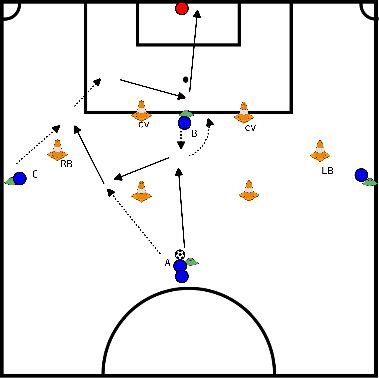
Distances:
- Pawns at 16 width 5 meters.
- Pawns underneath at 10 meters.
- Pawns side 3 meters from the 16 and 5 meters down.
- A stands 10 meters from the pawns.
- A plays the ball to the incoming B and immediately runs himself to the side past the defender.
- B drops the ball on A and goes to his starting position.
- As soon as B drops the ball, C starts running to pass the back.
- A plays the ball in the run along to C.
- C crosses past the last man and then puts the ball back to B.
- B rounds off.
- A becomes B, B becomes C and C retrieves the ball and connects behind and then through the other side
Coach moment:
A after pass immediately run through.
B get loose to ask for ball then immediately take position.
C at right time start not too deep because then too close to CV.
A after pass immediately run through.
B get loose to ask for ball then immediately take position.
C at right time start not too deep because then too close to CV.
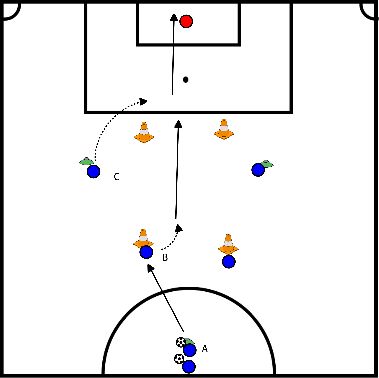
Distances:
- Big pawns outside 16 stand 3 meters outside it.
- Player C 10 meters outside the 16.
- Distance C and B is 10 meters.
- Distance B and A is 5 meters.
- Large pawns are opponents.
- A plays into B.
- B turns away from the opponent inside and crosses the ball between the defenders into C's running line.
- C rounds off.
- A becomes B. B becomes C. C retrieves the ball and closes in behind.
- Then the other side starts.
Coach moment: C not to leave too early otherwise offside also pay attention to this as a coach. Do not leave too late or the goalkeeper will pick up the ball.
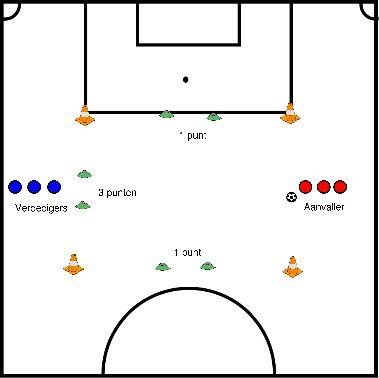
1 v 1 individual defending O16 1 - 4 players 1/4 pitch Game description
The attacker tries to reach a score by dribbling through a gate of pawns.
The defender tries to prevent a score. Because there are multiple goals, this becomes a challenge for him.
The goal of the defender is to send the attacker to the side and to conquer the ball or play the ball outside.
The rules of the game
The attacker tries to reach a score by dribbling through a gate of pawns.
The defender tries to prevent a score. Because there are multiple goals, this becomes a challenge for him.
The goal of the defender is to send the attacker to the side and to conquer the ball or play the ball outside.
The rules of the game
- The attacker starts the game by dribbling into the game.
- Once the attacker is through the gate, the defender may start preventing a score.
- Point count: a score through the side gates earns 1 point and a score straight through earns 3 points,
- If one game lasts longer than 2 minutes, a defender and attacker are added until a goal is scored. Only 1 ball remains in the field. If after 2 minutes - 4 minutes in total - no goal has been scored, another attacker and defender join in and so on until a goal is scored or the ball goes outside or is conquered by the defender.
- Variation: limit the number of ball contacts for the attacker, increase or decrease the size of the field, increase or decrease the size of the goals.
The preparation
Organization-wise you can lay out the field according to the following dimensions. If you want to make it more difficult for the player with the ball, make the field narrower and shorter.
The measurements Length: 15 meters Width: 15 meters, pawns should be 1.5 meters apart.
The measurements Length: 15 meters Width: 15 meters, pawns should be 1.5 meters apart.
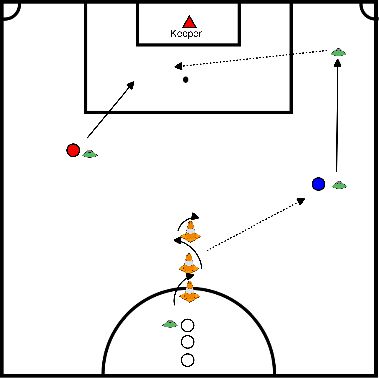
Game description:
The player with ball starts at the back and passes the pawns and passes the ball to the player waiting on the right.
When the player waiting on the right gets the ball, the player on the right in line plays the ball to the incoming player on the left in line.
This player then tries to shoot the ball into the goal behind the goalkeeper.
In this way, there will be repeated passes.
The player who has passed the pawns joins the player who has given the depth pass.
The player who made the deep pass goes to the place to finish. The player who finished correctly goes to get the ball and joins the players at the back who must pass the pawn.
The player with ball starts at the back and passes the pawns and passes the ball to the player waiting on the right.
When the player waiting on the right gets the ball, the player on the right in line plays the ball to the incoming player on the left in line.
This player then tries to shoot the ball into the goal behind the goalkeeper.
In this way, there will be repeated passes.
The player who has passed the pawns joins the player who has given the depth pass.
The player who made the deep pass goes to the place to finish. The player who finished correctly goes to get the ball and joins the players at the back who must pass the pawn.
First left, then right, or both sides at once if enough players.
Encourage left to use left foot, right to use right foot.
Encourage left to use left foot, right to use right foot.
1. Player A turns open to outside behind opponent out.
2. Player A passes forward to player B between cones.
3. Player A runs diagonally to cone in front of goal.
4. At the same time, player B caps/turns out of the cones toward the goal line.
5. Player B passes diagonally behind to player A who meanwhile is standing at the cone.
6. Player A shoots at goal.
7. Player A becomes Player B, Player B joins the starting position.
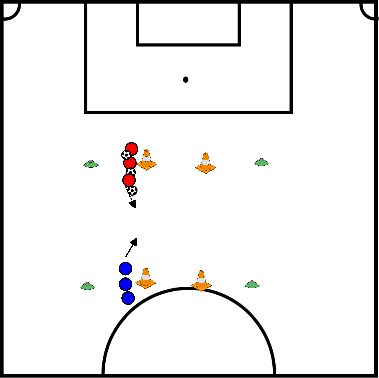
Distances pawns 10 L by 6 B Goals countdowns watch by age.
Hats not needed because 1 on 1.
Hats not needed because 1 on 1.
- Red dribbles into the box and plays the ball to blue.
- Blue tries to score on Red's goal, red takes the ball away and scores on blue's goal.
- On scoring or ball over the line out of box and join at the back on the other side where you were standing.
Coach moments:
Defence: make sure you stay between man and goal. be patient, bend your knees slightly, stand on your front feet.
Attack: keep speed in your game as soon as you are stationary, you are easy to defend, by body movements unbalance your opponent.
Tap the ball next to your opponent and then also accelerate. Then try to have your body between opponent and ball.
Defence: make sure you stay between man and goal. be patient, bend your knees slightly, stand on your front feet.
Attack: keep speed in your game as soon as you are stationary, you are easy to defend, by body movements unbalance your opponent.
Tap the ball next to your opponent and then also accelerate. Then try to have your body between opponent and ball.
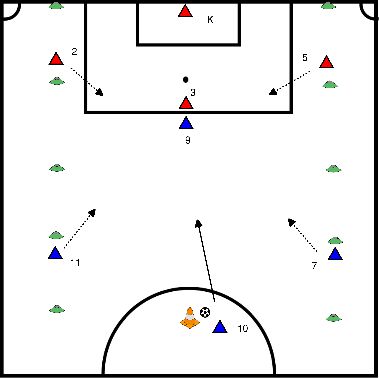
Form of play with attack vs defense according to the formation in double check 8v8
.Attack tries to score in big goal, defense tries to take away ball and play back to starting point.
Size of choice here 30 x 30 m
.Attack tries to score in big goal, defense tries to take away ball and play back to starting point.
Size of choice here 30 x 30 m
- Ball always leaves at 10, who dribbles in; K, 3 and 9 are already in their positions.
- From departure 10, 7 and 11 connect; 10 then plays 7, 9 or 11.
- As soon as the first pass arrives, 2 and 5 join in defense.
Attack ends at goal, ball over back line or when defense gets ball at starting point.
Then pass or switch depending on the number of players available.
Different variations possible, for example:
Then pass or switch depending on the number of players available.
Different variations possible, for example:
- Max 2 ball touches per attacker per attack.
- Max 5 passes to mandatory goal attempt.
- Max 3 passes to mandatory goal attempt.
- At least 2 triangles per attack.
- At least 2 double passes per attack.
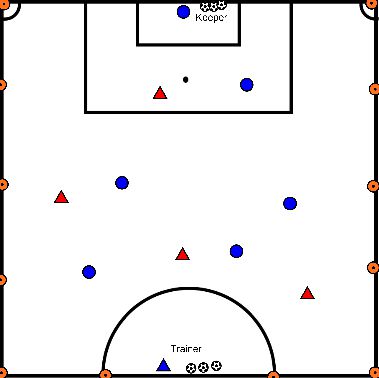
- Both teams are going to try to score on the goal where the goalkeeper is standing.
- For this, the right of attack must first be obtained by engaging in handball with the coach who stands on the other side of the field.
- So there is continuous switching between attacking and defending.
- The players will therefore have to be alert to their teammates and the actions taking place and coach each other here.
- If there is a back ball or the goalkeeper has the ball, the goalkeeper plays in to the side that had to stand last defensively.
- In case of a goal, the game is played on immediately by the coach who then plays in the side, which got the counter-goal.
- Size of field depends on number of players: Minimum width 25m, minimum length 40m. Preferably this game is played in an under/over situation.
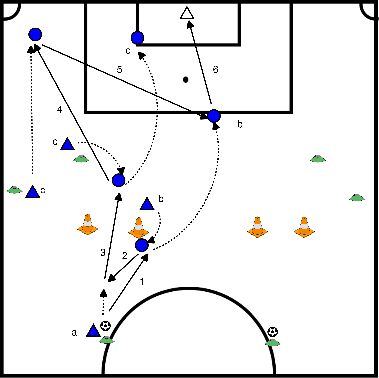
Practice on positional play, passing and finishing L + RStipple line
are the running moves, full lines are the pass lines.
Cones are defenders.
Player b finishes, if cross is too low or too soft, player c can finish.
Timing, clean passing and position are essential.
Passing:
a to b, b to c, c to d, d takes ball from b and joins on the other side.
Right side starts when cross is given to left, and vice versa.
are the running moves, full lines are the pass lines.
Cones are defenders.
Player b finishes, if cross is too low or too soft, player c can finish.
Timing, clean passing and position are essential.
Passing:
a to b, b to c, c to d, d takes ball from b and joins on the other side.
Right side starts when cross is given to left, and vice versa.