




Soccerexercises for technique condition
Last update: january 2026
Execution
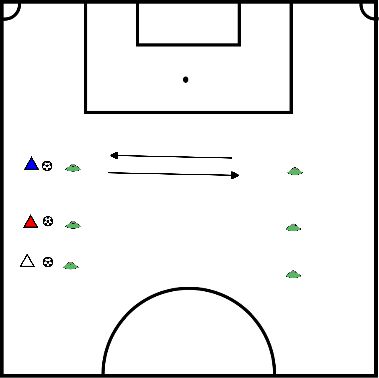
- For each player, place two cones approximately 15 metres apart. This distance can be adjusted as desired.
- The player runs back and forth with the ball around the cone.
- Upon return, the player stops the ball next to the cone.
- Then, the player runs back and forth at a high pace around the cone without the ball.
- The fastest player wins.
- Repeat the desired number of times.
- Try reversing the order: first without the ball and then with the ball.
Warm-up
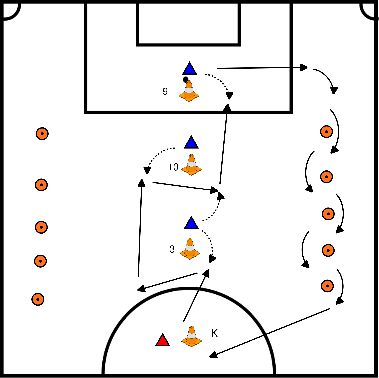
- The goalkeeper plays to the requesting central defender who drops back.
- The central defender passes back to the goalkeeper.
- The goalkeeper controls with the furthest foot and plays to the requesting attacking midfielder.
- The attacking midfielder controls with the furthest foot and passes back to the central defender.
- The central defender plays to the requesting striker who drops back.
- The striker controls with the furthest foot and turns out.
- The striker slaloms through cones back to the starting position.
- The goalkeeper takes the place of the central defender, the central defender takes the place of the attacking midfielder, and the attacking midfielder takes the place of the striker.
- Ball control with the left foot, pass with the right foot - or vice versa.
- Other technical or warm-up exercise along the cones instead of dribbling.
- The exercise can be applied on both sides.
Execution
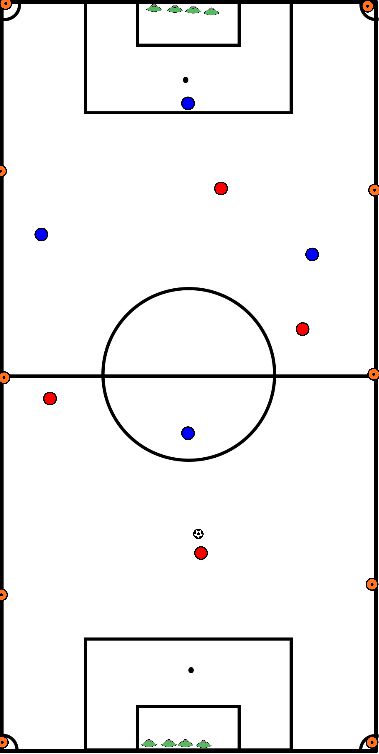
- A variation of the standard match play is executed.
- Behind each goal, there are 4 to 5 cones.
- As soon as team A scores, the scorer takes a cone from behind the goal where the goal was scored.
- The player runs as quickly as possible around the field to their own goal and places the cone there.
- Only after this may the player rejoin the game.
- A natural underload/overload moment arises.
- Players who "cut corners" must turn back, return the won cone, and then return to their own goal from outside the field.
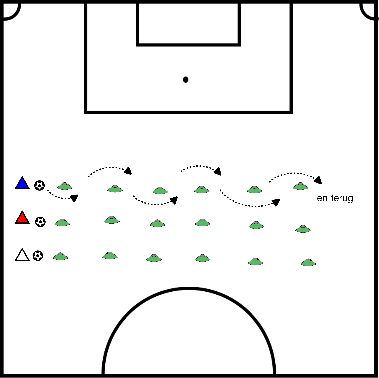
Execution
- Place 7 cones at a distance of approximately 15-20 meters from each other.
- With a small group: one player per series of cones; with a larger group: players one behind the other.
- Slalom at pace through the cones back and forth.
- Stop the ball next to the cone.
- The fastest player wins.
- Slalom at pace through the cones, but without slalom back.
- Stop the ball next to the cone.
- The fastest player wins.
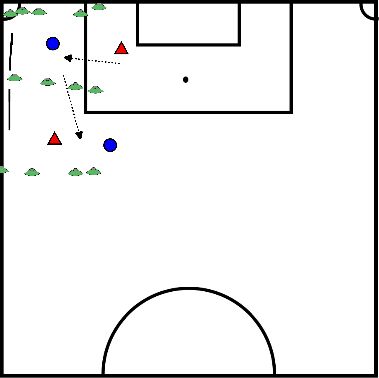
Goal:
Improve switching moment by putting direct pressure on the ball
content:
Improve switching moment by putting direct pressure on the ball
content:
- we start 1 vs 1
- 1 defender against 1 attacker
- the attacker tries to score in the small goalmouth, and immediately switches to the other side and becomes a defender
Coaching:
- Direct switching
- direct pressure on the ball
- no corners in your run
- apply full pressure for 3 seconds
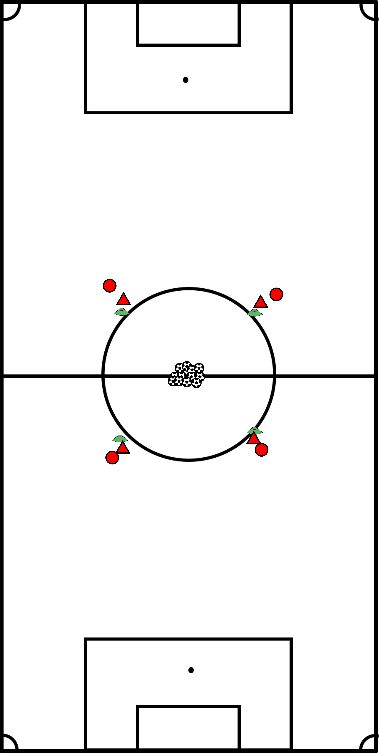
Goal of the exercise:
- Try to get 3 balls to your hat as fast as possible.
- Make 4 pairs.
Exercise:
- Start with 12 balls.
- Each time, 1 player from a pair will participate. The other player will not participate.
- The winner is the one who first has 3 balls at his hat.
- After this round, the second player goes.
- After each round, 1 ball is removed from the game, leaving fewer and fewer balls.
Game rules:
- Do not take more than 1 ball at a time.
- Dribble only.
- Players waiting are not allowed to help or hinder.
- It is not allowed to take balls away while dribbling, so no duels.
- Balls do not have to come from the middle only but may be taken buck away from another player.
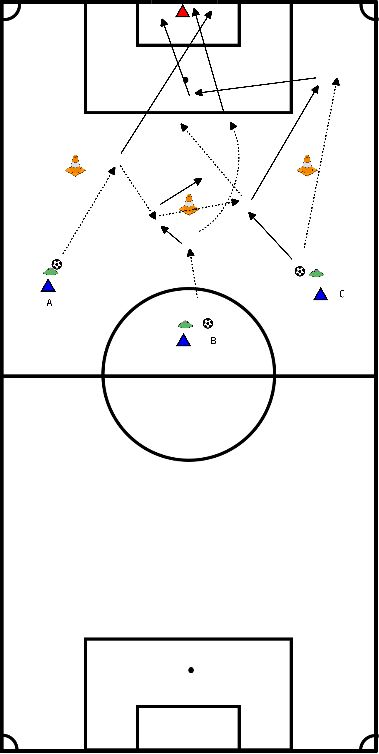
Conditional finishing in different match situations
Finishing form focused on finishing on goal.
The aim is to finish at a high tempo, while also addressing the conditional aspect.
Exercise:
Finishing form focused on finishing on goal.
The aim is to finish at a high tempo, while also addressing the conditional aspect.
Exercise:
- A dribbles to edge of 16 meters.
- A finishes.
- A sprints back to middle pylon and asks ball to B.
- B gives ball to A
- A rebounds to B.
- B works off.
- A sprints to 3rd pylon and asks ball to C.
- C rebounds ball to A.
- A gives deep ball to C.
- C sprints to side.
- C passes ball across the ground.
- A-B switch positions.
- A-B work off.
Coaching:
- Starting on time.
- Play the ball hard to the team-mate.
- Move on immediately.
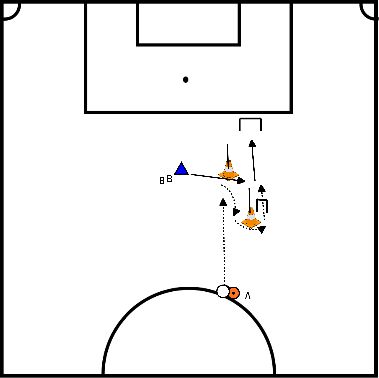
To maintain speed, position B is manned by 2 players.
- Player A sprints toward the first pole.
- Taps this pole, turns around and accelerates to pole 2.
- Turns briefly around pole 2 and jumps over the fence.
- Player B plays a tight ball into the run of player A at the moment of jumping.
- Player A lays one well and finishes in mini goal.
Player A picks up ball and joins B. Player B becomes player A.
Mirroring possible from 12+ players.
Mirroring possible from 12+ players.
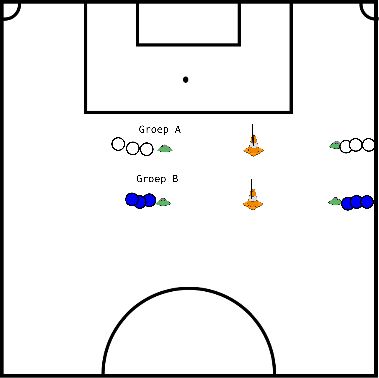
Two equal groups next to or facing each other with a pole after 8 meters.
Different variations with and without ball possible.
You play with group A against group B.
Passing of the box.
Different variations with and without ball possible.
You play with group A against group B.
Passing of the box.
- The left side starts at the same time.
- At high speed to middle pole, face forward, make a circle around the pole and continue walking to opposite side.
- Pass vest to next and they walk back again, circle around pole facing forward.
Variation:
Jacket is replaced for a ball. Rest of the exercise remains the same.
Jacket is replaced for a ball. Rest of the exercise remains the same.
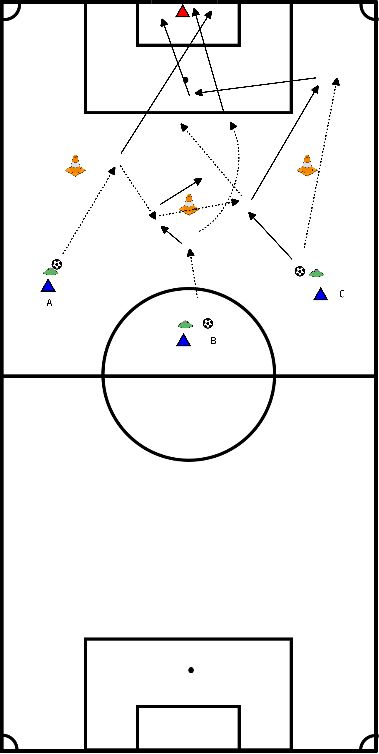
Conditional finishing with different match situations
Finishing form focused on finishing on goal.
The aim is to finish at a high tempo, while also addressing the conditional aspect
Exercise:
Finishing form focused on finishing on goal.
The aim is to finish at a high tempo, while also addressing the conditional aspect
Exercise:
- A dribbles to edge 16
- A finishes
- A sprints back to middle pylon and asks ball to B
- B gives ball to A
- A rebounds to B
- B Finishes
- A sprints to 3rd pylon and asks ball to C
- C rebounds ball to A
- A gives deep ball to C
- C sprints to the side
- C passes ball across the ground
- A-B change positions
- A-B work off
Coaching:
- start on time
- play hard on team-mate
- move on immediately
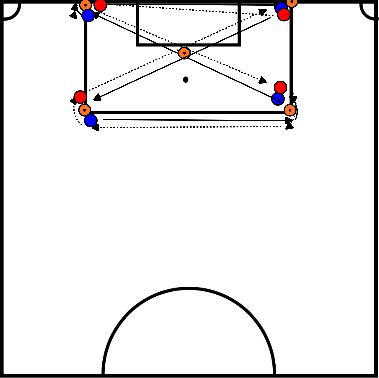
- Large rectangle, penalty box.
- Group split into two teams, no competition.
- Teams start at the same time in opposite corners.
- First gentle run, about 40% of maximum, on the long side.
- Diagonal at slightly faster pace, about 60% of maximum.
- At the pawns in the middle keep to the left.
- When you come back to the long side again in gentle run 40% and the diagonal again 60%.
- Keep this up in time.
- As an alternation you can turn half a turn and use the same diagonal on the short side.
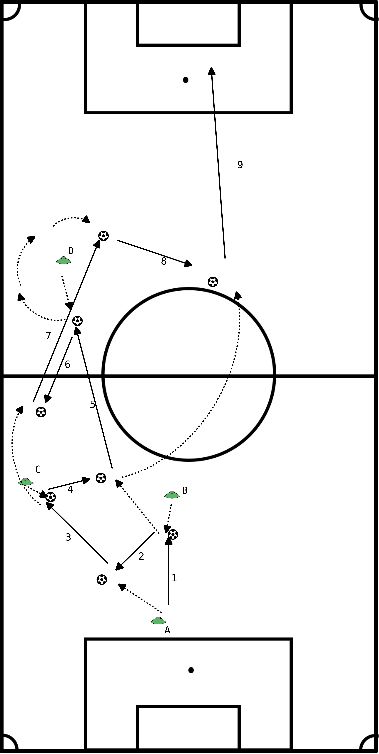
- The exercise starts with player A playing the ball in to the inquiring player B.
- Player B takes the ball and deposits it for the incoming player A, then offers himself to player C.
- Player A passes the ball to the inquiring player C, who in turn plays the ball in to the incoming player B.
- Once he passes the ball, he starts a run outside and goes to offer himself to player D.
- Player B takes the ball and passes it to the inquiring player D.
- Once player B has passed the ball, he starts a running action and offers himself in front of goal.
- Player D receives the ball and passes it back to the incoming player C.
- As soon as the ball is passed back, player D starts a run outside.
- There he receives the deep ball from player C and plays it into the run of the incoming player B.
- Player B finishes on goal.
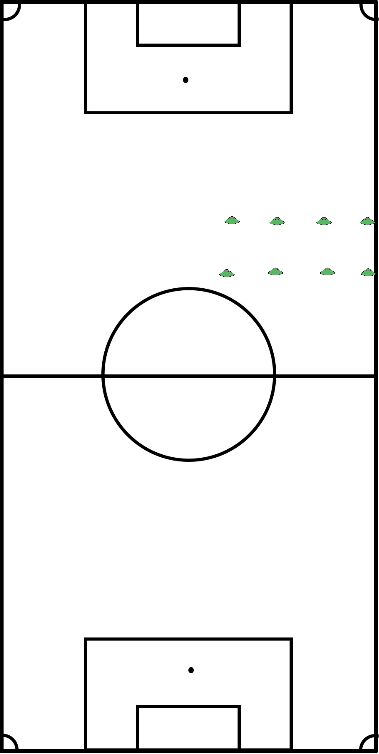
- From hat 1 to 2 jogging.
- From hat 2 to 3 exercises below:
- Tripping forward.
- Tripping sideways.
- Knee lifts forward.
- Knee lifts sideways.
- Heels buttocks forward.
- Heels buttocks sideways.
- Connecting stride.
- Cross stride.
- Hopping.
- Forward slant 3x left 3x right, back away backwards.
- Lunges.
- Frog jumps.
- Sprints 5x back and forth.
- Jogging from hat 4 to 4.
- And back.
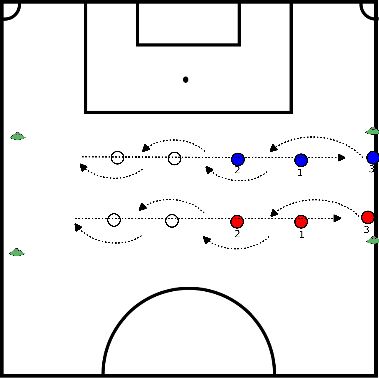
2 Teams compete to see who gets between the hats across the field first.
- 2 teams line up on the side of the field.
- Player 1 stands at one and a half meters with legs apart and facing the queue.
- Player 2 stands in the same position one and a half meters behind player 1.
- Player 3 starts the exercise by slaloming dribbling between the players.
When he has passed the last player, he passes the ball through the spread legs of the other players toward the first in the queue and stands in the same position one and a half meters behind the last player. - When there are no more players in the queue, player 1 starts the slalom and completes it as previously described.
In this way, the team moves forward toward the finish line. Whoever gets there first has won. - By varying the dribble, for example tip-top dribble or reverse dribble, you can make the exercise easier or more difficult.
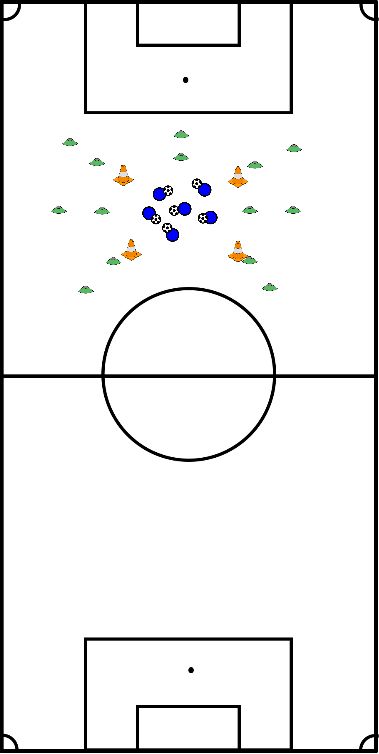
Check distances with the number of players.
- Have players dribble into the box.
- Trainer says 1: put players ball on foot.
- At 2: knee on foot.
- At 3: sit on ball.
- This one minute and then outside dribble through the goals in succession for about 2 minutes.
Game version 1: start in the box with dribbling at the sign of yes as fast as possible through a goal and dribble back into the box and finish with 1,2,3.
Game version 2: who will go through as many goals as possible within 1 minute.
Game version 2: who will go through as many goals as possible within 1 minute.
Warm-up in which the basic actions are applied.
- Goalkeeper plays to asking 3 who sags.
- 3 rebounds to the goalkeeper.
- Goalkeeper controls far foot and then to asking 10.
- 10 controls far foot and rebounds to 3.
- 3 plays to asking 9 who drops out.
- 9 control far foot and turn out.
- 9 slaloms through cones back to starting position.
Goalkeeper takes the place of 3, 3 of 10, 10 of 9.
Exercise can be applied to both sides.
Variations:
Exercise can be applied to both sides.
Variations:
- Ball takeover with left, pass with right - or vice versa.
- Other technical or warm-up exercise along the cones instead of dribbling.
A variation of the standard party game is played. Behind each goal there are 4 to 5 hats.
As soon as team a scores, the player who scores takes a hat from behind the goal in which the goal was scored and runs as fast as possible around the field to his own goal and puts the hat down here. Only after this may the player rejoin the game. There is thus a natural underclass / overtal moment.
Players who "cut off" must turn around and put the won hat back and then out of the field to get back to their own goal.
As soon as team a scores, the player who scores takes a hat from behind the goal in which the goal was scored and runs as fast as possible around the field to his own goal and puts the hat down here. Only after this may the player rejoin the game. There is thus a natural underclass / overtal moment.
Players who "cut off" must turn around and put the won hat back and then out of the field to get back to their own goal.
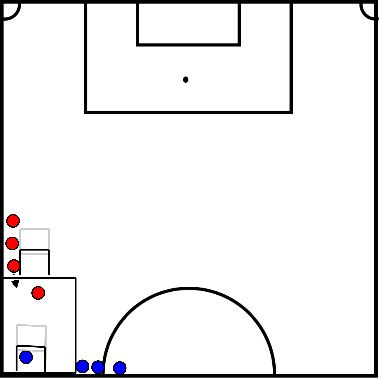
- Depending on the number of players you determine the size of the field and possibly the number of spaces.
- Max is 4 against 4.
- You start 1 against 1 with small or big goals (with goalie).
- Next to the goals are the other players.
- At one goal team red and the other team blue.
- At goal or ball out a player of team A comes in.
- At the next goal, a player from row B.
- So on until your maximum players are deployed.
- Next round starts with team B.
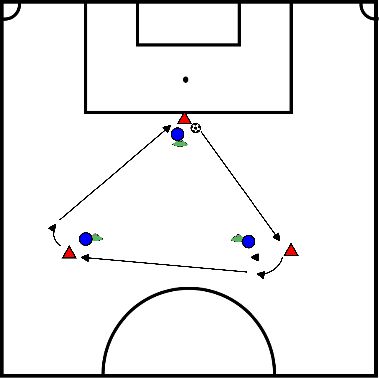
- Put 3 hats as reference points in triangle.
- Players stand in pairs at the potty.
- Pass is given, tight, quite hard, over the ground after the player who is to receive the ball makes himself free of the player in front of him.
- He takes the ball with his furthest foot and passes to the next player (2 times, take and pass).
- After the pass, he makes pace towards the hat he has passed to and takes position in front of the player who is still standing there.
- Goal: tight passing, good one touch ball handling, freeing up the defender
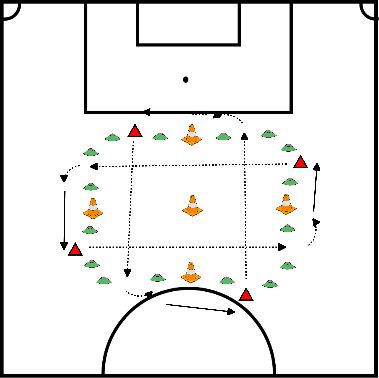
- Players work in groups of 4.
- Each quartet has a captain who says when the group leaves by shouting "go".
- Perform dribble exercises with foot and side indicated.
- First exercises 1, 3 and 5, then 2, 4 and 6
- 1: left quick float (hit a lot of ball)
- 2: right quick float (hit a lot of ball)
- 3: left fast float, in the middle stop and go (hit a lot of ball)
- 4: right fast float, in the middle stop and go (hit a lot of ball)
- 5: drag left, in the middle stop and go and drag right
- Note: at the end of each drill, players perform a drag to the next gate
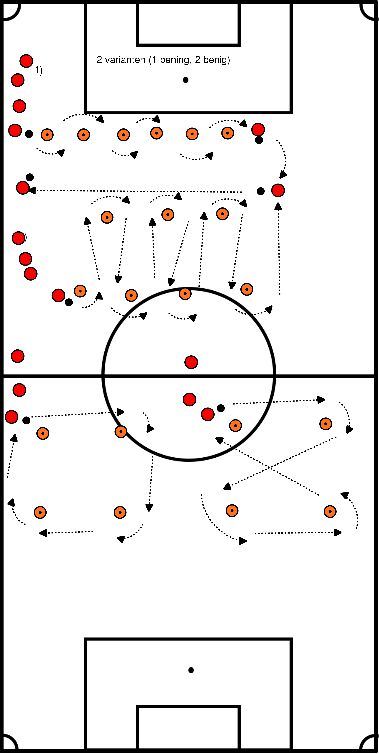
- 3 exercises around pawns.
- Slalom around cones, keep the ball close and take small steps with right foot inside foot and outside around cones
- Slalom around cones two-legged. First go to the left with the inside of right foot and take over the outside of left foot,
- Go to the right with inside left foot, and take over with outside left foot
- Place pawns as in 2nd series:
- Dribble tightly around them; keep the ball close to you, control is most important
- In a square (box)
- Speed is important, keep the ball with you,
- 2 variants as in picture.
- Around the box to the left and to the right, and in a cross.