




Soccerexercises for technique defense
Last update: january 2026
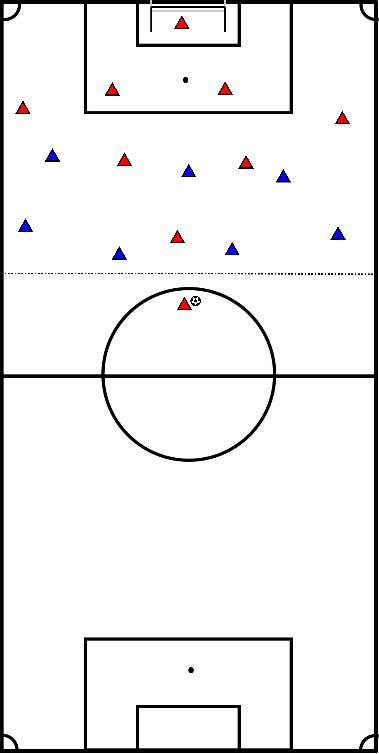
Objective:
- Improve pressure with the team
Field:
- 40x40
Description:
- We play 7 against 7 with 1 big goal
- Orange side is defensive - green side offensive
- We start on 1 side by introduction of ball by trainer
- Ball always goes to the attacking side
- Orange side must ensure that the green side does not score for 1 minute
- If the green side scores in the big goal, they get a point
- Does the orange side defend the goal for 1 minute, they get a point
Coaching:
- Apply pressure together
- Keep sides more open
- Always fix the axes
- Take out depth passes
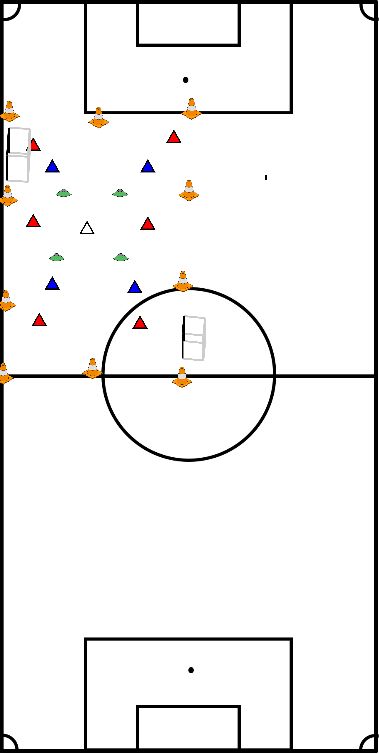
Objective:
- Center (cover dangerous zone) during opponent buildup
Exercise:
- 1 attacking team (red)
- 1 defending team (blue)
- 1 neutral player (white)
- Red is in overtime and play the ball around.
- They try to get the ball to the white player standing in a defined zone.
- Red and blue are not allowed in.
- Blue tries to prevent the stabbing ball through the center from being played.
- When blue conquers the ball they try to score in the goals as quickly as possible.
- Red gets a point if they give ball to the white player, blue gets a point if they can intercept the stabbing ball and also a point if they score.
Coaching:
- Cover the center
- Stay close to each other
- Switch sides
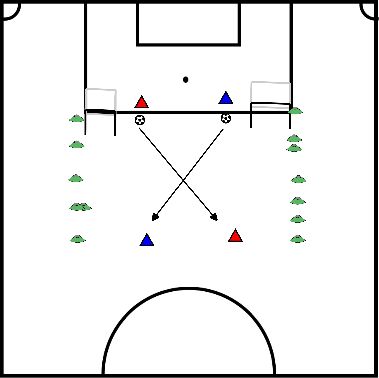
3 x off
With each exercise 1 person added
With each exercise 1 person added
- Player blue (on the back line) plays the ball diagonally to player red opposite him
- Player red (on the back line) plays the ball diagonally to player blue opposite him
- Then the players try to defend by putting high pressure
- Players who received the ball try to score
Situation 2
- As soon as one of the attackers has scored, and the other has not yet, Then they switch immediately, making the situation 1 against 1 | 2 against 2
Coaching:
- Switching moment immediately at ball loss or goal
- Direct pressure on the ball in man more situation
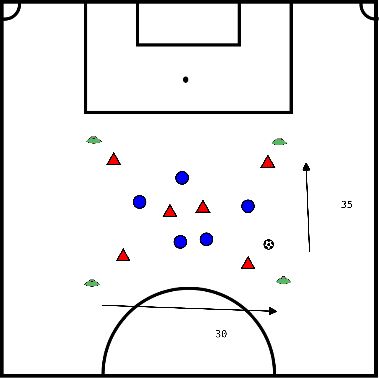
Goal:
Players recognize situation in midfield
Who is there:
(Assistemt) Trainer 1: coach attackers ( play on ball possession)
(Assistemt) Trainer 2: Put pressure in axis field coach
(Assistemt) Trainer 3: Shut down on mistakes, not standing well defensively.
exercise:
Players recognize situation in midfield
Who is there:
(Assistemt) Trainer 1: coach attackers ( play on ball possession)
(Assistemt) Trainer 2: Put pressure in axis field coach
(Assistemt) Trainer 3: Shut down on mistakes, not standing well defensively.
exercise:
- 1 offensive team ( green)
- 1 defensive team (red)
- overtime is played by attacking side.
- Attackers play the ball around
- when defenders conquer the ball they pass it around
- if the defensive team gets the ball to the middle man, the offensive team pressures them
Coaching:
- Letting the ball go to the sides
- Pass the ball to the middle man
- When the middle man does get the ball, pressure immediately
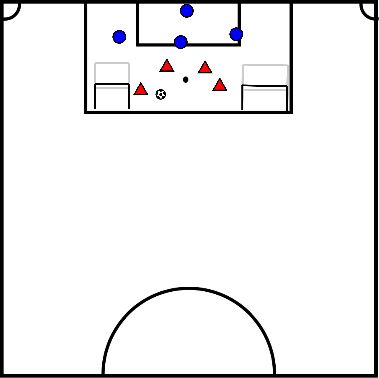
Goal:
Defenders push attackers to the side to get the shot out.
Description:
Defenders push attackers to the side to get the shot out.
Description:
- Goalkeeper plays ball to attackers.
- Attacking side starts between small goals with 4 players.
- Defending side plays with 3 players + goalkeeper.
- Attacking side tries to score as quickly as possible.
- Defenders try to prevent this by taking out the shot.
Coaching:
- Try to push the attacker to the sideline.
- Dare to put pressure forward.
- Switch sides immediately.
- Communication from the goalkeeper.
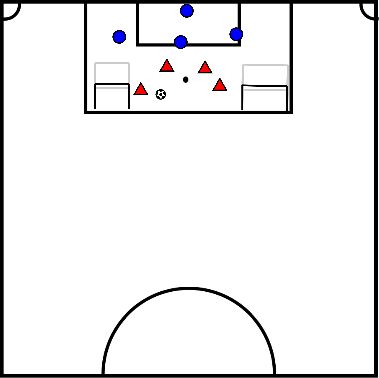
Goal:
Defenders push attackers to the side to get the shot out.
Description:
Defenders push attackers to the side to get the shot out.
Description:
- Ball always starts with attacking side.
- Attacking side starts between small goals with 4 players.
- Defending side plays with 3 players & goalkeeper.
- Attacking side tries to score as quickly as possible.
- Defenders try to prevent this by taking out the shot.
Coaching:
- Try to push the attacker to the sideline.
- Dare to put pressure forward.
- Switch sides immediately.
- Communication from the goalkeeper.
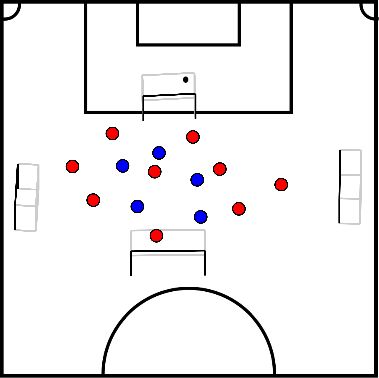
Description:
- Position play, where the overtal must put immediate pressure on ball loss
- Position play, where the overtal must put immediate pressure on ball loss
Game Shape:
- The red team plays the ball around or plays for possession.
- The blue team tries to take the ball away.
- If the blue team has gained possession of the ball, they must try to score as soon as possible in 1 of the 4 goals.
- The red team must prevent this from happening.
- We play 9 x 5.
Dimensions:
- 40x40
- 40x40
Coaching:
- Is it pressured at all when the ball is lost?
- If yes, by whom and by whom not? If no, why not?
- If pressure is applied, how? Aggressively from the idea of capturing the ball immediately or from a shuffling pace?
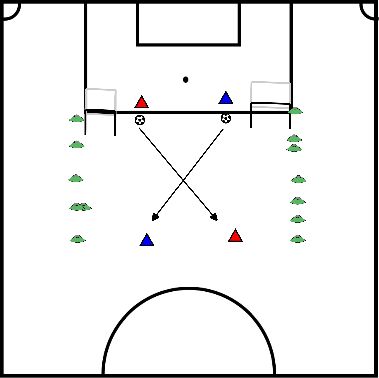
- Player blue on the back line plays the ball diagonally to player red across from him
- Player red on the back line plays the ball diagonally to player blue across from him
- Then the players try to defend by putting high pressure
- Players who received the ball try to score
- Player red on the back line plays the ball diagonally to player blue across from him
- Then the players try to defend by putting high pressure
- Players who received the ball try to score
Situation 2
- As soon as one of the attackers has scored, and the other has not yet scored, then they switch immediately, making the situation 1 against 1 / 2 against 2
Coaching:
- Switching moment immediately at ball loss or goal
- Direct pressure on the ball in man-more situation
Goal:
Defenders try to intercept the ball quickly:
Exercise:
Defenders try to intercept the ball quickly:
Exercise:
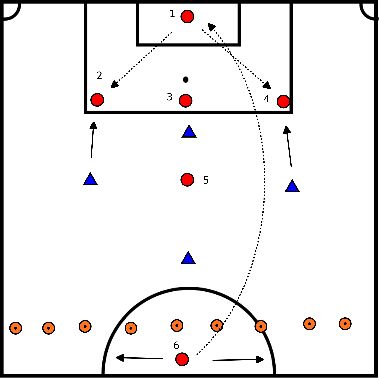
- Play starts at number 6 who kicks to goalkeeper
- Goalkeeper then plays directly to 2 or 4
- At the moment 2 or 4 is played to, the blue team starts pressing and tries to prevent the depth pass
- The red team can "score" by passing a depth pass to number 6, who can move all over the width in his defined zone
- The blue team can score in the big goal
Coaching:
- 2-5 from defending side direct pressure on the ball
- 9 defending directly covers to line the ball
- 4 defending direct pass on number 5 attacking side.
- 6 attackers moving with ball and joining the game
Goal:
Players recognize midfield situation
Exercise:
Players recognize midfield situation
Exercise:
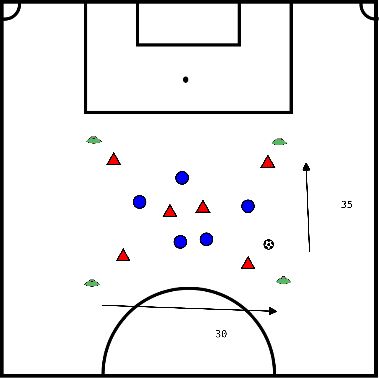
- 1 attacking team blue
- 1 defending team red
- 6 attackers play against 5 defenders
- Attackers play the ball around
- If defenders conquer the ball, they play the ball around
- If the defending team gets the ball to the middle player, the attacking team pressures them
Coaching:
- Letting ball go to the sides
- Ball line shield middle player
- When the middle player does get the ball, pressure immediately
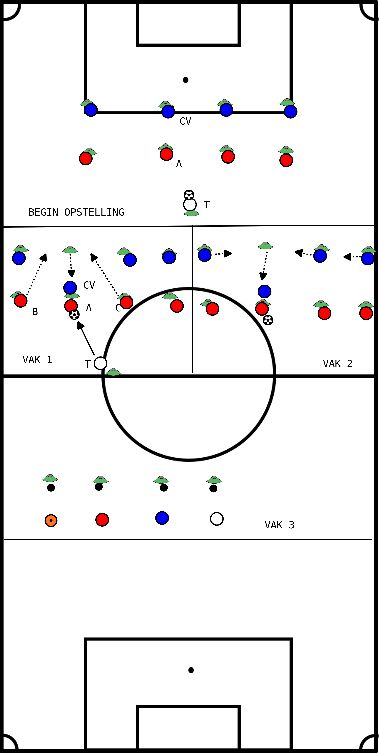
Distances: pawns 2 meters apart.
T= TRAINER.
CV= central defender.
Blue is defense.
Red is offense.
T= TRAINER.
CV= central defender.
Blue is defense.
Red is offense.
Explanation:
Box 1
- Trainer plays ball in to A, the closest man in this case, the CV, step forward to put pressure on player with ball.
- We see a gap created where there is space for the 2 attackers to run in. See the arrows from B&C.
Box 2
- Here we see the solution to cover this running line.
- The moment the defender steps in on the player with the ball, the other players step 1 meter to the middle to close the gap. In this way, no play can be made between them.
- The defender facing the attacker who gets the ball steps forward. The rest must slide inside.
Explanation to players:
- You explain that red are the attackers and blue are the defenders.
- You start in the starting lineup and play attacker A.
- You ask the players; what should the defense do now? Correct answer: opposing defender puts pressure on the man with the ball. Make sure the rest stay put.
- You ask the players; what is created now? Correct answer: space/ running line for the attackers to dive in. Demonstrate this by running one of the attackers into this gap.
- You now ask the players; how can they avoid this? Correct answer: all step in slightly. In this case exactly between the pawns.
Exercise:
- Ball at trainer is always back to beginning lineup.
- Initial exercise is passive, trainer plays to 1 attacker, the defenders take their steps, ball back to trainer.
- Then then play other attacker. Do about 5 minutes until defenders do their job.
- If it goes well quickly, you can make it harder just by increasing the ball pace.
- One step further is to allow the attackers to pass the ball among themselves and not just to the trainer.
- Then switch the attackers and defenders and do the same thing again. Both for about 10 minutes.
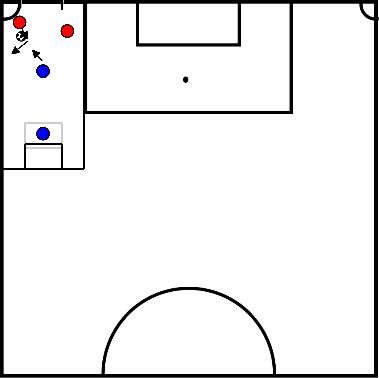
During this first phase of training, players are taught to choose position well while defending.
Players are encouraged to first choose a good position in relation to the attacking pair and to experience how to reduce the opponent's play.
Because of the one-against-two situation, the defender will have to shield the passing line well to the opponent without the ball, and then force the opponent with the ball to the side. Next, it is important that the opponent is forced to run diagonally forwards - in the direction of the sideline - and cannot turn.
The defender then waits for the right moment to intercept.
Coaching:
The defensive player shields the passing line to the opponent without the ball.
Goalkeeper checks off the goal and coaches fellow players.
Defender tries to force the ball-carrying opponent one way and at the right moment (at the side of the field) intercept the ball.
Organization:
Players are encouraged to first choose a good position in relation to the attacking pair and to experience how to reduce the opponent's play.
Because of the one-against-two situation, the defender will have to shield the passing line well to the opponent without the ball, and then force the opponent with the ball to the side. Next, it is important that the opponent is forced to run diagonally forwards - in the direction of the sideline - and cannot turn.
The defender then waits for the right moment to intercept.
Coaching:
The defensive player shields the passing line to the opponent without the ball.
Goalkeeper checks off the goal and coaches fellow players.
Defender tries to force the ball-carrying opponent one way and at the right moment (at the side of the field) intercept the ball.
Organization:
- Field is 20 meters long and 10 meters wide.
- 2 pupil goals.
- 3 caps in 2 different colors.
- Hats in 1 color to mark out the field.
- Sufficient balls at the build-up.
Contents:
- 1+keeper against 2.
- 1:1 against 2.
- Player of the constructing party takes the ball out.
- Defending player screens the goal halfway down the playing field.
- The opponent -attacking team- tries to score.
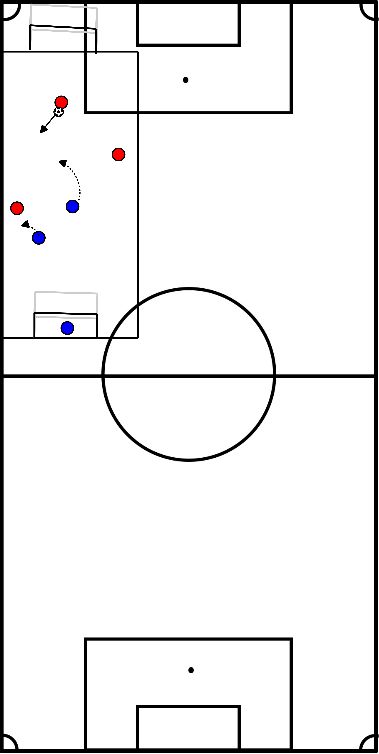
During this second form of practice players are taught to choose their position well while defending.
Players are stimulated to be well organized and to screen the center -the space in front of the goal- in order to force the opponent into one direction. This requires good mutual cooperation, which can sometimes feel unnatural for players because they have an urge for the ball. In this simplified underdog form of soccer, players can experience what happens when they give away too much space and do not cooperate well: the opponent will then be able to score easily.
It is important for the defender who presses for the ball not to give the opponent space to turn, and to force even more to the sideline. The other defender can learn to cover his/her back well.
To execute this exercise properly where the defending team can intercept the ball, the building up opponent is given a lot of space to build up. Only when one opponent dribbles with the ball towards the goal will one of the defenders step in and apply some pressure. Only when the opponent in possession of the ball explicitly looks for the 1v1 situation, one of the defensive players will try to intercept. Until then, they patiently screen the goal, waiting for the opponent to make a mistake .
Organization
Players are stimulated to be well organized and to screen the center -the space in front of the goal- in order to force the opponent into one direction. This requires good mutual cooperation, which can sometimes feel unnatural for players because they have an urge for the ball. In this simplified underdog form of soccer, players can experience what happens when they give away too much space and do not cooperate well: the opponent will then be able to score easily.
It is important for the defender who presses for the ball not to give the opponent space to turn, and to force even more to the sideline. The other defender can learn to cover his/her back well.
To execute this exercise properly where the defending team can intercept the ball, the building up opponent is given a lot of space to build up. Only when one opponent dribbles with the ball towards the goal will one of the defenders step in and apply some pressure. Only when the opponent in possession of the ball explicitly looks for the 1v1 situation, one of the defensive players will try to intercept. Until then, they patiently screen the goal, waiting for the opponent to make a mistake .
Organization
- The field is 30 meters long and 14 meters wide.
- 2 pupil goals.
- 5 caps in 2 different colors.
- Hats in 1 color to mark out the field.
- Sufficient balls for the build-up.
Contents
- 2+keeper against 3.
- 1:2 against 1:2
- Player of the constructing party takes the ball out.
- The defending team screens the goal halfway down the playing field.
- The opponent -attacking team- tries to score.
Coaching
- The two defensive players screen the pass line.
- The goalkeeper checks that they are shielding the goal and pass line properly and coaches fellow players.
- The two defensive players check spacing and pressure ahead.
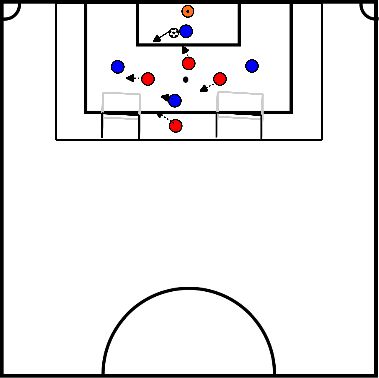
During this drill, players learn to remain patient and screen the goal properly, among other things, to resist resistance. An added difficulty is that there are two goals to be defended, making it extra important that the center is properly shielded. The most logical way is for the defending team to force the opponent to the side and for one side of the field to try to intercept the ball when the opponent tries to get closer to one of the two goals to create a scoring opportunity. This practice form is again more difficult than the first form due to the number of players, but remains manageable. It allows them to learn to cooperate and to maintain a proper distance between them.
Organization
Organization
- The field is 20 meters long and 40 meters wide.
- 2 mini goals and 1 pupil goal or 2 more mini goals.
- 8 caps in 2 different colors.
- Hats in 1 color to mark out the field.
- Sufficient balls for the build-up.
Contents
- 4 against 4+keeper
- 1:2:1 against 1:1:2:1
- Goalkeeper of the constructing party takes the ball out.
- Defending team shields the goal halfway down the playing field.
- The opponent -attacking team- tries to score.
Coaching
- The defending players screen the goal.
- The goalkeeper checks that they are shielding the goal properly and coaches fellow players.
- The defending players check the distance between them and wait for the opponent to come towards their half of the pitch.
- The player closest to the ball forces the dribbling opponent back out or to the side, the others keep the center close and provide back cover.
- The one closest to the ball waits patiently until an intervention leads to ball possession and forces the opponent back.
- The two goals are always shielded, the right moment to intercept the ball is only there if the goals are properly shielded.
- Coach your teammate when they can apply pressure to intercept the ball.
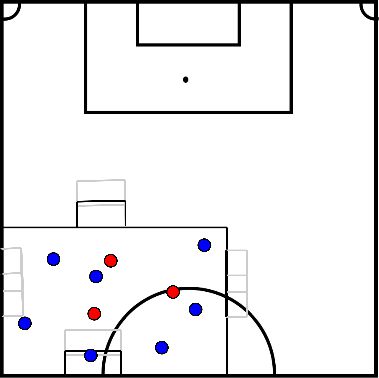
This type of exercise is a positional game in which the team with the excess number must press for the ball immediately after losing it.
The principle of play
What are your players supposed to do when the ball is lost somewhere on the field? If you want your team to put direct pressure on the ball in the transition from possession to loss of the ball, the following form of practice is very suitable to work on this. The playing principle that is central in this form of practice is 'putting pressure on the ball directly'. With 'putting pressure' I mean attacking the ball; actively moving towards the ball -and opponent- in an attempt to conquer it as soon as possible.
What are your players supposed to do when the ball is lost somewhere on the field? If you want your team to put direct pressure on the ball in the transition from possession to loss of the ball, the following form of practice is very suitable to work on this. The playing principle that is central in this form of practice is 'putting pressure on the ball directly'. With 'putting pressure' I mean attacking the ball; actively moving towards the ball -and opponent- in an attempt to conquer it as soon as possible.
The practice form
The red team plays the ball around or plays for possession. The yellow team tries to get rid of the ball.
When the yellow team is in possession of the ball, they must try to score as soon as possible in one of the four goals.
By keeping the size of the field relatively small, it is easy for the yellow team to attempt a goal from all positions on the field.
The red team is thus forced to put pressure on the ball immediately upon loss of possession to prevent a goal/attempt.
The red team plays the ball around or plays for possession. The yellow team tries to get rid of the ball.
When the yellow team is in possession of the ball, they must try to score as soon as possible in one of the four goals.
By keeping the size of the field relatively small, it is easy for the yellow team to attempt a goal from all positions on the field.
The red team is thus forced to put pressure on the ball immediately upon loss of possession to prevent a goal/attempt.
Coaching
What can you pay attention to in this exercise? Since pressure on the ball is central, it is logical to look mainly at this:
What can you pay attention to in this exercise? Since pressure on the ball is central, it is logical to look mainly at this:
- Is it pressured at all at ball loss?
- If yes, by whom and by whom not? If not, why not?
- If pressure is applied, how? Aggressively from the idea of capturing the ball immediately or from a shuffle pace?
Variations
Several variations are possible, some suggestions:
Several variations are possible, some suggestions:
- If you have no goalkeepers, you can also work with small goals only
- Let the under team score by dribbling out of the field (possibly in combination with the goals)
- Award points to the outnumbered team by playing around x number of times
- Award points to the outnumbered team if the ball is recaptured without a goal attempt by the underdog.
- More/less goals
- Count goals from the under number more heavily
Naturally, the form can also be played with other numbers, as long as there is an over- and undercount.
Direct pressure is very effective when it works. If it is not successful and the opponent can play under pressure, it is very likely that large spaces will be created, which is a risk. Correct adjustment of the pressure requires training.
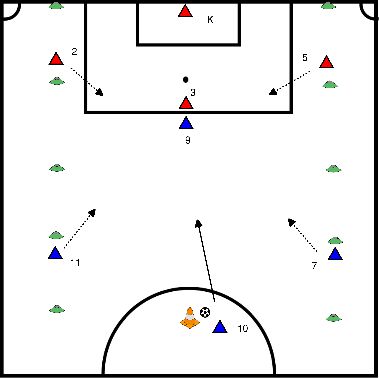
Form of play with attack vs defense according to the formation in double check 8v8
.Attack tries to score in big goal, defense tries to take away ball and play back to starting point.
Size of choice here 30 x 30 m
.Attack tries to score in big goal, defense tries to take away ball and play back to starting point.
Size of choice here 30 x 30 m
- Ball always leaves at 10, who dribbles in; K, 3 and 9 are already in their positions.
- From departure 10, 7 and 11 connect; 10 then plays 7, 9 or 11.
- As soon as the first pass arrives, 2 and 5 join in defense.
Attack ends at goal, ball over back line or when defense gets ball at starting point.
Then pass or switch depending on the number of players available.
Different variations possible, for example:
Then pass or switch depending on the number of players available.
Different variations possible, for example:
- Max 2 ball touches per attacker per attack.
- Max 5 passes to mandatory goal attempt.
- Max 3 passes to mandatory goal attempt.
- At least 2 triangles per attack.
- At least 2 double passes per attack.
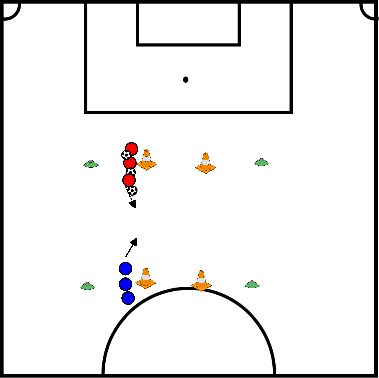
Distances pawns 10 L by 6 B Goals countdowns watch by age.
Hats not needed because 1 on 1.
Hats not needed because 1 on 1.
- Red dribbles into the box and plays the ball to blue.
- Blue tries to score on Red's goal, red takes the ball away and scores on blue's goal.
- On scoring or ball over the line out of box and join at the back on the other side where you were standing.
Coach moments:
Defence: make sure you stay between man and goal. be patient, bend your knees slightly, stand on your front feet.
Attack: keep speed in your game as soon as you are stationary, you are easy to defend, by body movements unbalance your opponent.
Tap the ball next to your opponent and then also accelerate. Then try to have your body between opponent and ball.
Defence: make sure you stay between man and goal. be patient, bend your knees slightly, stand on your front feet.
Attack: keep speed in your game as soon as you are stationary, you are easy to defend, by body movements unbalance your opponent.
Tap the ball next to your opponent and then also accelerate. Then try to have your body between opponent and ball.
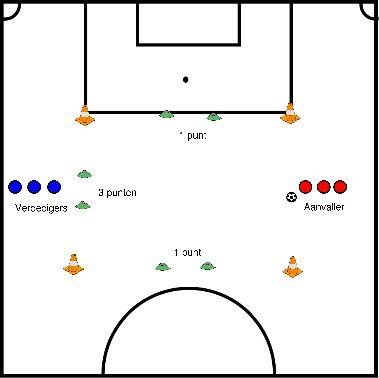
1 v 1 individual defending O16 1 - 4 players 1/4 pitch Game description
The attacker tries to reach a score by dribbling through a gate of pawns.
The defender tries to prevent a score. Because there are multiple goals, this becomes a challenge for him.
The goal of the defender is to send the attacker to the side and to conquer the ball or play the ball outside.
The rules of the game
The attacker tries to reach a score by dribbling through a gate of pawns.
The defender tries to prevent a score. Because there are multiple goals, this becomes a challenge for him.
The goal of the defender is to send the attacker to the side and to conquer the ball or play the ball outside.
The rules of the game
- The attacker starts the game by dribbling into the game.
- Once the attacker is through the gate, the defender may start preventing a score.
- Point count: a score through the side gates earns 1 point and a score straight through earns 3 points,
- If one game lasts longer than 2 minutes, a defender and attacker are added until a goal is scored. Only 1 ball remains in the field. If after 2 minutes - 4 minutes in total - no goal has been scored, another attacker and defender join in and so on until a goal is scored or the ball goes outside or is conquered by the defender.
- Variation: limit the number of ball contacts for the attacker, increase or decrease the size of the field, increase or decrease the size of the goals.
The preparation
Organizationally, you can lay out the field according to the following dimensions. If you want to make it more difficult for the player with the ball, make the field narrower and shorter.
The measurements Length: 15 meters Width: 15 meters, pawns should be 1.5 meters apart.
The measurements Length: 15 meters Width: 15 meters, pawns should be 1.5 meters apart.
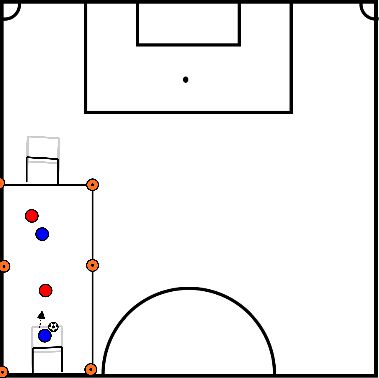
Goal: Improve disrupting and conquering the ball. Keep pressure on the ball and conquer at the right time.
2red players and 2 blue players.
Team red starts with ball, and tries to score. Coaching blue to prevent scoring.
2red players and 2 blue players.
Team red starts with ball, and tries to score. Coaching blue to prevent scoring.
Game rules:
- Both teams can score on a small goal.
- When ball is out, dribble in.
- On a back ball or corner kick, dribble in.
- Apply pressure by preventing the ball from being dribbled or played forward.
Points of attention:
- Do not rush to the opponent, approach cautiously.
- Stay face-to-face with the opponent as much as possible, do not turn your back on him.
- Try to force the opponent to the side.

Create a team red and a team blue.
Team red plays his teammate across the width of the field. Red leaves with the ball and at the moment of taking over the ball blue is allowed to defend.
Goal: to improve the defending of a one on one situation.
Dimensions: length 30/35 meters and width: 10/15 meters.
Team red plays his teammate across the width of the field. Red leaves with the ball and at the moment of taking over the ball blue is allowed to defend.
Goal: to improve the defending of a one on one situation.
Dimensions: length 30/35 meters and width: 10/15 meters.
Rules of play:
- Both teams can score on a big goal.
- At a goal, off-ball or corner kick, switch teams.
- After a while, the teams change positions.
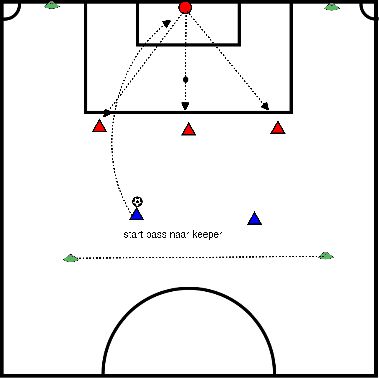
2 attackers against 3 defenders and goalkeeper.
In other group size 3 against 4 or 2 against 1 and so on.
Goal: The goal of the assignment is to have the goalkeeper play the ball into one of the 3 defenders.
In other group size 3 against 4 or 2 against 1 and so on.
Goal: The goal of the assignment is to have the goalkeeper play the ball into one of the 3 defenders.
- The ball starts with the 2 attackers. They play the ball deep to the goalkeeper to have a realistic start.
- The goalkeeper can catch the ball, take it and so on.
- The three defenders must constantly be on the ball.
- The goalkeeper tries to get the ball to one of the three defenders
. - The attackers' task is to block as early as possible to make the build-up by the defenders difficult.
- The task of the defenders is to get the ball over the line by means of play/construction, then again from the start.
When the 2 attackers capture the ball, start again.
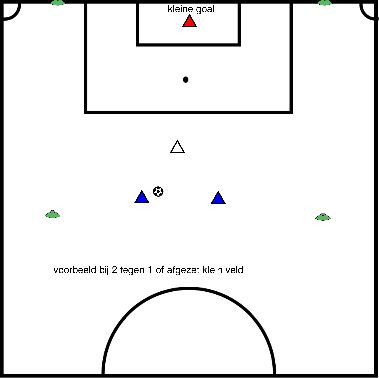
- On small goal 2 against 1 + 1 goalkeeper. At more 3 against 2, 4 against 3 etc.
- Fenced field.
- Goal: Free running, choosing position, scoring after action , not shooting from distance!
After 4 or 5 actions, turn around.
Total of 4 times so that everyone has 1 goalkeeper and 1 defender.
Varia:
Same as above but then 2 against 2 / 3 against 3 / 4 against 4 etc.
Important: Free running and action, do not score from a distance.
Possibly conditions minimum number of times overplaying.
Same as above but then 2 against 2 / 3 against 3 / 4 against 4 etc.
Important: Free running and action, do not score from a distance.
Possibly conditions minimum number of times overplaying.
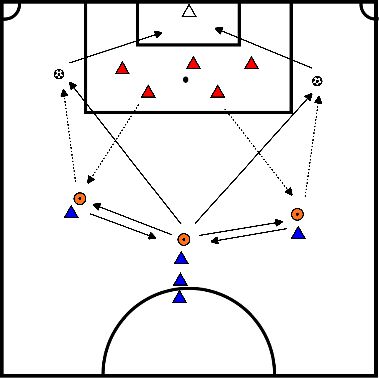
- Players divide into 2 groups
- 1 group will attack and the other will defend
- The attacking group will focus on the long ball and free play in a defended zone.
- The attacker at the central pawn decides to which side the ball will be played, the attackers at the other pawns offer themselves to the ball.
- One of the defenders (red triangle) will pressure the attacker who receives the ball
- The attacker passes the ball back and the central striker plays it deep
- The defender takes his place again
- The deep-lying attacker crosses