




Soccerexercises for seniors
- Start in a stable position on one leg and move around a cone.
- Go into a prone position and quickly stand upright.
- Place the slats between the legs.
- Move the ball to the left or right.
- First, move the leftmost or rightmost leg over the inside of the slats and catch the ball low.
- Repeat step 1.
- Go into a supine position and quickly stand upright.
- Repeat step 3.
- Move the ball to the left or right.
- First, move the right or left leg within the slats to push further and catch the ball.
Players walk across with ball while carrying out commands:
- Quietly run across with ball on foot
- Ball on foot and mill with arms
- Leave ball down and walk across 'raise knees, back heels seat'
- Ball alternately tapping left and right in front of you
- Ball tapping between the legs
- Take ball under sole good foot
- Ball under the sole lesser foot
- Backwards and pulling the ball
- Who can stop the ball fastest on the line (must not be outside and must touch line)
Creation of opportunities
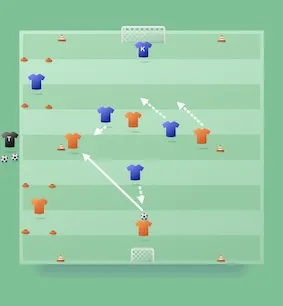
- Length: 40 meters
- Width: 20 meters
- The attackers score on a big goal with goalkeeper, the defenders score on a small goal
- When the ball is in touch, dribble in
- At the back ball/corner kick the attackers may dribble in a new ball from the small goal
- After a while the teams change positions
Creation of opportunities
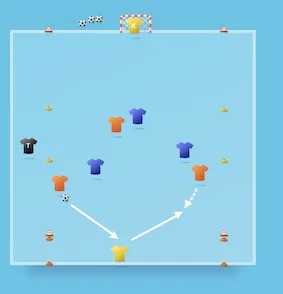
- Length: 40 meters
- Width: 20 meters
- Both teams can score on the big goal with goalkeeper
- The neutral player is the handball player in the yellow box opposite the big goal
- Before a goal may be scored, the team in possession of the ball must first use the neutral player, with this they get 'right of attack'
- At the moment the ball goes into touch, or if the opposing team intercepts the ball, 'right of attack' must again be obtained from the neutral player
- When the ball is in touch, dribble in
- Heels, buttocks
- Lift the knee
- Connecting step 3 times per side
- Cross step right
- Cross pass left
- Step with knees
- Cross-step/arms
- Groin in
- Groin out
- Swing the leg straight up
- Swing the leg in at an angle
- Quick footwork, tripping
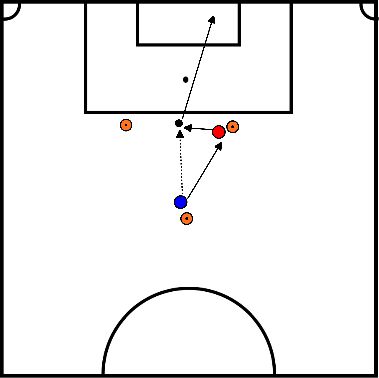
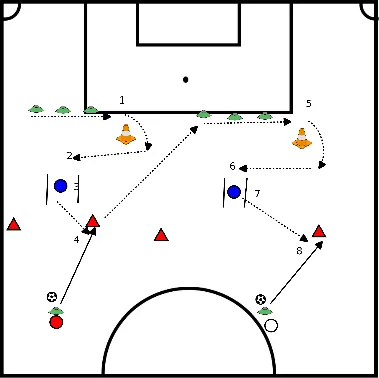
- At the first cone you give a pass to the player on the right, who controls the ball and passes it to the centre.
- If the teammate is on the left, finish with the right foot,
- If the team-mate is on the right, you finish with your left foot.
- Player who was allowed to finish passes on to rebound, player who rebounds passes on to finish.
- 3 bowls
- 1 mini goal
- One ball per player
- Walk straight ahead
- Dribble and extend hip outwards
- Dribble and extend hip inwards
- Straight ahead and, at each pawn, shuffle sideways to the player on the other side and around each other
- Straight ahead and at each pawn shuffle sideways to player on the other side and shoulder shuffle
- Accelerate 2 pawns, and 1 pawn backwards. Then speed up 2 pawns again.
- Walk firmly from one side to the other (75 to 80%)
- Running jumps
- Walk and change direction
- Stability:
- Stand on one leg.
- Pull up the other leg, so that the upper leg is horizontal.
- Lower leg vertically at an angle of about 90 degrees.
- Toes of the raised leg point upward.
- Contra arm to the front.
- After 5 seconds, switch legs (provided that the player is stable).
- Same as before, but with forward and sideways step.
- Same as before, but from a forward movement.
- Various plank exercises in closed and open chain.
- All poses should be held for 15-20 seconds.
- Positional defending needs to be very good
- Forcing opponent to play wide
- Take away ball
- Keep seeing the ball
- Without fouls preventing the scoring of the opponent
- Keeping an overview, seeing more than just direct opponent (covering your back)
- Working together (creating small spaces) to hold up the other party
- Start dribbling immediately
- Act fast, try to pass directly
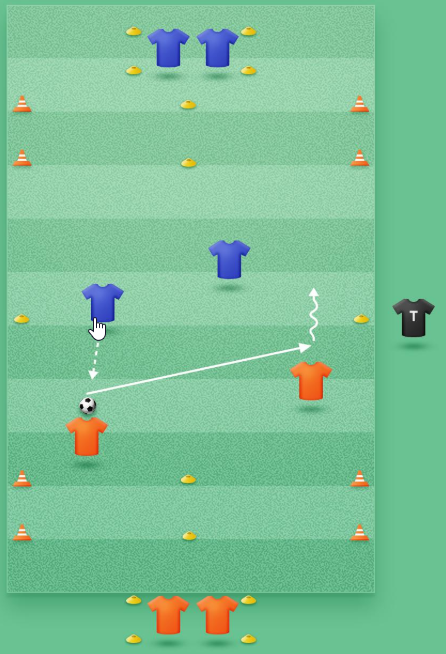
- You can use this exercise if you want to work in positions with a defensive triangle.
- You can apply variations where necessary and also change the distances.
- This exercise has been given several times with youth teams as well as with the first teams.
- As you can see in the picture we work on 2 sides.
- Approximately the space from the 16m to the center line.
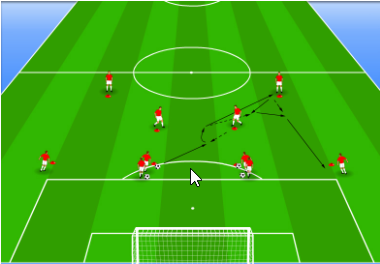
- First player plays the ball diagonally, player B turns with the ball and plays it to C who performs a 1/2 with B. C plays the ball deep on D. It connects to the other group.
- When A is past the zone the other group leaves.
- Passing on A-B-C-D.
- You can also replace player D by a goalkeeper.
- You can do enough variations in this warm-up exercise. An extra 1/2 for player D. Or player B who moves on the pass of C and responds to D. And so on.
- Let the exercise run for about 4 minutes before inserting a variation.
- Always emphasize the forward rotation of B.
- Take care of a short passing and a short acceleration after the pass at the end of the warming up.
Exercise1 RUN STRAIGHT FORWARD
- Jog to the last pylon.
- Make sure your upper body is upright.
- Your hips, knees and feet should form a line.
- Don't let your knees buckle inwards.
- On the way back, run a little faster.
- Do the exercise twice.
Exercise 2 RAISE KNEE AND TURN UPPER LEG OUTWARDS WHILE RUNNING
- Jog to the first pylon.
- Stop and raise your knee forward.
- Turn your knee out and put your foot down.
- Keep your pelvis horizontal and your upper body still.
- The hip, knee and foot of the supporting leg together form a straight line.
- Do not let the knee of the supporting leg bend inwards.
- Jog to the next pylon and repeat the exercise with the other leg.
- When you have finished the course, jog back. Do the exercise twice.
Exercise 3 RAISE KNEE AND TURN UPPER LEG INWARDS WHILE RUNNING
- Jog to the first pylon.
- Stop and raise your knee sideways.
- Turn your knee inwards and put your foot down.
- Keep your pelvis horizontal and your upper body still.
- The hip, knee and foot of the supporting leg together form a straight line.
- Do not let the knee of the supporting leg bend inwards.
- Jog to the next pylon and repeat the exercise with the other leg.
- When you have finished the course, jog back.
- Do the exercise twice.
Exercise 4 RUNNING AROUND A PARTNER
- Jog to the first pylon.
- Shuffle sideways, at an angle of 90 degrees to your partner, shuffle a whole circle around each other (without changing your direction of view).
- and back to the first pylon.
- Bend your hips and knees slightly and move your body weight to the ball of your feet.
- Do not let your knees bend inwards.
- Jog to the next pylon and repeat the exercise.
- When you have finished the course, jog back.
- Do the exercise twice.
Exercise 5 JUMP AND TOUCH SHOULDERS WHEN RUNNING
- Jog to the first pylon.
- Shuffle sideways, at an angle of 90 degrees to your partner.
- Jump in the middle towards each other to make shoulder to shoulder contact.
- Land on both feet with your hips and knees bent.
- Do not let your knees bend inwards.
- Shuffle back to the first pylon.
- Jog to the next cap and repeat the exercise.
- When you are ready with the course, jog back.
- Do the exercise twice.
Exercise 6 RUN ACCELERATING AND SLOWING DOWN
- Run quickly to the second pylon
- and then run backwards to the first pylon;
- keep your hips and knees slightly bent.
- Always run two pylons forward and one back.
- When you're done with the course, jog back.
- Do the exercise twice.
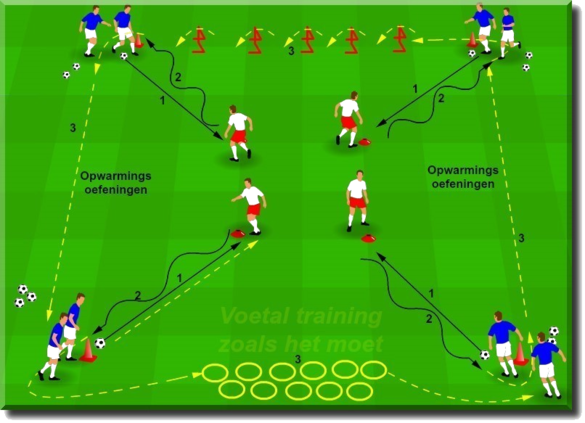
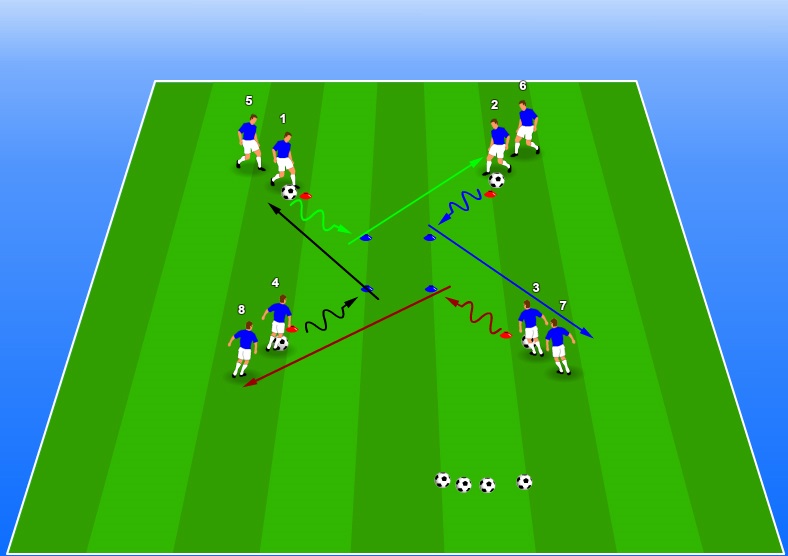
- The 4 groups start at the same time with one ball each
Group 1:
A plays to B and takes the place of B.
B controls the ball and dribbles to C,
when he gets to C, he gives the ball to C,
...who's restarting the exercise.
A runs towards and goes through the hoops,
Join group 2
Group 2.
Group 2: Same as group 1,
to group 3 with warm-up exercises.
Group 3:
Same as group 1,
to group 4 over or through the hedges.
Group 4:
Same as group 1,
to group 1 with warm-up exercises.
Description:
- Bowling: 1 player of each team takes turns kicking a ball from 5m to 10 cones.
- And tries to kick as many cones as possible.
Organization
- 10 cones in pyramid shape
- 5 m further a game from where the players may kick.
Duration:
- 10 min
Coaching:
- Take a good look
- Accurate passing
Note:
- start at 5m
- then 10m
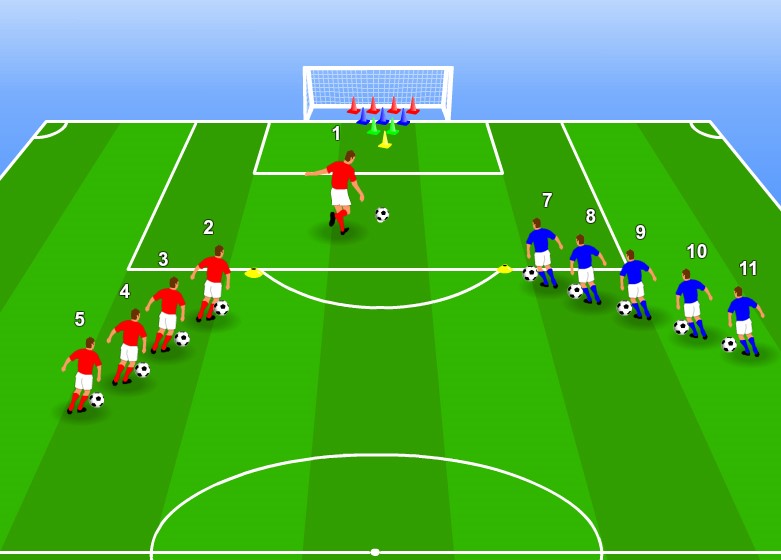
- A field of 20x30 meters
- 2 teams of equal number of players. if odd: with 1 chameleon (is in game with ball possession)
- Players may play a maximum of 3 passes with the ball and must then throw the ball over to a team-mate with their hands.
- in 15 continuous transfers by 1 party they have 1 point
- at 5 points opponent has to perform 10 push-ups
- 4 sessions of 5 min. Just let them play the first session, after the first session talk about the good moments but of course also address the lesser moments, think of coaching, getting into the ball, when throwing long ball. 3rd session with focus on positioning with the feet. before the 4th session, indicate where things are not going well yet.
- You'll see that it's easier with the hands.
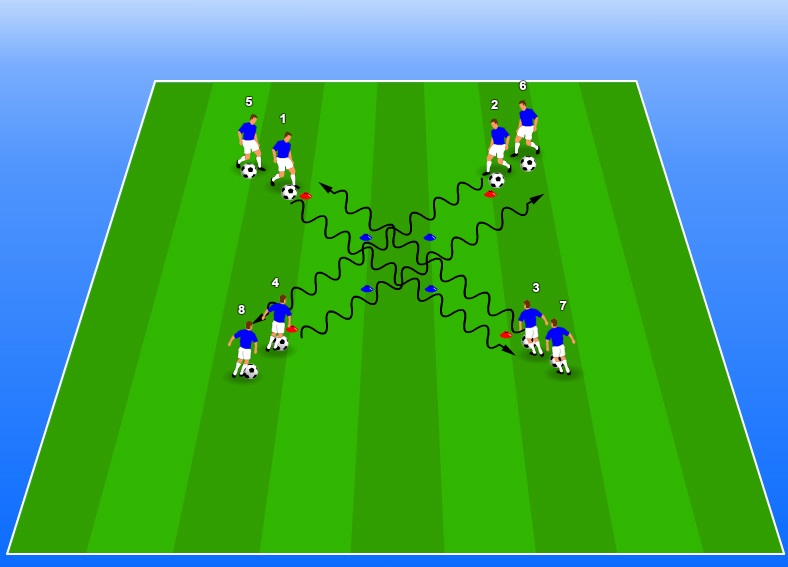
- Box training
- Line up:
- 4 pilons in box shape at 2m distance from each other.
- 4 pilons round at 4m from each other.
- Task 1: Drive the ball to the other side through the middle box without colliding.
Task 2: Drive the ball to the first pilon with the left foot to the right and take it to the next pilon to the right of starting position.
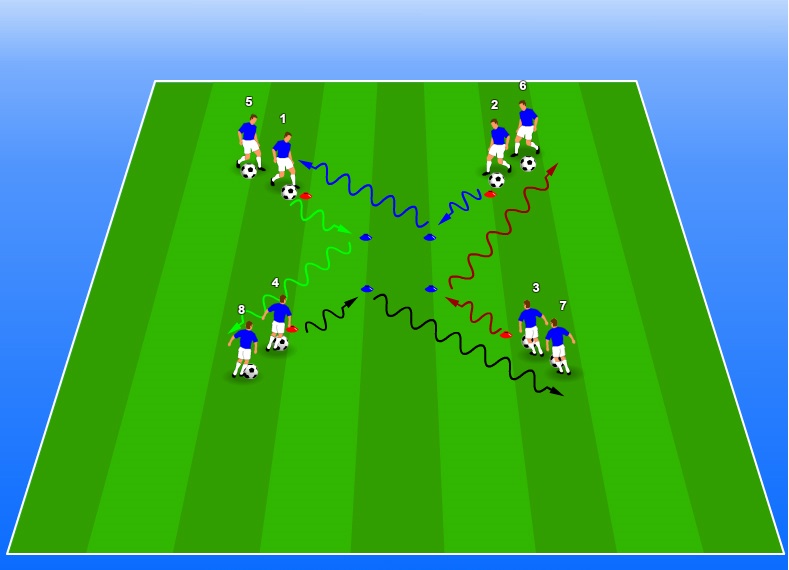
Task 3: Drive the ball to the first pilon with the right foot to the left and take it to the next pilon to the left of starting position.
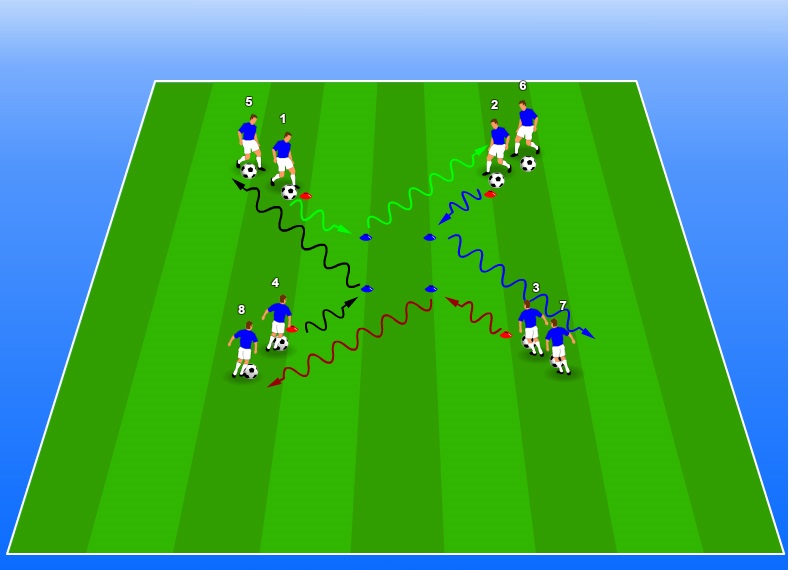
Task 4: Drive the ball to the first pilon with the left foot to the right and pass the ball to the player on the right of starting position (pass with right)

Task 5: Drive the ball to the first pilon with the right foot to the left and pass the ball to the player to the left of starting position. (Pass with left)
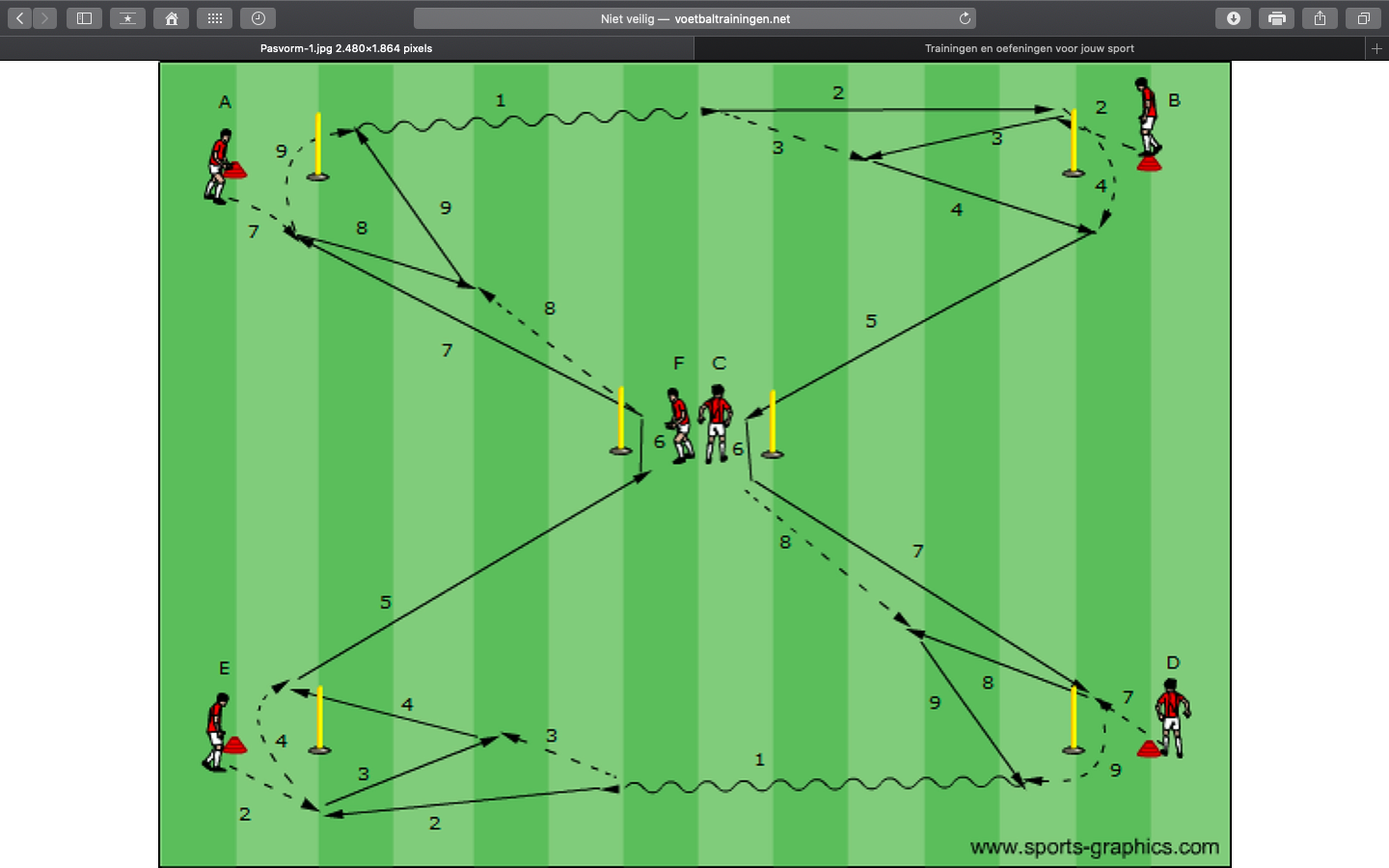
- Players A and D start by leading the ball to players B and E (1),
- The latter make themselves playable next to the stick on which A and D play the ball (2).
- B and E play the ball back (3) on which A and D pass the ball again (4).
- Then B and E play the ball on C and F (5).
- Doing a good control of the ball behind the stick (6)
- After that. they're going to finish on target.
- After finishing, they're going to get the ball and connect in the back.
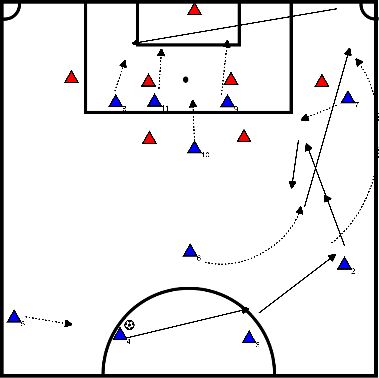
- Defense to attack in a 1-4-4-2.
- Here the running forms of the attack and defence are important.
- Form 2 of the 2 where the focus is on the outfielder 7/8 creates space for the 2/5 .
- Here the 6 of the bb game is used to give the through ball
- The exercise can be done without or with defense.
- It is important that they do not play the ball directly on the 7/8 from the moment they own the ball.
- First move the ball for some time between 3->4 4->5, where 5 gets up high as soon as the ball goes from 2 to 3.
- When 5 receives the ball not directly to the 8 games but first back to the 4.
- From 4 to the 3 and from 3 to the 2.
- Let the defense get through the right running lines at the right time before they play the ball to the 7/8.
- As soon as the ball goes from the 2 to the 7, pay attention to the correct running lines of the 7.
- Creating space for the 2 is done by letting the 7 get into the ball and bouncing the ball to the 6.
- After the bouncing from the 2 to the 7 the 2 have to make a running action in the depth.
- The 7 plays the ball on the 6 that comes under the ball.
- The 6 then plays the ball deep on the 2 with the 9 running to the first post, the 11 diagonally behind the 9 and the 8 around the second post in a line behind the 11 and 9.
- 10 comes on the 16 meter line and the 7 diagonally behind the 2.
- The following exercise contains a lot of speed, agility, coordination, passing and even duelling.
- A speed exercise that can be done at any time of the training.
- Any age group can do this exercise. There are enough variations possible that you can apply yourself.
- With the younger and even the older groups the FUN aspect is also very pleasant.
- You can apply this form of exercise to different distances. It is especially important to look at your age group and what you want to achieve.
- Both players A leave with shoulder to shoulder until they're between the poles.
- (1), They then accelerate around the pilon and go back to the stick
- (2,3). Behind the stick, they go sideways over the hurdles
- (4). Again they go behind the stick and accelerate forward to the stick that's the furthest away.
- (5). Back to the other pole again
- (6) to then get a ball played in from B
- (7) on which A finishes on target
- (8).Player who finishes first wins.
- In the older ages you can have the loser do push-ups or do an extra job.
- At younger ages you add up the points.
- A takes the place of B and B goes to A.
- As a variation, you can have players B throw up the ball so that A has to head the ball inside the goal.
- As you can see, it is all about speed, agility and coordination
- Whoever wins, it's always fun and hard work is done
- Have fun with this speed exercise and let us know what you thought of it
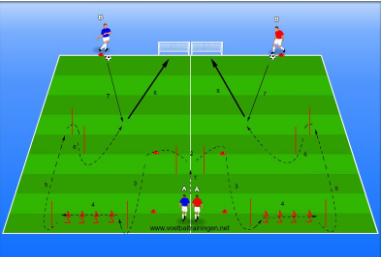
- Players A and D start by leading the ball to players B and E (1),
- The latter make themselves playable next to the stick on which A and D play the ball (2).
- B and E bounced the ball back (3) on which A and D pass the ball again (4).
- Then B and E play the ball on C and F (5).
- Doing a targeted check behind the stick (6) to then play the ball in on A and D
- Which make themselves playable (7),
- C and F ask for the ball back on which A and D play (8) and
- C and F bounced the ball again while A and D walked behind the stick (9).
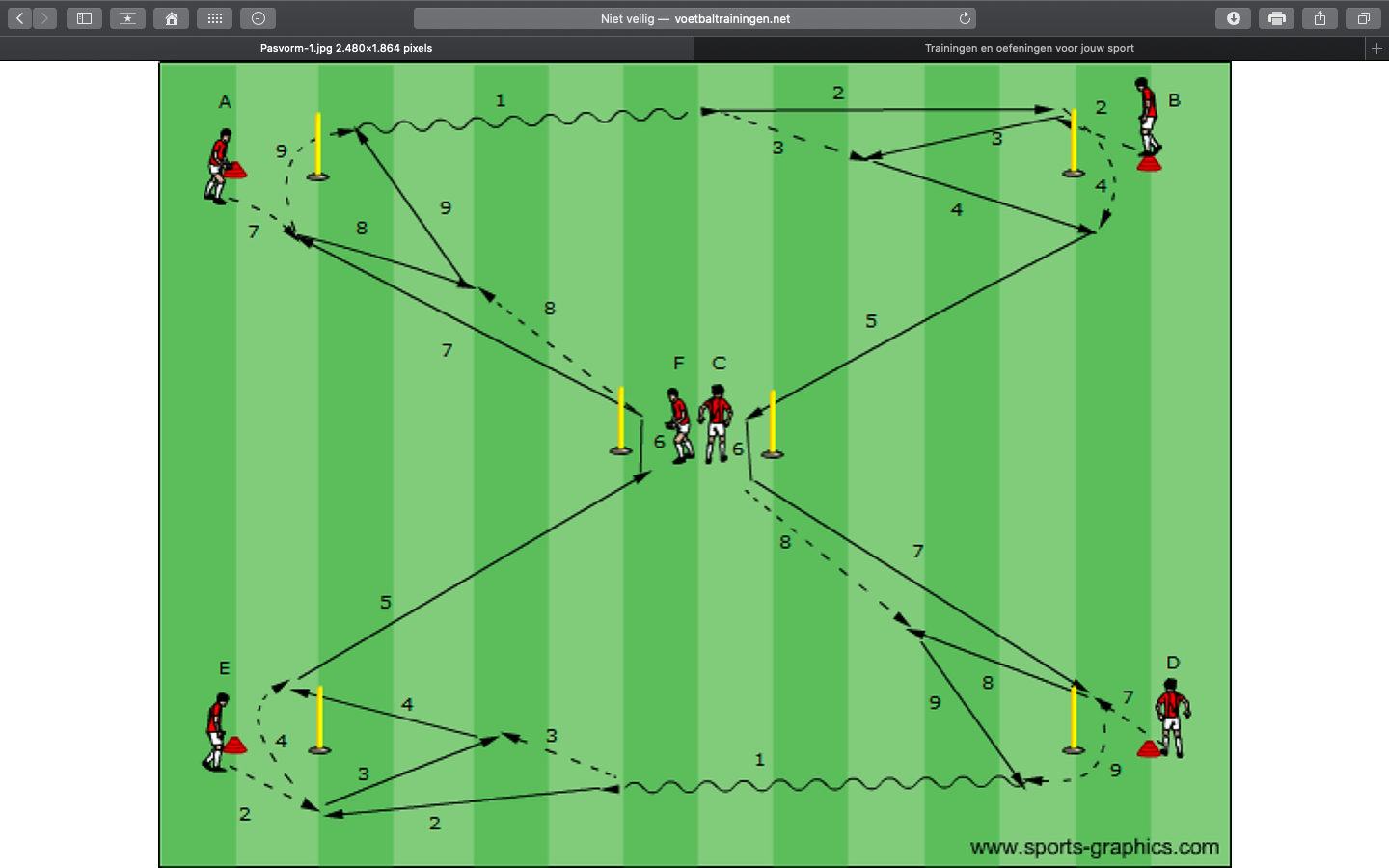
- The second shape has slightly more pace than the first fit.
- A and D again lead the ball (1) and play in to B and E which make themselves playable (2),
- B and E now play in to C and F (3) on which the latter play a handball while B and E walk behind the stick (4).
- B and E then play the ball in the course of the next player A and D (5) etc...
- The action is fast but timing of A and D when catching up is important.
- Move again A-B-C-D-E-F-A.
- Here again 2 players per place minimum.