




Soccerexercises for technique shoot
Last update: january 2026
Objective
- Collect as many cards as possible by scoring and perform the corresponding fitness exercises.
- Participants shoot at the goal. Upon scoring a goal, they may take a card.
- Each card has a colour that corresponds to a fitness exercise:
- Hearts: Push-ups
- Spades: Squats
- Clubs: Burpees
- Diamonds: Lunges
- The number on the card determines how many times the exercise must be performed. For example, Hearts 4 means 4 push-ups.
- After completing the exercise, they may continue shooting.
- The group with the most cards wins the game.
Objective
- Collect as many cards as possible by scoring and perform the corresponding fitness exercises.
Execution
- For each score, a player may take a card.
- Each card has a suit: clubs, spades, hearts, or diamonds.
- Each suit represents a specific fitness exercise:
- Hearts: Push-ups
- Spades: Squats
- Clubs: Burpees
- Diamonds: Lunges
- Perform the exercise the number of times indicated by the card. For example, Hearts 4 means 4 push-ups.
- After completing the exercise, the player may continue shooting.
- The group with the most collected cards wins.
Objective
- Improve the execution of various set pieces.
Execution
- Corner Kick Left/Right: Practise taking corner kicks from both the left and right sides of the pitch.
- Free Kick in Field: Work on free kicks within the field of play, focusing on precision and power.
- Free Kick near the Penalty Area: Practise free kicks near the penalty area, paying attention to technique and effectiveness.
- Throw-in: Improve the technique and tactics when throwing the ball in.
Description
- Bowling: Each player from each team takes turns kicking a ball from 5 metres towards 10 pins. Try to knock over as many pins as possible.
- 10 pins arranged in a pyramid shape. A spot 5 metres away from where the players may kick.
- 10 minutes
- Look carefully. Pass with control.
- Start at 5 metres, then move to 10 metres.
Content
- Defender number 1 delivers a long pass to attacker number 2.
- The attacker controls the ball and goes directly towards the goal to score.
- Defender number 1 engages in the one-on-one duel.
- If intercepted, the defender finishes on the small goals.
- If the goalkeeper stops the ball, the same applies.
- Defender number 1 may play with his goalkeeper.
- Defenders start with a ball.
- Attackers start without a ball.
- Switch roles and join after each turn.
- Distances can be increased or decreased.
- The attacker must accelerate towards the goal.
- The defender must control the pace.
- Switch immediately upon losing the ball.
- Encourage players to engage in duels.
- Upon ball recovery, immediately coach whether to play with the goalkeeper or go directly to one of the goals.
Introduction
- This activity involves speed, agility, coordination, passing, and duels.
- Suitable for all age groups with possible variations.
- The FUN aspect is enjoyable for both young and old.
Execution
- Players A start shoulder to shoulder and sprint to the cones.
- Accelerate around the marker and move backwards to the pole.
- Move sideways over the hurdles and then back behind the pole.
- Accelerate forward to the furthest pole and then backwards to the other pole.
- Player B plays a ball to A who finishes on goal.
- The player who finishes first wins.
Variations
- For older age groups, the loser may receive an extra task.
- For younger age groups, points are accumulated.
- Players switch positions after each round.
- Player B can throw the ball so A must head it towards the goal.
- Divide group into pairs.
- When playing ball take it in the air. Play high ball directly or head ball back between e.g. the back line and 16 meters.
- When playing ball take it in the air. Play high ball directly or head ball back between e.g. the back line and 16 meters.
- Player 1 with ball runs backwards and player 2 without ball forwards.
- Player 1 throws the ball in the air to player 2. He takes it and plays it back while running forward at a constant speed.
- Alternating left and right leg
- Taking the ball well to the side when attacking.
Variations:
- Play the ball back directly out of the air with the inside foot into the hands of the person running backwards.
- Ball through the air and back to the person running backwards.
Shooting game where they get to take a card when they have scored. Each playing card shows a "color," clubs, spades, hearts or diamonds. Each color represents a fitness exercise.
Hearts: Push-ups, Spades: Squat, Clubs: Burpee, Diamonds: Lunges.
Once they have picked a card, they must first perform the corresponding exercise, they do this the number the card indicates. For example, Hearts 4 = 4 push-ups. Then they may continue shooting again. Group with the most cards, has won.
Shooting game where they get to take a card when they have scored. Each playing card shows a "color," clubs, spades, hearts or diamonds. Each color represents a fitness exercise.
Hearts: Push-ups, Spades: Squat, Clubs: Burpee, Diamonds: Lunges.
Once they have picked a card, they must first perform the corresponding exercise, they do this the number the card indicates. For example, Hearts 4 = 4 push-ups. Then they may continue shooting again. Group with the most cards, has won.
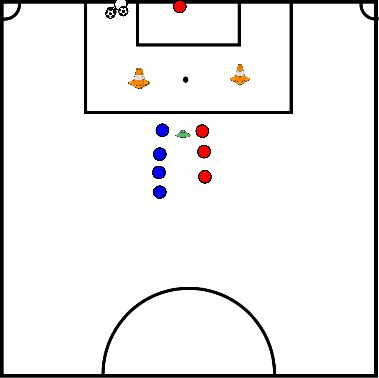
- All balls are next to the goal with the trainer.
- The trainer plays the balls to the players.
- The goal is to score. The player who scores stays in the game, while the player who misses or the goalie who stops the ball is out of the game.
- The team with 1 or more players remaining last wins.
- The player who has been goalkeeping makes sure the balls are returned to the coach until players are finished. After that, those players take over.
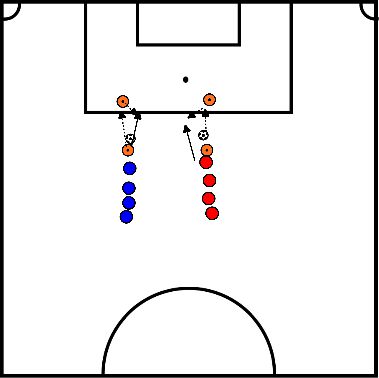
In groups A through D, players must shoot the ball in front of the 16-yard line. Beyond is off. For groups E through J, the line is halfway between the 5-meter area and the 16-meter line.
- One group starts with goalkeeping, in this case red.
- The trainer plays the ball in and the player from blue runs in and shoots directly at the goal. Don't assume first, then you're off.
- If he hits, he goes goalie and rejoins his group. If he misses, he goes to goal and then collects balls.
- When a player has shot at goal, hit or miss, the next ball from the opponent goes to goalkeeper.
Improving the shooting on goal and the handling of the ball by the goalkeeper, so that the striker does not get a rebound.
- Play the striker, bring him under and finish.
- If the ball comes back via the crossbar, post or goalkeeper, the striker may finish the rebound suddenly from the 16m-area.
- The ball may not leave the square until it has been shot on goal.
- The ball may not lie still anywhere.
- The player who shot at goal becomes the striker, the striker retrieves the ball and closes in behind.
Organization
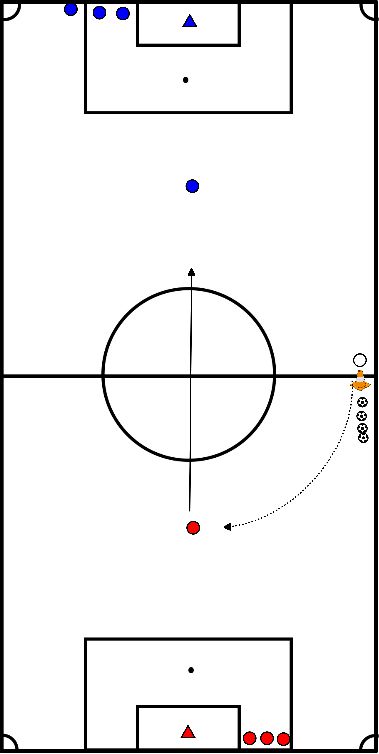
- Four players red + goalkeeper at a goal
- Four players blue + goalkeeper at a goal
- Trainer stands at the side of the field (with the balls)
Situation 1
- Trainer plays the ball to player 1 of team red
- Player 1 of team red and player 1 of team blue fight a 1 vs. 1 duel
Situation 2
- In this situation red has scored, that means that a blue player comes in.
- If blue steals the ball and scores, then a red player is added.
- In this case you create a 2 on 1 situation
Situation 3
- Blue managed to score in the previous situation, which means that a red player joins...
- You thereby create a 2 vs. 2 situation
Points of attention and rules
- Watch the numbers, 4 against 1 is no fun. Keep it challenging and keep the numbers at +1 at the most
- When the ball goes out, it starts with the trainer. The ball then goes to the person who is entitled to it.
- Next to it a player comes in (for a quick run through)
- Decide, as trainer, of which color a player must be added: logically this would be the team with the ball (but let it depend on the numbers).
- Continue to play until a 4 vs 4 situation has arisen.
Coach accents
- Passing to the front
- Depth in the game (think deep, run deep and play deep)
- Speed up your attack
- Make the field big (width and depth)
- Play a man off more by letting the defender choose
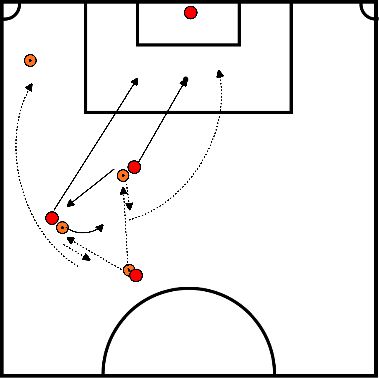
- In this practice form, two variants are completed.
- The team standing on the left plays against the team standing on the right.
- Always swap sides so players practice on both sides and with both legs.
- The deepest player is played in and drops the ball to the third man who finishes.
- The deepest player then gets directly into the ball and rebounds, after which the ball is played to the flank.
- The flank player can take the ball inside once to enter half space and must hit the low cross.
- Addition in the form is a defender of the opposing team may defend along with the low cross (2vs1).
SCORING SCORING (1) - YouTube
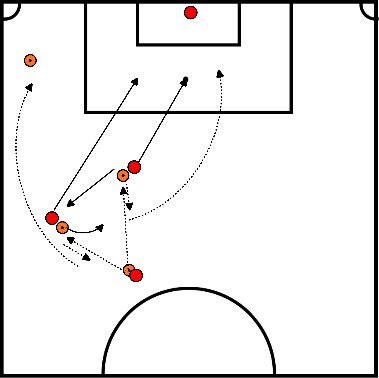
In this training form there are two variants
- The team on the left plays against the team on the right.
- Always swap sides so that players practice on both sides and with both legs.
- The deepest player is played in and drops the ball to the 3rd man who finishes
- The deepest player then gets directly into the ball and rebounds, after which the ball is played to the flank
- The winger can take the ball inside once to enter half space and must hit the low cross
Addition in the form is a defender of the opposing team may also defend the low cross (2vs1).
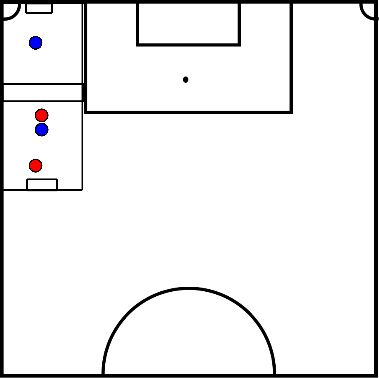
- In this game 2vs1 is played in two squares
- The two squares are split by a strip in which an attacker and a defender start
- The attacker must be played into this lane by his/her team-mate who dribbles into it
- The defender tries to prevent this
- The attacker who is played into the lane can rebound or turn on the ball
- The defender in the box is only allowed to defend in the box and in the front part of the pitch
- The defender in the second box may only defend there
- In this way, getting free in a small space, shielding the ball, rebounding under pressure, opening up under pressure and playing out a 2vs1 situation are trained
- When the defenders take the ball away, the 2vs1 situation changes into a 2vs2 situation and everyone can come into all the squares
- The defenders can then make a point by scoring in the opponent's goal
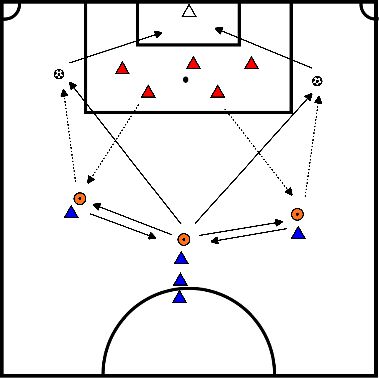
- Players divide into 2 groups
- 1 group will attack and the other will defend
- The attacking group will focus on the long ball and free play in a defended zone.
- The attacker at the central pawn decides to which side the ball will be played, the attackers at the other pawns offer themselves to the ball.
- One of the defenders (red triangle) will pressure the attacker who receives the ball
- The attacker passes the ball back and the central striker plays it deep
- The defender takes his place again
- The deep-lying attacker crosses
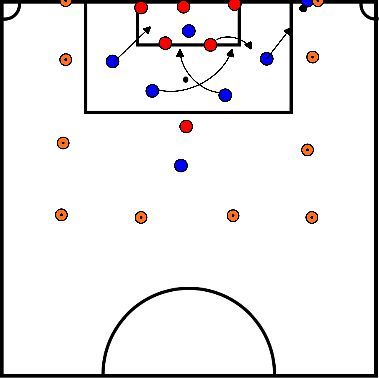
- Exercise corner kick 15 minutes.
- Coach on where to stand and what running lines are expected of them.
- Only run when the ball is played.
- No fixed instruction, do not walk on top of each other.
- If possible, shoot straight away.
- When not scoring, create more overtime with attackers.
- The goal is to score when there are an even number of opponents.
- Let the attackers change positions often.

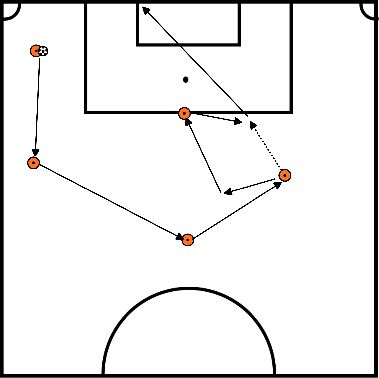
- Player 1 rebounds on player 2.
- Player 2 sprints around the pawn and then runs towards the goal to receive the cross.
- Player 1 drives towards the pawn and rebounds to player 3.
- Player 3 runs to the back line after the handball with player 1 passing deep.
- Player 3 crosses and player 1 finishes.
- ATTENTION:
- Dribble and tap the ball every 1 or 2 steps.
- Control the ball.
- The deep pass must be powerful.
- Player 1 must keep good contact for the cross and sprint in time for the goal.
- Remark:
- 2 goalkeepers constantly alternate, every 5 balls.
- Finishing exercise.
- Reaching the goal through clean passing.
- Sequence:
- Pass.
- Turn up + pass.
- Turn up + pass.
- Handball.
- Pass.
- Finish.
- Logical turn-around, deflecting striker picks up the ball from the player who shot.
- The player who shoots immediately rejoins as a central handball player in the dot.
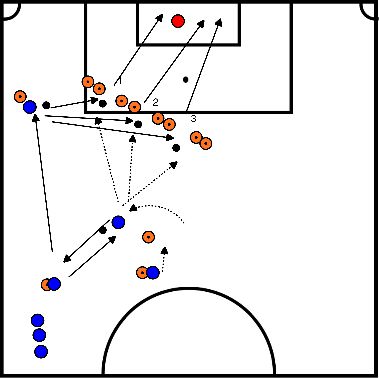
- Place pylons as shown in the picture.
- Players on pylon 1, pylon 2 and pylon 3.
- Player 2 runs round the pylon, calls and offers. (practise running free from man).
- Player pylon 1 plays in and player pylon 2 rebounds.
- Player pylon 2 walks up to pos 1 2 or 3 to choose place to finish.
- Player pylon 1 passes to player pylon 3.
- Player pylon 3 sends a tailored cross to the chosen place of player pylon 2.
- Player pylon 2 takes over or finishes directly on the chosen spot.
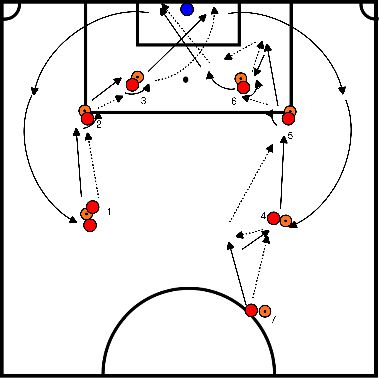
- Finish during the opening turn and/or after the handball 15 - 20 minutes.
- Variant 1 with opening twist.
- Player 1 passes to player 2.
- Player 1 walks to the pawn of player 2.
- Player 2 turns open and passes to player 3.
- Player 2 walks to the pawn of player 3.
- Player 3 turns open and shoots directly at goal.
- Player 3 retrieves the ball and passes to player 4.
- Variant 2 with handball.
- Player 4 plays into player 5.
- Player 4 runs to the pawn of player 5.
- Player 5 turns open and plays into player 6.
- Player 5 runs to and shows where he wants the ball.
- Player 6 looks where player 5 wants the ball and bounces it there.
- Player 5 rebounds the ball on the 11 meter and then quickly runs back to the pawn near player 6.
- Player 6 starts running when the ball is played and shoots the ball on goal.
- Retrieve the ball quickly and join player 1 at the back.
- With 9 - 10 players this exercise is so good.
- If you have 12 or more players, use the following variation.
- These three points are then a replacement of point 1.
- Player 7 passes the ball to player 1(or 6).
- Player 1(0f 6) rebounds the ball diagonally and walks to the pawn of player 2(or 5).
- Player 7 runs into the ball and plays the ball to player 2(or 5).
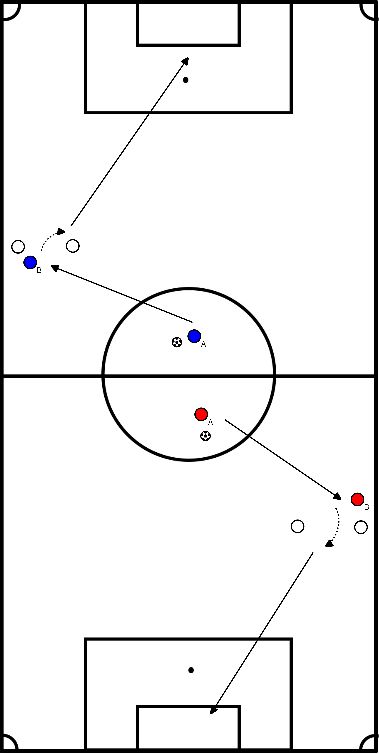
- Duel: form 2 groups against each other with finishing.
- First on the right then on the left.
- Defender A plays on flank B.
- B controls the ball between the pilons.
- Places the ball ready to finish.
- Turned inside.
- Finish on small yellow target.
- Do the same on the other side.
- When a point is scored, turn the pilon upside down
- Whoever scores 5 point first (centrally) wins.
- Move over:
- A becomes B
- Possibly with goalkeeper.
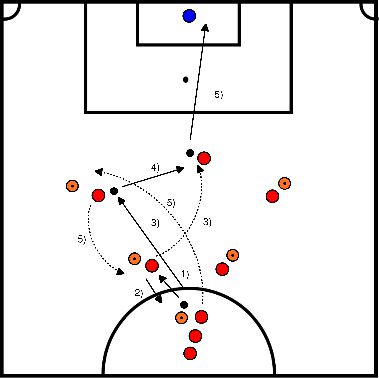
- 4 pilons as on picture
- Each pilon 1 player
- Rest of players at 1st pilon
- Player 1 plays first left player 2
- Player 2 bounces back on player 1
- Player 1 gives a deep pass on the same left side to player 3
- Meanwhile, player 2 walks to the 16 meter line
- Player 3 moves wide, player 2 moves round
- Player 1 to player 3 position
- Player 3 to player 2 position
- Player 2 (who has completed) takes ball and joins row of player 1 (start)
- Then on the right side the same
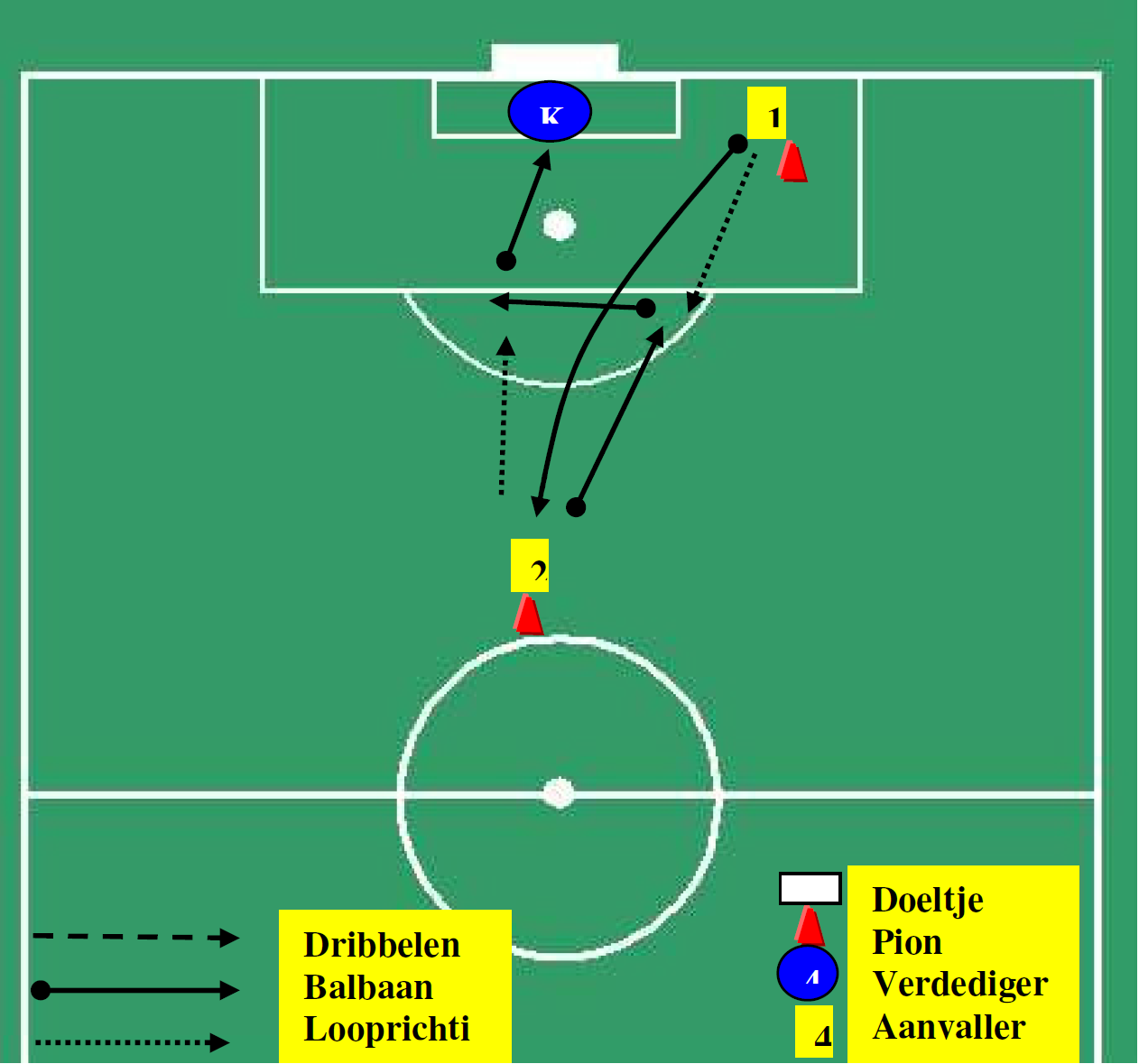
Description
- No. 1 gives a long pass on no. 2
- No. 1 presents itself for the 1 - 2
- No. 2 enters the ball and passes the ball on no. 1
- He's playing him on the inside
- Player number 1 passes the ball with his right leg at number 2
- Player #1 controls the ball or shoots directly at the goal
- When working from the other side than using the left leg
Structure of the exercise form
- Pairs of two with one ball
- Players at number 1 have ball possession
- After having worked change tasks and connect behind
- Increasing/reducing distances
Coaching
- Play the ball tight
- Play the ball on the inside so you have to play with the right.
- The ball will then come to the finisher
- Make sure players don't stand still for too long