


Soccerexercises for u16
Distance 15 meters:
- Heels, buttocks
- Lift the knee
- Connecting step 3 times per side
- Cross step right
- Cross pass left
- Step with knees
- Cross-step/arms
- Groin in
- Groin out
- Swing the leg straight up
- Swing the leg in at an angle
- Quick footwork, tripping
- One ball per triplet
- Start with a distance of about 15 meters
- Two players on one side and one player on the other side.
- One of the players on the side with two plays the ball to the player on the other side, this player takes the ball and plays it to the player on the other side, and so on.
- Practice both with your good and lesser leg.
- After a few minutes increase the distance, about 20, 25, 30 meters, at the 30 meters practice a lobster kick.
1) You have an agreement with one of the players that he, together with you, will place the wall. He/She is the player on the outside of the wall. This player stands on the side of the short corner.
- Distance 16 to 18 metres: 6 defenders (this free kick is not so dangerous. Over the wall is almost impossible because the distance is too short, so there is a good chance that the defender will try to shoot into the long corner. Concentrate on the long corner)
- Distance 19 - 22 metres: 5 defenders (this is the most dangerous free kick, as it can go both into the short and long corners)
- Distance 22 - 28 metres: 3 defenders
- Distance more than 28 metres: no wall

Organization:
There is 3:3 played. Without goalkeepers.
On the goal of 7 meters may only be scored from the 16 meters area.
The other party can score on the 2 goals, from any position.
If the ball goes out at the sides, it is restarted with a kick.
After a goal or if the ball passes the backline, the game is restarted on the back line of the offensive team (triangles).
There will also be 2 new defenders and 3 new attackers in the field.
Points of attention:
Fierce defending before they are in the 16 meter area.
Make the field small when defending.
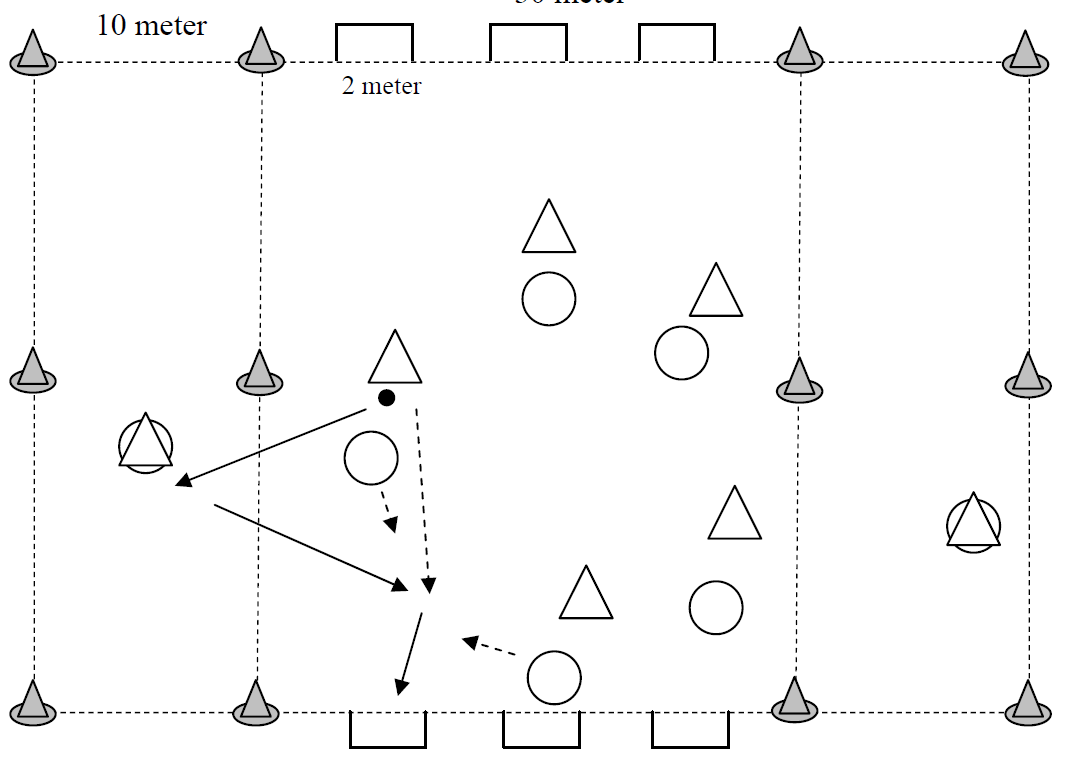
Organization:
There will be 5:5 or 4:4 with extra players on the sides, the wingers. These 2 players are with the ball owning team.
The wing players may dribble with the ball first.
After a few minutes they have to play immediately.
The players on the sides are not allowed to score.
After 10 minutes or a little less the offside players change.
Remarks:
Players sometimes find it better to keep their own man, than to prevent a goal by stepping in or covering an opponent standing closer to the goal. Let them do it wrong a few times first. Use these situations later to give them directions.
Points of attention:
Do they know how their fellow players stand when they have to defend?
Don't let anyone release his marked man.
Stand between the opponent and the goals.
Have them positioned so that they can see the opponent and the ball.
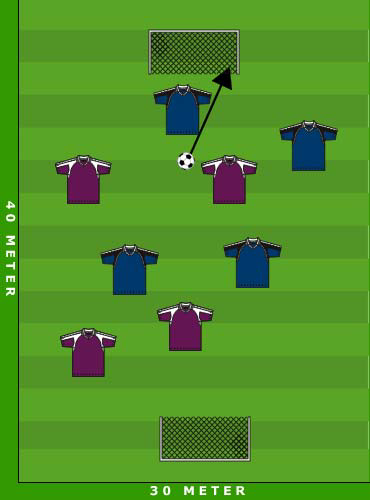
Field setup:
2 big goals
Gameplay:
This can be in 4 against 4 or 3 against 3 setup. Both teams play with a small ball and have to overpass given the size of the field. Because of the small field and the small ball, they are forced to take the ball well and pass cleanly.
Game rules/tips:
- Scoring can be done in 2 ways: if the ball is kicked over the line, 1 point is deducted from the score and if the ball is scored in the goal, 1 point is added to the score.
- If the ball is scored or kicked over the line, the ball must be given to the other team.
- It is not allowed to score from one's own half.
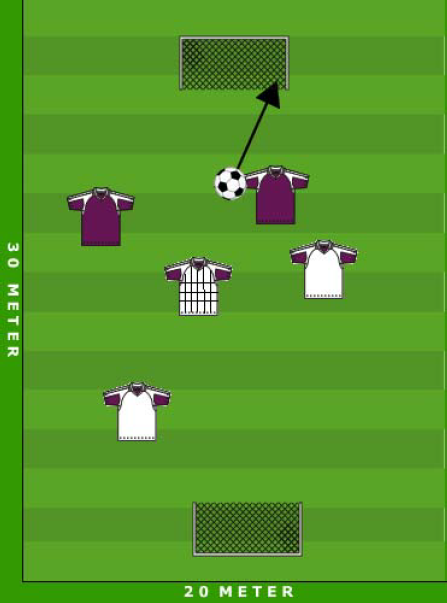
Field setup:
2 big goals
Gameplay:
2 players purple play against 3 players white. White plays with a chameleon. This means that when an attack is set up by the purple team, the chameleon plays with to the purple team. When an attack is set up by the white team, the chameleon belongs to the white team.
Rules/tips:
- If a goal is scored, the ball must be given to the other team.
- You may not score from your own half.
- If the ball has crossed the line, it must be thrown in.
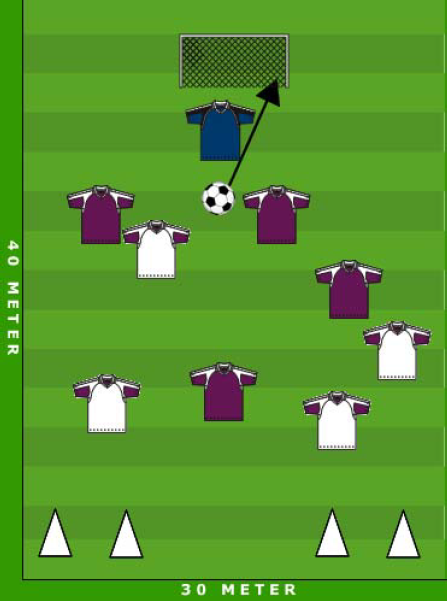
Field setup:
1 large goal and 2 small pylon goals along each line and 1 ball.
Course of play:
4 players purple play a game against 4 players white.
Laws/tips:
- If a goal is scored, the ball must be given to the other team.
- You may not score from your own half.
- If the ball is over the line it must be thrown in.
- The attackers must score on the big goal and the defenders on the 2 small pylon goals.
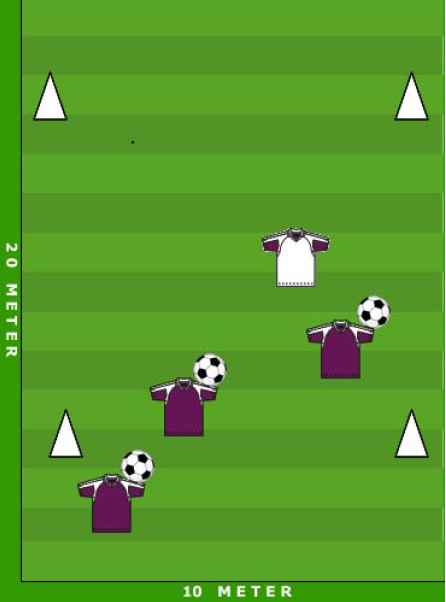
Field setup:
Put out a field with 4 pawns at 20 by 10 meters.
Course of play:
Players must come from one side of the field with a ball on the other side. In the middle is the ball collector. This player should try to take the ball from the running players.
Rules of the game:
- Watch carefully where and when you can run over with the ball.
- The collector must try to chase the players to the side.
- If the collector touches the ball from another player, the player who has touched the ball must be in the middle.
- If the ball goes over the sideline of a player then the player is also off and becomes the collector.
- You may not walk back over the imaginary backline.
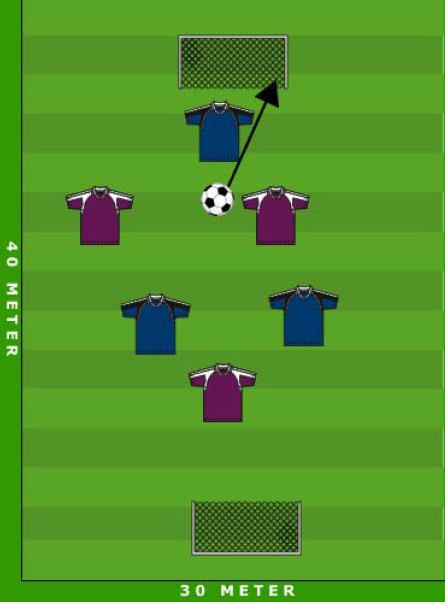
Field setup:
2 goals along each line and 1 ball.
Course of play:
3 players in blue play a game against 3 players in purple.
Game rules/tips:
- If a goals is scored, the ball must be given to the other team.
- You may not score from your own half.
- If the ball is over the line it must be thrown in.
- It is important to make triangles on the field to be able to pass the ball well to each other without the opponent being able to get in between.
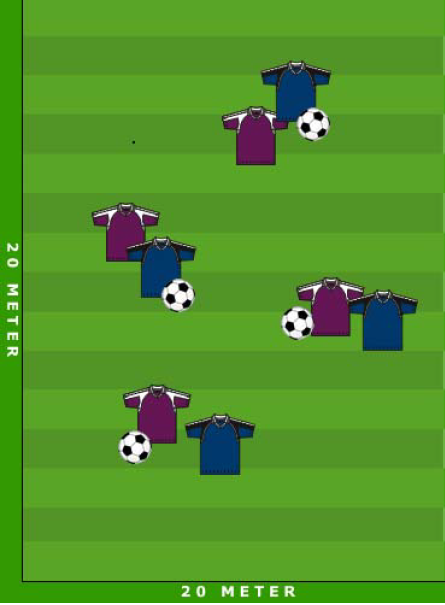
Field setup:
Put out a field with 4 pylons at 20 by 20 meters.
Course of play:
Every 2 players get one ball. The purple player must try to shield the ball in front of the blue player. The blue player must try to get the ball without making a foul.
Rules of the game:
- If a player takes the ball, then this player may shield the ball and the other player must take the ball back.
- On the whistle signal of the trainer you have to switch players.
- You may not switch to another player that you have already played against once.
- When shielding the ball, use your body well.
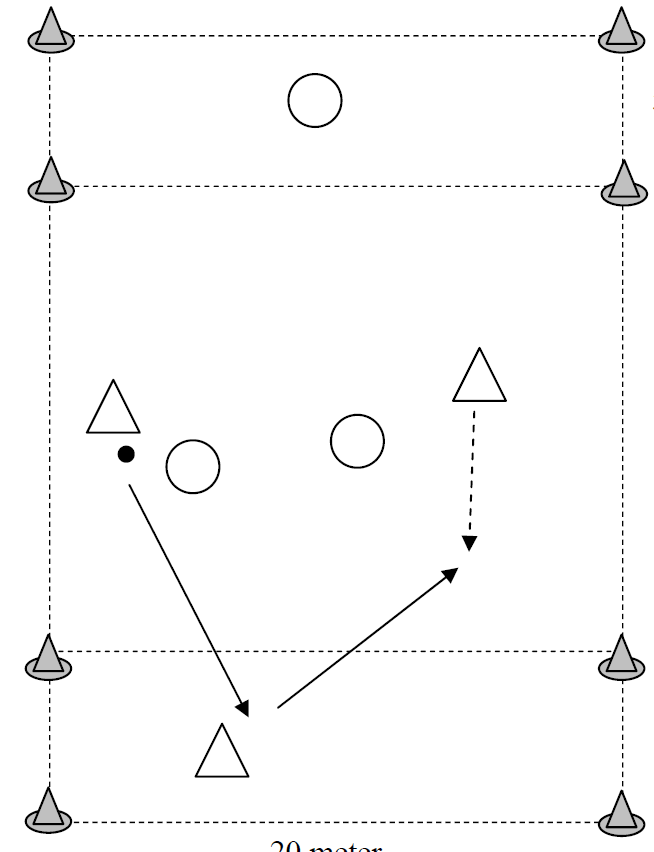
Organization:
2:2 will be played on 2 fields. The players in the so called striker squares at the top and bottom serve as goals.
They can score by playing their fellow player in the striker area, he must get the ball under control in this area. After a goal, the other party may start.
After this, the game is played with a first-time ball. The striker gets the ball and has to play it directly back to a fellow player. Only now a point is scored.
The strikers are not allowed to come out of their box, and the other players are not allowed in the striker's box.
After 8 minutes of substitution
Points of attention:
First check if the other player has played the ball correctly, then ask for the ball through a running action.
If you pass cleanly, then the striker can also play back well.
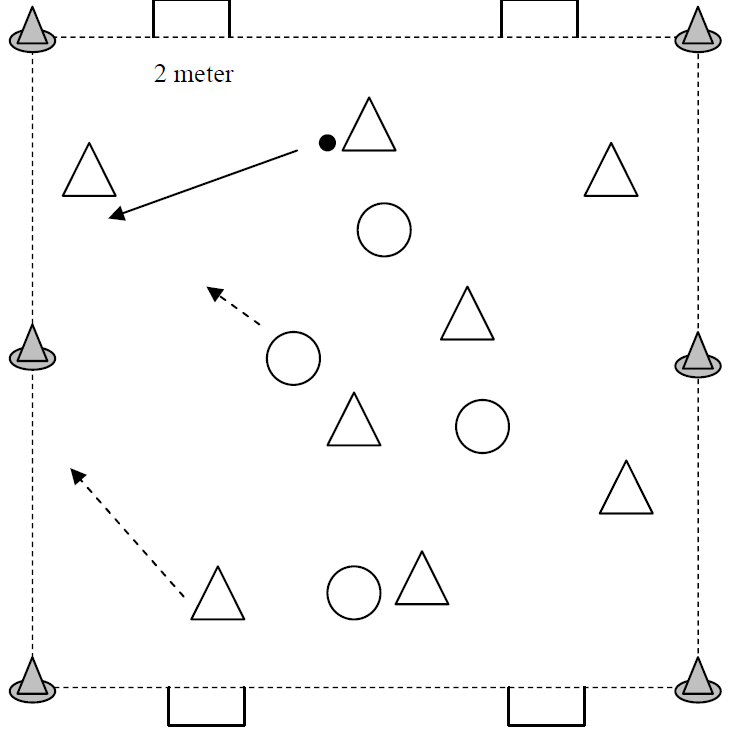
Organization:
There will be played 8 against 4.
6:3, 7:3, 7:4, 9:4 or 9:5 is also possible.
With more or less players the dimensions have to be adjusted.
The 8 may score after 5 passes.
The 4 may always try to score.
If the ball is intercepted by the 4, if the ball goes out or after scoring, there must be counted again.
After, in total, 5 goals or after 10 minutes, teams are switched
To make it easier or more difficult, the number of replaying can be changed.
Points of attention:
Use the left and right foot.
If possible keep the ball low
Assuming the right foot.
Correct ball speed.
Direct play.
Organization:
- There will be played 6 against 3.
- 8: 4, 6:3, 7:3, 7:4, 9:4 or 9:5 is also possible.
- With more or less players the dimensions have to be adjusted.
- The 6 may score after 4 replay.
- The 3 may always try to score.
- If the ball is intercepted by the trio, if the ball goes into touch or after scoring, there must be
- to be recounted.
- After, in total, 5 goals or after 10 minutes of substitution.
- In order to make it easier or more difficult, the number of passes can be changed.
Points of attention:
- Use the left and right foot.
- If possible, keep the ball low
- Assuming the right foot.
- Right ball speed.
- Immediate play.
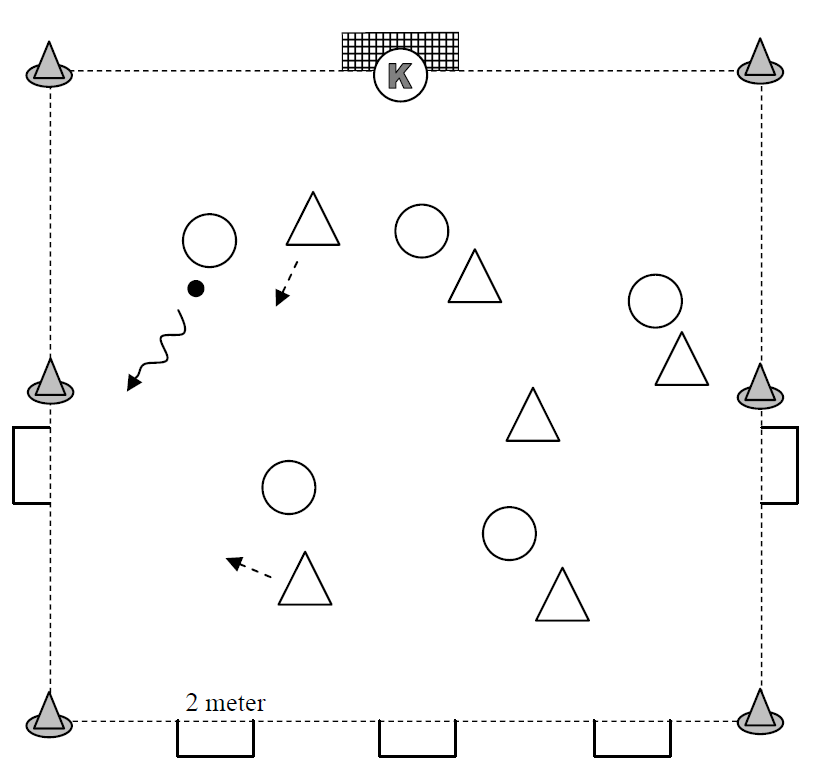
Organization:
- There will be played 4 against 4 + goalkeeper.
- If the party that has to score on the big goal has lost the ball, they have to defend 5 goals.
- After 15 minutes there's a changing of halves.
Remarks:
- If the triangles' attackers lose the ball, they can very quickly score a counter-goal.
- Especially the players who don't defend often in the league games won't like this kind of game.
Points of attention:
- Cover the man in time.
- Don't go in too quick.
- Cover on the right side.
- Posture during the duels, through the knees.
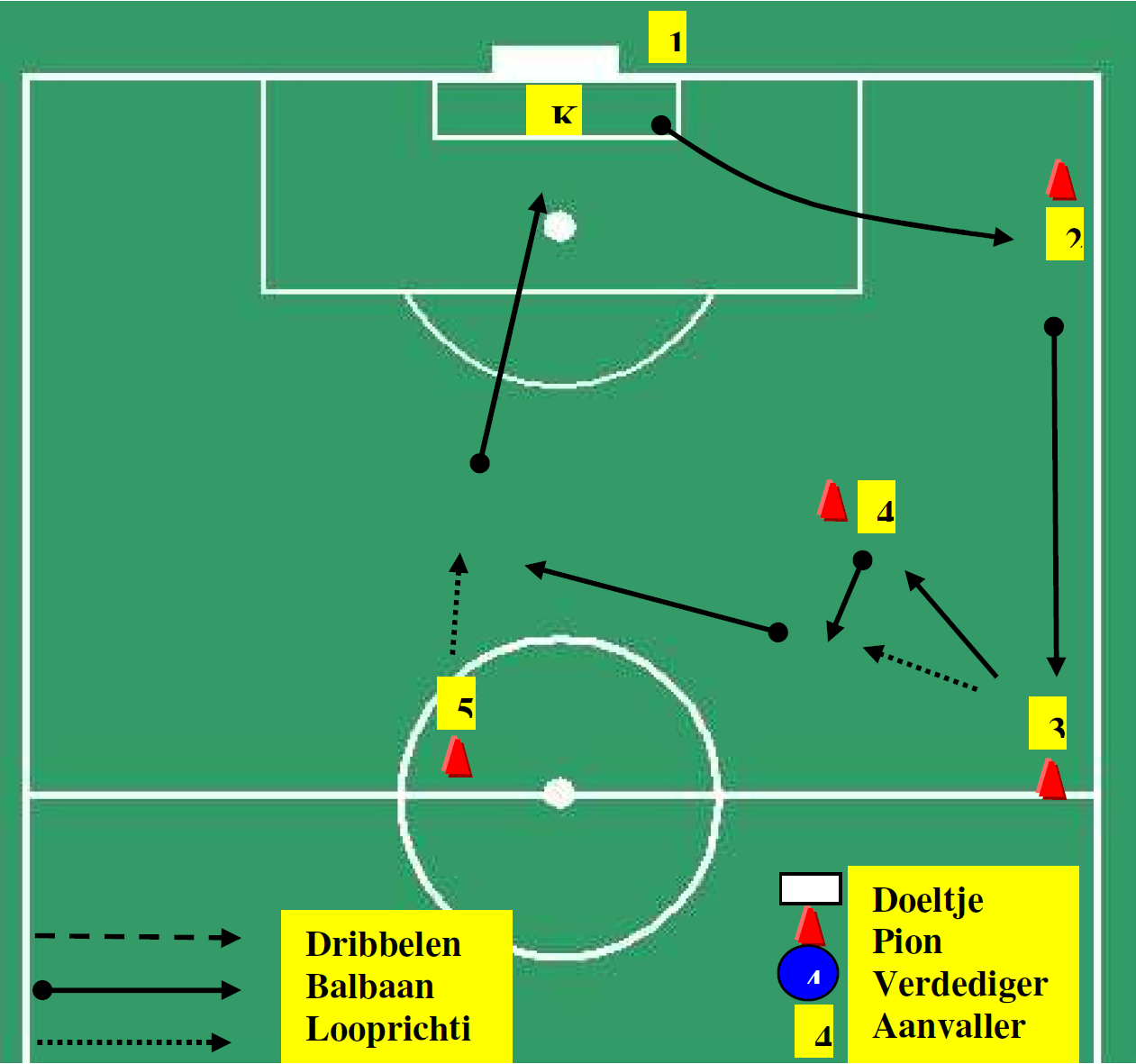
Content
- No. 1 or goalkeeper takes a goal kick
- No. 2 takes the ball
- No. 2 gives a depth pass on no. 3
- No. 3 plays in on no. 4 this comes in the ball
- No. 4 makes room for the incoming player
- No. 3 plays no. 5 to
- No. 5 takes the ball and scores
Structure of the exercise form
- At number 1 two players with a ball
- At 2, 3 and 5 three players
- Move from 1 to 5
- If there is no goalkeeper then 5 goes on goal
- Increasing/reducing distances
- Responding to the outer leg
- Eye contact and getting into the ball
- At position 4, add a defender
- Ball over the ground and/or through the air
- In case of delay, player 1 takes the goal kick
Coaching
- When No. 1 has control over the ball, only then come into the ball
- At no. 4 first away from the ball and then into the ball
- Ensuring that one does not fall short of each other that's easy to defend
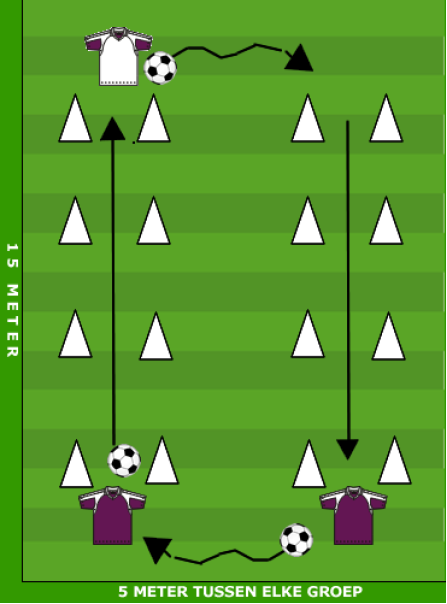
Field setup:
- Place 2 x 4 x 2 pilons next to each other so that two streets of pilons are formed.
The course of play:
- The players have to try to pass exactly through the pilon street and then sprint through it after the ball.
- Another player (white) receives the ball and dribbles to the other street.
- There this player does exactly the same towards player 3.
- Player 3 starts again on the same spot as player 1.
Laws of the Game:
- The ball must pass through the pilon street.
- If you hit a pilon, you have to sprint to straighten the pilon and try again.
- The ball must pass all pilons before the receiving player can take it.
- Both teams can score in a big goal with goalkeeper
- When the ball is out, the attackers play the ball back in, play or dribble in front of the defenders
- At a corner kick or goalkick, start at the goalkeeper of the trio
- Double score when the pair scores
- When the ball goes back in play by the goaldefender, he no longer participates in the game.
- Over time, the teams change.
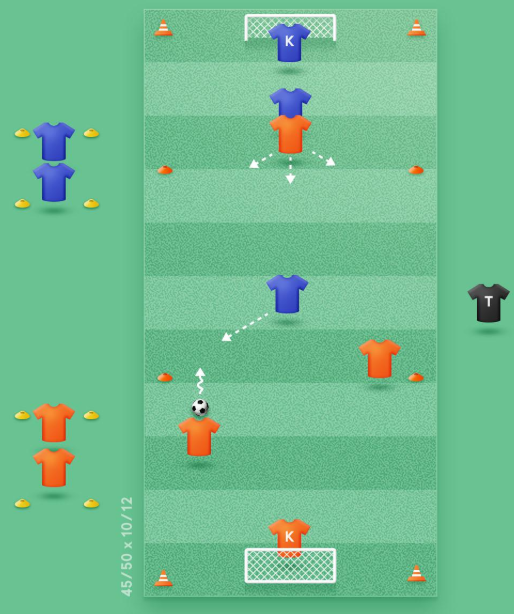
- The attackers try to create a chance or goal as quickly as possible
- The defenders try to hold up the attackers as long as possible and force them to one side
- The bottom defenders keep them close to each other so they can help each other.
- Do not get out if outnumbered, wait for the opponent to bring the ball to the side and then put pressure on it and keep the opponent on the same side