




Soccerexercises for u17
- Practise switching sides during a match.
- Quickly transition from defending to attacking.
- Set up the goals with different coloured cones.
- Adjust the field size as desired, depending on the number of players.
- Form two teams; playing with a numerical disadvantage or advantage is possible but not necessary.
- Emphasise teamwork, not individual scoring.
- Start with a passing round, then call out a colour of a cone and they must score there.
- Continue scoring at that goal until a new colour is called.
- Begin with a new colour every 30-60 seconds, increase the pace if it goes well.
- Add an extra dimension by passing the ball in from the side when the ball is out.
- Players must come to the ball, otherwise the ball is not played.
- Adjust the level of difficulty to the team's level.
- Switching gears as quickly as possible is the focus of this exercise.
- As a coach you can of course always choose where you put the emphasis in this exercise: switching to ball possession or switching after ball loss.
The exercise form
- The red side plays in the red square a positional game 7 vs 5.
- When yellow captures the ball, the player of the yellow side plays a fellow player in the yellow square.
- The 5 yellow players from the red square plus 5 random red players move to the yellow square.
- Switching, in other words. In the yellow square the positional play then continues 7 against 5, until red captures the ball and plays it back to the red square.
- Then the players switch back to the red square.
Coaching
Apart from whether the positional play goes well, the main issue is of course the switching. Therefore:
- Switchover to ball possession: is the game actually moved to the other square as soon as possible?
- Switchover after ball loss: can the pass to the other square still be prevented? By putting immediate pressure on the ball
- Switching after ball loss: if the game cannot be prevented, do 2 players switch to the other square a.s.a.p.?
- Player stands behind a set of steps.
- Two feet per "step" in the staircase.
- Watch your posture:
- Walk straight.
- Knees slightly bent.
- Short movements.
- Arms should be active along the body.
- Variation
- Side-Step with two feet per step;
- Zigzagging with one foot in, then two feet on the step, then one foot back in. (different from the first)
- After kicking off, start sprinting and rebound at the pylon on the ball played in.
- Then go back in line.
Preparation:
- Make groups of 2 for this passing warm-up, with 1 ball per group of 2.
- The players with ball line up, on the sideline. The other players stand opposite to eachother, about 6 meters from the player with ball.
Exercise:
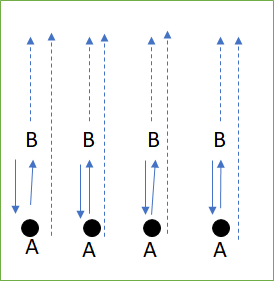
- Player A dribbles forward, while player B jogs backwards across the field.
- As the players jog across the field, player A passes the ball to B, who passes back to A, just until they reach the opposite sideline.
- The roles reverse when the players reach the other side of the field. Player A then runs backwards to the line where they started.
Variation possibilities:
- alternate from right foot to left foot.
- try to apply one hit
- focus on quality over speed, it's not a race.
- Three players start simultaneously with dribbling to the other side.
- The defender tries to steal the ball, if he succeeds, he gets one point.
- When the players reach the middle square, they can score (pass-aim) on one of the cones.
- After they have aimed at the cones, they collect the ball and dribble back via the ditch.
- After a certain amount of time, there will be a change of defenders.
Size: depending on age and skill.
Length: 15-25 metres.
Width: 10-15 metres.
- Players can score by stopping the ball at five metres from the goal and scoring.
- The ball must be scored in the goal. When you have done this three times, you move to the next line (seven meters). When you have done this three times more, you move to the champions line (ten meters).
- The first person to score three times from the champion's line is the Lion King.
- When you have missed twice from a certain line, then move again one line closer to the goal.
- Points only count when the player dribbles back to the starting position via the ditch.
Dimensions: adjust depending on age and skill (e.g. distances to goal 7, 10 and 15 metres).
- All players have a ball, except two players (the lions).
- One player acts as a catcher and tries to catch as many players as possible within 45 seconds while dribbling, the other player guards the lion's den with the conquering balls.
- The other player guards the lion pit with the captured balls. The tagged players collect first in the box.
- The tapped players can get the ball back by dribbling it out of the lion's den untapped. (If you want to be tapped, you must first get out of the lion pit and try again).
- Who has captured the most balls, is the Lion King.
Size: depending on age and skill.
Length: 15-20 metres.
Width: 10-15 metres.
- Three players start simultaneously with dribbling to the other side.
- The defender tries to take the ball away, if he succeeds, he gets one point.
- When the players arrive at the middle square, they can shoot at one of the lions in front of the goal.
- After they shoot at the lions, they collect the ball and dribble back via the ditch.
- After a certain time, the defenders are changed.
Size: depending on age and skill.
Length: 15-25 metres.
Width: 10-15 metres.
- Two players start simultaneously with dribbling to the other side.
- The defender tries to steal the ball, and if he succeeds, he gets one point.
- When the players reach the middle square, they may score (shoot) at the big pupil goal.
- After they have aimed at the pawns, they collect the ball and dribble back via the ditch.
- After a certain amount of time, there will be a change of defenders.
Size: depending on age and skill.
Length: 15-25 metres.
Width: 10-15 metres.
- Both players can score by passing-aiming the ball against a pawn.
- When the ball is out, dribble in.
- Dribble in at a rear ball or corner kick.
Size: depends on age and skill.
Length: 10-20 meters.
Width: 15-30 metres.
Number of players: 4-6
players (if necessary, change players when a goal is scored, a back ball is played or a corner kick is taken).
Equipment:-
Each player one ball.
4-6 vests (2 colours).
16 cones.
- Three players start simultaneously with dribbling to the other side.
- The defender tries to steal the ball, and if he succeeds, he gets one point.
- When the players reach the middle square, they can shoot at one of the lions in front of the goal.
- After shooting at the lions, they collect the ball and dribble back via the ditch.
- After a certain amount of time, the defenders are changed.
Size: depending on age and skill.
Length: 15-25 metres.
Width: 10-15 metres.
- Players can score by stopping the ball at five metres from the goal and score by shooting the ball through one of the holes in the hole cloth, which is hung in the goal.
- The ball must be shot at the goal, through the holes in the goal. When you have succeeded three times, you move to the next line (seven metres). When you have done this three times again, you move to the champion's line (ten meters).
- The first person to score three times from the champion's line is the Lion King.
- When you have missed twice from a certain line, then move again one line closer to the goal.
- Points only count when the player dribbles back to the starting position via the ditch.
Dimensions: Adjust depending on age and skill
(e.g. distances to hole 7, 10 and 15 metres).
Number of players: •
4-6 players.
- Four players start simultaneously with dribbling to the other side.
- The defender tries to steal the ball, and if he succeeds, he gets one point.
- When the players reach the middle square, they can score (pass-aim) on one of the two small goals.
- After they have aimed at the small goal, they collect the ball and dribble back via the ditch.
- After a certain time, there is a change of defenders.
Size: depending on age and skill.
Length: 15-25 metres.
Width: 10-15 metres.
- Two players start simultaneously with dribbling to the other side.
- The defender tries to steal the ball, and if he succeeds, he gets one point.
- When the players reach the middle square, they can score (pass-aim) on one of the two small goals.
- After they have aimed at the small goal, they collect the ball and dribble back via the ditch.
- After a certain time, there is a change of defender.
Size: depending on age and skill.
Length: 15-25 metres.
Width: 10-15 metres.
- One player starts dribbling to the other side.
- The defender tries to take the ball away, and if he succeeds, he gets one point.
- When the players reach the middle square, they can score (shoot) at the pupil's goal.
- After they shoot at the goal, they pick up the ball and dribble back via the ditch.
- After a certain amount of time, there will be a change of defenders.
Size: depending on age and skill.
Length: 15-25 metres.
Width: 10-15 metres.
- The attacker with the ball starts dribbling from the back-line near the small goal towards the pupil's goal. The defender without the ball may try to overtake the player and take the ball.
- Both players can score, the attackers at the big pupil goal, the defenders at the small goal.
- When the ball is out, by switching attacker and defender.
- When the attacker has shot at the pupil target, he dribbles back to the starting point via the ditch.
Size: depending on age and ability.
Length: 15-25 metres.
Width: 10-15 metres.
- The attacker with the ball starts dribbling from the back line near the small goal towards the pupil's goal. The defender without the ball can try to overtake the player and take the ball.
- Both players can score, the attackers on the pupil goal, the defenders on the small goal.
- When the ball is out, by switching attacker and defender.
- When the attacker has shot at the pupil's goal, he dribbles back to the start via the ditch.
Size: depending on age and ability.
Length: 15-25 metres.
Width: 10-15 metres
- The attacker with the ball starts dribbling from the back line near the small goal towards the pupil's goal. The defender without the ball can try to overtake the player and take the ball.
- Both players can score, the attackers on the pupil goal, the defenders on the small goal.
- When the ball is out, by switching attacker and defender.
- When the attacker has shot at the pupil's goal, he dribbles back to the start via the ditch.
Size: depending on age and ability.
Length: 15-25 metres.
Width: 10-15 metres.
- The players try, dribbling with a ball, to dribble from one of the four squares to another square (stadium).
- The handler indicates to the players to which stadium they are going to dribble (e.g. "we are now dribbling towards the Arena").
- The dribbling from stadium to stadium is done together by all players.
- The supervisor can adjust the route of the dribble, the size of the boxes and the speed.
Size: depending on age and skill.
Length: 30-40 metres.
Width: 20-25 metres.
- The players try, dribbling with a ball, to dribble from their pawn to the middle square (the pond) and back.
- The player(s) in the box (crocodile) tries to keep the ball out of the box (pond) by picking it up or tapping it away. If the ball is touched, first go back to the pawn where you started.
- If the player succeeds in returning to the box without the ball being touched by the crocodile, he may place a hat on his pawn. The player who is the first to have five hats on his pawn is the winner.
Size: depending on age and skill.
Length: 30 metres.
Width: 20 metres.
- All players start with a ball, except the defender. The defender tries to take or knock balls away from the other players.
- The defender counts how many balls he has taken or tapped away. After a certain time, the defender will be changed.
Size: depending on age and skill.
Length: 20-25 meter.
Width: 15-20 meters.
Attacking:
Score goals.
- Dribble through the box.
- Staying active.
Defence:
Preventing goals and conquering the ball.
- Take away the ball.
- Staying active.
- All players start with a ball and dribble through the box.
- The players try to keep the ball inside the box and not collide with each other.
Size: depending on age and skill.
- Length: 20-25 metres.
- Width: 15-20 metres.
Material:
• Every player one
Attacking: Scoring goals.
- Dribble through the box (try to keep the ball close to you).
- Try to dribble where there are no other players.
- Stay active.
- Half of the players start with a ball, the other players try to conquer the balls.
- The players who lose a ball, try to conquer another one.
Size: depending on age and skill.
Length: 20-25 meters.
Width: 15-20 meters.
Attacking:
Score goals.
- Dribble through the box.
- Staying active.
Defence:
Preventing goals and conquering the ball.
- Take away the ball.
- Staying active.
- All players start with a ball and dribble through the box.
- The players try to keep the ball inside the box and not collide with each other.
- The players with the ball can score points by dribbling through the small goals, not being allowed to dribble through the same small goal twice in a row.
depending on age and ability.
Length: 20-25 metres.
Width: 15-20 metres.
Goal Scoring.
- Dribble through the box (“try to keep the ball close to youâ€).
- Try to dribble where there are no other players.
- Stay active.
- All players start with a ball and dribble through the box. The defender tries to take or knock balls away from the other players.
- The defender counts how many balls he has taken or tapped away. After a certain time, the defenders are changed.
- The players with the ball can score points by dribbling through the small goals. They are not allowed to dribble through the same small goal twice.
Size: depending on age and ability.
Length: 20-25 metres.
Width: 15-20 metres.
Goal Scoring.
- Dribble through the box (“try to keep the ball close to youâ€).
- Try to dribble where there are no other players.
- Keep participating actively.
- All players jog in over the field (square)
- Half the number of players has a ball
- players with ball pass the ball to a player without ball (eye contact).
- The players are not allowed to keep the ball with them for longer than 5 sec.
- At the moment the trainer whistles (signal), all players without a ball sprint as fast as possible to the closest player who has a ball and try to take it away.
- The player who has the ball should try to fence it off. (1:1 duel)
- When the trainer blows the whistle again we switch back to jogging and passing!
Nice variant is when you have an odd number of players, the player who can't find a direct opponent gets a command (for example sprint over the width of the field).
- Split your team into four teams of four
- 1 ball per team
IMPLEMENTATION:
- Players play the ball around within their team of four in the area that was put out
QUALITY:
- Players are constantly moving, with many tempo changes to find space.
- Each team must try to maintain a diamond shape
- Players must all communicate with teammates, the ball must be asked for and the player's name must be called by the person who is playing the ball.
- Passes should arrive well, in space or in the feet.
- Players should not touch each other, nor should the balls touch each other.
- This exercise requires great vigilance on the part of the players.
PROGRESS:
- Add a passive defender who can defend any ball.
- Add a defender who can conquer the ball.
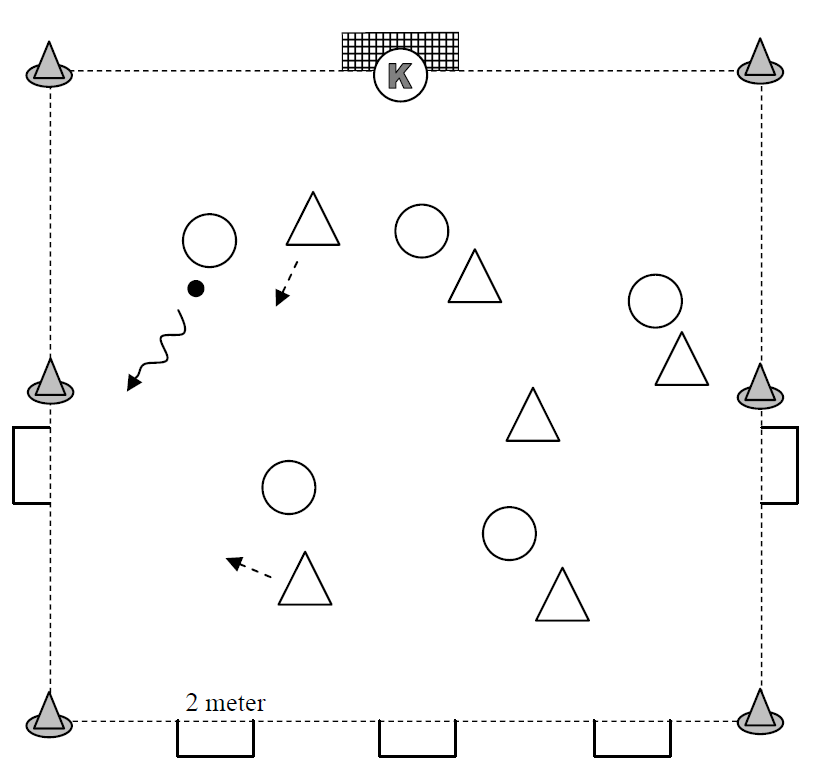
Organization:
There will be 6 against 5 + goalkeeper.
If the party that has to score on the big goal has lost the ball, they have to defend 5 goals.
After 15 minutes of changing halves.
Remarks:
If the attackers of the triangle game lose the ball, it can very quickly result in a counter-goal.
Especially the players who don't play in the league games can't like this kind of game.
Points of attention:
Cover the man in time.
Do not go in recklessly.
Cover on the good side.
Posture during the duels, through the knees.