



Volleyballexercises
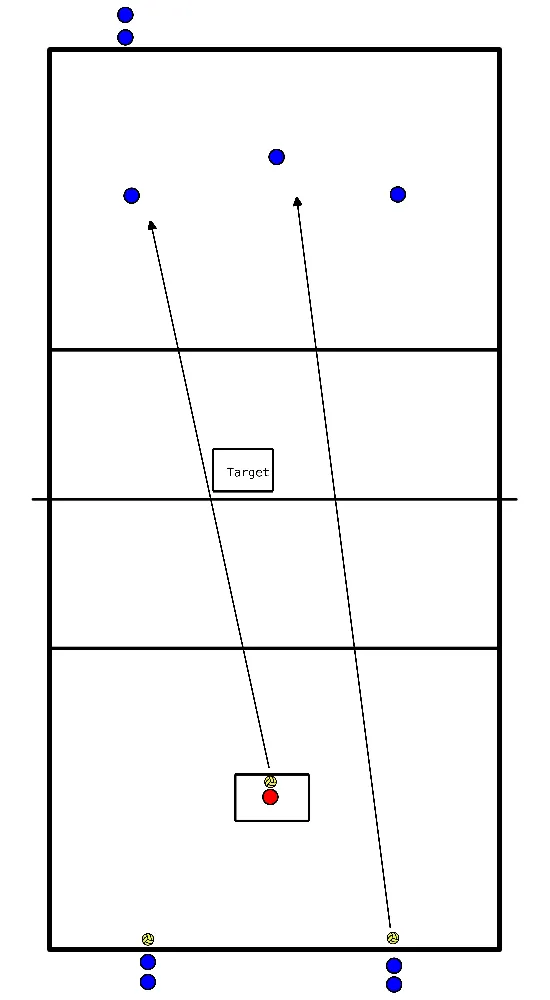
- Divide players into two groups: Passers (Liberos, DS, and Outsides) and Servers.
- Passers form the receiving line.
- Servers are divided into two lines and must alternate lines at all times.
- The drill starts with a topspin serve from the box by a coach or player.
- Followed by a serve from zone 1 and a serve from zone 5.
- Serves alternate between these zones.
- Passers must pass the ball to the target in zone 3.
- After 9 serves, the receiving line rotates.
- Instead of a target in zone 3, position setters to set the ball to targets in zones 4 and 2.
- Establish responsibility zones for each player on the reception line for serves originating from different zones of the court.
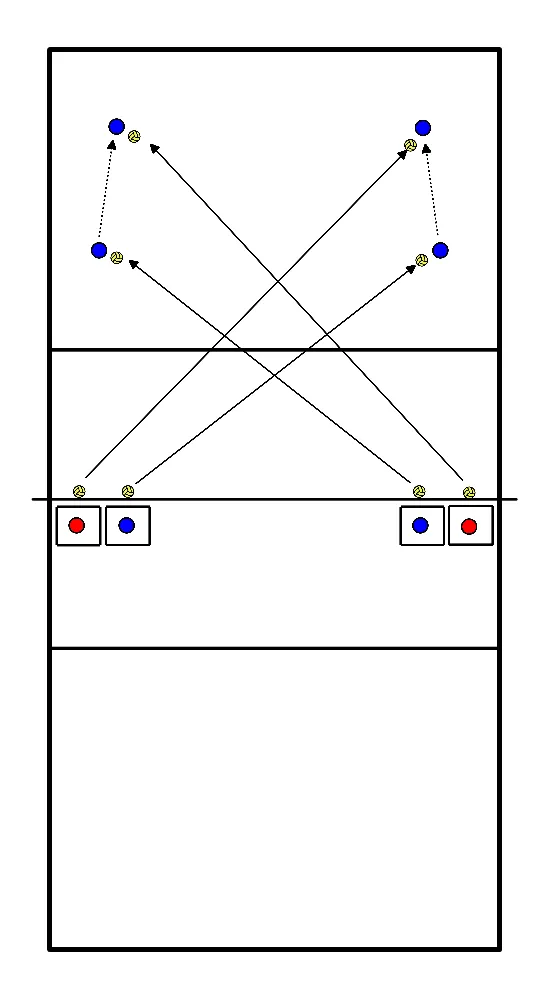
- Place 4 boxes on the court: 2 in zone 2 and 2 in zone 4.
- Position 2 players and 2 coaches to hit from the boxes.
- If boxes are unavailable, hit from the floor on the same side as the defense.
- Form 2 groups for the drill.
- Determine the base position, typically 3ft behind the 10ft line and 3ft from the sideline.
- Dig two balls from the outside or rightside hitter.
- Adjust your body by squaring to the hitter.
- Dig two balls from cross-court hits, one simulating perimeter defense and the other rotational defense.
- Perform perimeter defense first, followed by rotational defense.
- Pass both balls using only one touch to the center of the court between zones 3 and 6.
- Emphasize quick footwork to reach defensive positions efficiently.
- Do not teach players to push the defense into the net unless it is a free-ball situation.
- Teach perimeter defense even if it is not the main strategy, as players should be proficient in both methods.
- Ensure players understand the importance of their starting base position for effective defense.
- Include a middle block hit.
- Include a line tip.
- Combine a middle blocker hit, a cross hit, and a line tip for more complex scenarios.
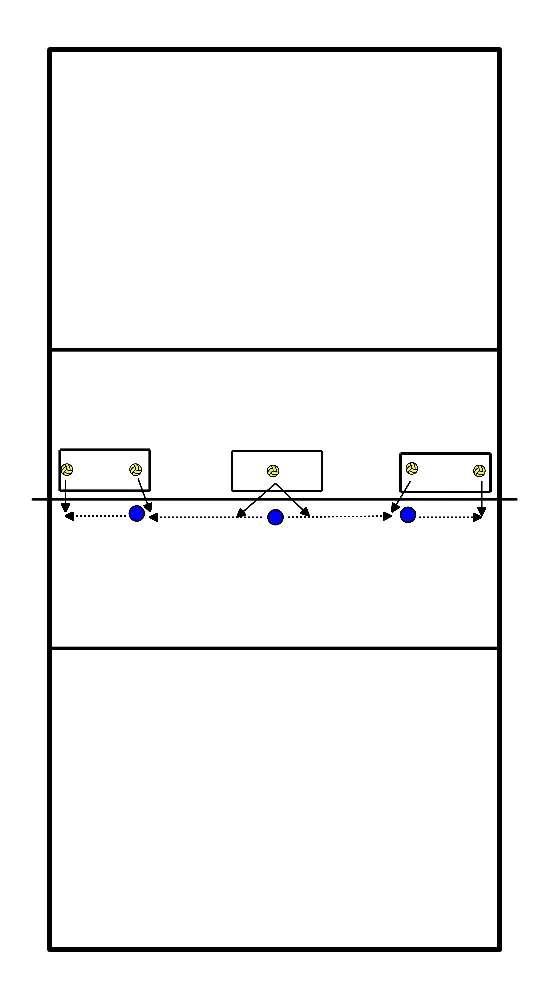
- Split the players into two groups: one group for blocking and one group on the boxes.
- Players on the boxes will hit the ball.
- The player in the middle box hits towards zone 1 and zone 5.
- Middle blockers should position their arms to close the targeted zone and swing block towards the side where the player on the box will hit.
- Rotate after each hit.
- When the player on the middle box hits to zone 1, middle blockers position their arms to close zone 1 and swing block to the left side.
- When the player on the middle box hits to zone 5, middle blockers position their arms to close zone 5 and swing block to the right side.
- Start in the base position and swing block a line hit.
- Complete two blocks before rotating.
- Simulate a ball to the middle blocker, requiring outside and rightside players to assist with the block, then move to the sides with a swing block to protect a line hit.
- Simulate a ball to the middle blocker, requiring outside and rightside players to assist with the block, then move to the sides with a swing block to protect a cross hit.
- Introduce the double block.
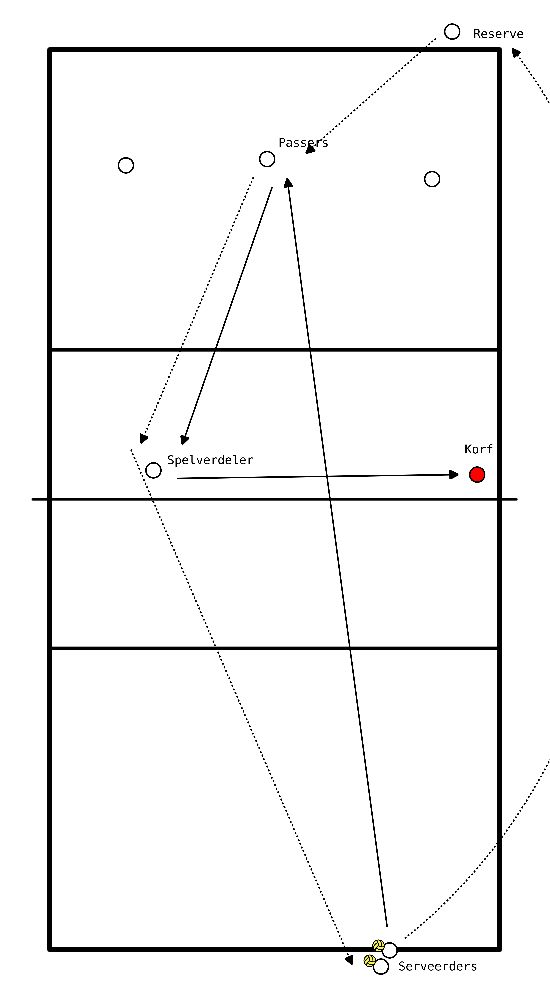
- Three players in the serve-receive on positions 5, 6, and 1.
- One substitute behind the court.
- A setter starting on position 2/3.
- The rest of the players with a ball on the opposite side.
- Serve towards the receivers.
- Pass to position 2/3.
- The setter plays the ball to position 4 where a hoop is placed.
- A ball in an acceptable trajectory hitting the hoop is 1 point, directly in is 2 points.
- Encourage the team to aim for as many points as possible.
- Choose a fixed setter or rotate: receiver -> setter -> server -> substitute -> receiver.
- With a large group, you can use two sides.
- With a small group, you can reduce the number of receivers.
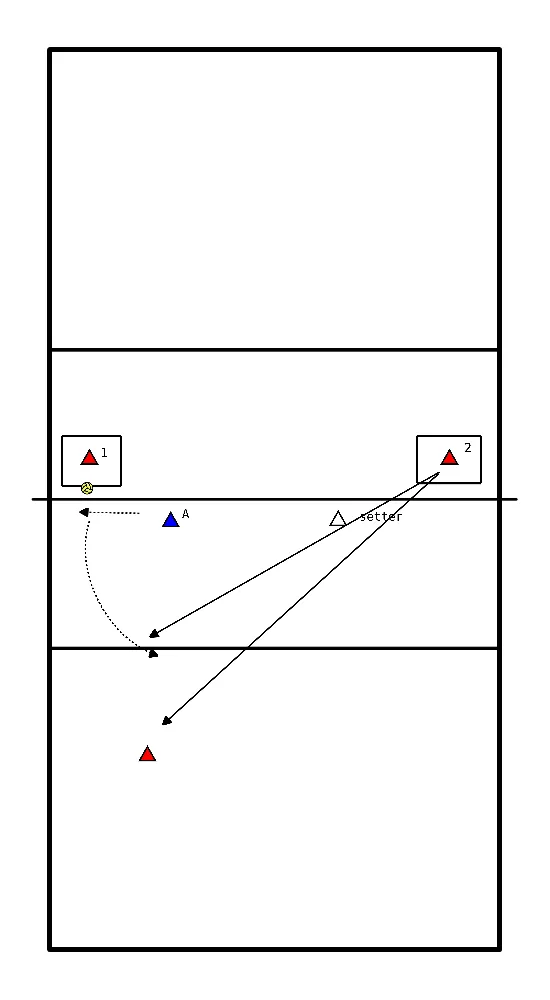
- Use 2 to 3 courts.
- Player 1 and Player 2 stand on the box with the ball.
- Player A is in the blocking front formation.
- The libero is in zone 5.
- The setter is ready.
- Player 1 holds the ball high.
- Player A performs a block movement and places hands over the net.
- Player A moves out for the defence of Player 2.
- The setter performs a block jump for Player 2.
- The setter passes to Player A.
- Player A executes an attack.
- Focus on attack build-up from defence.
- Ensure quick movements and good footwork.
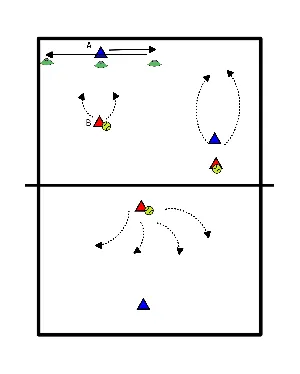
- Starting Position: 2 players, 3 cones, 2 tennis balls
- Execution: Player A moves between the cones. Player B holds 2 tennis balls up high. Player A returns to the central point, after which Player B taps a tennis ball. Player A catches the ball.
- Starting Position: 2 players, 5 tennis balls
- Execution: Player B throws 5 tennis balls randomly into the field. Player A tries to hit the balls after 1 bounce.
- Starting Position: 2 players, 1 tennis ball
- Execution: Player A stands with their back to Player B. Player B throws a challenging tennis ball over Player A. Player A catches the ball after 1 bounce.
- Movement and Reaction
- Footwork
- Always return to home base!
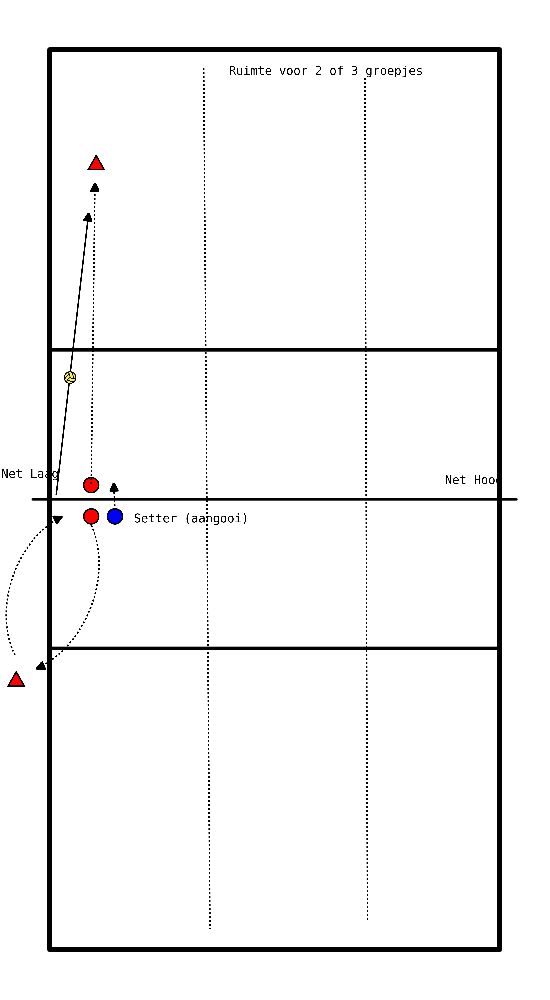
- Groups of 3 people of approximately equal height.
- One ball per group of three.
- Two blockers facing each other at the net.
- Setter next to one of the blockers.
- The server pays attention to the correct steps: Short, Long, Join, Arms engaged during jump.
- The attacker requests a higher or lower ball for correct timing.
- The defender determines the start of the exercise.
- Defender counts down: 3-2-1-block.
- Try to make the hands touch each other above the net.
- Defender: Shuffle backwards to approximately 5-6 metre position with speed.
- Attacker: Quickly to the 3 metre line ready for attack.
- Throw: Almost vertically upwards on the indication of the attacker's height.
- Attacker: Straightforward gentle hit.
- Defender: Pass upwards and catch.
- Server moves to the other side of the net, same principle but mirrored.
- 5 attacks per person, thus 10 throws.
- Switch roles among each other, 3 times in total, everyone is the server once.
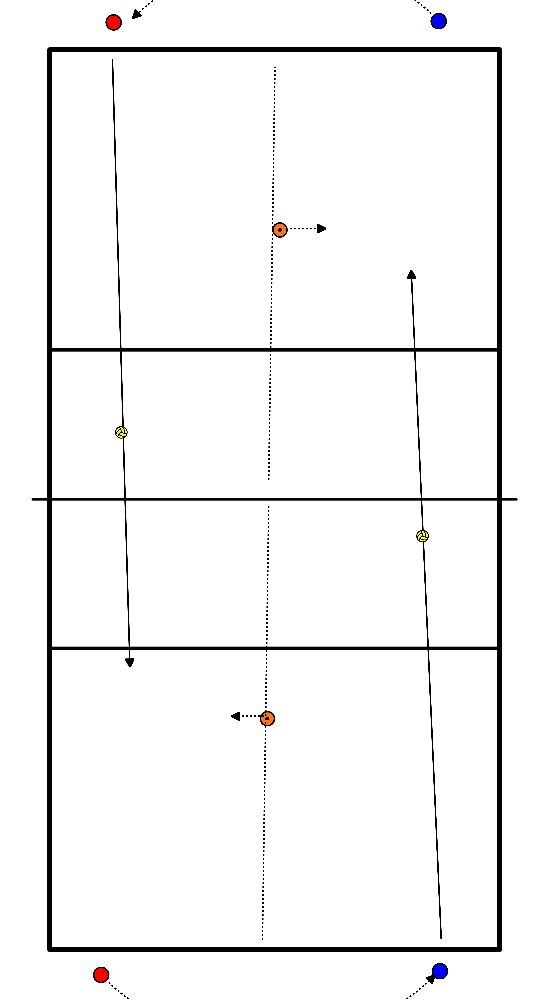
- Form pairs with one ball per duo.
- The trainer places cones in different colours in the middle of the court, as many as there are pairs.
- Always aim at a specific side of the cone, the trainer indicates which side:
- Right of the cone
- Straight ahead
- Left of the cone
- Diagonal
- In front of the cone (short)
- Behind the cone (deep)
- For a successful task: move the cone 1 metre to make the area smaller.
- For an unsuccessful task: move the cone 0.5 metres back to make the area larger.
- Challenge: Bring your cone as close as possible to the respective line of the court.
- Execution: 5 minutes of serving.
- The pair with the smallest area after this time is the winner.
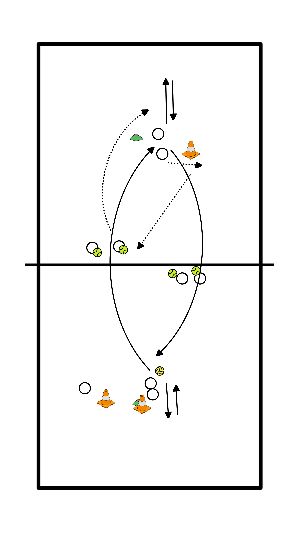
- Throw with a run-up from cone position V to position III, side A.
- Throw with one arm, run-up from position II and catch the ball with an extended arm.
- With passing and intermediate pass overhead and underhand.
- Tennis balls are replaced by a ball. Player runs up and passes to player at position 2.
- Player at position 5.
- Player chooses position 2 or 5 and plays over to the place where they are not standing.
- 15 minutes of basketball throwing.
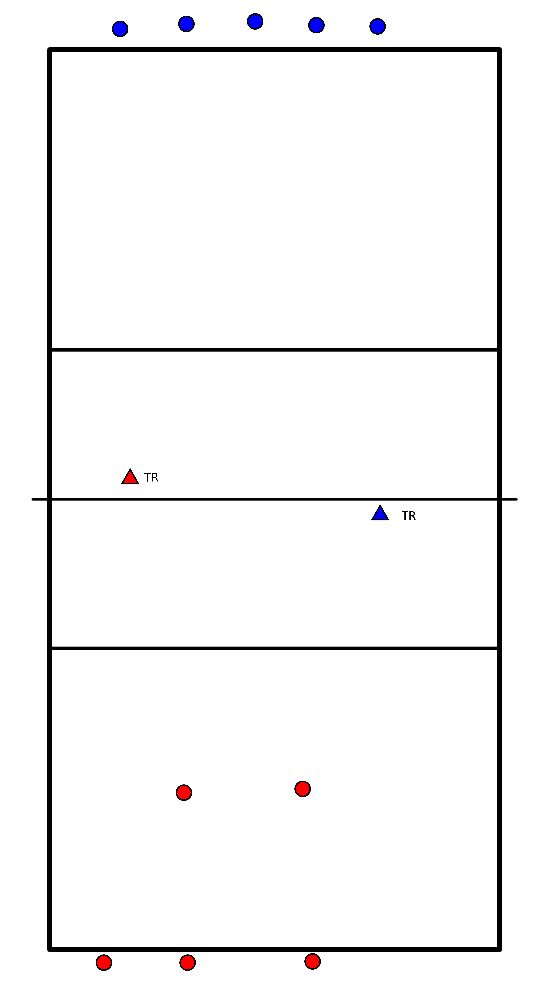
- Divide the group into two teams.
- The trainer is positioned on the side of the passers and catches the passes.
- Team A starts with serving, and Team B will be passing.
- After 15 points, switch the servers and passers.
- The trainer will now also catch passes on the other side of the net.
- Good serve that scores: +1 point.
- Good pass that is caught by the trainer: +1 point.
- Faulty serve that goes out or into the net: -1 point.
- Faulty pass: -1 point.
- Give each player a ball and have them stand by the wall, at a distance of 30-40 cm.
- Hold the ball above the head in a setting position.
- Push the ball against the wall using only the fingers and catch it back in the hands.
- Keep the elbows steady and the hands still to prevent the ball from hitting the face.
- Have players stand slightly further from the wall, about 1 metre.
- Toss the ball up and set it against the wall.
- Now extend the elbows and knees, make yourself tall!
- Catch the ball back.
- Now try to set onto the concrete beam, so push the ball high.
- Try to continue setting.
- Those who master this technique well may play over the net.
- Let the ball bounce on the ground in front of you and then set it over the net.
- Return via the other side of the ribbon.
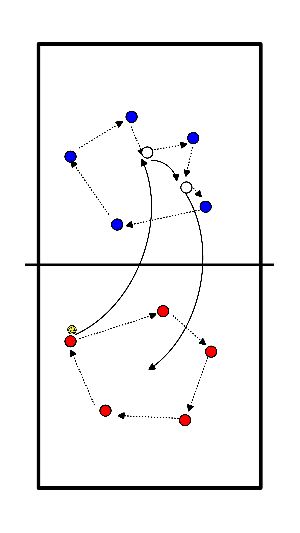
- Divide the group across both courts.
- Play the ball underhand over the net in a maximum of two actions.
- After each net crossing, the team rotates one position.
- If the ball falls on the floor or the opponent plays the ball differently, the team that played the ball over the net scores.
- The game does not need to stop in principle.
- If the game does stop, the ball is put back into play with an underhand serve from the backcourt.
- Whoever reaches 15 points first wins.
- Optional: Depending on the level, the second ball may be attacked from a standing position from the backcourt.
- Focus
- Communicate
- Master the task
- Persevere
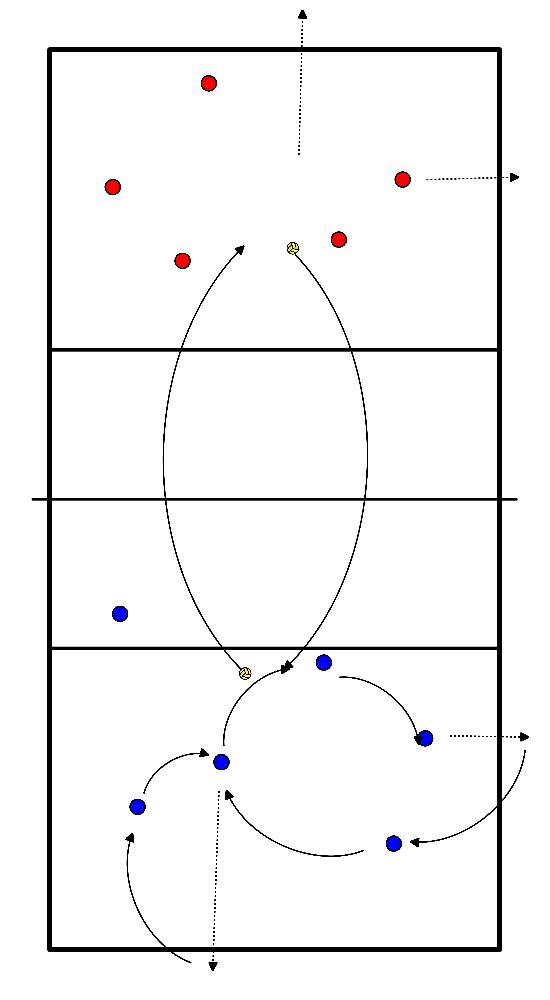
- Start as a warm-up and end as a true battle.
- Players are placed randomly on the court.
- The ball is caught and immediately thrown over the net (one-time play).
- After throwing the ball, the player runs to a wall (at the back or on the side) to touch it and returns to the court.
- The other players rotate one position.
- It is difficult to score.
- In case of a faulty throw (into the net or out), the player must sprint around the opponent's court.
- Duration: 5-10 minutes
- At level "A" and higher, fewer players on the court for more intensity.
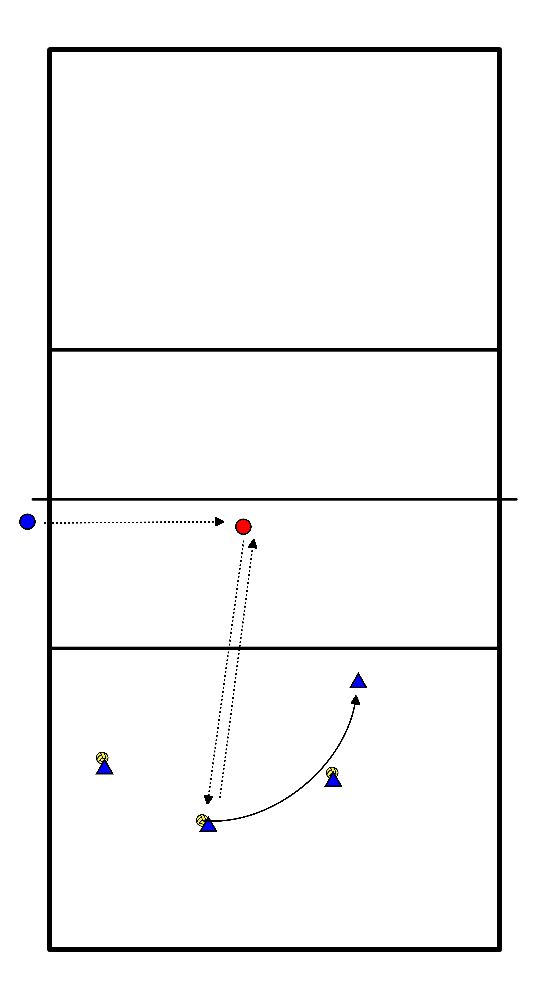
- Divide the group into two. One player stands with a few balls at the pole.
- One setter stands at the net to distribute the ball.
- Each defender has a ball, except one. So if there are four defenders on the court, three have a ball.
- The player at the pole sets the ball to the setter.
- The setter plays the ball (initially easy) to a random defender with a ball.
- This defender first throws their ball to another defender without a ball and then passes to the setter.
- The setter immediately plays another ball to a different defender with a ball.
- Regularly switch players and positions.
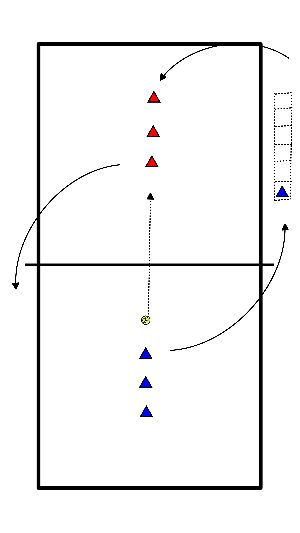
- Divide the team into two groups. Have the players form two lines facing each other at the 3-meter line.
- Players pass the ball over the net and then run around the net post to join the other group.
- On one side, parallel to the sideline, there is an agility ladder. Players perform an exercise through the ladder before joining the line.
- Expand with block jumps, attack approach, or strength exercises.
- Alternate between underhand and overhand passing.
- The ball must not fall to the ground.
- Communication is crucial.
- Optionally, add a penalty if the ball falls to the ground.
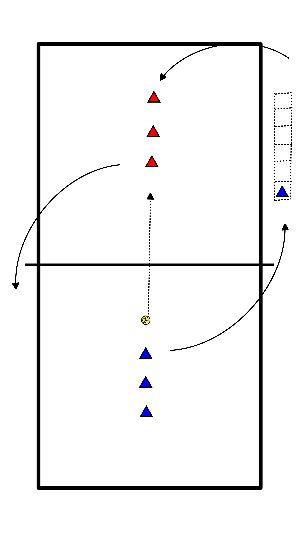
- Divide the team into two groups.
- Have the players form two lines facing each other at the 3-meter line.
- Players pass the ball over the net and then run around the net post to join the other group.
- Place a speed ladder parallel to the sideline.
- Have the players perform a drill through the ladder before joining the line.
- Optionally extend with block jumps, attack passes, or strength exercises.
- The ball must not fall to the ground.
- Communication is essential.
- Optionally add a penalty if the ball falls to the ground.
- Alternate between underhand and overhand passing.
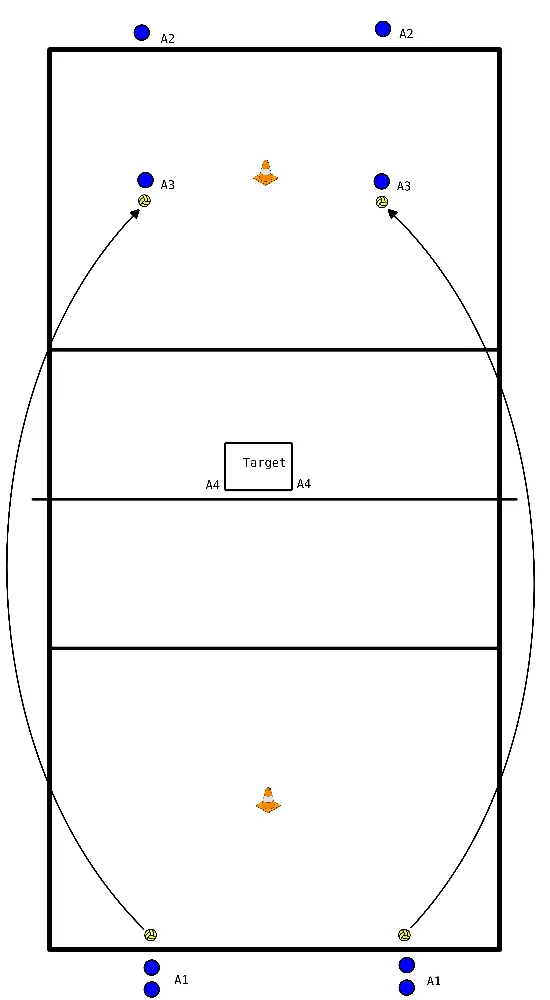
- Divide the court into two lanes.
- Organize players into two groups, each serving within their designated lane.
- Player serves to her partner on the opposite court and then passes to herself (3 minutes).
- Player passes to herself and sets to the target or her partner as a target in zone 3 (3 minutes).
- Player passes to the target or her partner as a target in zone 3 (3 minutes).
- Player performs an overhand pass only to the target or her partner as a target in zone 3 (3 minutes).
- Perform the same drills as above, but serve cross-court.
- Server aims to serve to a group member on the opposite side.
- Passers must deliver the ball to a group member positioned at the net in zone 3.
- After serving, players rotate positions: server to passer, passer to target, and target to server.
- Scoring: Perfect pass = 3 points, Good pass = 2 points, Okay pass = 1 point, Service mistake = 0 points, Two consecutive service mistakes = -1 point.
- The first group to reach 30 points wins.
- After actions, players rotate as follows: A1 to A2, A2 to A3, A3 to A4, and A4 to A1.
- Divide the game into sets and switch lanes after each set.
- Use a real target instead of players, with coaches judging the passes.
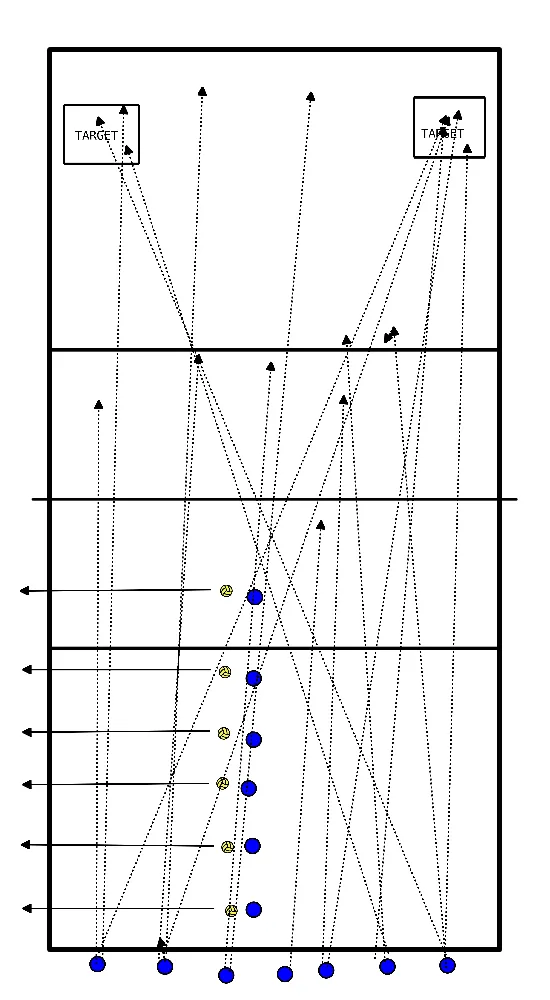
- The Jump Float Serve is a technique where the server jumps before making contact with the ball, aiming for a flat trajectory with minimal spin.
- Serving to the Wall (3 minutes)
- Stand a few meters away from a wall.
- Practice your jump float serve by aiming to hit the wall at a consistent height.
- Focus on your form and the flat trajectory of the ball.
- Free Serve with Net Awareness (3 minutes)
- Serve freely, aiming to deliver your best jump float serve.
- Concentrate on not hitting the net, maintaining a good height and trajectory.
- Serving to the Target in Line (3 minutes)
- Set up a target straight ahead on the court.
- Practice serving directly to the target using the jump float serve technique.
- Serving to the Target in Cross (3 minutes)
- Position a target diagonally across the court.
- Focus on serving to this cross-court target, maintaining the jump float serve form.
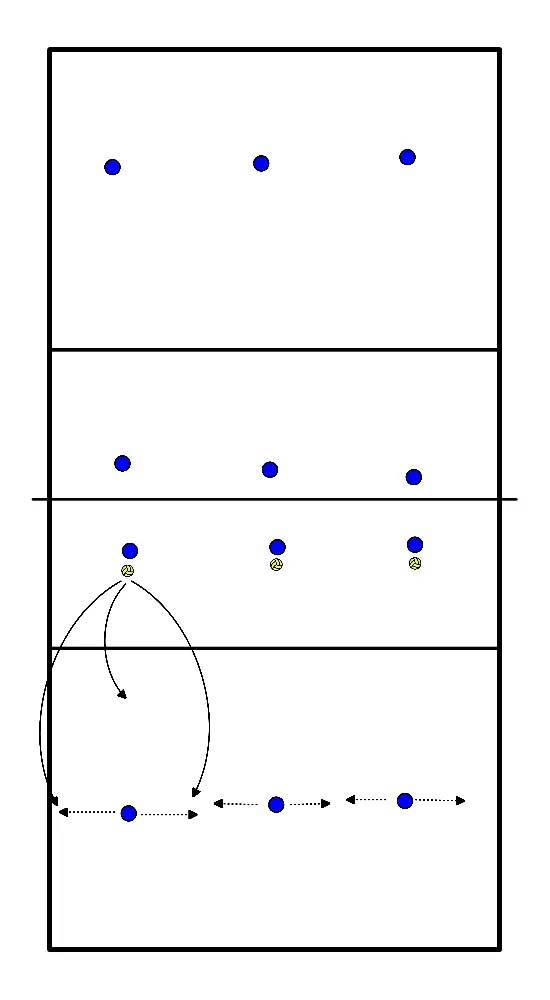
- Improve ball control and coordination between partners.
- From the net, Player 1 hits a down ball to the left side. Partner sets the ball back to Player 1. Continue for 1 minute.
- From the net, Player 1 hits a down ball to the right side. Partner sets the ball back to Player 1. Continue for 1 minute.
- From the net, Player 1 hits a down ball to both the left and right sides. Partner passes the ball back to Player 1. Continue for 1 minute.
- Repeat the previous step, hitting a down ball to both the left and right sides. Partner passes the ball back to Player 1. Continue for 1 minute.
- From the net, Player 1 hits a down ball to both the left and right sides. Partner passes the ball back and goes to the tip. Continue for 2 minutes.
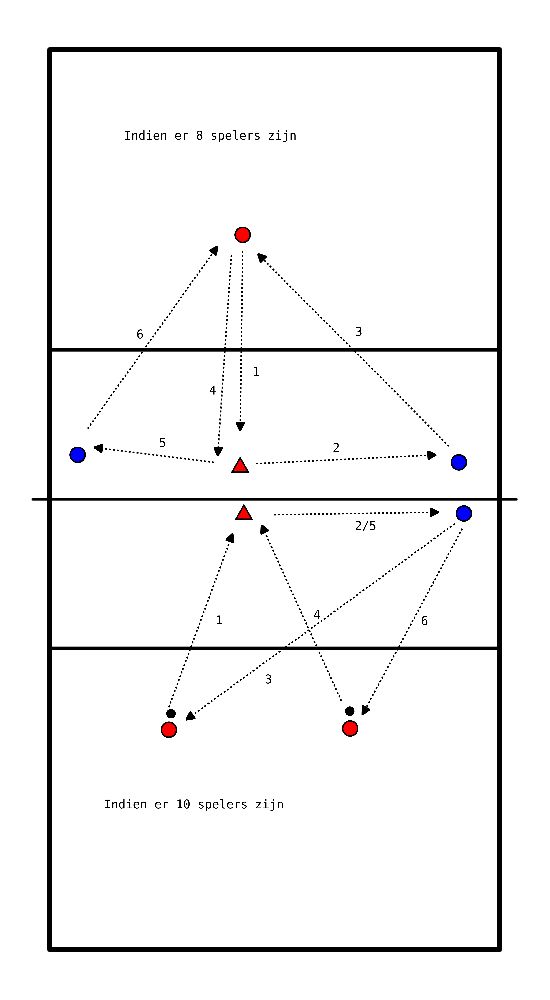
- 1 SV at mid position 3
- 1 player on position 2
- 1 player at position 4
- 2 passers backfield
- Passer at position 5 --> overhand to setter
- Setter setup to player position 4
- Passer at position 1 --> ball overhand to setter
- Setter setup backwards to player position 2
At 7 players --> see drawing top field and on bottom field then SV plays only 1 way.
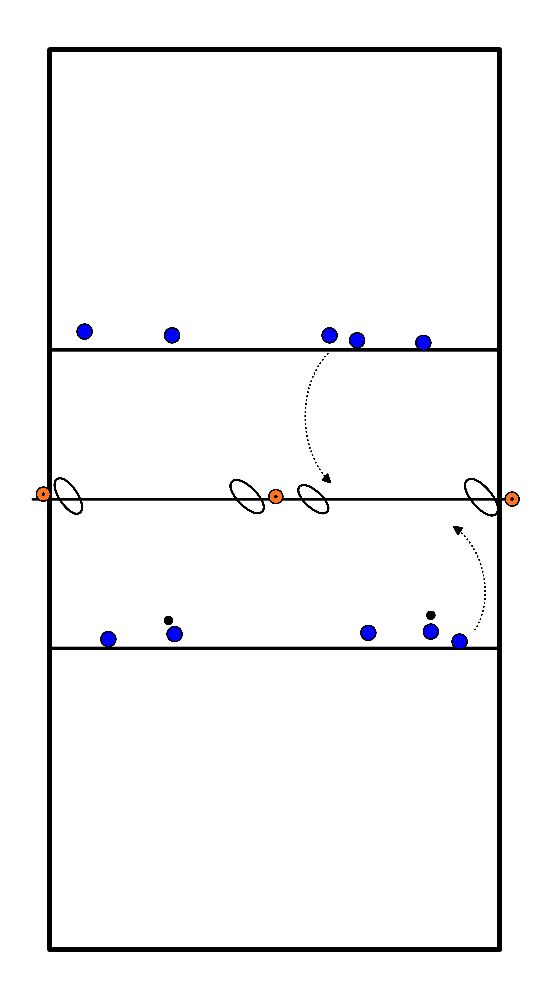
- field is divided into 2.
- 2 against 2 & 3 against 3.
- 4 hoops under the net.
- First build-up.
- Save: throw the ball over in overhand throw.
- Catch & throw
- Catch & throw
- Attack.
- Second build-up
- Save: Passing the ball with a collision ball over the net.
- Catch & throw
- Pass
- Attack
- Third build-up
- Save: Jump and after this a collision ball over the net.
- Volleyball contact
- Catch, throw up & pass
- Attack
- Fourth set up
- Save: hit the ball over the net via the ground.
- Volleyball contact
- Volleyball contact
- Attack.
- Setter taps the pass position with the foot (hoop). At 3-on-3 the passer runs in.
- Passing.
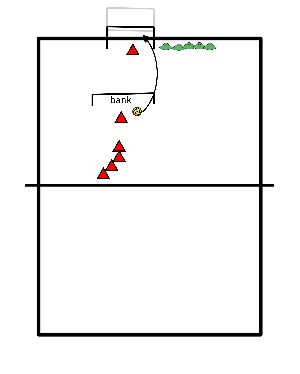
- Goal in the middle of the field against the wall, with one player in it
- Other players in a row
- Players throw/strike the ball at the goal and try to score in the goal. Each in turn.
- The player in the goal , blue, tries to keep the balls out of the goal.
Use 5 pawns as scoreboards.
Each player who scores may take a pawn away from the goalkeeper. At 5 goals switch players in goal.
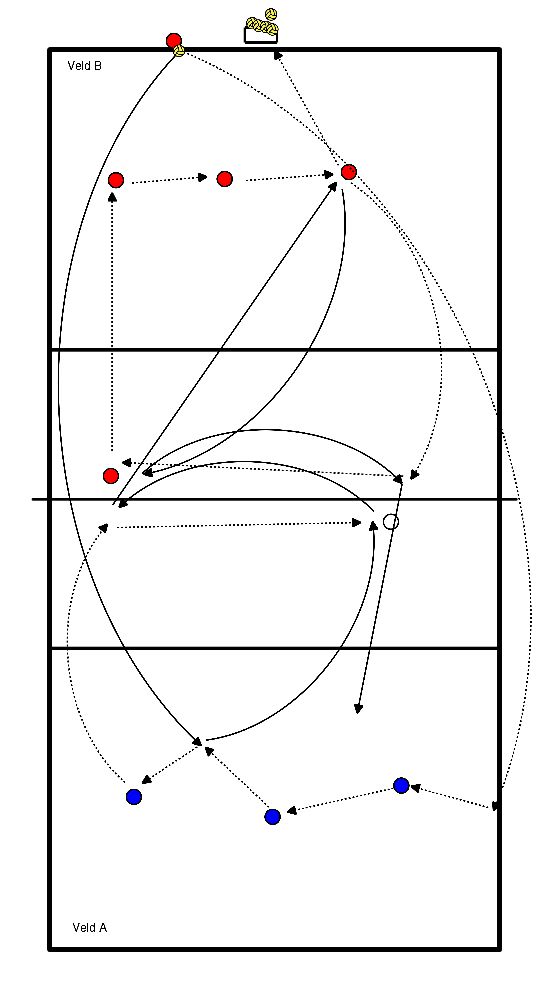
- 3 passers and "Sv" on 2 and reserve on 1
- 3 defenders and 1 sv/block on 2
- Ball is served. First trainer, then players.
- Pass by 1, 5 or 6 to p2/3.
- "Sv" gives a setup to p4
- Player on p5 runs a "C" and attacks the ball.
- Possible rally play
- "Sv" goes to get ball and then serve
- Field A:
- Reserve=>1=>6=>5=>2=>field B
- Field B:
- Reserve =>5=>2=>1=>6=>serve=>field A
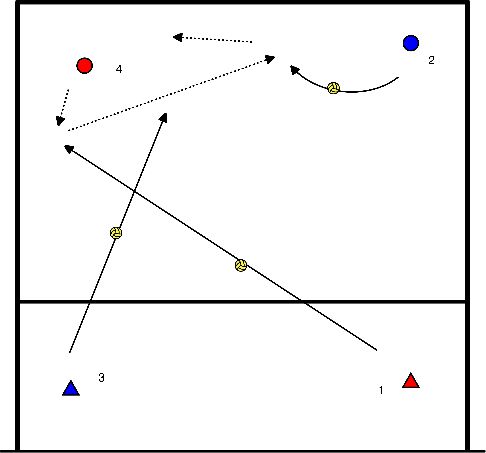
- A player is at work. (player 4)
- The other 3 players are lined up in different corners of the field. (see drawing)
- They make sure that the player can defend balls.
- Every time a player is down, it is the next player's turn.
- The exercise is carried out on one half of the field.
- Player 1 smashes into player 4, player 2 gives a short ball, player 3 smashes.
- After 3 balls we rotate one place:
- Player 4 to position player 2.
- Player 2 to position player 1.
- Player 1 to position player 3.
- Player 3 to position player 1.
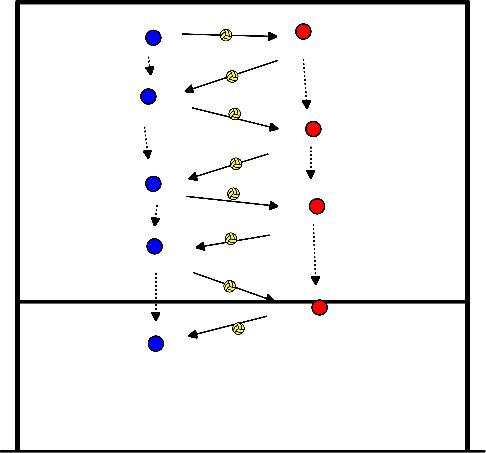
- Throwing the ball over the fence with pairs, overhead and underhand, meanwhile moving sideways:
- Each pair a minimum of 6 times throwing and moving the ball sideways - 2 rounds.
- Each pair to play the ball overhand at least 6 times - 4 rounds.
- Each pair to play the ball underhand a minimum of 6 times - 4 rounds.
- Each pair to play the ball with one arm at least 6 times - 1 round.
- When everything is over, start again until it's time.
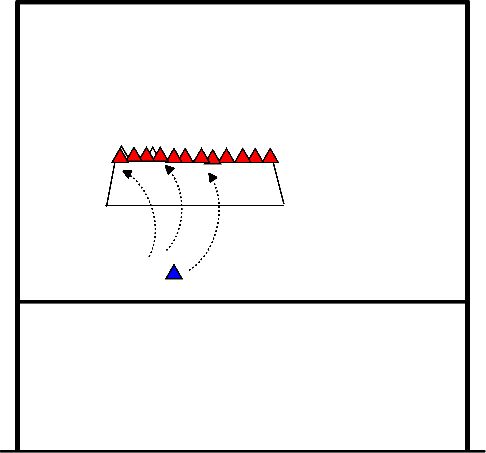
Arrangement of material:
- Cupboard with all the cones on it.
Game flow:
- The players stand at a certain distance from the cabinet, and throw/strike at the cones.
They try to throw off as many as possible in one go.
Remark:
- This can be done 1 by 1, but you can also have all the kids together knock the cones off.
- Can also be part of an exercise (reward).
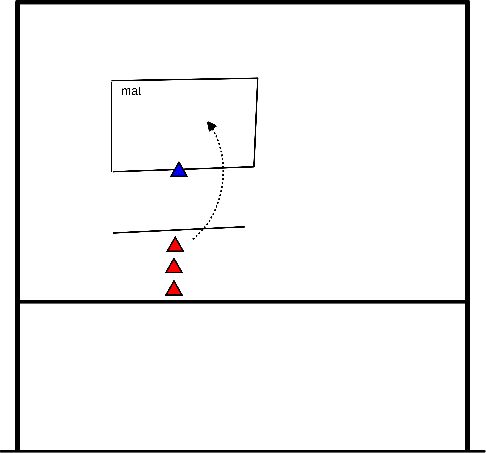
Arrangement of material:
- Mat against a wall
- Player 1 (blue) near the mat
- Other players (red), behind a certain line (depends on players)
Game flow:
- The players behind the line throw the ball to the mat
- Player 1 tries to keep the ball from the mat, he can do this with various movements.
As soon as one of the players touches the mat, they may take a marker from Player 1.
If Player 1 has no more marker disc, he loses and another player may take it. (number to choose, for example 5)
This is always fun to do, especially the smaller kids like it.
- You have a monkey= This person is appointed by the trainer. This person must try to steal the coconut without getting caught.
- You have a coconut= This is basically just the volleyball, or another ball.
- You have a monkey hunter= This person is also assigned by the trainer, but the monkey hunter is ''undercover'', so he is just a palm tree but if the monkey has the ball in his hand, he may tap the monkey.
- And finally you have the Palm Trees= These are all the other players who are not the monkey or the monkey hunter.
You put all the players in a circle on one side of the field, in the middle of this circle you put the ''coconut''.
The trainer chooses the monkey in the presence of the whole team. The monkey then moves towards a wall or stands somewhere with its eyes and ears closed, facing the other way so it cannot see the team. You then say "The monkey hunter is....." (you point out the child, do not say the name of the child). If everyone knows who the monkey hunter is you say that the monkey can come back. The space between the palm trees where the monkey goes in the beginning, he must go back again.
For example, if the monkey goes between John and Peter in the direction of the coconut, it cannot go back between Hans and John.
If the monkey takes the coconut outside the circle without being tapped, the monkey wins.
If the monkey is tapped before it leaves the circle with the coconut, the monkey hunter has won.
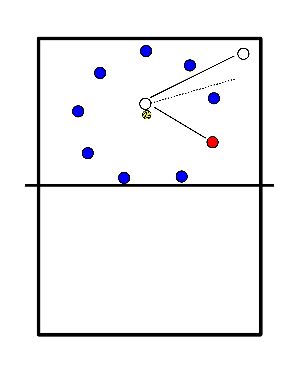
- The blue balls are the "palm trees" players.
- The red dot is the ''monkey hunter''. The monkey does not know who the monkey hunter is. The monkey hunter is trying to tap the monkey.
- The white ball is the ''monkey''. He is trying to get the coconut without being tapped.
- The yellow ball is the coconut.