



Volleyballexercises for technique block / net defense
- Line up attackers and blockers at the 3-meter line.
- The coach plays a rally ball to attacker 1.
- Blocker 4 moves to the net.
- Attacker 1 passes to the setter and calls where he wants the set-up (left, middle, or right).
- The blocker follows the attacker and attempts to block.
- The attacker retrieves the ball and joins the back of his own line.
- If the attackers score 10 times, attackers and blockers switch roles.
- Warm-up hitting on the outside and middle positions.
- Except for the setter, the other players consecutively perform a pass, an attack, and a serve.
- Player 1 throws a firm ball to player 7.
- Player 7 passes the ball to the setter.
- Player 1 moves to the other line and joins at the back.
- The setter delivers a set to player 6.
- Player 6 spikes the ball straight onto the mat.
- Player 6 retrieves their hit ball.
- Player 6 serves the ball to the other mat.
- Player 6 retrieves their ball.
- Player 6 joins the line.
- This can also be done with a middle attack.
- After 10 minutes, a block is added.

- 2 players with ball on field B
- 1 playmaker at position 2/3 on field A
- 2 passers on field A at 5 meters from the net
- 1 attacker on 3 meter line
- The rest in line along left sideline
- Player on field B passes ball to passer on field A
- The pass is followed by a setup on 4 that is attacked by player standing by
- blocking at position 2
- blocking on positions 2 and 3
- defense on position 5
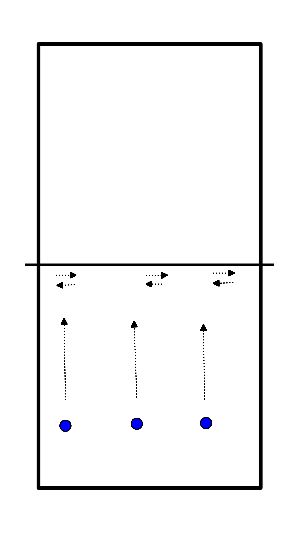
- Jump through; block and return. Slightly through the knees.
- Block with 1 lateral pass right and block again.
- Blocks with 1 side pass right and blocks and again to left side pass and block.
- Same as number 3 but then with Cross 'inside' right and again left.
- Info: if to right blocks start with your left leg, if to left blocks, start right leg.
- Same as number 3 but with Cross 'outside'.
- Info: if to right blocks right leg must also open to make your jump more powerful. reverse to left blocks.
- Block with 1 lateral pass right, idem to left. Straight inside cross, same to left. Straight outside cross, idem to the left.
- The base team of six gets successively from the small team a serve, an attack -trainer plays rally ball the small team- and a free ball.
- The trainer plays rally ball on the small team and they play the ball back in one go.
- If this succeeds, they rotate one spot.
- If this fails, the players from the small team switch with players from the base team.
- Service is made from position 5 on a pair; p/l & libero.
- After service, this person goes to defend at position 5.
- Side-out must be scored by attackers at position 3, 4 or 6.
- After the side-out, the coach hits balls from position 4 into the diagonal, which are defended by players at position 4, 5 and 6.
- From the defense again the attack must be scored. Rally is played out, after which everything starts again.
- Block shields position 1 and 2. After the pass/defense cover -don't do nothing-.
- Make good choices in game distribution.
- Efficiency training: 20 balls 10 x service & 10x defense.
- Serve from position 1, block at position 3 and 4. Shield position 4 and 5.
- Defending at position 1, 2, 5 and 6.
- Attacking at position 1, 3 and 6.
The middle players take turns "working".
- Blocking at position 3 on the ball.
- Blocking on 4 on thrown ball, making space and attacking run on 3.
- Blocking on thrown ball on 3 and finally blocking on position 2 on hit ball.
- After blocking, dive to the 3-meter line and join the strike.
- The one who struck goes to block, and so on.
- When the one who attacked steps in to attack, the outside blocker joins in.
- Passer starts at position 5, with foot on the three-meter line.
- Ball is thrown up and hit from position 1 other side.
- When thrown up, the passer may move.
- Catcher runs in from position 4 to 2/3 and takes place on the mat.
- Pass on mat is 1 point, catcher then serves from 1 to 5.
- In the zone is 1 point, on the mat is 2 points.
- Then retrieve ball and attack.
- Whoever gets to 15 points first wins.
Variation
- Same, only now with 2 regular players, who take turns starting from position 4.
- An attacker is now added.
- The passer and passer make room for the new passer.
- The one who attacked serves again.
- The one who attacked goes to defend in the straight and then goes to block.
- The one who blocked becomes the reserve passer.
- Points can be gained by good pass, good service, score in attack or good defense, block can catch ball.
- Who will reach 20 points first?
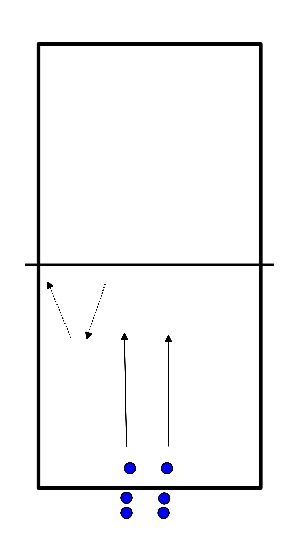
- Blocks middle, side to corner and block there too.
- Blocks middle, defense facing net to 4 meters, attack on corner, defend facing net to 4 meters etc.
- Blocks middle, 5x dive on 3 meter line, 5x block on corner, dive 3 meter line.
- Same as 3 but after dive on 3 meter still defending on attack T.
- There are 3 threesomes, a 1 playmaker and 1 libero.
- 1 trio will serve and defend, 1 trio will block and 1 trio will pass, along with the libero, and attack.
- Sets always start at 18-18 and the match is played between attackers and defenders/blockers.
- Attackers can only score directly from the side-out.
- If the ball is defended, it must be caught by the right forward.
- If that succeeds, it is a point for the defenders/blockers, otherwise for the attackers.
- Trainer/player and ball pit on field B p4.
- Block field B on P2/ P3 and defend p5.
- 2 players on field A on P2/ P3 block.
- Defending field B on P4 and P5.
- Trainer/player hits ball to P4/ P5.
- Block and turn immediately after the action.
- Defend ball, setup and attack on P4.
- Block-defend-catch.
- Players stand in the corners of one half of the game. Players at the net throw straight ahead, players in the backfield throw diagonally. Everyone runs after their ball.
- Same, only the players at the net play overhand and the players in the backfield play underarm.
- Same, only everyone on one side of the court and the ball is thrown in over the net from the other side, with an attacking run.
There is one distributor on 2/3. Pass from position 1, set-up to 4. Pass from position 5, set-up to 2.
Passer takes up attacker's position and attacker retrieves ball and takes up position of the one who threw up, attack placement on mats.
The one who threw up joins the other row. - Same, only the one who threw now stays in position to block once. After the block pass. Other remains the same.
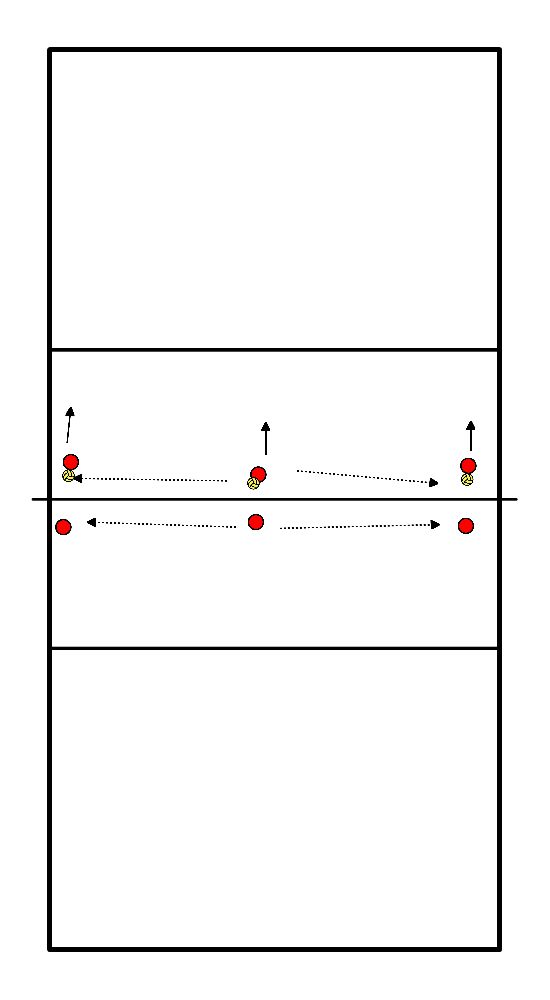
- 2 players facing each other in the middle.
- Dominant side has ball.
- Both block and the non-dominant side taps the ball with two hands.
- After landing, dominant side chooses a side and moves sideways to the antenna and jumps again with ball which is tapped over the net by the non-dominant side.
- Then 1 blocked player, 2 players with balls behind them, 1 attacker on the opposite side. Ball is thrown over the blockers to the attacker.
- Blocker watches arm of attacker and blocks ball to position 6.
- Extend to 2-block with slide and centre, including movement.
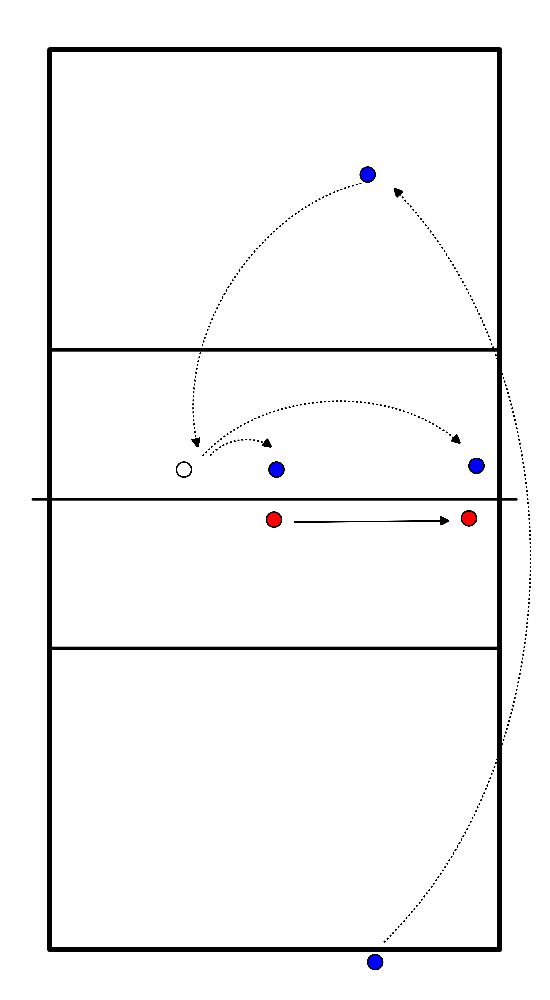
- This exercise is about the movement of the middle block and cooperation with the outside blocker.
- The ball is introduced through service or throw in (by the trainer or team-mate).
- Service is towards the passer.
- Passer brings the ball to the distributor.
- The distributor sets up the attack.
- After 10 attacks the game is continued.
- Players prefer to play on their own position.
- Important for the exercise:
- The playmaker communicates with his attackers about the desired attacking position and speed (especially the alternation between rise and short of the middle attacker).
- Mid block jumps with a rising attack (not full).
- If the ball goes outside, he lands on his left foot and moves outside to set up a two-man block (connecting).
- If the ball is played over middle, the outside blocker steps out to make a pass if the ball falls short or is hit.
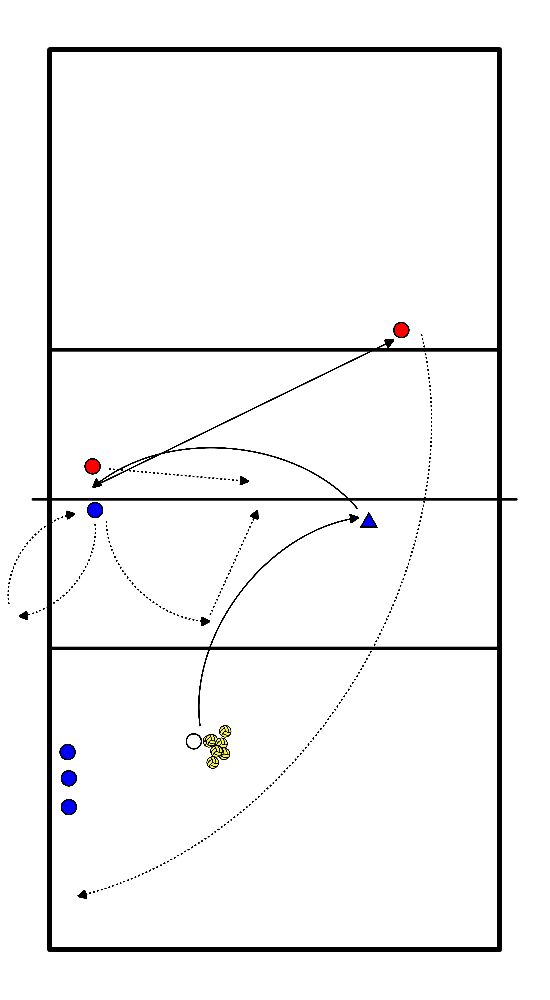
- Organization:
- Trainer throws to playmaker on p2/4 on field A.
- Every 5 setups the players are changed.
- On p4 an attacker stands at the net.
- On court B there is a blocker on p2 and a defender on p5.
- Execution:
- Trainer claps on the ball and throws to.
- The attacker walks back from the net at the moment of hit and attacks the setup on p4.
- She then runs back again and attacks a 2nd ball at p3.
- The block on field B moves with her to p3.
- Running directions:
- Attacker becomes block.
- Block becomes defense.
- Defense retrieves the balls and becomes attacker.
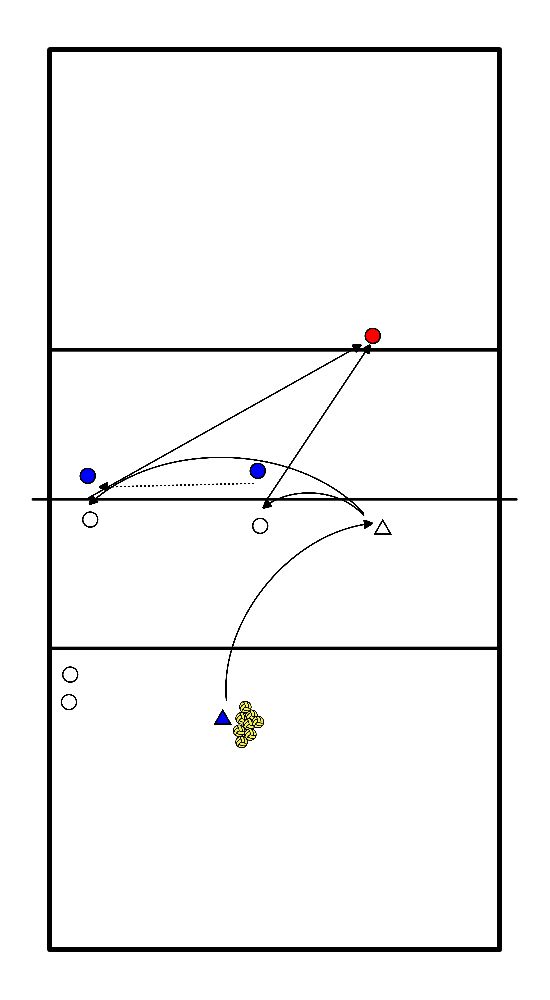
- Organization:
- Field A:
- Sv on p2/3, attackers on p3 and p4.
- Field B:
- Block on p2 and p3 and libero on p5.
- Field A:
- Execution:
- Tr throws balls at field A.
- Sv. gives setup to p3 or p4.
- On field B the block on p3 chooses whether to attack on p3 or on p4.
- Block attack and possibly catch the defended ball.
- Attention Point:
- Block must read setupper and make a choice based on that.
- Prevent "gambling".
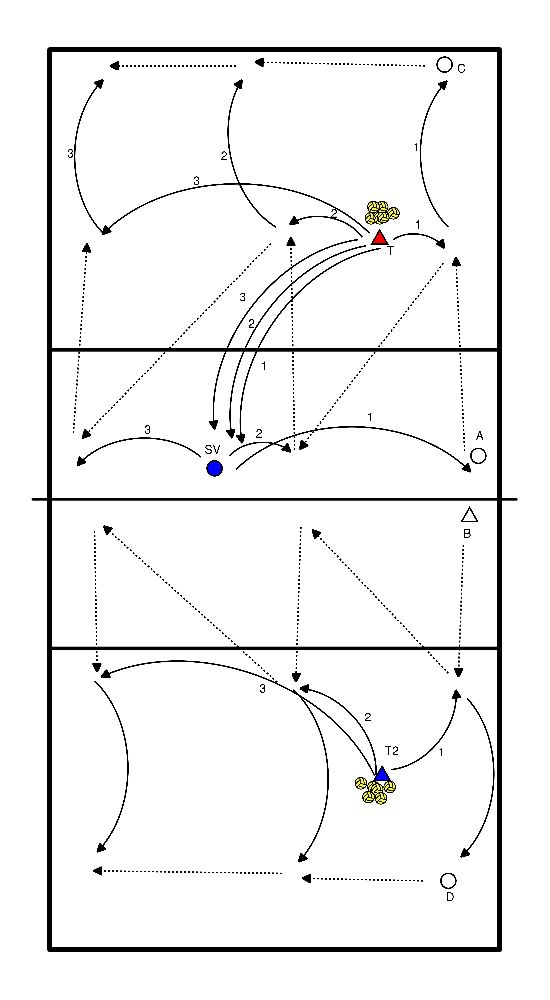
Goal: improve condition in combination with attack/block/defense
T throws a total of three balls to SV.
- T throws ball to SV.
- SV gives a set-up pos 4 , where A attacks. Immediately after the attack T throws a ball, A defends ball back to C.
- After defense T, throws ball 2 to SV. SV 2é pace to A --> attack, C throws ball --> A defended back.
- T throws 3e ball to SV. Sv set-up to pos. 2, A attack on pos. 2, after attack Ball defend.
On the other side of the net.
- B same as A.
- B tries to block A's attack.
- After each block, defend ball from T2.
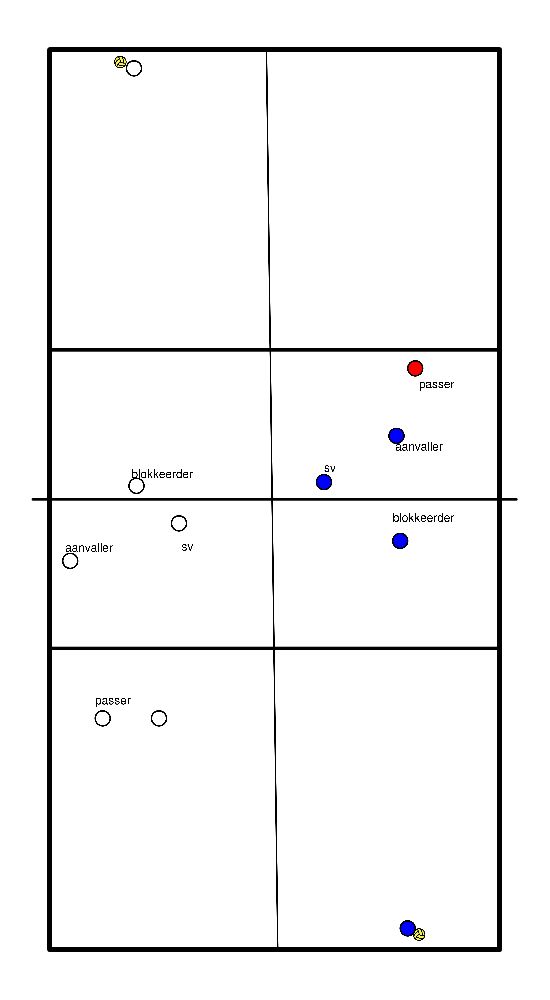
- field is divided in 2 parts
- on side 1 are 1 playmaker, the libero and the middle attackers
- on side 2 are the other players
- there are on each side 1 attacker and 1 blocker and a server.
- depending on the number of players there is 1 passer or 2 passers.
- the purpose of this exercise is to get in agreement with the distributor which ball you want to play.
- With the middle players we will practice on the 'rise' balls and other variations such as the 'neck'.
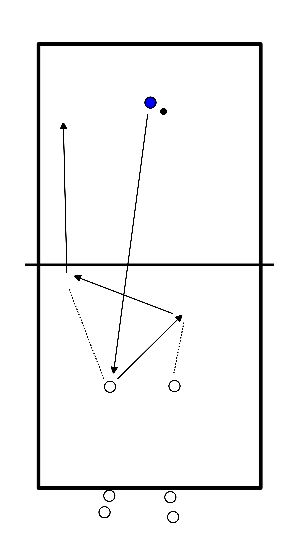
- 2 rows behind the back line.
- First 2 stand in the field.
- Trainer brings in ball.
- Pass left player towards position 2/3 then setup of right player.
- The passer goes to attack on own side of the court.
- The setupper does attack coverage.
- The two teams rotate to form a new pair.
- Extension: There are now 2 attackers at the net.
- The rest do exactly the same as before.
- Attackers come back from the net after the coach has brought in the ball.
- The setup always goes to the opposite corner from the set-upper.
- Pass from the right back, then left back setup on the right front.
- Set-upper covers and takes the place of the attacker.
- The passer remains standing and so does the non-offending player.
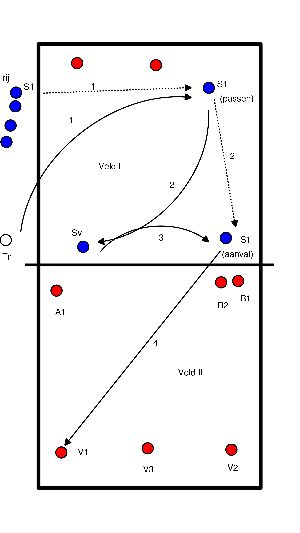
Warming up / all-round training
Each player will pass, attack, distribute, block, defend, rally, with turnovers.
#2 means
- Trainer stands with cart with balls at the pole at #2 (position 2)
- Players stand outside the field at the side of #1 and a playmaker at # 2/3
- First round starts with Trainer throwing the ball to #5, player 1 runs from the sideline to the ball and plays it to the distributor.
- Start with "blue players" (see drawing), then extend with "red players
Further course of play:
- Tr throws ball for S1 to #5
- S1 runs in and plays to Sv (#2/3)
- Sv gives setup to the outside (#4)
- S1 attacks.
- Turn over: S1 becomes Sv, Sv gets the ball and joins the line at #1.
Expansion 1
- Sv turns to the other side of the net and becomes a blocker.
Now the same steps as above, but with the block opposite the attacker. - Turn over: S1 (has just attacked) becomes Sv at #2/3, Sv
passes under the net and becomes B1 at #2B1
who, after blocking, goes to get the ball and joins the row.
Extend 2
- After blocking at #2, player goes to defend at #5. Attacker is obliged to pass to #5.
- When the ball is defended a rally may be played (2 vs. 2)
- After end of rally or no defence or fault in attack, turn over
Extend 3 and more
- One can extend with a 2nd blocker, 2nd and 3rd defender (on resp. #1 and #6)
- More players can be added to field I (so players from the sideline move in when a rally arises)
- The passing game becomes S1 (passing and attacking) -> Sv -> B1 (#3) -> B2 (#2) -> V1 (#1) -> V2 (#6) -> V3 (#5) possibly A2 (#4) and then connect again.
- You can expand to 6 against 6, so start with blue, then B1, then B2, then V1, then V2 (when continuing the game, first V2 and then V1), then V3 (continuing the game with V2, V3, V1) and then possibly A1. In the meantime, players in field I must be added.
- If there are several players in Area I, you can choose to throw in a ball on S1 at #5 instead of throwing in a ball through Tr.
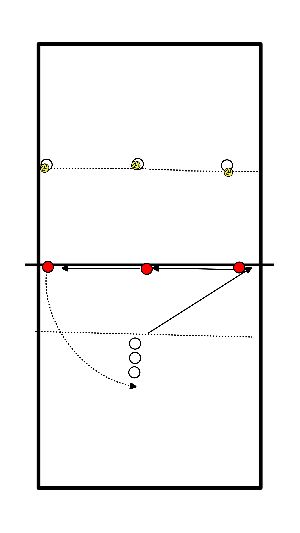
- 3 players on 1 side of the net on 3m line
- the other 3 in a row also on the 3m line on the other side of the net.
- Player 1 leaves and goes to block on position 2,
- on the other side she receives a ball from a player on the 3m line, which she will block.
- Then the player moves with cross pass to the middle, there she will also block a ball thrown to her.
- Finally, she receives a ball at position 4 and blocks it there as well.
- While one player is already blocking in the middle, the next one can already start at position 2
- After a number of times, you can switch
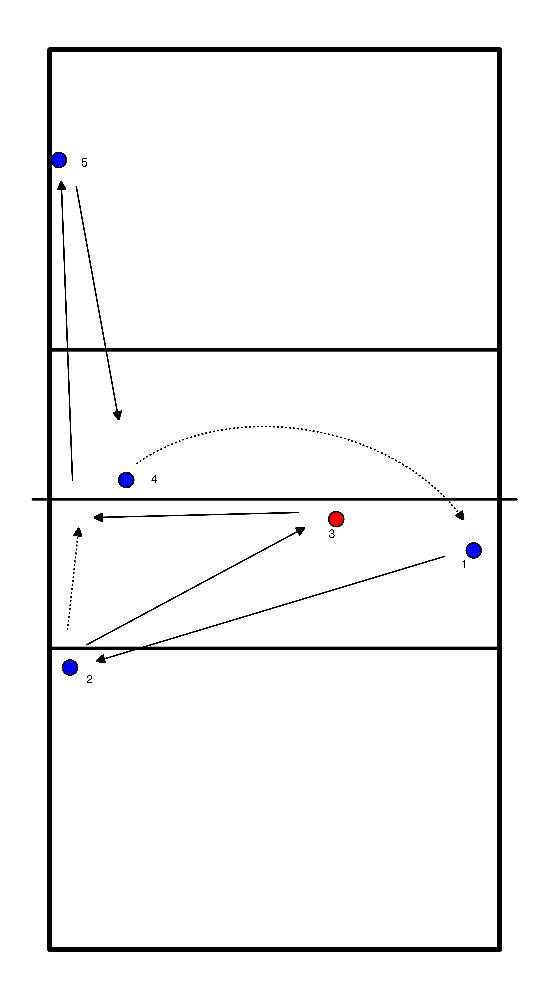
Hitting on the outside and the middle
Then
Except for the playmaker, the other players perform successively a reception, an attack block and a defence.
The exercise goes as follows:
- 1 player 1 hits a technical ball to player 7
- 2a player 7 passes the ball to the play distributor
- 2b player 1 walks to the other line and closes at the back.
- 3 the play dealer gives a setup to player 6
- 4 player 6 smashes the ball on the line or diagonally
- 5 player 6 retrieves his batted ball himself
- 6 player 6 serves the ball to the other mat
- 7 player 6 retrieves his own ball
- 8 player 6 joins row
- This can also be done with a middle attack
After 10 minutes a block is added
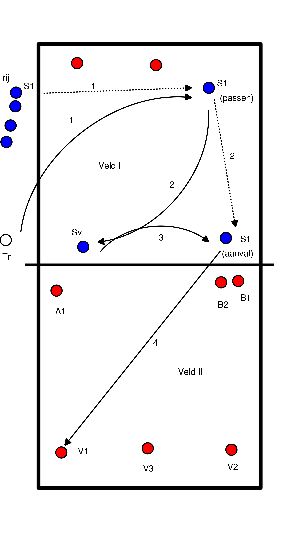
Warming up / all-round training
Each player will pass, attack, distribute, block, defend, rally, with turnovers.
#2 means
- Trainer stands with cart with balls at the pole at #2 (position 2)
- Players stand outside the field at the side of #1 and a playmaker at # 2/3
- First round starts with Trainer throwing the ball to #5, player 1 runs from the sideline to the ball and plays it to the distributor.
- Start with "blue players" (see drawing), then extend with "red players
Further course of play:
- Tr throws ball for S1 to #5
- S1 runs in and plays to Sv (#2/3)
- Sv gives setup to the outside (#4)
- S1 attacks.
- Turn over: S1 becomes Sv, Sv gets the ball and joins the line at #1.
Expansion 1
- Sv turns to the other side of the net and becomes a blocker.
Now the same steps as above, but with the block opposite the attacker. - Turn over: S1 (has just attacked) becomes Sv at #2/3, Sv
passes under the net and becomes B1 at #2B1
who, after blocking, goes to get the ball and joins the row.
Extend 2
- After blocking at #2, player goes to defend at #5. Attacker is obliged to pass to #5.
- When the ball is defended a rally may be played (2 vs. 2)
- After end of rally or no defence or fault in attack, turn over
Extend 3 and more
- One can extend with a 2nd blocker, 2nd and 3rd defender (on resp. #1 and #6)
- More players can be added to field I (so players from the sideline move in when a rally arises)
- The passing game becomes S1 (passing and attacking) -> Sv -> B1 (#3) -> B2 (#2) -> V1 (#1) -> V2 (#6) -> V3 (#5) possibly A2 (#4) and then connect again.
- You can expand to 6 against 6, so start with blue, then B1, then B2, then V1, then V2 (when continuing the game, first V2 and then V1), then V3 (continuing the game with V2, V3, V1) and then possibly A1. In the meantime, players in field I must be added.
- If there are several players in Area I, you can choose to throw in a ball on S1 at #5 instead of throwing in a ball through Tr.
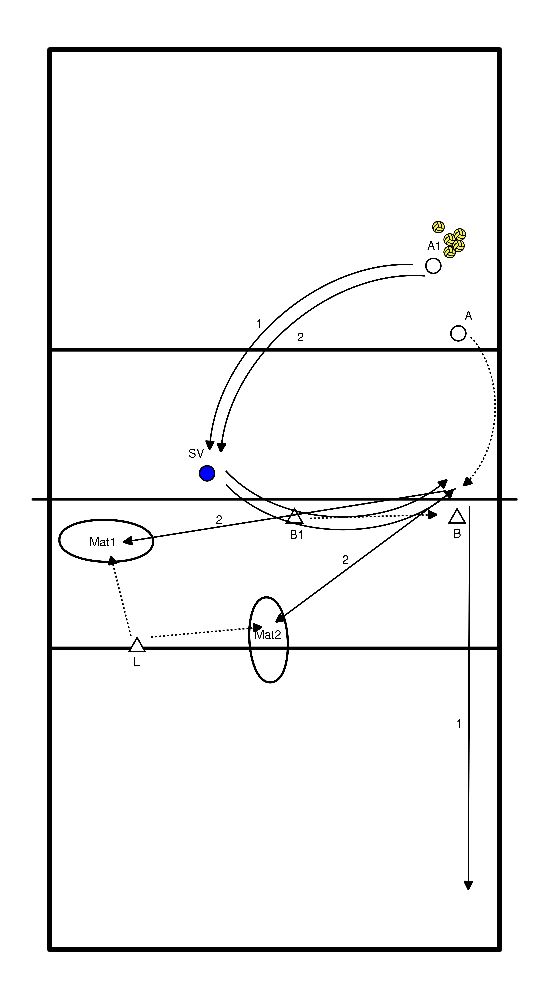
Goal : develop game insight for attack
- A1 plays the ball to SV.
- Sv set-up to pos.4 where A attacks.
- At the moment A attacks, A1 plays a second ball to SV.
- B & B1 take care of the block. (B1 always starts from pos.3), L defense.
- Second attack of A. place ball. L stands on a mat. Where L is not standing should be played to.
We try to grow into a match form. Block gets points when attack can be stopped. Attack when scored or ball on the mat. Defender when defended.
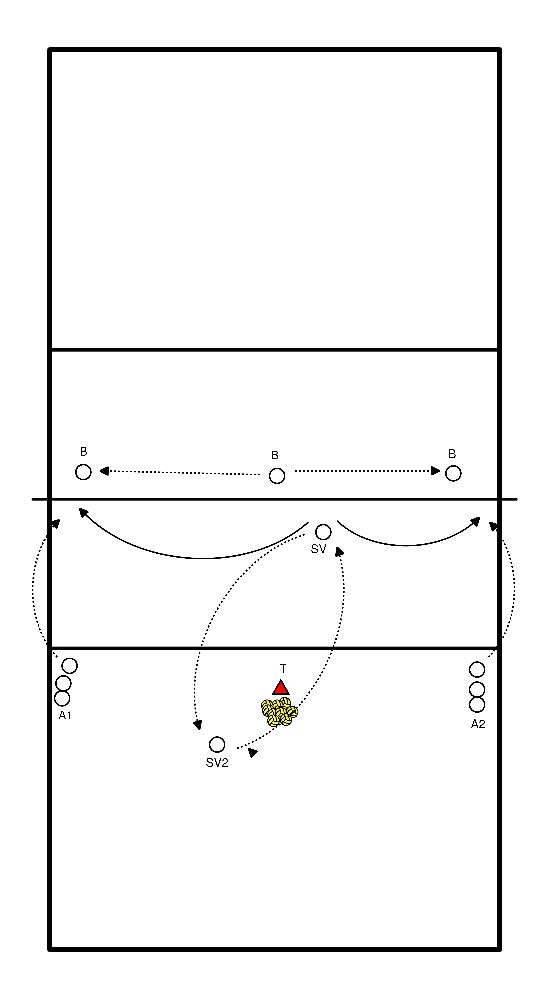
Goal of the exercise is, the playmaker must try to make sure that on the other side of the net a double block can not be formed.
- T plays the balls at a high pace towards pos. 3.
- SV walks in and gives set-up for -or backwards to fool the block.
- B tries to come to a drawbar block on attack.
- SV passes around T after set-up.
- SV1 & 2 switch positions after each set-up.
Expansion :
- Add field defense. (Liberos)
- B's play ball high back over to attacker passing towards pos 3/2
- Exercise starts again from pass attacker.