



Volleyballexercises for technique general
Last update: january 2026
Execution
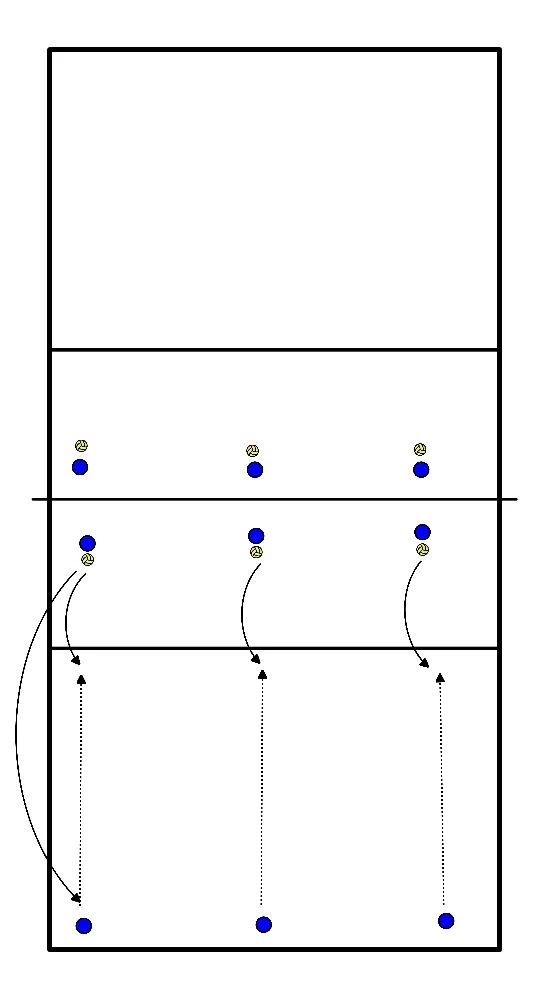
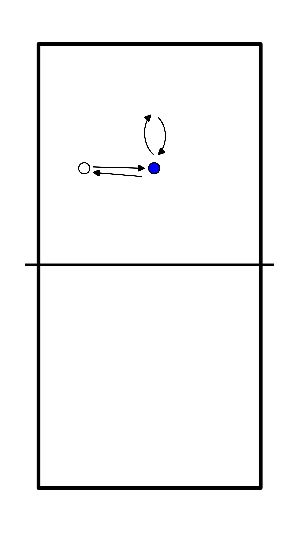
- Player 1 stands at the net and tosses both deep and short balls to their partner. The partner moves forward and backward to set the ball back to Player 1. (2 min)
- From the net, Player 1 tosses both deep and short balls to their partner. The partner moves forward and backward to pass the ball back to Player 1. (2 min)
- From the base, Player 1 tosses a deep ball to their partner. The partner moves back to bump the ball to themselves, then sets it forward, and moves to cover a short tip. (2 min)
- From the base, Player 1 hits a deep ball to their partner. The partner moves back to pass the ball back to Player 1 and then moves forward to cover a short tip. (2 min)
- From the base, Player 1 hits a deep ball to their partner. The partner moves back to pass the ball back to Player 1, then moves forward to cover a short tip, and finally goes to receive a deep free ball. (2 min)
Execution
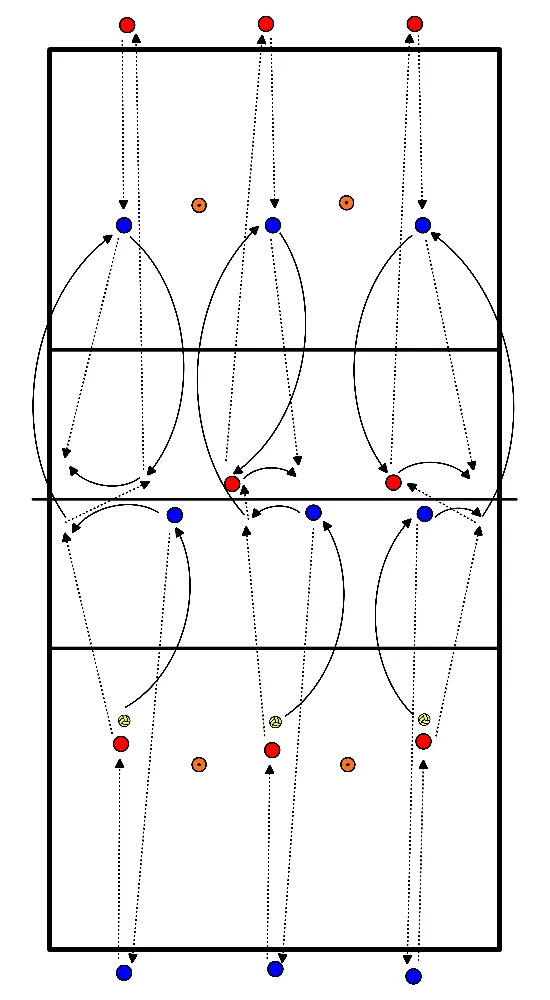
- 3 Touches: Dig the ball for yourself and pass it to the setter. Then, hit the ball to your partner on the opposite court. After hitting, switch courts to become the setter for your partner. Continue this cycle for 3 minutes.
- 2 Touches: Dig the ball directly to the setter, then hit it to your partner on the opposite court. After hitting, switch courts to become the setter for your partner. Continue this cycle for 3 minutes. After setting, the player should move to the end line.
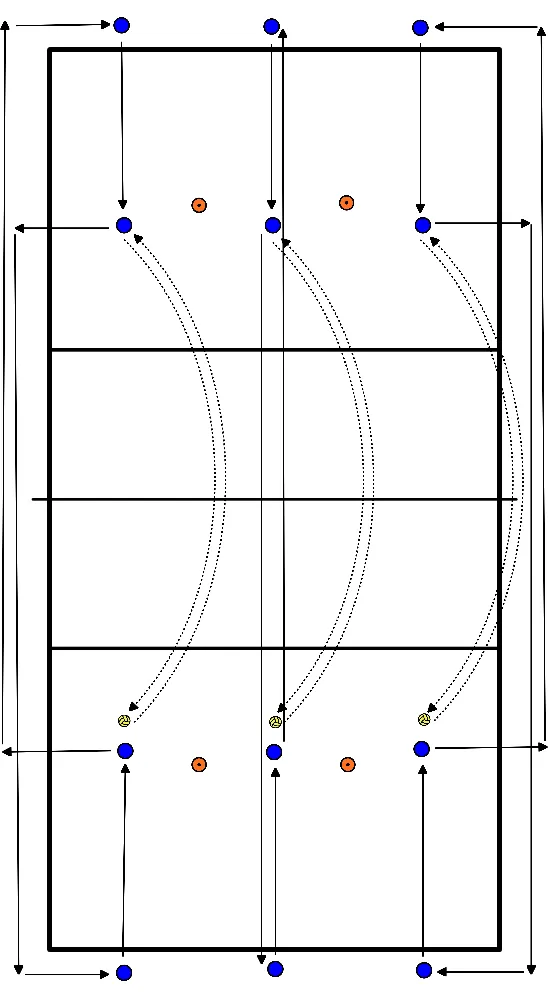
Introduction
- This drill focuses on improving your ball control skills, including setting and bumping, with varying numbers of touches.
2 Touches Drills
- Set yourself and then set to your partner for 2 minutes.
- Bump yourself and then bump to your partner for 2 minutes.
- Bump yourself and then set to your partner for 2 minutes.
1 Touch Drills
- Set directly to your partner for 1 minute.
- Bump directly to your partner for 1 minute.
3 Touches Drills
- Bump yourself twice and then set to your partner for 2 minutes.
- Set yourself twice and then bump to your partner for 2 minutes.
- Set yourself, bump yourself, and then set to your partner for 2 minutes.
- Bump yourself, set yourself, and then bump to your partner for 2 minutes.
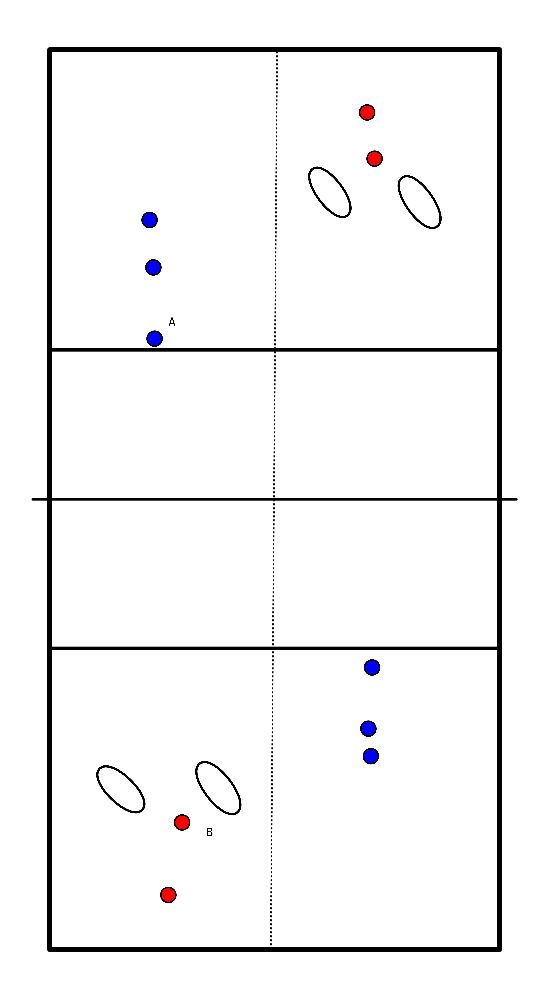
Organization
- 2 hoops on 1 side of the field
- 2 players behind the hoops
- 2 players on the side without the hoops.
Gameplay A
- Player A collides the ball in front of himself and keys it across the field towards 1 of the 2 hoops.
- Player B collides the ball and dribbles with the ball to the other side, The dribbling is done with the hand which side the ball collided; Left side collision is left hand dribbling. Right side collision is right hand dribbling.
Match form: Can the first player score in a hoop or not? against the hoop = 1 point. In the hoop is 2 points.
Gameplay B
- Player A throws the ball up in front of himself and keys it across the field towards 1 of the 2 hoops.
- Player B bounces the ball and dribbles only 1 more time towards the net. after this the player keys over the net and catches his own ball. player B joins back behind.
Game sequence C
- Player A throws the ball up in front of himself and keys it across the court.
- Player B throws a hoop at the place where the ball will collide (ball insight); after this he calls an attack position 4 or 2.
- Player C moves sight to the ball and dribbles to the net, makes a high dribble and keys to the attacking player.
- Player B keys the ball in 1 contact over the net and catches his own ball
If it goes well 2 players play against each other max 2 times and after this move on.
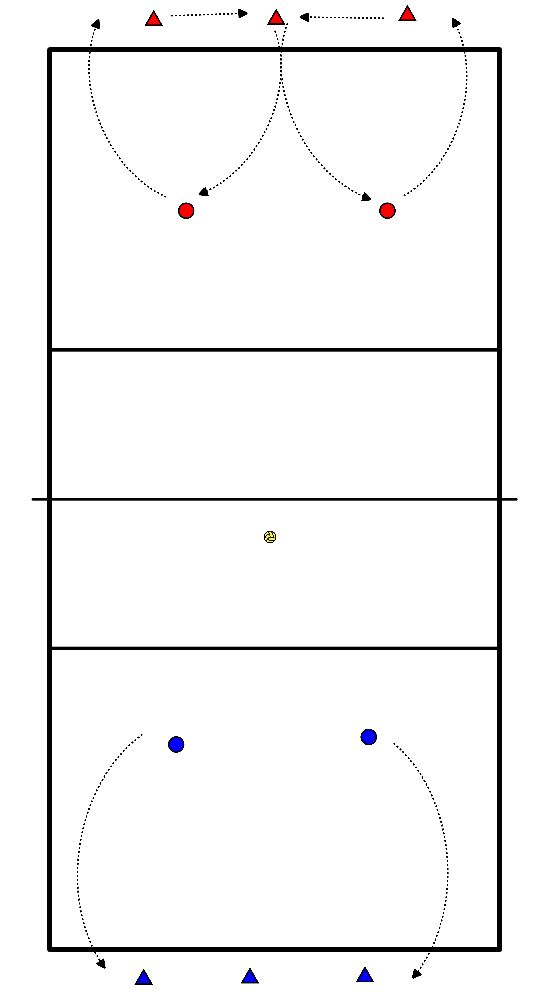
- Two teams of up to 4 people, 1 ball.
- On both sides 2 persons in the field, other persons behind the back line.
Goal: score in 1x in the other field, inside the lines.
Rules:
- Start with simple underhand service
- We play underhand tennis, so in 1x over the net.
- Difficult ball may bounce 1x, but then the ball must be returned with: one hand, one foot or the head.
If a mistake is made, the player leaves the court, goes to the back line, and a new player takes over.
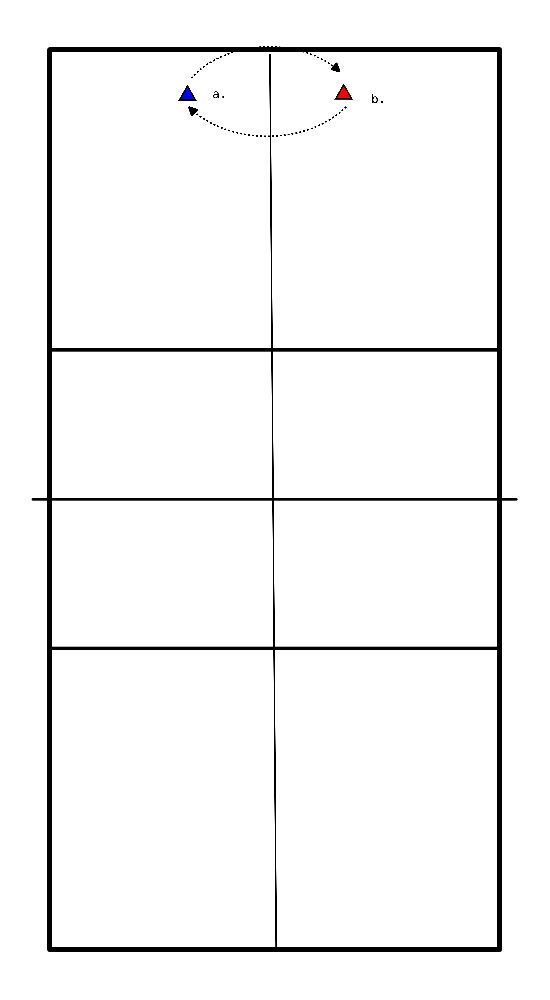
Players face each other on opposite sides of the net. Each player has a ball.
- Player a. and player b. simultaneously throw underhand over the net with 2 hands and catch each other's ball
- Match: each player throws over the net 10 times! Which pair is the fastest?
- Player a. chooses from rolling under the net or throwing over. Player b. must do the opposite. Choose and switch 5 times each
- Player a. and player b. simultaneously throw underhand over the net with 2 hands and now catch each other's ball in key position overhead.
- Player a. and player b. simultaneously throw underhand over the net with 2 hands - now key each other's ball vertically above the head and now catch in key position above the head.
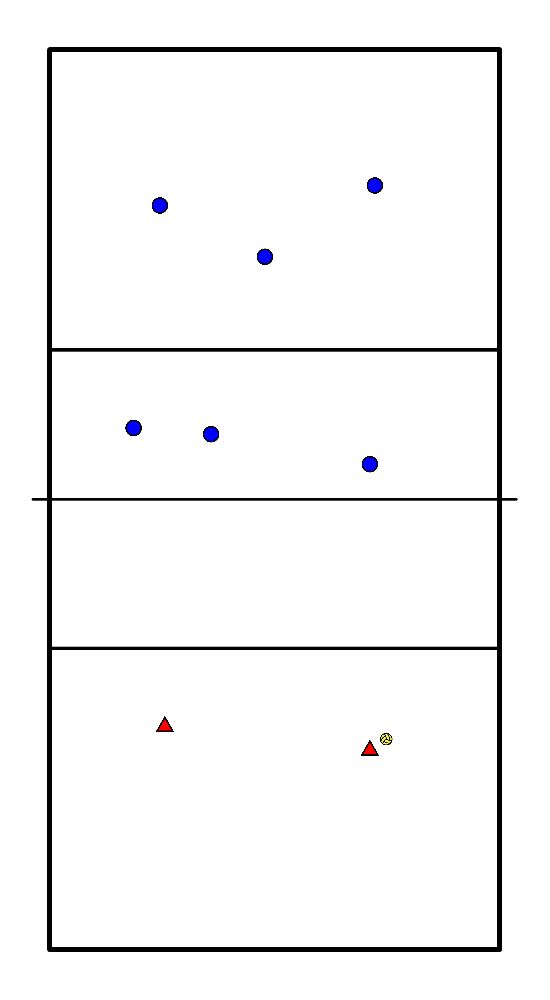
- 2 teams are made.
- 1 team starts in the field, the other team stands at the side.
- A ball is thrown into the field by the trainers. This MUST be played in 3x over the net.
- If it is only passed once, then it is 2x no play -2x2=4x push-ups.
- If the ball is passed 2x, it is 1x2=2x push up.
- If the ball is played 3 times but goes out or into the net, then it is no point -3x2=6x push-ups-.
- Once one team is out, the other team comes in.
- The ball played over the net must be near the trainers so they can continue the rally.
- The trainers may only play on when the team has played 3 times.
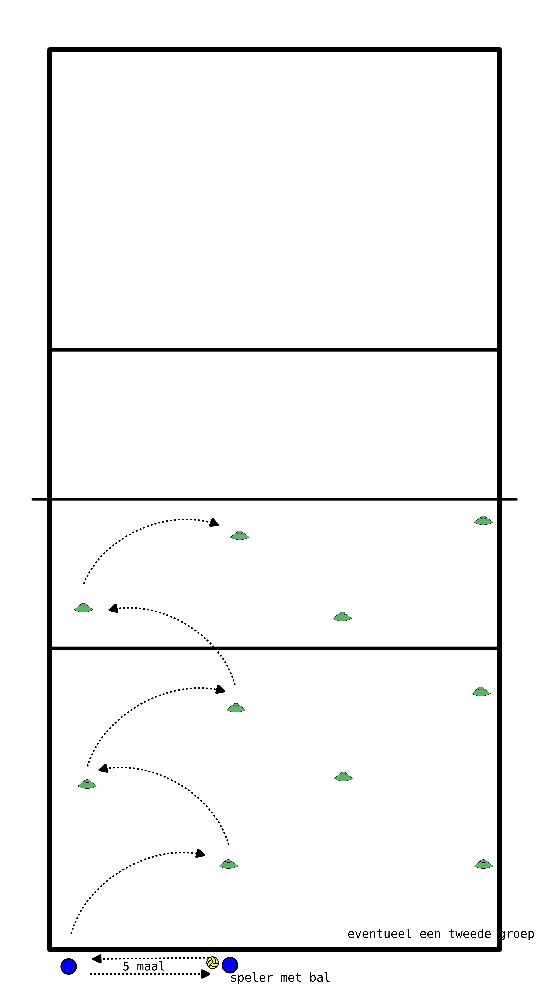
Players stand in pairs with 1 ball.
Start about 2 meters apart.
Repeat the same thing 4 times each time. Then player switches places with their playing partner.
Start about 2 meters apart.
Repeat the same thing 4 times each time. Then player switches places with their playing partner.
- On belly and they push the ball back and forth 5 times - then course OH throwing to each other. After throwing, player moves via side shuffle.
- On belly and they push the ball back and forth 5 times - then course overhand keying/pushing - catch ball each time.
- On knees start with 5 times keying/pushing - then course overhand keying/pushing - 1 player catches - 1 player keys back immediately.
- Starting on knees with 5 times keying/pushing - then overhand keying/pushing - who can continue keying?
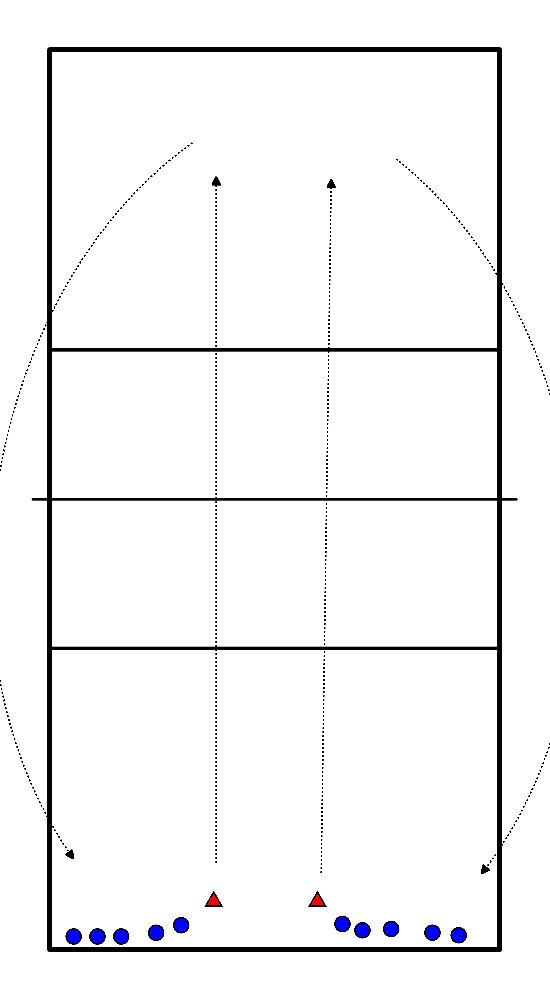
- Make 2 rows with 1 trainer each.
- Each player has a ball.
- We roll the ball to the opposite side of the field.
- Player tries to stop ball before the back line.
- The ways of rolling - stopping:
- Player stands - rolls ball - player stops ball.
- Player is sitting - rolling - player stops ball.
- Player lies on belly - rolls - player stops ball.
- Player lies on belly - rolls - player stops ball by lying in front of ball and stopping with forehead.
- Player lies on belly - rolling - going around ball - passing ball through legs - player stops ball.
- Player next to trainer - trainer throws ball - player catches ball OH after max 1 bots.
- Player next to trainer - trainer throws ball - player runs under ball and turns towards trainer - player catches ball OH after max 1 bots.
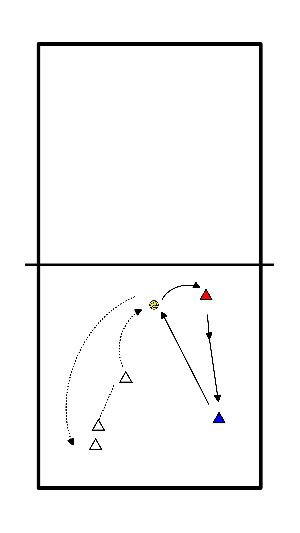
In beach volleyball, learn to set and play compactly.
- 1 player at the net as attacker.
- 1 player in defense (line).
- The other players take turns to give a set on defense.
- After their set they go back to the back of the line.
The coach pays attention to the following
- That the defense brings the ball in compactly.
- That the setters distribute the ball to the attacker with the right footwork, hand technique and height.
- They also have to bring their set to the right hand of the attacker.
- Per person 2 balls
- One ball between the legs/under the arm, other in two hands on a side of choice, throw ball straight up and catch with two hands
- When the ball is up on one side, throw the other ball up on the other side.
- Keep arms straight, throw as much as possible straight up
- Pairs 2 balls.
- One person throws a ball straight to the other person
- Meanwhile the other person throws his ball straight up and throws it back.
- Then catch your own ball
- Purpose of exercise:
- Improve motor speed.
- Explanation of the exercise:
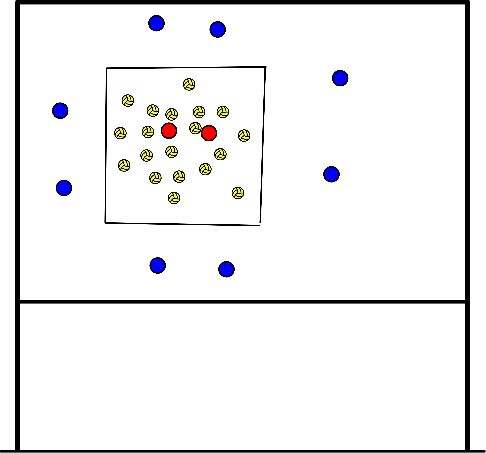
- Make a square of benches and throw in all the balls you have.
- Place two players in the square and the rest around them.
- At the sign of the trainer the two players will try to throw all balls out of the square.
- The rest of the players have to throw all the balls back into the square.
- After 60 seconds the exercises are stopped and the two players count the number of balls in the square.
- The winner is the one who has the least number of balls in the square.
- Everyone takes their turn.
- Duration of the exercise:
- 20-25 min.
- Explanation:
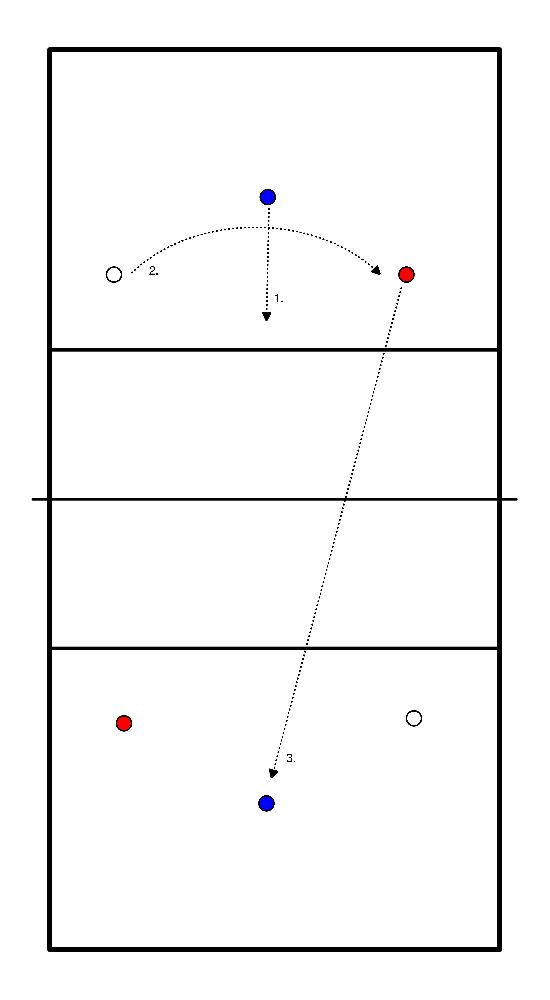
- 2 teams of 3 players
- Per team 3 volleyballs (different balls so you can tell the difference, 2 'baby' and 1 'normal' ball)
- The team must play the 'normal' ball over the net in 3 times and meanwhile the 'babies' are thrown over.
- Each player may only touch the 'normal' ball once!
- (When a player has played the 'regular' ball, he gets a 'baby' thrown to him)
- Starting positions:
- Mid-back has no ball. Mid-back has no ball (he passes the ball to the distributor).
- Distributor gives a set-up on the outside.
- 3rd player plays the ball over the net. (At first do not attack, only if it goes well!)
- Learning to pass to playmaker (position 2) with movement towards the ball.
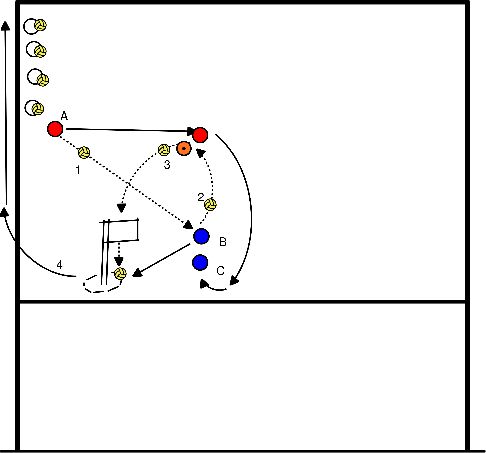
- Line up at position 1.
- Players there have a ball in their hands.
- Player A plays to player B at position 3.
- Player A moves sideways to position 6.
- Player B plays the ball back to position 6.
- Player A plays the ball (preferably) BH to the korf basket at position 2.
- Player B catches the ball and joins the line at position 1.
- Player C moves into position player B.
- Player A moves to player C's position, position 3.
- On the other side of the net you can practice the same.
- Later on, alternate with player instead of basket, place of throw, position of return and position of pass.
- To learn to always pass to the distributor.
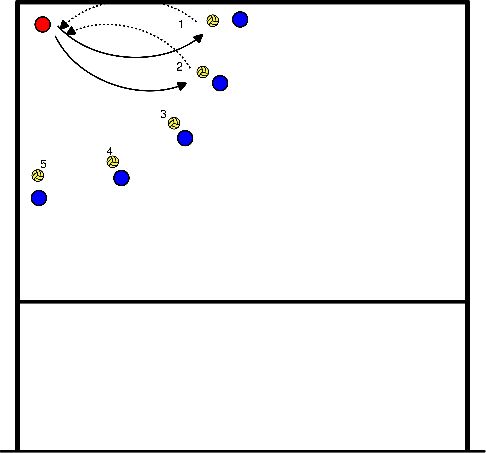
- Objective:
- Increase responsiveness.
- Place one player in the corner of the field.
- Have at least 4 players stand around him in a quarter circle.
- Each player has his own ball.
- Throw the ball in tempo (tight) on the knees of the player in the corner to pass back underhand.
- After passing, immediately throw the ball to the next player in the quarter circle.
- Player in the corner so consecutive balls in underhand pass back:
- Important to stay low.
- Expect the ball.
- Respond regardless.
- About 5 rounds and then replace the player in the corner.
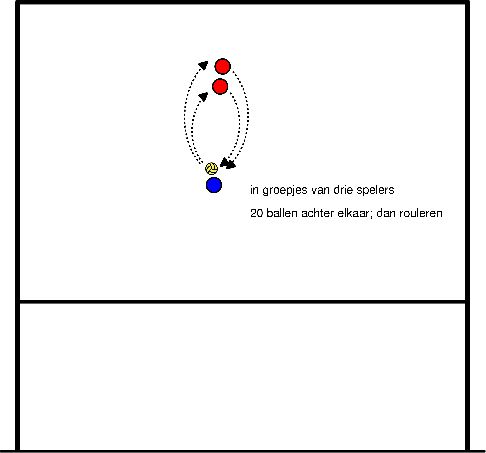
- Two players stand behind each other.
- About half a meter apart, facing the same way.
- Another player stands 3 or 4 meters away from them and has a ball and throws it to upper hand.
- The one who throws throws randomly on player 1 and 2.
- Player 1 or 2 calls loose if he thinks the ball is for him and plays overhand back.
- About 20 balls in a row.
- Then the group of 3 changes position until everyone has been there.
- After that again, but now without talking.
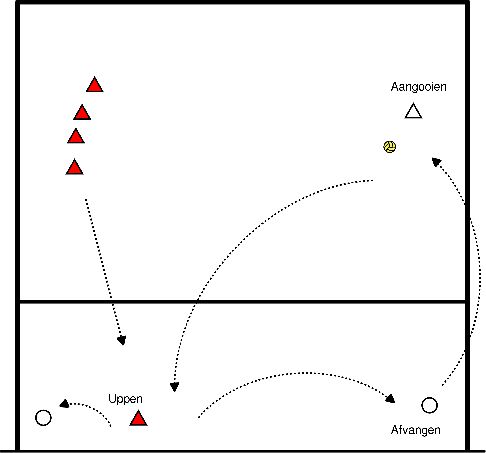
- Training for upping
- At position 4 (outside attack) korfball pole with hooptied . (with sturdy velcro)
- Upper at position 2get ready. (lay down dot)
- Reserve uppers in a line on position.
- Trainer at position 5, throws the ball to upper.
- He picks up the ball through the hoop.
- Behind that, an attacker is ready to catch the ball and puts it in the trainer's ballcar.
- Catch is in the line at position 6.
- Upper is going to catch.
- Variation:
- Uppercut back to outside position.
- Throw the ball from the other side and pass to position 2.
- Have the distributor step in from position 1.
- Points of attention when upping:
- Getting under the ball, the ball should fall on your forehead.
- Hands in the shape of the ball (make sure the hands are not too far to the side; like catching an inu)
- Right foot more forward than the left.
- Face towards position 4.
- At ball contact, slightly bend the knees and push out the ball, stretching the legs.
- When playing, the ball must remain in front of the upper. (Be careful not to arch your back)
- When uppercutting backwards, bend the back along with the uppercut.
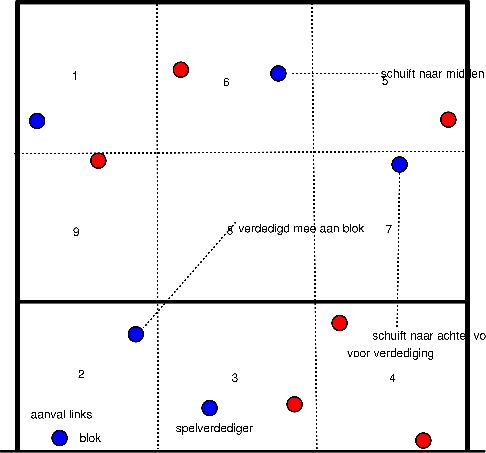
- Often the volleyball field is divided into six positions, you can also divide the field into nine sections of three by three meters.
- This can be of value in coaching, service and (tactical) attack.
- I let the group hold hands and then call a number below ten.
- The group must then move as quickly as possible to the appropriate section.
- Tip: After practicing this, I call out a number under ten at practice and have players point to the appropriate section on the court.
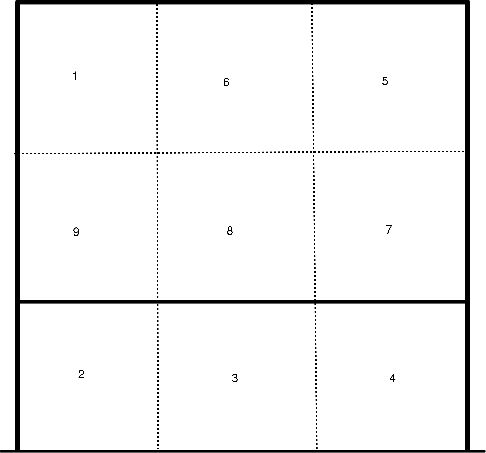
- Often the volleyball field is divided into six positions, you can also divide the field into nine sections of three by three meters.
- This can be of value in coaching, service and (tactical) attack.
- I let the group hold hands and then call a number below ten.
- The group must then move as quickly as possible to the appropriate section.
- Tip: After practicing this, I call out a number under ten at practice and have players point to the appropriate section on the court.
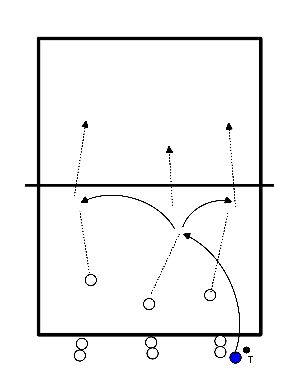
- Trainer brings the ball from the backfield into the centre.
- The middle player of the trio must set it up directly to one of the other players.
- Call who you are serving.
- In this way, the 'non-attacker' can go directly under the net to defend the ball.
- Once at the other side, a perfect attack is built up and a new trio is ready to defend this attack and turn it into a counter-attack.
- If you win the rally, the trio counts its point, but the next round starts from the beginning.
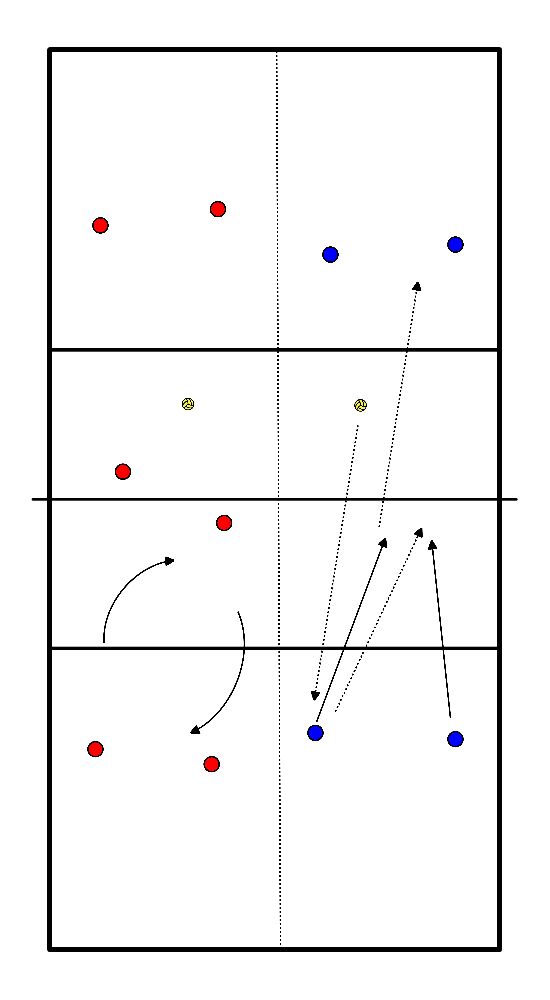
- 3 against 3 or 2 tegn 2 (depending on number of players) on half court.
- The ball must be kept in play on control.
- Two players in the back of the court, the one who does not pass comes in for set up.
- In case of 3 against 3, 1 player stands at the net and turns if the ball doesn't go over the net.
- When they have passed the ball over the net 10 times in a row, they may go to the next level.
- When the ball falls on the ground they start counting again.
- Points of attention: on control, technical ball control
- 1) attack out of position
- 2) with jump - hit calmly and aimed - (withheld)
- 3) with jump full force - hit aimed
- 4) hit free from the trap.
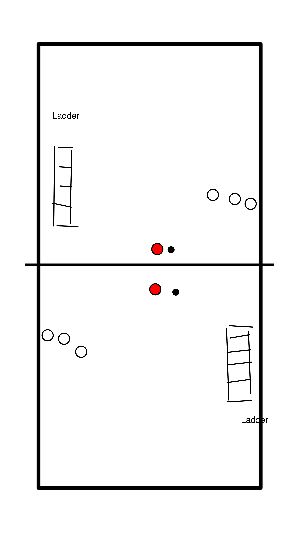
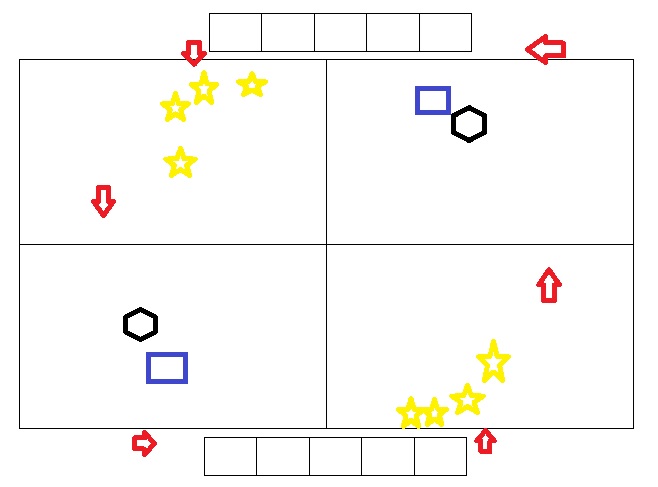
Basic exercise:
- Trainer throws ball, player catches ball and puts it in the cart.
- After this the player goes to the ladder. Here he goes through it and joins the next row.
Differentiation/Extension:
- Throwing the ball in a difficult way (left and right, front and back).
- Playing underhand and catching for themselves.
- Two players stand ready next to each other and have to call loose.
- A setupper comes on and has to catch the underhand ball.
- An attacker arrives and has to play the ball from the setupper over the net.

- Group split into two groups of 5, field divided into two halves'.
- on each side a bench on the back line with cones on it. (opposite sides)
- 3 players leave on the back line, 1 reserve, 1 service on other side of the field.
- A serve is given to the three players: reception - pass - touch over net.
- when the player has played the ball the players walk to the side where the bench is: reception - pass - hit to the cones
- Which team hits the most cones off the bench?
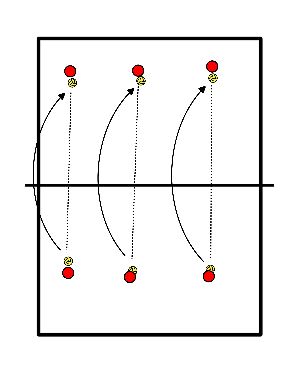
- The players are in pairs, one player on each side of the net.
- Both players have a ball.
- One player throws the ball underarms with outstretched arms over the net and the other rolls the ball under the net to the other side.
- Extension: play a key to catch the ball and roll it under the net again.
- Catch the ball with a key and roll it to the opposite side of the net.
- You can extend this exercise and make it more difficult.
https://youtu.be/bYJZ3UkSVMM
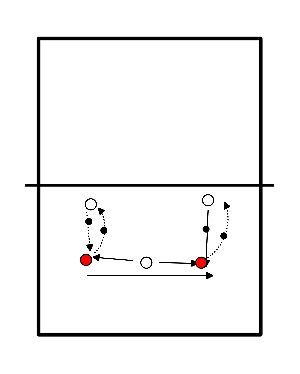
- Per 3 players
- 2 balls. person 1&2 stand on 1 side,
- person 3 in the middle opposite them.
- Person 1 throws a ball to person 3,
- who plays it back to person 1 underhand.
- Then person 3 moves in shuffle until she is opposite person 2, this person also throws a ball which person 3 in turn plays back underhand.
- Then move sideways again to person 1
- So continuously move sideways to play balls back underhand from person 1 and 2,
- After X number of balls you change
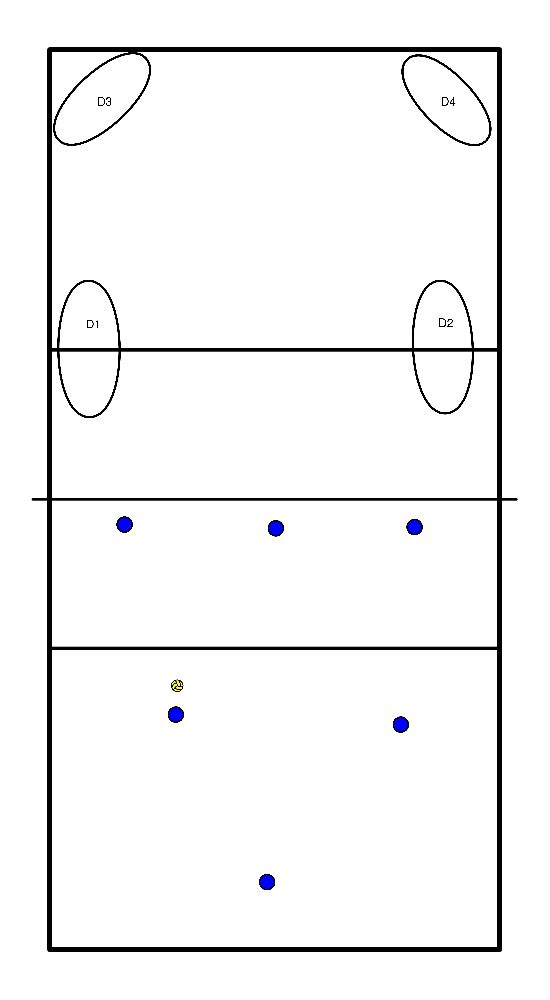
- When delivering a freeball we want to disrupt the opponents offence as much as possible.
- We can also use the freeball to take out an offensive attacker by pulling them close to the net or making them take the first contact.
- Dump zones are meant to target the setter or setter transition area and to pull an outside hitter off of their approach.
- If there is time, the player passing the ball should look at the opponents side of the net to determine where to place the ball - D1, D2, D3, D4
- Teammates not involved in the play should be:
- Ready to defend the freeball
- Looking at the opponents transition or positioning on the court
- Communicating to the player passing the ball on where to put the ball - 1, 2, 3, 4