

Volleyballexercises for technique passing / defense / reception
Last update: january 2026
Execution
- Form pairs: one player with a ball, the other without a ball lying on the ground.
- Series of 30 seconds with 30 seconds rest.
- At the start signal, the player lying down stands up and receives the ball thrown to them.
- The player returns the ball overhead and goes back to the ground.
- Repeat: rise explosively, be ready, play, and return to the ground.
- After 30 seconds rest, the next series of 30 seconds with underhand passing.
- Switch roles and start again.
Setup
- Divide the team into two groups. Each group takes position on one side of the net.
- One side serves, while the other side positions three players as receivers.
- The receivers attempt to pass the ball upwards and catch it on their own side.
- Servers take turns serving.
- After each catch, a new receiver enters the field for the one who caught the ball.
- Play until 10 points are reached.
- The servers score a point if the ball is not caught.
- The receivers score a point if the ball is caught.
- An incorrect service does not count.
- After one round, the teams switch sides.
- In the second round, they play with two receivers instead of three.
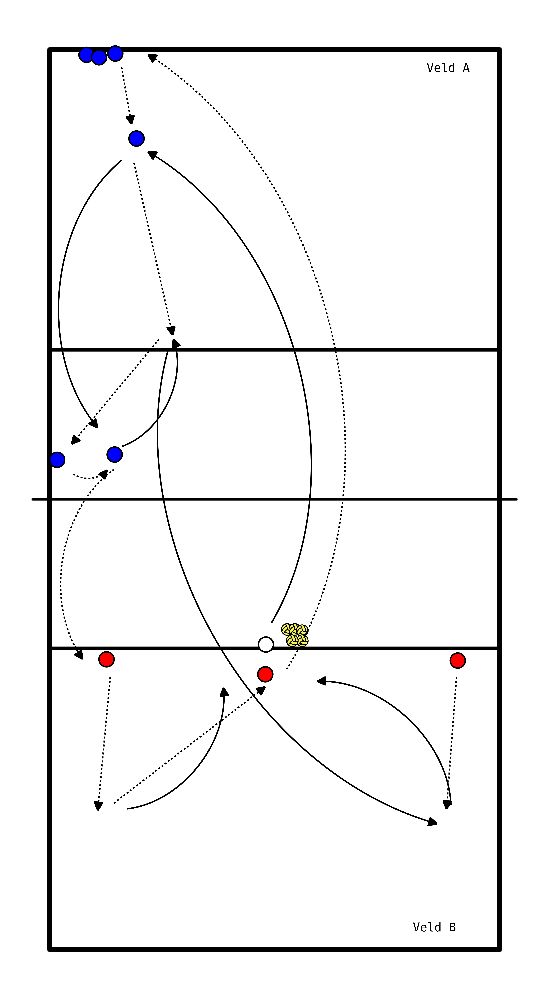
Organization:
- Field A.
- Players on 7 meter P1 (row) and 1 player on P2
- Reserve on P2
- Field B:
- Trainer with ball carrier on 3 meter line
- Players on P1 and P5 (both on 3 meter line) and on p6
Execution:
- Trainer throws ball up high.
- Player on P1 passes to P2 gets setup on 3 meter line and plays the ball overhand to P5 or P1
- Underhand play up and catch at trainer.
- Run: P6 to reserve P2; P2 to reserve P5b or P1b
- After catching reserve P1a
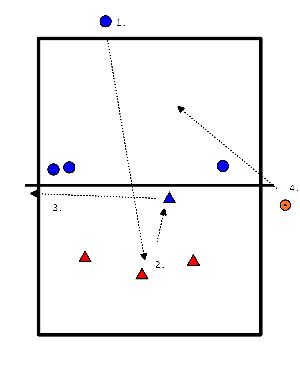
2 teams consisting of 4 players
Variant 1
Variant 1
- 3 players take care of the service pass
- setter tries to play the ball to the outside on position 4,
- here the ball is caught and thrown into the ball box.
opposing team:
- server enters the field
- 2-team at the net makes a block action and walks back into the field
- coach plays a rally ball
Variant 2
- 3 players take care of the service pass
- setter tries to play the ball to the outside at position 4,
- here the ball is finished.
opposing team:
- server enters the field
- 2 players at the net make a block action on the attack
- everyone plays the rally and then the coach plays another rally ball
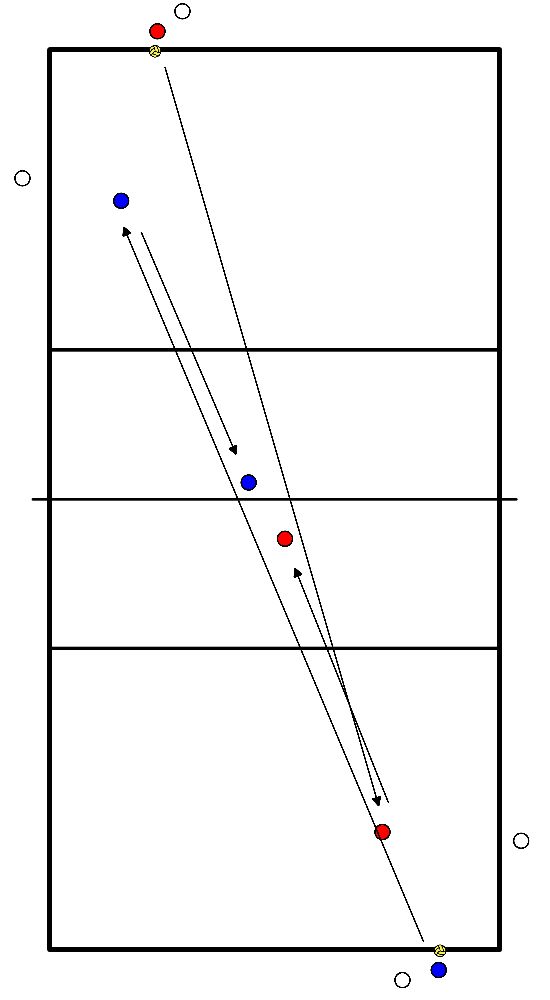
- Serve from position 1 diagonally to position 1.
- There is a passer who passes to a playmaker, if he catches the ball within 2 steps you get 1 point.
- Faulty service is point off.
- Which team reaches the 15 first, if this takes too long you can lower it.
- In this exercise taking turns serving is recommended.
- Server becomes passer, passer becomes catcher, catcher becomes server. rotate on own side.
- If possible reserve server, then reserve passers.
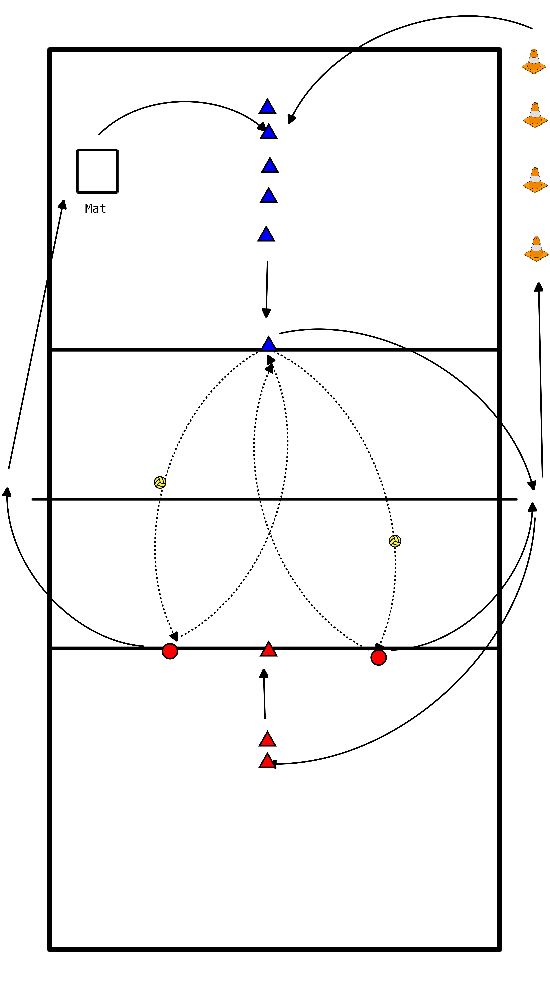
Starting position: 3 players on red side, rest on blue side.
- Blue side always starts, with OH service.
- Tennis OH directly over the net => approximately 3 meter line.
- After Tennis outside the posts to the other side.
- Red players: place ball in center of court where around 3 meters the blue players are.
- Blue players: Place ball deliberately left or right of the center of the field where the red team is standing.
- Red side: thinking, what is your next action?
- Played left => Red player is going to do exercise 1
- Played right => Red player is going to do exercise 2.
Examples of exercises:
- Mat => make roll
- Pawns => shuffle through them
- Foot ladder with assignment.
- Bad Ball => pick up in bin and join the other team.
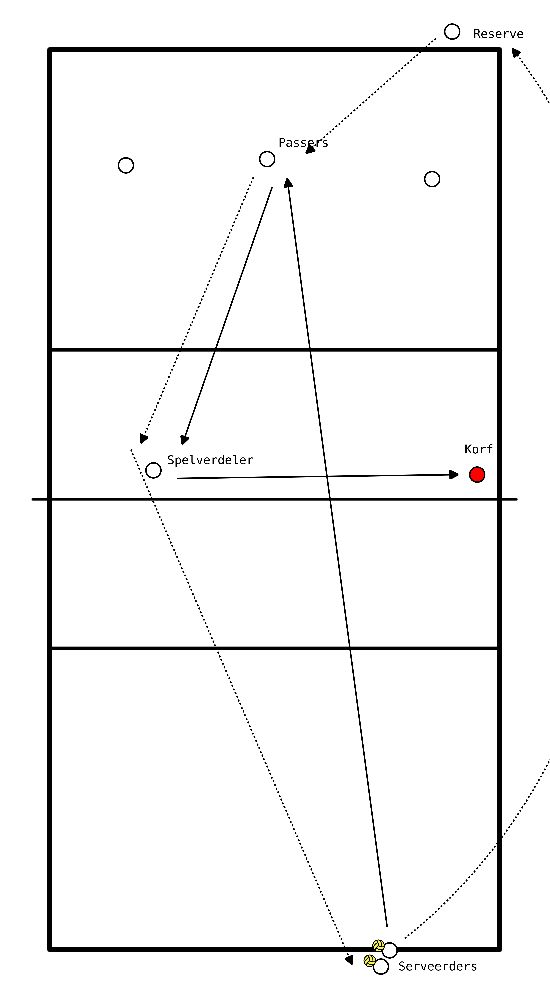
- 3 people in the serve pass at 5, 6 and 1 + 1 reserve behind the court.
- 1 playmaker starting at 2/3.
- The rest with ball on the opposite side.
- Serve on the passers, bring pass to position 2/3.
- Then the playmaker plays a ball to position 4 where a basket is set up.
- Ball played in an acceptable ball trajectory against the basket is 1 point, ball directly into it is 2 points.
- Push the team to actually go for as many points as possible.
- You can choose to have a fixed playmaker, or rotate. In that case the passer --> playmaker --> server --> reserve --> passer.
- With a large group you can use 2 sides, with a small group you can also cut the number of passers.
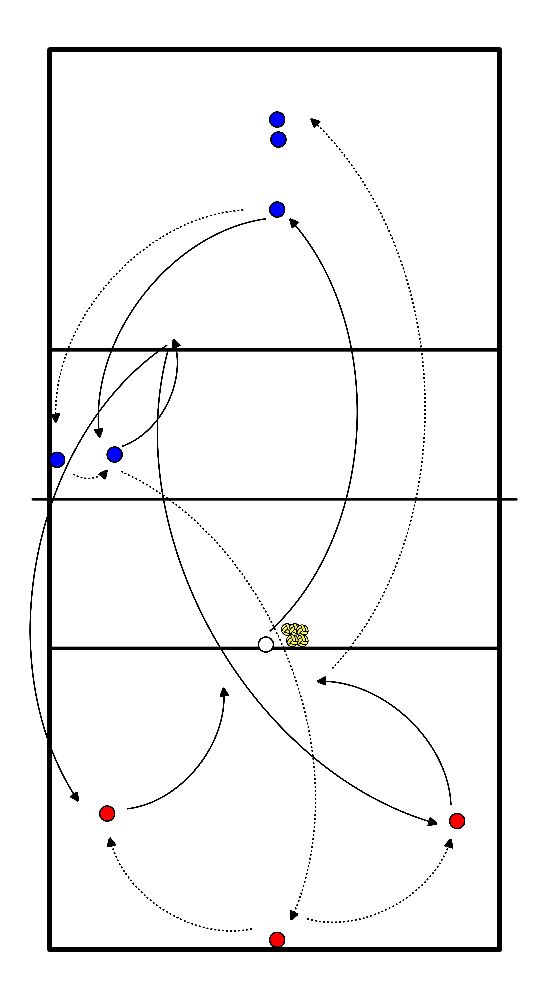
Organization:
- Field A.
- Players lined up at 6 meters and 1 player on p2
- Reserve on p2
- Field B:
- Trainer with ball carrier at 3m
- Players on p1 and P5 and reserve on p6
Execution:
- Trainer throws ball up high.
- Player on p6 passes to P2 gets setup on 3m line and plays the BH to p5 or p1
- Underhand play up and catch at Trainer.
- Run: P6 to spare P2; P2 to spare P6
- P6 takes the place of P1 or P5 and these go to field A P6
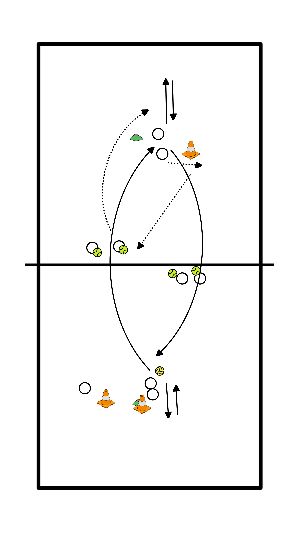
15 minutes basket ball throwing
Exercise 1: throwing
Exercise 1: throwing
- run-up from cone position V to position III side A.
Exercise 2: throw 1 arm
- run-up position II and catch ball with outstretched arm.
Exercise 3: with keys and intermediate key OH & TT.
Exercise 4: TB are replaced with ball , player runs on and keys to player at position 2.
Exercise 5: player at position 5.
Exercise 6: player chooses 2 or 5 - overplay to where he is not.
Exercise 4: TB are replaced with ball , player runs on and keys to player at position 2.
Exercise 5: player at position 5.
Exercise 6: player chooses 2 or 5 - overplay to where he is not.
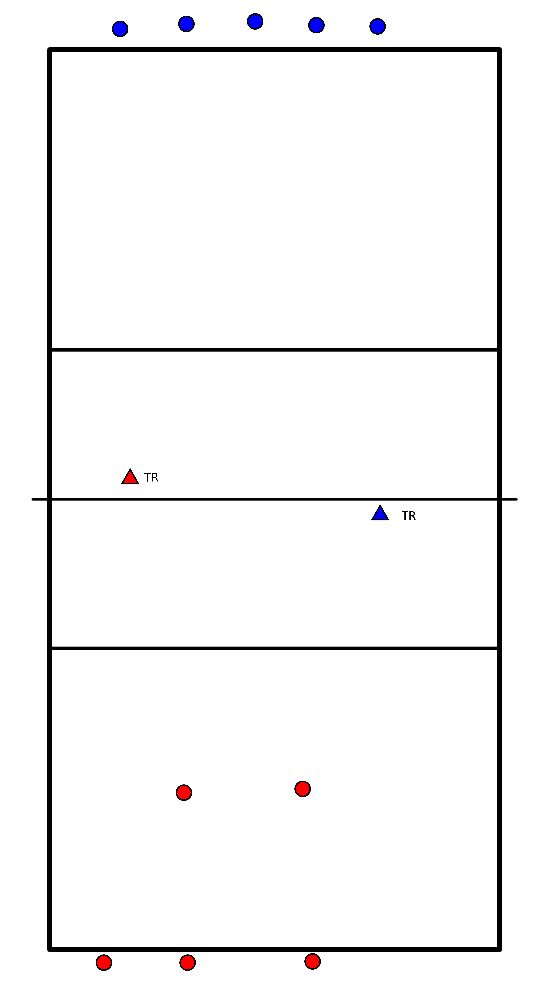
Divide the group into two.
TR stands on the passers' side and catches the pass --> who has 15 points first
TR stands on the passers' side and catches the pass --> who has 15 points first
- Team A serves starts
- Other team B passes --> 2/3 here stands the TR
- Change of servers and passers. Pay attention because now the TR is also going to catch on the other side of the net.
Point count
- Good serve that scores --> + 1 point
- Good pass that TR catches and scores --> + 1 point
- Wrong serve that goes out or enters the net --> - 1 point
- Foul pass --> - 1 point
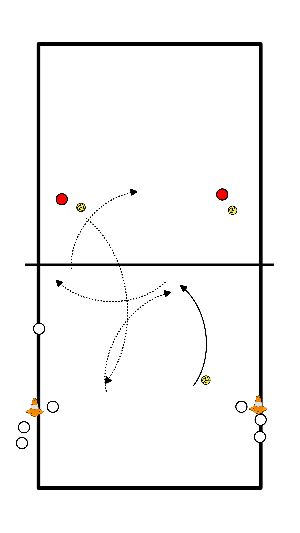
- Trainers stand at pos II and IV and throw 2 -high balls across.
- Cones on the outside lines.
- Player A (IV) and B (I) in reception leave aside from player C attack at position IV.
- Player D, E, F behind cone.
- T1 throws to A, B runs in and passes to C, C drops to mat, B=>C, C retrieves ball and becomes F, D takes place of B.
- T2 throws to D, A runs in and gives pass to player B.
- Cones in the middle.
- Cones in the corners behind.
- Trainers may choose where to throw to.
- Trainers succeed from 6 meters -tight balls.
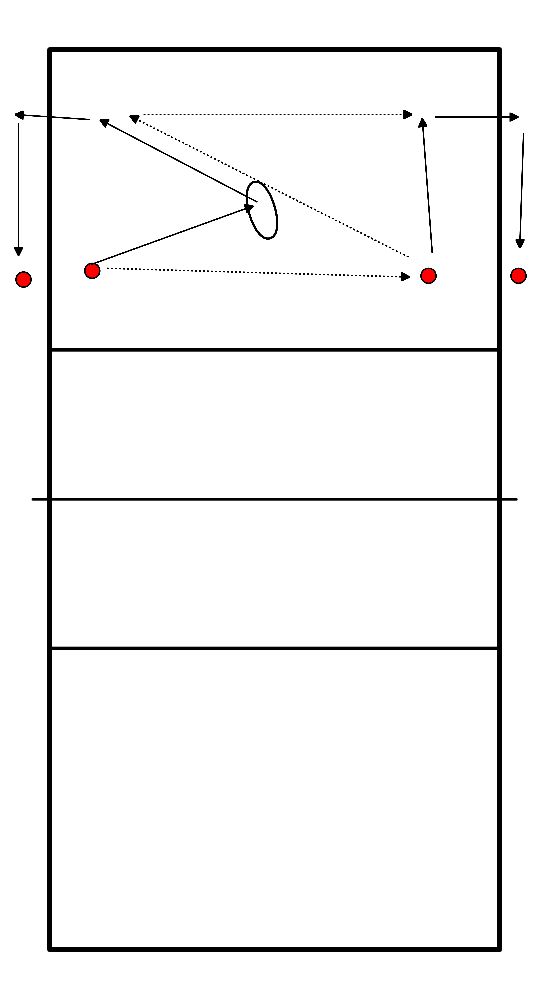
- Divide the group in two
- Overplay (first BH then OH)
- Put a hoop in the middle
Exercise
- Two players face each other.
- One player plays straight ahead, the other plays diagonally.
- There is an imaginary square.
- Distance between players is at least 4 meters, but may be greater.
- Start with overhand play.
- As soon as the ball is hit by the other player, you may move to the other corner of the imaginary square.
- It is important to move only after your opponent has hit the ball and not after you have played the ball.
- Extension 1:
- Playing underarms.
- Extension 2:
- After playing, step into the center hoop and then to your other position.
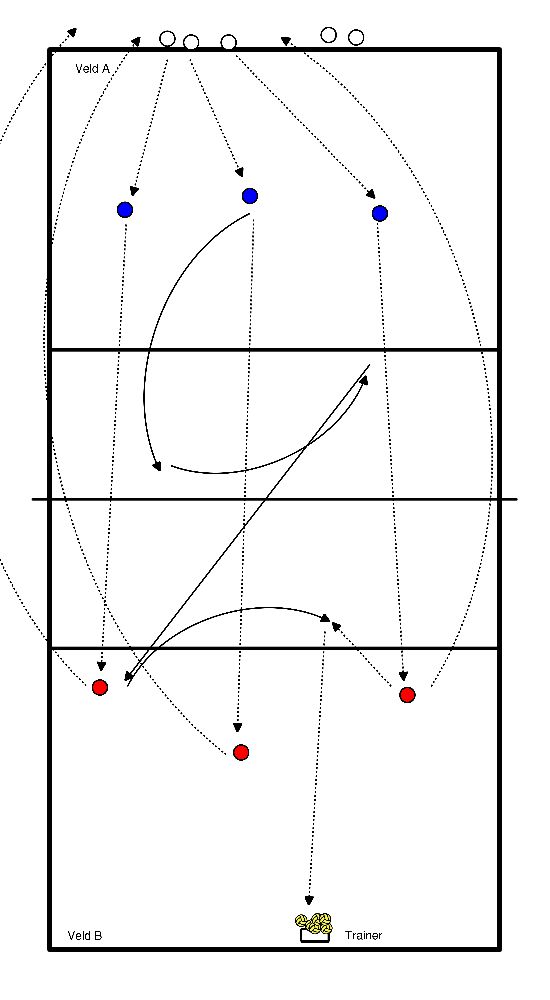
Organization:
- Making trios
- 1 trio on field B ("service field")
- 1 trio on field A (reception)
- 1 trio reserve at field A
Execution:
- Trainer serves quietly and the trio at field A passes the ball to p2
- There is a "playmaker" and gives a setup for player 3
- This player hits the ball from a standing position over the net
- The trio there defends and catches.
- Passers become defenders B
- Defenders B become reserve A
- Spare A becomes Passer A
Pay attention:
- Each time the trio passes, choose another position.
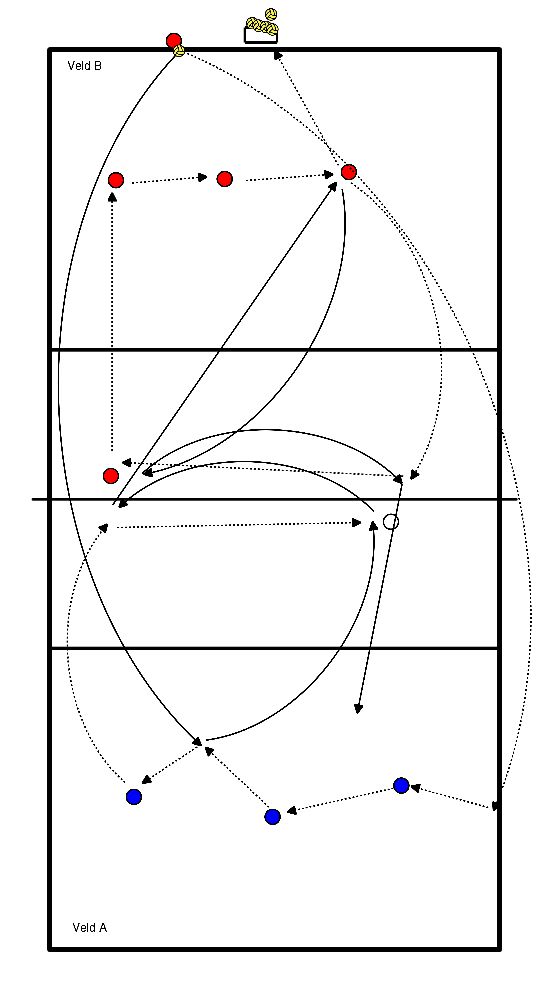
Organization:
- 3 passers and "Sv" on 2 and reserve on 1
- 3 defenders and 1 sv/block on 2
Execution:
- Ball is served. First trainer, then players.
- Pass by 1, 5 or 6 to p2/3.
- "Sv" gives a setup to p4
- Player on p5 runs a "C" and attacks the ball.
- Possible rally play
- "Sv" goes to get ball and then serve
Runs:
- Field A:
- Reserve=>1=>6=>5=>2=>field B
- Field B:
- Reserve =>5=>2=>1=>6=>serve=>field A
NB: FOCUS IS ON SERVICE PASS
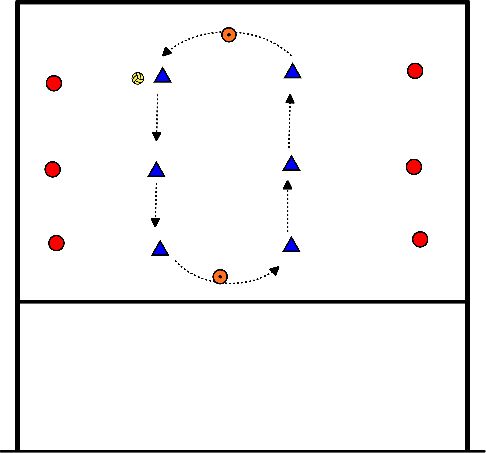
- Half of the players stand in a line 2 metres apart.
- Preferably with a wall at their back.
- The other players pass this line in turn at 4 metres from the thrower.
- There is no net in between.
- They are given a ball to return overhead.
- Then they move sideways to the next starter.
- Go down the row and come back to the beginning.
- If there are enough players, a second row can be set up in mirror image.
- Then the players who return the ball go back along this row and have then walked a circle.
- (Row players 1 stand with their backs to row players 2, to throwers 1 and 2 stand with their faces to each other).
- After that you can alternate between the groups and do the same with underhand return.
- As a variation, use different throwing distances.
- Important points of attention: throwing the ball neatly, moving sideways, sitting low when playing OH, high ball tempo.
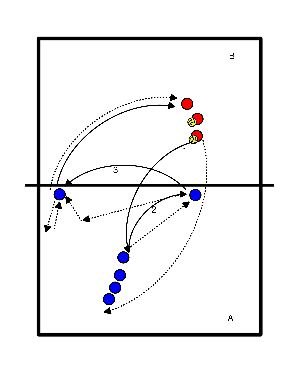
- Basically an exercise to play well BH, but also with an "attacking idea".
- Organisation:
- Line up 2 players with ball and 1 without ball on position 5/6 on field B.
- Line-up of 4 players on position 6 on field A.
- There is also a player on position 2/3 and at the net on position 4.
- Working method:
- On field B the player in front throws/strikes the ball to the first players on field A and then closes the gap on field A.
- The OH passes the ball high to the players on 2/3.
- The latter plays the ball BH to position 4, first going to "attack coverage" and then taking position 4.
- As soon as the ball leaves 2/3, the player on 4 moves to the 3m-line.
- Then, after a short "run", this player plays the ball BH to the player without the ball on field B.
- This player catches the ball and closes in at the back of field B.
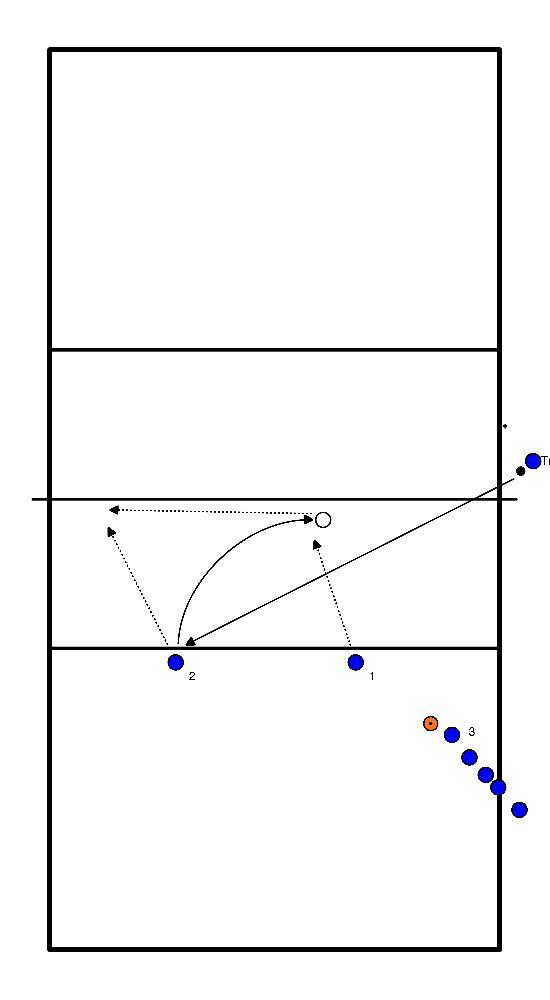
- Practice setup underhand because of emergency balls or ill fitting balls.
- The trainer throws the balls to player 2 who plays the ball underhand to the right front.
- Player 1 walks to this position and gives an underhand setup on the outside where player 2 attacks.
- After this action player 1 goes to position of player 2 and player 3 comes to position of player 1. etc.
- The attackers get the balls themselves and put them back in the ballcar.
- When the pass is going well you can increase the pace so that the exercise continues and people do not have to wait too long.
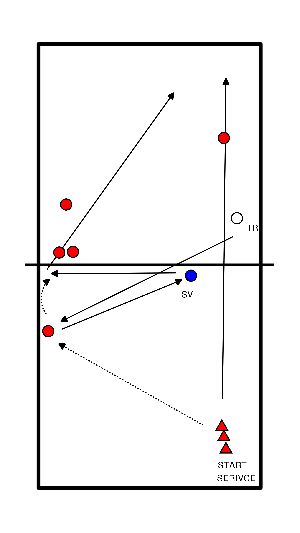
- Player starts serving, straight through, on the other side a defender is passing.
- The passer passes to the trainer.
- After service the player runs directly to position 5, where the trainer throws a ball for passing at 2-3.
- Fixed playmaker, gives set-up on the outside.
- After passing, the player makes an attack.
- 2 blockers, defense behind the block and defense at left back.
RUNNING ROUTE:
- The attacker becomes outside blocker.
- Outside blocker becomes inside blocker.
- Inside blocker goes to defend behind the block.
- Defender behind the block starts defending at left back.
- The left back picks up the ball and connects with the servers.
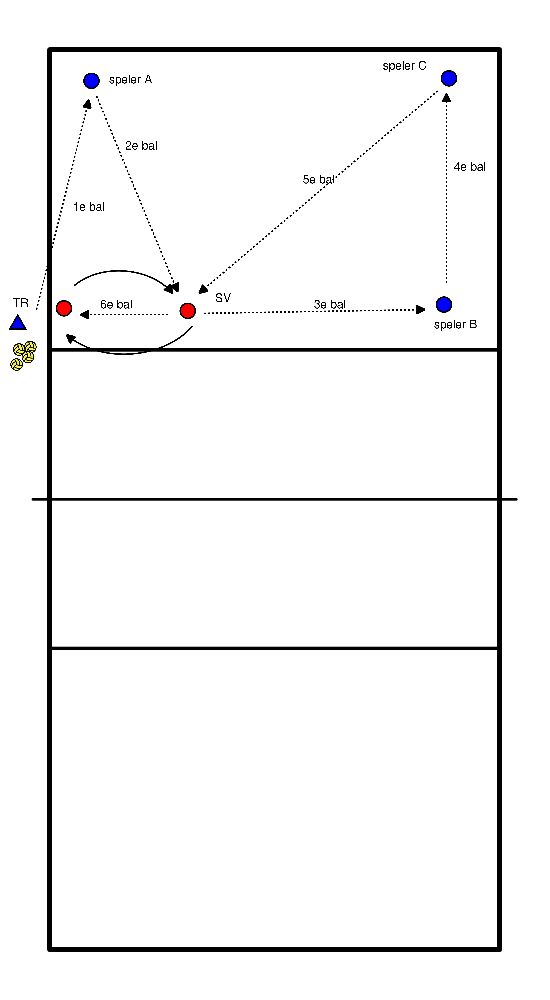
- TR --> throws the ball to player A.
- Player S --> pass to SV.
- SV --> setup to player B.
- Player B --> pass to --> player C.
- Player C --> pass to SV.
- SV setup on diagonal to reserve SV.
- Back up SV catches --> ball in ball pit.
- After 10 substitutions of SV.
- When both SVs have been through, the other players turn one spot --> the exercise starts again.
- When there are more than 5 players, split the group in two. (Possibly an extra passer.
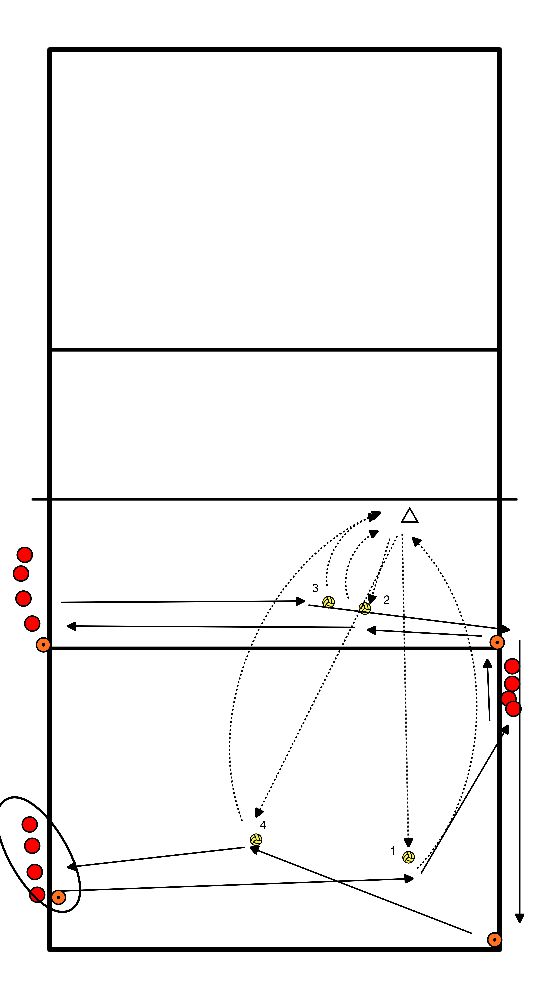
- Trainer pours ball to position 1.
- Player from starting position (circle) runs passes back to trainer/catcher, and runs to pawn at 3 meter line.
- Other players also get ball and join behind player 1.
- Then trainer throws ball at position 2, passes and walks to other pawn 3 meter line.
- Other players also get a ball and join behind player 1.
- Then trainer throws ball on position 3, passes and walks to other pawn at serve. (via pawn 3 meter line)
- Other players also get a ball and join behind player 1.
- Then trainer throws ball on position 4, passes and continues to other pawn at starting position. (circle)
- Other players also get a ball and close behind player 1.
- Goal:
- Wherever the ball is, it always goes towards the goal. (sv simulated by catcher/trainer)
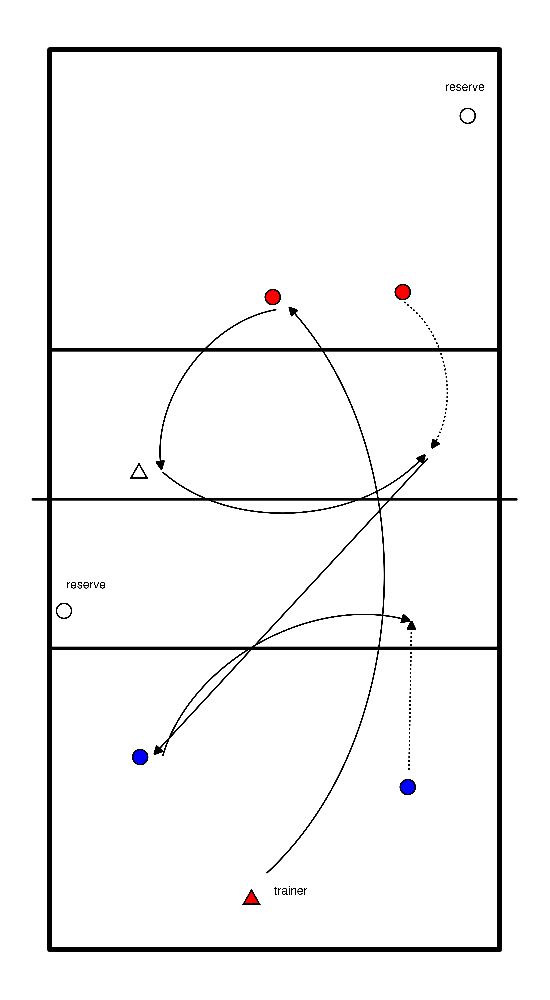
- Organization:
- Field B:
- 2 passers and 1 reserve.
- 1 playmaker on p2/3.
- Field A:
- Defender on 5 and 1.
- Reserve on p5.
- Coach serves.
- Field B:
- Execution:
- Trainer serves.
- Pass and setup to the non-passer.
- Attack thus on p3 or p4.
- Attacker becomes playmaker, passer stays.
- Spare becomes passer and playmaker becomes spare on p5.
- P5 passes to p1 and p1 becomes reserve passer.
- Defended ball is passed to p2.
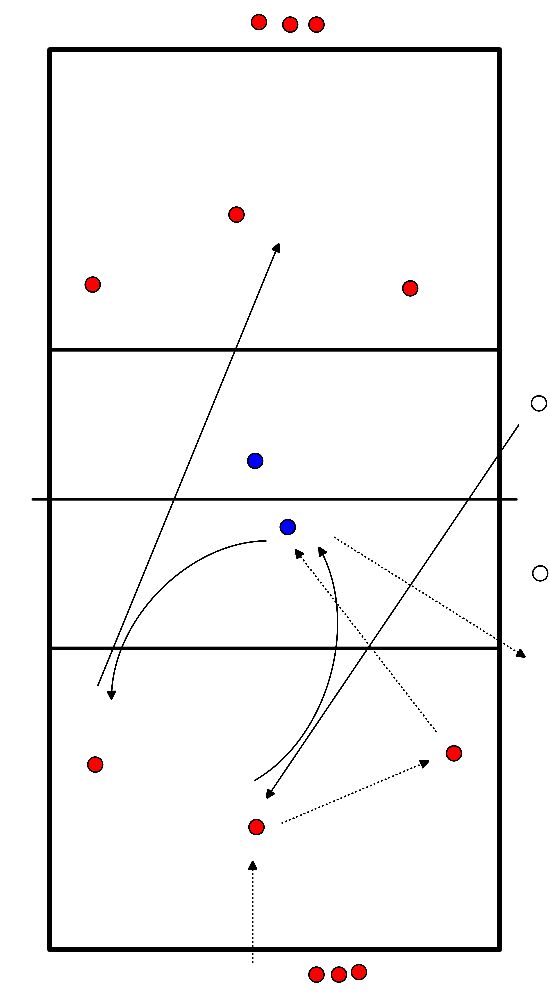
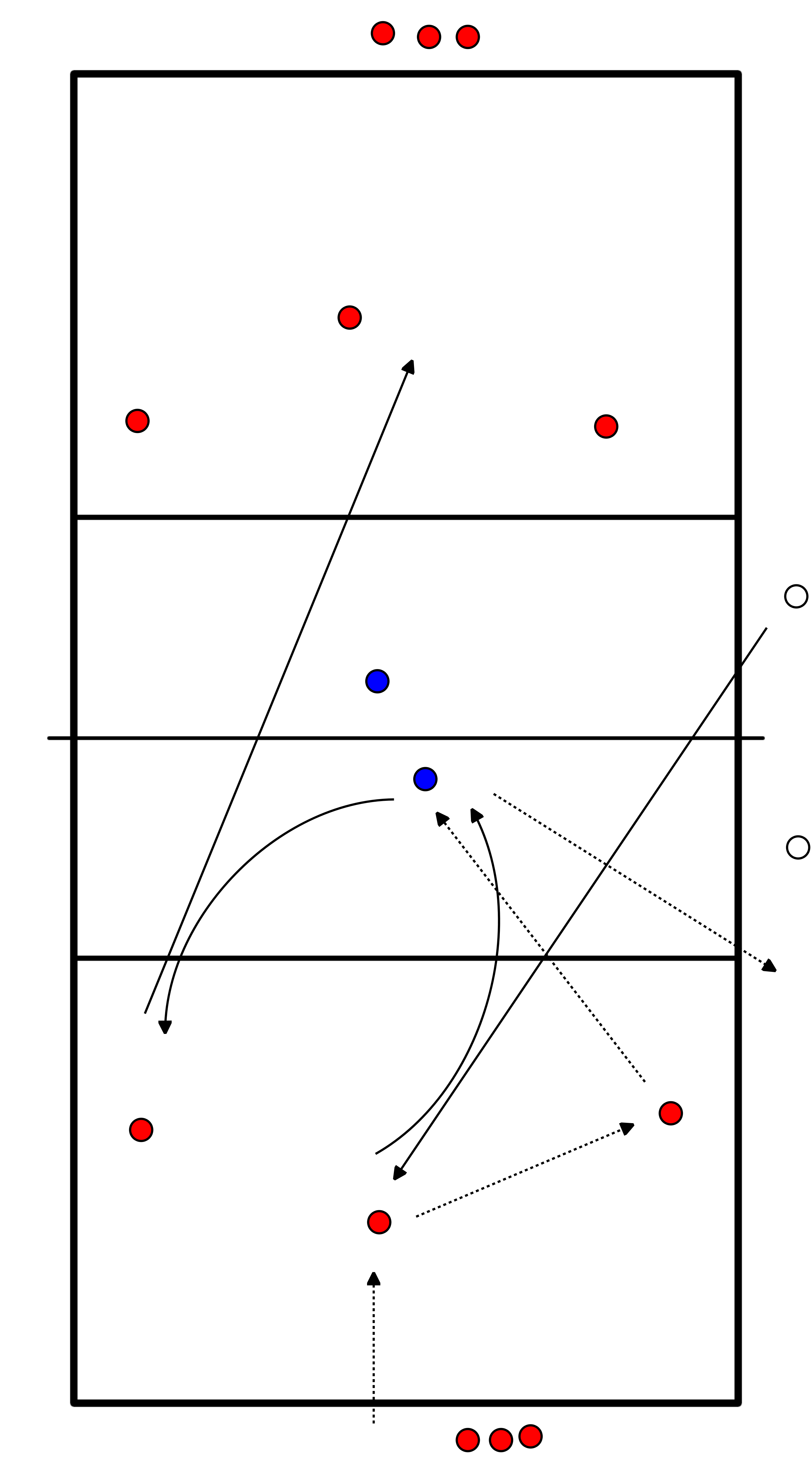
BALBAGE :
- Two teams of at least 5 people
- Trainer (white sideline) throws ball on the MA (position 6)
- Pass to playmaker
- Distributor gives high ball to left front and right front near the 3 meter line
- Attack on 3 meter
- Opponent defends the ball and builds up a new attack in the same way, if not defended, trainer throws in a ball
LOOP DIRECTION:
- Defender (mid-back) takes place of attacker (left or right)
- Attacker goes to position MV (position 3)
- MV runs out of the field and joins group on back line
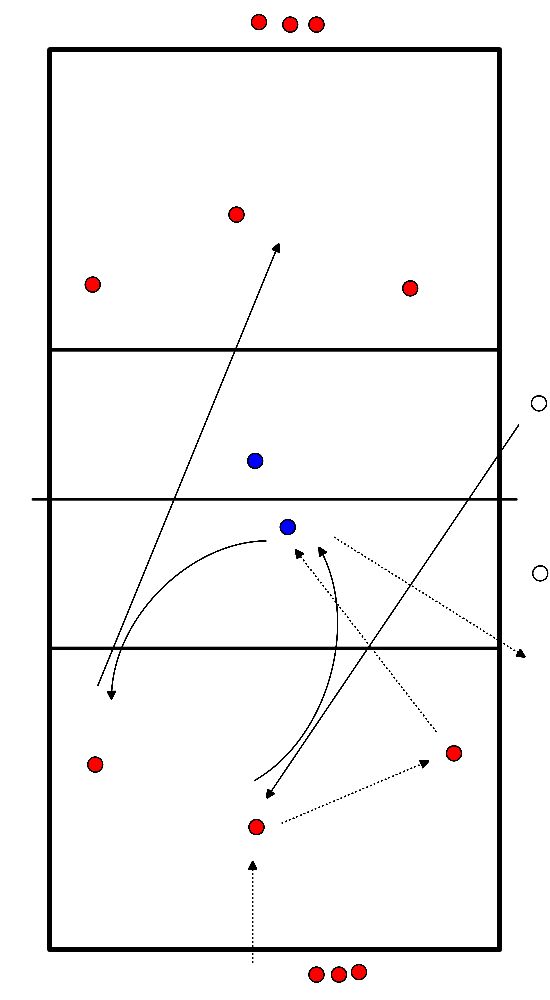
BALBAGE :
- Two teams of at least 5 people
- Trainer (white sideline) throws ball on the MA (position 6)
- Pass to playmaker
- Distributor gives high ball to left front and right front near the 3 meter line
- Attack on 3 meter
- Opponent defends the ball and builds up a new attack in the same way, if not defended, trainer throws in a ball
LOOP DIRECTION:
- Defender (mid-back) takes place of attacker (left or right)
- Attacker goes to position MV (position 3)
- MV runs out of the field and joins group on back line